Questions

[4 Mark Question Answer]

🎯

Test yourself on this topic

17 questions · timed · auto-graded

Question 14 Marks
Why is the following planet not inhabitable?
Mercury
Answer
Mercury is not inhabitable due to the following reasons:
  1. A part of it turned towards the Sun is always in sunlight. There it is a continuous long day. The temperature reaches 450°C in this hottest part. It experiences a perpetual summer.
  2. Its other side is always turned away from the Sun. There is a continuous night on this side. It is like perpetual winter, the temperature going 150°C below freezing point. Therefore, the diurnal range of temperature is very high.
  3. There’ is a very little atmosphere and no .water on this planet. The atmospheric envelope is so thin that Mercury’s world is airless.
View full question & answer
Question 24 Marks
Distinguish between inner and outer planets.
Answer
Inner Planets :
  1. The Planets similar to the Earth are known as an inner planet (small, in size)
  2. Mercury, Venus, Earth, Mars are inner planets and are known as terrestrial planets.
  3. They are composed of rocks. The surface of the inner planets has mountains, volcanoes, and craters.
  4. None of the inner planets have rings orbiting them
Outer Planets :
  1. The planets which are not similar to Earth are known as outer planets, (large in size)
  2. Jupiter, Saturn, Uranus, Neptune, and Pluto are outer planets and as known as major planets.
  3. Most of them are made of gas.
  4. All of the outer plants have rings orbiting them.
View full question & answer
Question 34 Marks
Distinguish between the following pair.
Planet and Satellite.
Answer
Planet :
  1. Planets are opaque bodies which revolve around the Sun.
  2. Planets originate from the Sun.
  3. There are nine planets in the Solar System. The earth is a planet.
Satellite :
  1. Satellites are small spherical bodies which revolve around a particular planet.
  2. Satellites originate from the Sun.
  3. There are 33 Satellites in the Solar System. Moon is the Satellite of the Earth.
View full question & answer
Question 44 Marks
Distinguish between the following pair.
Meteors and Meteorites
Answer
Meteors :
  1. A meteor is a shooting star like a streak of light across the sky at night. It is composed of pieces of stony or metallic rocks.
  2. These travel around the world in an eccentric orbit.
  3. Big meteors fell down in Siberia in 1980 and 1948.
Meteorites :
  1. Meteorites are the scattered pieces of the meteors which are unconcerned after burning.
  2. These are the dust of meteors falling on the earth as meteorites, some of these are also of great size.
  3. About 5000 years back a meteorite fell down in Arizona (USA) and created a hollow, 180 meters deep and of 12,000 meters diameter.
View full question & answer
Question 54 Marks
Distinguish between the following pair.
Periodical and Non-periodical comets
Answer
Periodical comets: The comets which have regular orbits around the Sun and occur at fixed intervals are called periodical comets. Halley’s comet is a periodical comet and is one of the most famous comets, which is due next in 2062. It is seen at intervals of 76 years. It was seen in 1910 and in 1986.
Non-periodical comets: Such comets are seen very rarely and they are not sighted at regular intervals. There are records of observations of about 1000 comets. Some of these have been named. Comets become visible only when they travel close to the Sun. The ice melts and the gas and dust are swept back to form the tail. The tail always points away from the Sun.
View full question & answer
Question 64 Marks
Distinguish between the following pair.
Planet and Planetoids
Answer
Planets :
  1. The planets are bigger bodies and visible as nine planets.
  2. These move in their elliptical orbits around the sun in different spans of time.
  3. These are nine planets with particular names.
Planetoids :
  1. These are smaller bodies planets in the form of debris.
  2. These revolve around the Sun once in about 5 years along their own elliptical orbits between Mars and Jupiter in the gap.
  3. These are about 50,000 planetoids in the gap.
View full question & answer
Question 74 Marks
Distinguish between the following pair.
Superior and Inferior planets.
Answer
Superior Planets :
  1. The six planets outside the Earth’s orbit are known as the superior planets.
  2. Mars, Jupiter, Saturn, and Uranus Neptune and Pluto are superior planets.
Inferior Planets :
  1. The two planets inside the Earth’s orbit are known as the inferior planets.
  2. Mercury and Venus are inferior planets.
View full question & answer
Question 84 Marks
Arrange the nine planets of the solar system in order of their sizes.
Answer
 The largest planet is Jupiter and the smallest is Mercury. According to their size, the planets are :
  1. Jupiter
  2. Saturn
  3. Neptune
  4. Uranus
  5. Earth
  6. Venus
  7. Pluto
  8. Mars
  9. Mercury
View full question & answer
Question 94 Marks
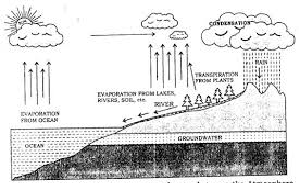
Draw a fully labelled diagram of the water cycle and explain its working and significance with reference to the diagram.
View full question & answer
Question 104 Marks
Earth has the most ideal temperature conditions.
Answer
Earth has the most ideal temperature conditions because it is neither too close nor too distant from the sun. This position in the Solar System makes it possible to receive neither excessive nor totally deficient heat from the Sun. Its average temperature surface temperature is 17 degrees Celsius for more favourable for living conditions than about 500°C on the nearest planets and about 150° to 200° Celsius below freezing point on the sunlit sides of distant planets. Earth is, thus, neither a burning furnace nor an extremely cold planet.
View full question & answer
Question 114 Marks
State three factors which have made life possible on the Earth and on no other planet.
Answer
The factors which have made life possible on earth and on no other planet are as follows :
  1. Earth is the only planet in the Solar System which is neither too hot nor too cold.
  2. The atmospheric blanket around the earth protects it from ultra-violet and other deadly sun rays.
  3. The mixture of gases in the atmosphere is suited to the growth and survival of life.
  4. Plants, through the process of photosynthesis, take away carbon dioxide from the atmosphere and make oxygen available for animals to breathe.
  5. Oceans play a great supporting role. They cover three-fourths of the earths surface and are responsible for the operation of the hydrological cycle which makes water on land surface available.
  6. Circulation of many life cycles not make energy and food available but also process the wastes which otherwise would harm life.
View full question & answer
Question 124 Marks
Distinguish between a planet and a star.
Answer
A Planet :
  1. A planet revolves around a star
  2. A planet has not got its own light.
  3. A planet is a solid body.
A Star :
  1. A star remains still on its position.
  2. A star has got its own light.
  3. A star is a burning gaseous body.
View full question & answer
Question 134 Marks
Answer
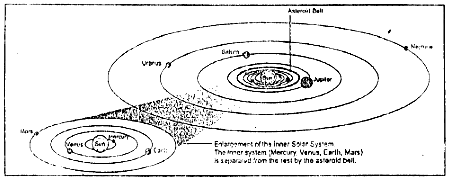
(a) The sun along with eight planets and asteroids forms the Solar System.
(b)
  1. The stars like the sun radiate heat and light. Planets have no light of their own. They reflect the light of their stars.
  2. The stars are large burning masses very far from us while the planets are solid bodies nearer to us.
(c) The planets within the asteroids belt i.e. Mercury, Venus, Earth, and Mars, are called the Terrestrial planets.
(d)
  1. The earth enjoys an ideal average temperature of 17°C
  2. The earth consists of the life-system.
(e) The satellites are the celestial bodies that revolve around the planets.
View full question & answer
Question 144 Marks
Describe the role of the following in making the earth a habitable planet.
Water
Answer
 Water — 70% of the earth’s surface is covered by water. Water plays the following role :
  1. It is responsible for moderating the climate and surface conditions of the earth.
  2. Water from seas, rivers, and lakes evaporates into the atmosphere where it condenses and falls back as precipitation. Most of the water on land flows back to the oceans. Thus, water moves in a continuous cycle — the hydrological cycle. There is a proper balance between evaporation, condensation, and precipitation without which life would not be possible.
  3. Water can absorb enormous amounts of heat without causing much change in its temperature. During the day, waterbodies rapidly absorb an enormous amount of heat: thus, the earth remains fairly cool. At night the waterbodies release vast amounts of heat that they absorbed during the day, which along with other atmospheric effects, keep most of the surface from freezing at night.
View full question & answer
Question 154 Marks
Describe the role of the following in making the earth a habitable planet.
Atmosphere
Answer
Atmosphere — Atmosphere plays a very important role in making the earth an habitant planet. Atmosphere plays the following role:
  1. The atmosphere receives heat from the sun by solar radiation and loses heat by earth’s radiation. In this way, a balance is maintained.
  2. The earth’s atmosphere is made up of life-supporting gases like nitrogen, oxygen, and carbon dioxide. Other gases include Helium and Argon.
  3. The ozone present in the earth’s atmosphere absorbs the harmful ultraviolet rays of the sun.
  4. The atmosphere also prevents the loss of heat from the earth’s surface and helps to keep the earth warm.
View full question & answer
Question 164 Marks
Give the distinctive features of the earth as a unique planet. Also, give three points of comparison with respect to other planets.
Answer
The earth possesses all the essential features necessary for maintaining the life-system. It is provided with atmosphere and hydrosphere along with the lithosphere. Moreover, the average temperature of 17°C is ideal for survival. Three points of comparison with respect to other planets are as follows.
  1. Other planets are either too hot or too cold that is unfavourable for life.
  2. Other planets are devoid of atmosphere and hydrosphere and some are surrounded by poisonous gases.
  3. Other planets are devoid of freshwater bodies, like rivers and lakes.
View full question & answer
Question 174 Marks
Answer
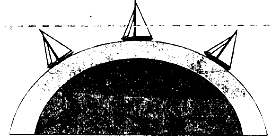
(a) The picture shows the spherical shape of the earth.
(b) Three pillars of equal height were put along the Bedford Level canal area in England each at 5 km. interval. After observation, it came to know that the middle pole was higher than the sideward poles. This proved that the earth’s surface was curved and the earth is a spherical body.
(c) The times of sunset and sunrise are different in the different parts of the earth because the earth moves from west to east and the places situated in the east get sunrise first. Japan is called the land of the rising sun, as it is in the eastern-most part of the Eastern Hemisphere and the date starts from the Eastern Hemisphere. It proves that the earth is spherical.
(d) The atmosphere is indispensable for life on earth, as it provides air to inhale; rainfall and freshwater bodies after the hydrological cycle. Moreover, it absorbs the extremely hot ultraviolet rays of the sun and makes the temperature ideal on earth. Other planets are either very hot or very cold due to the absence of an atmosphere.
View full question & answer
[4 Mark Question Answer] - Geography STD 9 Questions - Vidyadip