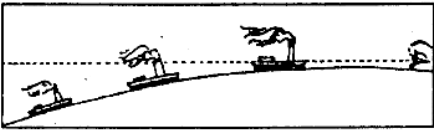
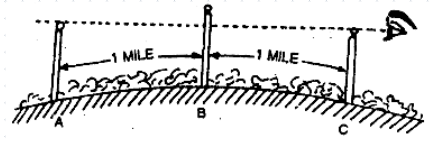
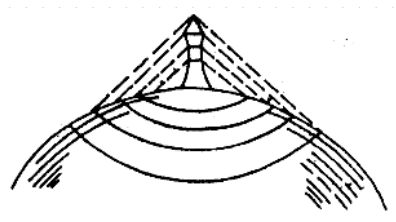
Question 14 MarksDescribe any three experiments to prove the Spherical Shape of the Earth.AnswerIf you observe a ship approaching sea coast, the top of the mast is seen first and the hull, lower parts are seen gradually. Due to the curvature of the Earth, the whole ship is not seen at one time.Fix three poles of equal length at equal distance on the ground. These do not give a horizontal level. The top of the middle pole looks higher than the other two poles due to the curvature pf the Earth. This experiment was done by Mr A.R. Wallace on Bedford canal.f you look around at the Earth’s horizon (where Earth and sky appear to meet), it will everywhere and always appear circular. It widens with increasing altitude due to Spherical Earth.View full question & answer→
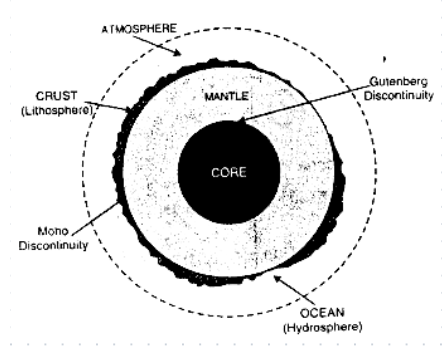
Question 24 MarksExplain briefly the structure of the earth. ### Discuss the structure of the earth giving details about each of its layers and arguments in support of your contention. ### Describe the structure of the Earth.AnswerThe structure of the earth means the interior of the earth.The entire earth is composed of three zonesLithosphereMesosphere andBarysphere.The Crust or Lithosphere It is the outermost layer. Its thickness varies from 8 to 60 kms. It is solid and is formed largely of igneous rocks. The crust consists of two layers.a lower, continuous layer of basaltic (mafic) rocks andand upper layer of granitic (felsic) rock, which constitutes bulk of continents. It is absent in ocean basins. These parts of the crust forming the continents are much thicker than the crust under the oceans. Its main universal constituents are Silica and Aluminium. It is collectively known as ‘SIAL’. It has an average density of 2.7. The lower layer has an average density of 3.0. It main mineral constituents are Silica (SI) and Magnesium (MA) and is therefore called ‘SIMA’. Since the SIAL is lighter than the SIMA, the continents can be said to be floating on the layer of denser SIMA.(ii) Mantle or The Mesosphere Beneath the crust or Lithosphere lies the Mantle or Mesosphere. Its thickness is 2840 km. Its density is 3.1 to 5.0. It depth is 2900 km. It is again divided into two sub layers.the internal Silicate layer (SIMA). Its thickness is 1140 km and density varies from 3.1 to 4.75 andMixed layer of metals and silicates. Its thickness is 1700 kms. and density is 4.75 – 5.0.(iii) Core or the Barysphere It is the central nucleus. It is made up of dense rock materials – Nickel and Iron. It is also called the layer ‘NIFE’. Its thickness is 3471 km (radius of core). It is again divided into two sub-layerThe outer core is liquid or plastic in nature andInner core (Barysphere) which is solid and rigid because of tremendous overlying pressure. The density of core is 5.1 to 13.View full question & answer→
Question 34 MarksExplain the layers of the interior of the earth with reference to the following : $(a)$ Depth $(b)$ Temperature $(c)$ Density.AnswerCrust : $(a)$ Depth $35-50 \ km$ below continents and $6-12 \ km$. below the oceans. $(b)$ Temperature $-$ Less than $870^\circ C$ $(c)$ Density $- 2.7 g/Cm^3 – 5.5 g/Cm^3.$ Mantle : $(a)$ Depth $- \ 50 \ – 2900 \ km.$ $(b)$ Temperature $- 1500^\circ C \ –\ 2200^\circ C$ $(c)$ Density $- 3 g/Cm^3 \ – \ 4.5 g/Cm^3$ Core : $(a)$ Depth $-\ 2900 \ km \ – \ 3500 \ km$ $(b)$ Temperature $- \ 2200^\circ C\ – \ 5000^\circ C$ $(c)$ Density $- \ 10.0 g/Cm^3\ – \ 13.6 g/Cm^3.$View full question & answer→