Questions

[4 Mark Question Answer]

🎯

Test yourself on this topic

5 questions · timed · auto-graded

Question 14 Marks
What Is the impact of toxic compounds on human beings?
Answer
Toxic Compounds :
  • Mercury, Methyl mercury
  • Heavy metals, Cadmium
  • Arsenic
  • Fluoride
Impact on Human beings :
  • ‘Minamata’ disease in Japan.
  • ‘ltai-itai’ disease in Japan.
  • Cancer, ulcers, kidney failure.
  • ‘Fluorosis’ discolouring of teeth.
View full question & answer
Question 24 Marks
Explain with examples the effects of radiations on the environment and on humans.
Answer
Radiations emitting from radioactive materials and the disposal of radioactive wastes cause pollution and damage the environment. The high-level products of nuclear wastes remain in the environment for several hundred years. Radioactive threats to the environment are the accidents connected with the activities of nuclear reactors, nuclear-powered vessels and satellites, etc. On human being it causes genetic variations, and somatic variation i.e. damage to body organs, breast cancer, thyroid cancer, lung cancer, brain cancer and defective eyesight
View full question & answer
Question 34 Marks
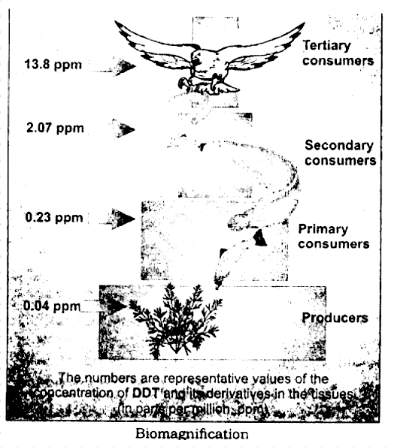
Explain with the help of a diagram how the accumulation of toxic substances increases as we move up the food chain.
View full question & answer
Question 44 Marks
How does air pollution affect human beings and environment
Answer
Air pollution affects human health in various harmful diseases e.g. irritation in eyes, headache, vomiting, respiratory disease, cancer, damage to liver, and kidneys. $SO_2$ causes harm to plants by yellowing the leaves$, NO_2$​​​​​​​ causes suppressed the growth of plants. Animals eating the polluted grass are affected with arsenic poisoning.
Soot, dust, and fumes discolour the fabrics arid buildings. The Taj Mahal has suffered damage caused by $SO_2$​​​​​​​ in the air by getting discoloured and corroded. $SO_2$​​​​​​​ and $H_2SO_4$​​​​​​​ cause corrosion of metals like steel, copper and zinc.
View full question & answer
Question 54 Marks
Noise pollution is detrimental to human health and environment. Discuss.
Answer
Noise pollution has ill effects not only on human beings but also on the environment. Human Health
  1. Effect on hearing or Deafness: Continuous exposure to noise levels above 100 dB has an adverse effect on hearing ability within a fairly short time. Many workers who are exposed to the noise of jet aircraft or very noisy workshops for even moderate periods soon develop detectable hearing defects.
  2. Effect on Communication: External sounds can interfere with conversation and use of the telephone, as well as the enjoyment of radio and television programmes.
  3. Repeated interference with sleep: Different people have different depths of sleep and they can adjust to natural sounds. However, noisy conditions near residential areas at night causes difficulties in sleeping.
  4. Mental or Physiological Effects: Many people complain that noise makes them mentally ill. Experiments have been performed to attempt to confirm or disprove these claims. Doctors and scientists have now medically confirmed that *noise disturbs the biological organisms and their respective functions.
  5. Effects on Physical Health and Psychological problems: Noise has a little physical effect on the biological performance provided that the noise level is below about 90 dB. Damage to the inner ear may result if continuous noise levels exceed about 100 dB and can lead to physical illness. Psychiatrists and psychologists have in recent researches made observations that noise has a certain relation with physical health causing tension resulting in problems such as speech interference, annoyance, fatigue, sleep interference, and emotional distress.
    Effects on Environment: The noise booms cause cracks in national and archaeological monuments Very high levels of noise are the cause of cracks in hills. High-intensity explosions can break glass panes and vibrations in the buildings.
View full question & answer
[4 Mark Question Answer] - Geography STD 9 Questions - Vidyadip