Questions

[4 Mark Question Answer]

🎯

Test yourself on this topic

4 questions · timed · auto-graded

Question 14 Marks
Define precipitation. Write short notes on three forms of precipitation.
Answer
The process by which products of condensation, viz water droplets, ice crystals, sleet, etc., fall to the ground is known as precipitation. Rainfall, snowfall, drizzle, sleet and hail are the chief forms of precipitation. Precipitation takes place only when the particles of water join together to form large-sized particles which become too heavy to remain in suspension in the cloud.
  1. Rain: It is the most common form of precipitation. Raindrops of smaller size and less intensity are known as a drizzle.
  2. Dew: When water vapour condenses on the surface, it forms tiny droplets of water called dew. Dew commonly occurs during winter on account of cooling of air below the dew point.
  3. Frost: In very low temperature, when condensation occurs at zero metre or ground level, water vapour freezes into minute crystals of ice on objects near the ground such as blades of grass, leaves and tiny rock particles. Frost is harmful to plants.
View full question & answer
Question 24 Marks
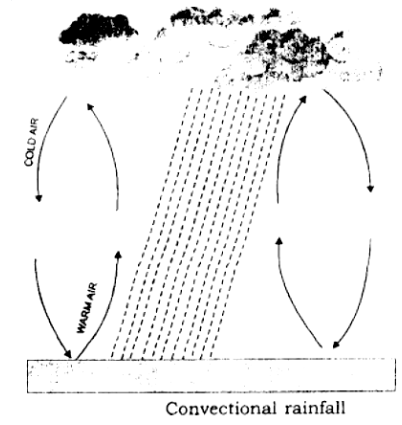
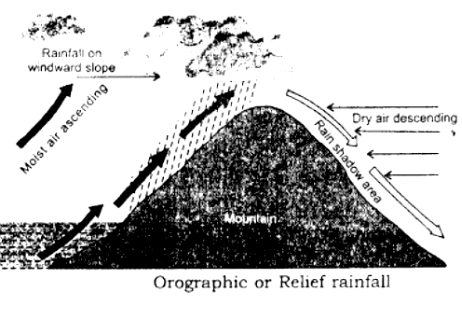
Name the three types of rainfall. With the help of a diagram describe each type of rainfall.
View full question & answer
Question 34 Marks
define : Forms of Condensation.
Answer
Forms of condensation: Following are the forms of the
  • condensation: Dew, frost, fog, mist, white frost and clouds. The clouds are formed when the temperature falls down below dew points, while dew, fog and clouds are formed when the temperature remains higher than the freezing point.
  • Clouds: Clouds are formed when minute droplets of water vapour condense on nuclei and remain suspended in the air.
  • Dew: When water vapour condenses on the surface, it forms tiny droplets of water called dew. Dew commonly occurs during winter on account of cooling of air below the dew point.
  • Frost: In very low temperature, when condensation occurs at zero metre or ground level, water vapour freezes into minute crystals of rice on objects near the ground such as blades of grass, leaves and tiny rock particles. Frost is harmful to plants.
  • Fog and Mist: Fog and Mist are two related terms. Droplets of water suspended in the atmosphere close to the surface of the earth are termed as fog. On long winter nights, the ground cools more rapidly than the air above. Such cooling reduces the temperature at the surface to below dew point. Water vapour at lower levels get condensed around minute solid particles to form fog.
View full question & answer
Question 44 Marks
Distinguish between Absolute Humidity and Relative Humidity.
Answer
Absolute Humidity :
  1. It is the measure of the actual amount of water vapour in the air, regardless of temperature.
  2. It is expressed as grams of moisture per cubic meter of air(g/m3).
  3. The higher the amount of water vapour, the higher is the absolute humidity.
  4. In weather calculations, absolute humidity is generally not taken into account.
Relative Humidity:
  1. It measures water vapour in the air but relative to the maximum vapour that the air can hold at that temperature.
  2. It is expressed as the ratio (percentage value) between the absolute humidity of a given mass of air and the maximum amount of water vapour that it can hold at the same temperature.
  3. Warm air possesses more water vapour than cold air, so with the same amount of absolute humidity, air will have a different relative humidity depending on temperature.
  4. It is the essential characteristic of weather forecasts, which indicates the likelihood of precipitation, dew, or fog.
View full question & answer
[4 Mark Question Answer] - Geography STD 9 Questions - Vidyadip