Questions

[4 Mark Question Answer]

🎯

Test yourself on this topic

5 questions · timed · auto-graded

Question 14 Marks
Trace the origin and flow of the Gulf Stream. What is the effect of this current on the coasts of North America and Western Europe?
Answer
Gulf Stream – The Gulf Stream is one of the largest warm currents. It originates from the Gulf of Mexico (about 20°N) and moves in a north-easterly direction along the eastern coast of North America. The average speed is about 33 km per day and its average width is -about 70 km. Under the impact of the Westerlies, this warm current reaches the western coast of Europe (about 70°N latitude). The general direction of flow of the Gulf Stream, north of 30° N latitude, is northward. Near Newfoundland, its water mixes with the cold water of the Labrador Current, which forms very dense fog. The foggy conditions around Newfoundland hamper the navigation of ships. From here, the Gulf Stream moves north eastwards. This current gradually widens and its speed decreases. It becomes a prominent, slow-moving current known as the North Atlantic Drift. Near western Europe, it splits into two parts. One part moves northwards, past UK, and Norway, while the other part is deflected southwards as the cold Canary Current. The warm water of the Gulf Stream modifies the weather conditions off the eastern coast of North America and the western coast of Europe.
View full question & answer
Question 24 Marks
Describe the circulation pattern of the following ocean current. : The Kuroshio current
Answer
 The Kuroshio current – is a strong western boundary current in the western North Pacific Ocean. It begins off the east coast of Taiwan and flows north-eastward past Japan, where it merges with the easterly drift of the North Pacific Current. It is analogous to the Gulf Stream in the Atlantic Ocean, transporting warm, tropical water northward towards the polar region. It is also sometimes known as the Black Stream — the English translation of Kuroshio, and an allusion to the deep blue of its water — and also as the Japan Current.
View full question & answer
Question 34 Marks
Differentiate between High Tides and Low Tides.
Answer
High Tides :
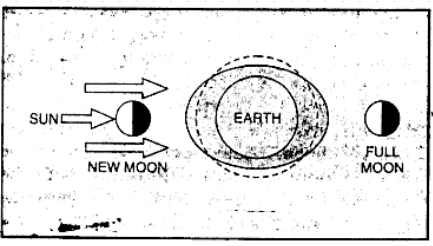
  1. When the sun and the earth and the moon are in the same line.
  2. Caused when all the gravitational forces work together.
  3. Occurs at the time of Full moon and new moon.
Low Tides :
  1. When the sun and the earth and the moon are at the position of right angles.
  2. Caused when the gravitational forces of the sun work against each other.
  3. Occurs during the 8th day of each fortnight of a month.
View full question & answer
Question 44 Marks
Discuss the origin of tides. Illustrate the formation of Spring Tides.
View full question & answer
Question 54 Marks
Each day a tide is delayed by 26 minutes. : Give reasons
Answer
Each day a tide is delayed by 26 minutes because the moon also rotates on its axis (west to east) while revolving around the earth. Since the earth rotates from west to east, the tide centre shifts westward. When the tide centre completes one round, the moon’s position is ahead of the tide centre by that time. The moon also revolves around the earth, with the result, the tide centre takes another 52 minutes to come under the moon. Thus, a particular tide centre takes 24 hours 52 minutes to come under the moon but by that time there is another tide at the opposite side of the referred tide centre and this happens after 12 hours 26 minutes.
View full question & answer
[4 Mark Question Answer] - Geography STD 9 Questions - Vidyadip