Questions

[4 Mark Question Answer]

🎯

Test yourself on this topic

17 questions · timed · auto-graded

Question 14 Marks
Name four factors that affect the temperature of a place.
Answer
The four factors that affect the temperature of a place are :
  1. Latitude - Distance from equator
  2. Altitude from the sea-level
  3. Distance from the sea.
  4. Wind direction
  5. Natural vegetation
  6. Slope of the land.
View full question & answer
Question 24 Marks
What is global warming? What are its causes? State its effects.
Answer
Global warming: The burning of fossil fuels, (coal, gas, petroleum), the cultivation of the soil, large scale industrialisation, rapid means of transport and deforestation has caused an imbalance in the atmosphere. These activities are increasing the amount of carbon dioxide. Thus, the greenhouse effect has raised the average, the temperature of the earth by 0.5°C. By the year 2000, the earth’s, average temperature will go up by 2°C. This is called global warming. Global warming is causing a rise in sea-levels due to the melting of glaciers. It is threatening to submerge many coastal areas.
View full question & answer
Question 34 Marks
Explain the Greenhouse effect of the atmosphere.
Answer
The atmosphere is heated by the radiation from the earth’s surface below. This action is compared to that of a glasshouse of a greenhouse in which vegetables and flowers are grown in polar areas. Glasshouse permits radiation to get in but does not allow radiation to escape out. Therefore, the glasshouse is warmer from inside than outside. The atmosphere also acts like a blanket keeping the earth warm. It is known as the greenhouse effect of the atmosphere. This is due to the presence of carbon dioxide in the atmosphere. Carbon dioxide has the ability to absorb earth radiation. The carbon dioxide layer acts as a glass roof of the greenhouse. With the increase in carbon dioxide, the temperature of the earth is increasing. Due to this, the year 1955 was the hottest year in India during this century.
View full question & answer
Question 44 Marks
Explain the importance of insolation.
Answer
Sun is the most important source of atmospheric heat. Sun’s diameter is more than 100 times the Earth’s diameter and has a surface temperature of more than 10,000 °F. The heat waves radiate from the sun in all directions at a speed of 186,000 miles per second of 3 lakh km per second. The solar radiation received by the earth is 1/2000 millionth part of solar output. Yet, this small amount is vital for our existence on the earth. It is estimated that on average the Earth receives about 1.9 g calories per minute per sq. cm. This is known as ‘solar constant’. All the physical phenomena depend upon insolation. Winds and ocean currents originate due to insolation. The earth is habitable only due to insolation.
View full question & answer
Question 54 Marks
Distinguish between maritime climate and continental climate.
Answer
The nearness to sea has a moderating influence on the temperature of coastal areas. Maritime or equable temperatures are found in coastal areas. But extremes of temperatures, with a continental climate, are found in inland areas remote from the sea. Due to the presence of land breezes and sea breezes in coastal areas: the summers are warm and winters are cool. This is due to the differential heating and cooling of land and water. Land surfaces are heated more quickly than water. But a greater annual range of temperature is found as we go away from the equator. The climate of Mumbai is more equable than that of Delhi.
View full question & answer
Question 64 Marks
State the importance of insolation.
Answer
Importance of insolation The radiant energy received by the earth from the sun is called the incoming solar radiation or insolation. The insolation received by the earth is responsible for all forms of activity on the Earth. The circulation in the atmosphere is due to the differential heating of the atmosphere by insolation. The radiant energy from the sun enables plants to manufacture their own food. This forms the basis for food needed by all other organisms on the Earth. The circulation of ocean water is also due to the unequal heating of ocean water by insolation.
View full question & answer
Question 74 Marks
Explain the ranges of temperature and show their calculation.
Answer
The Diurnal range is calculated by subtracting minimum temperature from the maximum temperature within 24 hours or of one day. The Mean monthly range is calculated by subtracting the mean minimum temperature from mean maximum temperature within 30 days or a month. Annual range of temperature is calculated by subtracting the mean minimum temperature from the mean maximum temperature within one year i.e. mostly between June and January.
View full question & answer
Question 84 Marks
Name four factors that affect the temperature of a place.
Answer
The four factors that affect the temperature of a place are :
  1. Latitude - Distance from equator
  2. Altitude from the sea-level
  3. Distance from the sea.
  4. Wind direction
  5. Natural vegetation
  6. Slope of the land.
View full question & answer
Question 94 Marks
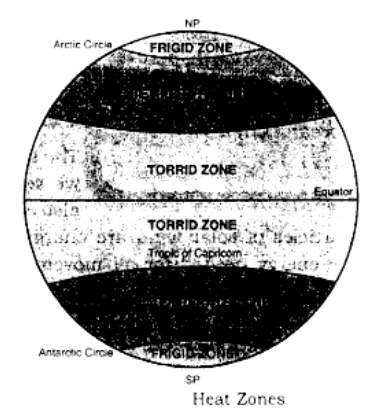
With the help of a diagram, show the heat zones of the earth and write briefly about each of them.
View full question & answer
Question 104 Marks
State how the Global Heat Balance is achieved?
Answer
Out of 100 units of solar radiation 35 units are reflected back by atmospheric layers and clouds and snowfields etc, 14 units are absorbed by the ultra-violet rays in the ozone layer and only 51 units are received by the earth as insolation and again these 51 units are reflected back by terrestrial radiation out of which 34 units are absorbed by the earth and sent back to atmospheric layers and 17 units radiated back into space. This process is called the Heat budget or Global Heat Balance.
View full question & answer
Question 114 Marks
Explain the effect of latitude and ocean currents on the temperature of a place.
Answer
The Tropical areas are far warmer than the polar areas due to differences in the angle of incidence of the rays of the sun. At higher latitudes, the sun rays are slanting so the temperature is comparatively low whereas in lower latitudes the sun rays are vertical so the temperature is high. 
Ocean currents greatly affect the tire climate of a place or region e.g. the European western coast enjoys ice-free coasts and developed navigation due to the warm, effect of the Gulf Stream – North Atlantic Drift, while the cold current of Benguela keeps the warm South African coast cool and mild.
Ocean currents act much like a conveyor belt, transporting warm water and precipitation from the equator toward the poles and cold water from the poles back to the tropics. Thus, ocean currents regulate global climate, helping to counteract the uneven distribution of solar radiation reaching Earth’s surface. Without currents in the ocean, regional temperatures would be more extreme—super hot at the equator and frigid toward the poles—and much less of Earth’s land would be habitable.
View full question & answer
Question 124 Marks
Describe the four factors that affect the distribution of temperature.
Answer
The factors are different physical properties of land and water keeping continental climate cold and oceanic climate mild Latitude The temperature decreases from the equator towards poles.
Distance from the sea keeps coastal ports mild and areas for from sea cold. Altitude mountains are cooler than plains due to the lapse rate of decrease of temperature of 1°C for every 166 m. of height;
Slope of the land South facing slopes of mountains is warmer than northern facing. Inversion of temperature takes place in hilly valley regions due to higher sunny slopes and the valley downward covered with fog and snow are cooler than higher slopes.
Wind direction Windward slopes get much rainfall, while the Leeward slopes are drier.
Natural vegetation cover absorbs 90% of solar energy, which is again consumed in transpiration, and keeping forested is mild, while snowy lands are cold.
Cloud Cover and Humidity: Clouds reflect the sunlight leaving the land below cool. Still, the humidity absorbs heat keeping these areas with average temperatures, not more than
View full question & answer
Question 134 Marks
Land is heated and cooled faster than the sea.
Answer
Sunlight falls on both land and water. Land surfaces are opaque and darker and absorb most of the light and surface heats up whereas water reflects most of the sunlight falling on it back to the atmosphere. That is why land surfaces heat up faster than water. During summers land is much warmer than water. Also rougher and dryer materials absorb more radiations than wetter ones. The land has a smaller heat capacity than water i.e land needs less heat to raise its temperature
Water has a high specific heat capacity and it has to lose more energy than land to decrease its temperature. Also, water retains heat for a longer period of time.
View full question & answer
Question 144 Marks
Annual Range and Monthly Range of Temperature.
Answer
Annual Range of Temperature :
  1. It is the difference between the highest and lowest temperatures within one year.
  2. It is the difference between the highest temperature of May-June and the lowest temperature in December January, i.e. the temperature difference between summer and winter.
Monthly range of Temperature :
  1. It is the difference between the maximum and minimum temperatures within a month.
  2. Mostly the middle of the month is noted for maximum and end of the month records minimum temperatures.
View full question & answer
Question 154 Marks
Torrid and Temperate Zones.
Answer
Torrid Zone :
  1. It lies between 23 1/2° N and 23 1/2° S
  2. It receives the highest temperature and rainfall.
  3. It receives the vertical sun’s rays.
  4. Equatorial region and the tropical belt receive maximum insolation
Temperate Zone :
  1. It lies between 23 1/2° N and 66 1/2° N & 23 1/2° S and 66 1/2° S
  2. It receives medium, temperature, and rainfall.
  3. It received slanting rays of the sun.
  4. Due to the spherical shape of the earth, this zone received quite less amount of insolation.
View full question & answer
Question 164 Marks
Land Breeze and Sea Breeze.
Answer
Land Breeze :
  1. It blows from Land to sea.
  2. It blows at night.
  3. It makes the seawater cooler.
  4. It moderates the temperature of the sea.
Sea Breeze :
  1. It blows from sea to land.
  2. It blows in the day time.
  3. It makes coastal parts warmer
  4. It moderates the climate of the coastal parts.
View full question & answer
Question 174 Marks
Insolation and Terrestrial Radiation.
Answer
Insolation :
  1. It is the incoming solar radiation intercepted by the earth.
  2. It travels in short waves.
  3. Insolation involves only 51 units out of 100 units of solar radiation.
Terrestrial Radiation :
  1. It is the earth’s radiation given back to the atmosphere and space.
  2. It travels in long waves.
  3. Out of 51 units of insolation 34 units are transferred to the atmosphere and 17 units go back to space
View full question & answer
[4 Mark Question Answer] - Geography STD 9 Questions - Vidyadip