Questions

[4 Mark Question Answer]

🎯

Test yourself on this topic

13 questions · timed · auto-graded

Question 14 Marks
Name the types Sedimentary rocks based on agents of formation.
Answer
There are five main types of rocks on the basis of agents of formation:
  1. Riverine Rocks These are formed by the sediments deposited by running water or river.
  2. Lacustrine Rocks These are formed by the deposition of silt etc on the bed of lakes.
  3. Glacial Rocks These are formed by the debris carried on and deposited by glaciers.
  4. Aeolean Rocks These are formed by the deposition sand accumulation by the wind.
  5. Marine Rocks These are formed by the deposition of sediments at the ocean floor. These types are Calcarious and Carbonaceous sedimentary Rocks.
View full question & answer
Question 24 Marks
State two points of distinction between rocks and minerals.
Answer
Rocks Minerals
Rocks contain minerals. Minerals do not contain rocks.
Rocks are the aggregates of minerals and other rock material. Mineral are the compounds of pure elements with a definite chemical Composition.
Three chief types of rocks are Igneous, Sedimentary and Metamorphic. Four chief mineral groups are silicates, carbonates, sulphides and metallic minerals.
Example: granite, sandstone, slate and quartz Example: Iron, silicon, magnesium, nickel, calcium, potassium, sodium
View full question & answer
Question 34 Marks
Give some examples of metamorphic rocks formed from sedimentary and igneous rocks.
Answer
Sedimentary Rocks :
  1. Limestone
  2. Clay and Shale
  3. Sandstone
  4. Coal
Metamorphic Rocks :
  1. Marble
  2.  Slate
  3. Quartzite
  4. Graphite
Igneous Rocks :
  1. Granite
  2. Basalt
Metamorphic Rocks :
  1. Gneiss
  2. Schist
View full question & answer
Question 44 Marks
What are metamorphic rocks?
Answer
Metamorphic rocks are those rocks which were formerly igneous or sedimentary rocks, but owing to extreme heat and pressure in the interior of the earth it has been changed or altered to such an extent that they are quite different from what they once were slate, which is in reality clay, and marble’ which is in reality lime stone. Other examples of metamorphic rocks are quartzite from sand stone, graphite from coal, gneiss from granite and Mica from Schist.
View full question & answer
Question 54 Marks
Distinguish between Thermal metamorphism and Dynamic metamorphism.
Answer
Thermal metamorphism : When the transformation of the original rock takes place principally because of the influence of high temperature, the rock is said to be caused through Thermal metamorphism. For example, graphite (from coal) and slate (from clay). The heat may result from the intrusion of hot magma or from the friction of moving rock layers. It may also occur due to chemical changes.
Dynamic metamorphism : When the transformation of the original rock takes place mainly because of the influence of pressure at a great depth within the earth’s crust, it is known as Dynamic Metamorphism.
View full question & answer
Question 64 Marks
Distinguish between Intrusive and Extrusive Rocks
Answer
Intrusive Rocks Extrusive Rocks
Intrustive rocks are formed beneath the surface of the Earth. Extrusive rocks are formed on the surface of the Earth.
These rocks have large size crystals due to slow cooling. Crystals are not formed due to rapid cooling of lava.
These are also known as plutonic rocks. These are also known as volcanic rocks.
Granite is an example of these rocks. Basalt is an example of these rocks.
View full question & answer
Question 74 Marks
Rocks are of great economic significance.
Answer
Rocks are of great economic significance Some of the main benefits of rocks are as follows :
  • After disintergration, they turn into valuable soils.
  • They are the store-houses of a large number of minerals.
  • They are the source of precious metals like gold, silver, platinum etc.
  • They are source of fuel-minerals.
  • They provide different types of stones.
View full question & answer
Question 84 Marks
How are sedimentary and igneous rocks formed?
Answer
Sedimentary rocks are formed by the process of consolidation of sediments deposited commonly in water bodies like seas or lakes. The sediments are derived by the rivers, glaciers, winds and waves. The sediments consist of loose particles of gravel, sand, silt and clay in various proportions. These loose particles get consolidated or compacted into hard rocks by the presence of cementing substances like lime or the pressure of overlying deposits.
Formation of igneous rocks : The rocks which are formed by the process of solidification of molten rock material (magma), are called igneous rocks.
The processes involved in the formation of igneous rocks are cooling and solidification.
Two types of igneous rocks are
  • Intrusive igneous rocks
  • Extrusive igneous rocks.
Formation of extrusive rocks : These rocks are also known as volcanic rocks, because they are formed by the solidification of lava on the earth’s surface. As on the outer surface of the earths’ crust the rate of cooling and solidification is more rapid than in the interior, the different minerals composing the magma have less time to become crystalline. The crystals formed are small. Basalt is a good example of this type of rock. Extrusive rocks are much more fine-grained as compared to intrusive granite. The hot magma free of gases is converted into lava on reaching the surface. It takes the form of lava flows, lava sheet and lava plateau. The north-western part of Peninsular India, known as the Deccan Trap, covers a great area of basaltic regur soil formed by the weathering of these rocks. Basaltic lava rocks cover a wide area in Columbia, the Snake Plateau of U.S.A. The other name of extrusive rock is Volcanic
Rock The properties of extrusive rocks :
  1. These rocks are formed by the solidification of lava on the earth’s surface.
  2. These rocks are very fine-grained.
  3. They are usually dark coloured.
The other name given to intrusive rock is Plutonic rock.
Formation of intrusive rocks : When the molten material of the interior part of the earth’s crust finds its way through clefts or spaces that it has made by pushing the surrounding rocks apart, and does not reach the surface. This is known as the Intrusive Rocks. Dolerite and granite are the best examples of intrusive rocks.
Properties of intrusive rocks :
  1. They have large crystals.
  2. They are very compact.
  3. They are glassy in appearance.
View full question & answer
Question 94 Marks
What is meant by a rock?
Answer
A rock can be defined as “an aggregate of minerals that forms a more or less definite unit of the earth’s crust”. A rock does not possess a definite composition like that of a chemical compounds, but is usually a mixture of various minerals.
The bulk of rocks is made up of silica or quartz and feldspar. Feldspar are composed of silica, aluminium, potassium and sodium or calcium. Some rocks are composed of grains cemented together, while several other are crystalline, compact or even glass-like.
All material (whether hard like stone or sand) of which the crust of the earth is composed are called rocks e.g, stone, clay, lava, sand, chalk, salt, coal marble etc.
View full question & answer
Question 104 Marks
How are sedimentary rocks classified?
Answer
Sedimentary rocks are classified into the following types according to the nature of sediments, their origin, composition and the mode of formation.
  1. Inorganic rocks or Mechanically-formed Sedimentary Rocks :- These type of rocks are formed by the deposition of land derived material. When the river began to flow, they eroded the rocks and washed away to the sea. Clay, shale, sandstone were formed in this way. These rocks are called inorganic rocks.
  2. Organically formed Sedimentary Rocks :- These rocks are formed by the deposition of plants and sea organisms. Millions of years ago, there grew huge forest in marshy places. In course of ages they were buried underground and the internal heat changed them into coal. Moreover, there are millions and millions of sea-organisms whose skeleton are made of Calcium carbonate derived from sea water. After their death skeleton sink to the bottom of the seas and are formed into lime true and chalk and coal.
  3. Chemically-formed Sedimentary Rocks :- There rocks are formed by the evaporation of water from solution containing mineral. Various kinds of salts precipitate from waters of shallow desert lakes, where evaporation of the water is rapid. Gypsum is the best example of this kind of rocks. Several nitrates and potash are also chemically formed sedimentary rocks.
View full question & answer
Question 114 Marks
Explain the formation of sedimentary rocks on the basis of agents of formation.
Answer
There are five main types of rocks on the basis of agents of formation:
  1. Riverine Rocks These are formed by the sediments deposited by running water or river.
  2. Lacustrine Rocks These are formed by the deposition of silt etc on the bed of lakes.
  3. Glacial Rocks These are formed by the debris carried oh and deposited by glaciers.
  4. Aeolean Rocks These are formed by the deposition sand accumulation by the wind.
  5. Marine Rocks These are formed by the deposition of sediments at the ocean floor. These types are Calcarious and Carbonaceous sedimentary Rocks.
View full question & answer
Question 124 Marks
Give a detailed account of lithiflcation of sedimentary rocks.
Answer
Lithification means solidification. The loose material carried on by water, wind and ice is deposited slowly in different layers one upon another. Gradually the deposited sediments become solid and hard due to pressure and temperature. Evaporation results in the loss of water within the sediments and these are compacted and cemented. Compaction takes place by increasing weight and pressure of over lying sediments e.g. sand is converted to sandstone. Cementation takes place by bonding of compacted sediments by natural elements like calcium compounds, silica and iron with a property to bind the loose materials to solid state.
View full question & answer
Question 134 Marks
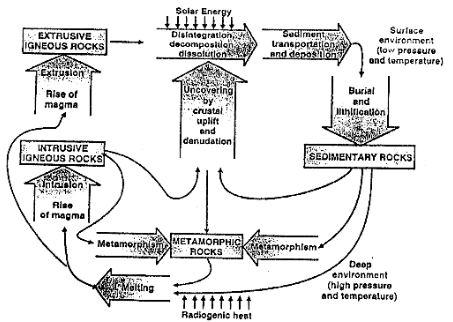
What is Rock Cycle. How does it keep the earth young?
View full question & answer
[4 Mark Question Answer] - Geography STD 9 Questions - Vidyadip