Questions

[3 Mark Question Answer]

🎯

Test yourself on this topic

15 questions · timed · auto-graded

Question 13 Marks
Mention one effect of seasons in low and high latitudes.
Answer
The effect of seasons in low and high latitudes is distinct through various phases of different seasons. Low latitude areas get ample temperature and rainfall while the high latitude areas are cold and receive less rainfall. Tropical regions are always warm with heavy rainfall season, while the temperate and polar regions are cold with scanty rainfall, while the polar regions are always covered with perpetual snow due to the temperature below 0°C.
View full question & answer
Question 33 Marks
What are the results of the difference in the Earth’s speed of rotation at various latitudes?
Answer
At the equator, the Earth’s speed of rotation is about 1600 km per hour. The speed goes on decreasing poleward. At 60° latitude, it is 800 km per hour. This difference affects the general circulation of the atmosphere. Winds are deflected to the right in the Northern Hemisphere and to the left in the Southern Hemisphere. Similarly, ocean currents are also deflected. This is known as Ferral’s Law. Due to this, the Earth is flattened at the poles and bulging at the equator.
View full question & answer
Question 43 Marks
What are the effects of the inclination of the axis?
Answer
(a) There is the apparent movement of the Sun from the equator towards tropics.
(b) It causes opposite seasons in the two Hemisphere.
(c) It results in the variation of length of day and night.
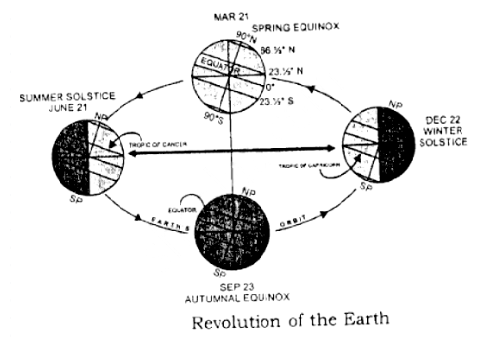
(d) When the North Pole is tilted towards the Sun, the South Pole turns away from the Sun. So the two Hemispheres are alternately exposed to the Sun rays.
View full question & answer
Question 53 Marks
Daylight increases as we go polewards in summer in The Northern Hemisphere. Why?
Answer
In summer, the Sun is overhead at the Tropic of Cancer (23 1 /2° N). The northern hemisphere is inclined towards the Sun. The circle of light does not pass through the poles. The circle, of light cuts all the parallels unequally. The larger part of each parallel is in light. So days are longer than nights. At 66 1 /2° N latitude, there is 24 hour complete, continuous daylight. Thus, North pole has daylight for six months
View full question & answer
Question 63 Marks
Why are days and nights equal throughout the world on 21st March and 23rd September?
Answer
21 st March and 23rd September are seasonal positions of the Earth and are known as equinoxes meaning equal nights. The Sun is overhead at the equator. Both the Hemispheres are equally inclined towards the Sun. The circle of light passes through the poles. With the result, one half of each hemisphere is in the light and the other half in darkness. So the days and nights are equal all over the world.
View full question & answer
Question 73 Marks
How is that the opposite seasons are found in Australia and India?
Answer
India lies in the Northern Hemisphere while Australia lies in the Southern Hemisphere. Due to inclination of the Axis of the Earth, opposite seasons occur in two Hemispheres. On 21st June, when the Northern Hemisphere is inclined towards the Sun, the Southern Hemisphere turns away from the Sun. When it is summer in India, it is winter in Australia.
View full question & answer
Question 83 Marks
Twilight is of longer duration in higher latitudes than at Equator.
Answer
The duration of twilight at a place depends on the path of the Sun in the sky. In the low latitudes, where the Sun’s path is almost vertical, the duration of twilight is short. The Sun sinks below the horizon rapidly. In the middle and high latitudes the duration of twilight is long because at these latitudes the Sun has an inclined path.
View full question & answer
Question 93 Marks
The duration of day and night is equal everywhere on 21st March and 23rd September.
Answer
These are two special positions in the revolutionary course of the Earth when days and nights are equal throughout the world. They are the two equinox, the first on March 21 st and the second on September, 23 rd. Because on these two days the mid-day sun is overhead at the equator, the positions of both the hemispheres are the same in respect of the sun.
View full question & answer
Question 103 Marks
The areas, lying on the Equator, have their duration of day-light almost constant throughout the year.
Answer
Days and Nights are equal throughout the year at the equator that is both days and nights are of twelve hours duration there.
Reason: The reason for this is that throughout the course of the earth’s revolution round the Sun, one half of the equator is always in the light and the other is in the dark, that is the circle of illumination always cuts the equator into two equal parts. Hence days and nights are always equal to every point at the equator.
View full question & answer
Question 113 Marks
Which country is known as the land of the ‘Midnight Sun’?
Answer
Norway.
Long Answer-
Norway experiences a natural phenomenon known as the midnight sun. The country acquired the name "the Land of Midnight Sun" because in the summer months, some parts of the country experience sunshine throughout the day. Norway is situated on the northern end of Europe. It borders Sweden to the west, Finland, and Russia to the North. A small part of Norway is situated north of the Arctic Circle. This northern part of Norway experiences the midnight sun during the summer.
View full question & answer
Question 123 Marks
What is the speed of rotation at the equator?
Answer
Speed of the Earth's Rotation at the Equator is calculated as follows:
Circumference of the Earth at the Equator = 40,000 kilometers
Time to complete one Rotation = 24 hours
Speed of Rotation = Distance/Time = 40,000 km / 24 hr = 1670 km/hr.
View full question & answer
Question 133 Marks
Twilight and Dawn.
Answer
Twilight :
(a) It is the reflection of light of the sun after the sunset.
(b) This light is slightly yellowish in colour.
Dawn :
(a) It is the reflection of light of the sun before the sunrise.
(b) This light is slightly reddish in colour
View full question & answer
Question 143 Marks
Vertical and Slanting Rays.
Answer
Vertical Rays :
(a) Vertical Rays of the sun fall within its migration belt.
(b) Migration belts are between Tropics of Cancer and Capricorn.
Slanting Rays. :
(a) Slanting Rays of the sun fall in temperate and polar regions.
(b) Slanting Rays of the sun fall in 23 1/2° N – 90°N and 23 1/2° S – 90°S regions
View full question & answer
Question 153 Marks
Describe how the duration of sunlight changes from the Equator to the Poles with respect to the angle of incidence.
Answer
As the angle of incidence changes from 0° to 90° from Poles towards the Equator; So the duration of sunlight also changes. The duration of daylight is 12 hours on the equator and 24 hours on the North Pole in summer and 24 hours on the South Pole in winter. So the duration of sunlight increases from the Equator to the North Pole and decrease in the winter season and vice-versa in between Equator and South Pole.
View full question & answer
[3 Mark Question Answer] - Geography STD 9 Questions - Vidyadip