Questions

[4 Mark Question Answer]

🎯

Test yourself on this topic

14 questions · timed · auto-graded

Question 14 Marks
What are the effects of revolution?
Answer
(a) Due to the revolution, the length of days and nights varies at a place at different times of the year.
(b) Revolution causes a change of seasons.
(c) It helps in the location of Tropic of Cancer and Tropic of Capricorn due to the fact that Sun rays fall vertical here.
(d) The altitude of the mid-day Sun changes.
(e) It gives us a measure of time for one year.
(f) Poles have days and nights of 6 months duration.
(g) It determines the distribution of solar energy on Earth.
View full question & answer
Question 24 Marks
What are the effects of rotation?
Answer
(a) Rotation causes days and nights.
(b) All heavenly bodies like Sun, Moon, planets appear to move from East to West.
(c) Tides occur regularly twice a day.
(d) Winds and ocean currents change their directions.
(e) The four main directions (North, South, East, West) can be determined with the help of rotation.
(f) We get a measure of time. A day consists of 24 hours – one complete rotation.
(g) The different times of a day like sunrise, noon, sunset, midnight can be determined due to rotation.
View full question & answer
Question 34 Marks
Distinguish between the following pair :
Solstice and Equinoxes
Answer
Solstices :
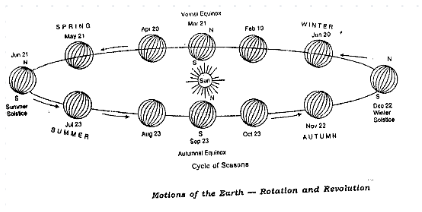
  1. The positions of the Earth on 21st June and 22nd December are known as Solstices.
  2. The Sun is overhead at tropics.
  3. Days and nights are unequal.
  4. The term Solstice means “Sun standing ‘still’.
  5. There is summer or winter season in Northern Hemisphere.
Equinoxes :
  1. The positions of the Earth on 23rd September and 21st March are known as Equinoxes.
  2. The Sun is overhead at the Equator.
  3. Days and nights are equal.
  4. The term Equinox means ‘Equal nights’.
  5. There is autumn or spring season in Northern Hemisphere.
View full question & answer
Question 44 Marks
Distinguish between the following pair :
Summer Solstice and Winter Solstice.
Answer
Summer Solstice :
  1. The Earth is in this position on its orbit on 21st June.
  2. The Sun is overhead on Tropic of Cancer (23 1/2° N).
  3. Days are longer than nights in the Northern Hemisphere.
  4. There is summer season in the Northern and winter season in the Southern Hemisphere.
Winter Solstice :
  1. The Earth is in this position on its orbit on 22nd December.
  2. The Sun is overhead on Tropic of Capricorn (23 1/2° S).
  3. Days are shorter than night in the Northern Hemisphere.
  4. There is winter season in the Northern and summer season in the Southern Hemisphere.
View full question & answer
Question 54 Marks
Account for the unequal length of day and night.
Answer
The length of day and night varies throughout the year. Sometimes the days are longer and nights are shorter and vice versa. It is due to two reasons :
(a) The inclination of the axis.
(b) The revolution of the Earth.
Due to the inclined axis, one hemisphere leans towards the Sun for the six months; the other Hemisphere leans towards the Sun for the next six months. In summer, on 21st June, days are longer in the Northern Hemisphere and the nights are shorter. In winter, the conditions are reversed, the days are shorter and nights are longer in the Northern Hemisphere. If the axes were vertical, there would have been equal days and nights everywhere.
View full question & answer
Question 64 Marks
Why are days longer than nights in summer?
Answer
During summer the North Pole continues to slant more towards the sun. Because of the tilt, it exposes a larger areas to sunshine. The Northern Hemisphere in this case has longer days and shorter nights. On 22 June, North Pole slants most towards the Sun, this is the longest day (the Summer Solstice) in Northern Hemisphere. The situation is exactly the opposite in Southern Hemisphere. On 22nd December is remains tilted most towards the Sun. So the days are longer and nights are shorter in the Southern Summer which is opposite of Northern Winter.
View full question & answer
Question 74 Marks
Why are there seasons on earth?
Answer
The axis of the earth is inclined at an angle of 66 1 °/2 to its orbital plane or 21 1 °/2 between the equator and orbital plane. While earth swings around the Sun. Different parts of its surface are exposed to sunlight for different lengths of time each day. Some regions bask in the warmth of the sunlight while others remain cold. Earth’s tilt while spreading the light over a larger area causes changes in the altitudes of the sun in different latitudes. This causes slow changes in temperature at a place. The changing weather conditions in an annual cycle of revolution is called Season. If the earth did not tilt on its axis there would be no seasons.
View full question & answer
Question 84 Marks
What is Midnight Sun ? Where does it shine ?
Answer
Daylight increases as we go polewards. At the Arctic Circle, the sun never sets at mid-summer (21st June) and sunshine is received for all the 24 hours. The areas include parts of Alaska and Northern Europe. In most parts of Norway, situated north of the Arctic Circle, Sunshines 24 hours over the beautiful countryside. A place called Hammerfest has become famous as the place of Midnight Sun. In Antarctica, surrounding the South Pole, Sunshine all night during the South Summer, late in December.
View full question & answer
Question 94 Marks
The regions, near North Pole and South Pole, have six months of continuous day-light and darkness.
Answer
On account of the obliquity of the earth’s axis, for six months i.e., from March 21 to Sept. 23, the north pole is inclined towards the Sun and is always in the light. During this period the South pole is inclined away from the Sun and is throughout in the dark. Hence it is a day for six months at the north pole and night at the south pole. But from September 23 to March 21st the case is just the opposite. The north pole is inclined away from the Sun and is in the dark while the south pole is inclined, towards the Sun and is in the light.
View full question & answer
Question 104 Marks
What is the Rotation of Earth's effects?
Answer
Its effects :
  1. Day and nights are caused. This is by far the most important effect of rotation.
  2. The sun, the moon, and the star appear to revolve around the earth from east to west.
  3. Winds and currents change their direction.
  4. Different places have different local times.
  5. Tides occur regularly twice a day.
  6. Coriolis Effect
View full question & answer
Question 114 Marks
Equinox and Solstice.
Answer
 Equinox :
(a) It means the duration of days and nights equal.
(b) 21st March and 23rd September are the dates of Equinox all over the world.
(c) The sun is vertical on the equator.
Solstice :
(a) It is the particular position of the earth during the year.
(b) The dates of summer and Winter Solstices are 21st June and 22nd December.
(c) The sun is vertical on the Tropic of Cancer and Tropic of Capricorn respectively.
View full question & answer
Question 124 Marks
Rotation and Revolution
Answer
Rotation :
(a) It is the motion of the earth along its axis.
(b) The time taken for rotation is 24 hours.
(c) It causes days and nights.
Revolution :
(a) It is the motion of the earth in its orbit around the sun.
(b) The time taken for the revolution is 365 days 5 hours 59 minutes and 16 seconds. It causes different types of seasons.
View full question & answer
Question 134 Marks
Explain with the help of a diagram how the tilt of the earth’s axis and the revolution cause
  1. seasons.
  2. variation in the length of day and night; and
  3. changes in the altitude of the midday sun at different times of the year.
View full question & answer
Question 144 Marks
Describe the two interesting phenomena made by the circle of illumination viz., Solstice and Equinox.
Answer
The circle of illumination is the lighted part of the earth by the sun. On June 21, Northern Hemisphere enjoys the longest day due to the sun’s position overhead at the Tropic of Cancer. It is called the Summer Solstice. On the other hand, when the sun is overhead on the Tropic of Capricorn, the Southern Hemisphere gets the longest day on December 22, which is known as Winter Solstice. The dates of Equinox are 21st March and 23rd September when the days and nights are equal all over the world and there are spring and autumn seasons in Northern Hemisphere and autumn and spring in Southern Hemisphere respectively.
View full question & answer
[4 Mark Question Answer] - Geography STD 9 Questions - Vidyadip