Question 12 Marks
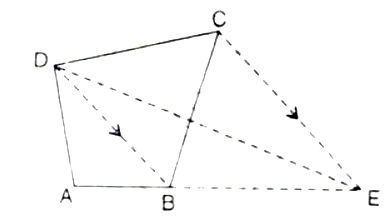
In the following figure$, \text{CE}$ is drawn parallel to diagonals $\text{DB}$ of the quadrilateral $\text{ABCD}$ which meets $AB$ produced at point $E.$Prove that $\triangle ADE$ and quadrilateral $\text{ABCD}$ are equal in area.
Answer
View full question & answer→Since $\triangle DCB$ and $\triangle DEB$ are on the same base $DB$ and between the same parallels
i.e. $DB \| CE,$ therefore we get
Ar.$ ( \triangle DCB) =$ Ar.$ ( \triangle DEB )$
Ar. $( \triangle DCB + \triangle ADB )$ = Ar. $(\triangle DEB + \triangle ADB )$
Ar.$ \text{( ABCD )} =$ Ar. $( \triangle ADE )$
Hence proved.
i.e. $DB \| CE,$ therefore we get
Ar.$ ( \triangle DCB) =$ Ar.$ ( \triangle DEB )$
Ar. $( \triangle DCB + \triangle ADB )$ = Ar. $(\triangle DEB + \triangle ADB )$
Ar.$ \text{( ABCD )} =$ Ar. $( \triangle ADE )$
Hence proved.