Questions

[3 marks sum]

🎯

Test yourself on this topic

13 questions · timed · auto-graded

Question 13 Marks
In the following figure, $OAB$ is a triangle and $AB \| DC.$
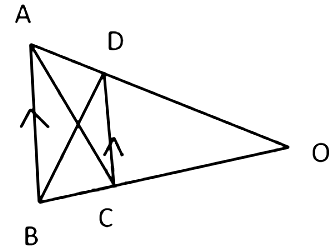
If the area of $\triangle CAD=140 \ cm^2$ and the area of $\triangle ODC=172\ \ cm^2$, find:$(i)$ the area of $\triangle DBC,(ii)$ the area of $\triangle OAC,(iii)$ the area of $\triangle ODB$.
Answer
Given:
$\triangle CAD = 140 \ cm^2$
$\triangle ODC = 172 \ cm^2$
$AB \| CD$
As $\triangle DBC$ and $\triangle CAD$ have same base $CD$ and between the same parallel lines,
Hence,
Area of $\triangle DBC =$ Area of $\triangle CAD = 140 \ cm^2$
Area of $\triangle OAC =$ Area of $\triangle CAD +$ Area of $\triangle ODC$
$= 140 \ cm^2 + 172 \ cm^2 = 312 \ cm^2$
Area of $\triangle ODB =$ Area of $\triangle DBC +$ Area of $\triangle ODC$
$= 140 \ cm^2 + 172 \ cm^2$
$= 312 \ cm^2.$
View full question & answer
Question 23 Marks
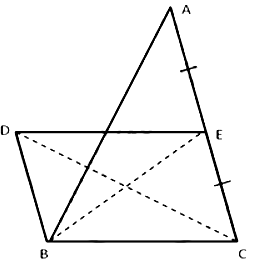
In the following figure, $BD$ is parallel to $CA, E$ is mid$-$point of $CA$ and $BD = `1/2`CA$.Prove that: $ar. ( \triangle ABC ) = 2 \times ar.( \triangle DBC )$
​​​​​​​
Answer
Here $\text{BCED}$ is a parallelogram,
Since $BD = CE$ and $BD \| CE.$
$ar. ( \triangle DBC ) = ar. ( \triangle EBC ) ......($ Since they have the same base and are between the same parallels $)$
In $\triangle ABC,$
$BE$ is the median,
So, $ar. ( \triangle EBC ) = `1/2` ar. ( \triangle ABC )$
Now, $ar. ( \triangle ABC ) = ar. ( \triangle EBC ) + ar. ( \triangle ABE)$
Also,$ ar. ( \triangle ABC ) = 2ar. ( \triangle EBC )$
$\Rightarrow ar. ( \triangle ABC ) = 2ar. ( \triangle DBC )$
View full question & answer
Question 33 Marks
The perimeter of a $\triangle ABC$ is $37 \ cm$ and the ratio between the lengths of its altitudes be $6: 5: 4.$ Find the lengths of its sides. Let the sides be $x \ cm, y \ cm$ and $(37 - x - y) \ cm.$ Also, let the lengths of altitudes be $6a \ cm, 5a \ cm$ and $4a \ cm.$
Answer
Consider that the sides be $ x \ cm, y \ cm$ and ($37 - x - y) \ cm.$
also, consider that the lengths of altitudes be $6a \ cm, 5a \ cm$ and $4a \ cm.$
$\therefore$ Area of a $\triangle =\frac{1}{2} \times$ base $\times$ altitude
$\therefore \frac{1}{2} \times x \times 6 a=\frac{1}{2} \times y \times 5 a$
$=\frac{1}{2} \times(37-x-y) \times 4 a$
$6x = 5y = 148 - 4x - 4y$
$6x = 5y$ and $6x = 148 - 4x - 4y$
$6x - 5y = 0$ and $10x + 4y = 148$
Solving both the equations,
we have
$X = 10 \ cm, y = 12 \ cm$ and $( 37 - x - y ) \ cm = 15\ cm.$
View full question & answer
Question 43 Marks
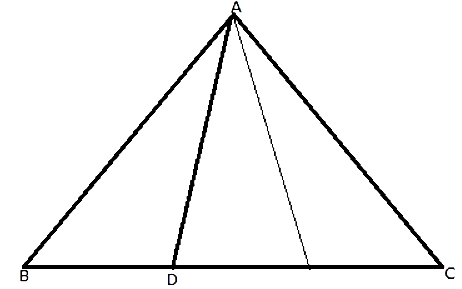
The base $BC$ of $\triangle ABC$ is divided at $D$ .so that $BD=\frac{1}{2} DC$.Prove that area of $ΔABD=\frac{1}{3}$ of the area of $ΔABC.$
Answer


In $\triangle ABC ,
\because BD =\frac{1}{2} DC \Rightarrow \frac{ BD }{ DC }=\frac{1}{2}$
$∴ Ar.( ΔABD ) : Ar.( ΔADC ) = 1:2$
But $Ar.( ΔABD ) + Ar.( ΔADC ) = Ar.( ΔABC )$
$Ar.( ΔABD ) + 2Ar.( ΔABD ) = Ar.( ΔABC )$
$3 Ar.( ΔABD ) = Ar.( ΔABC )$
$Ar.( ΔABD ) = \frac{1}{3} \operatorname{Ar} .(\triangle ABC )$
View full question & answer
Question 53 Marks
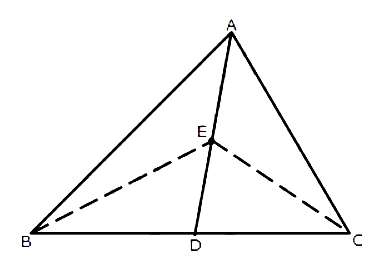
In the figure of question $2,$ if $E$ is the mid$-$ point of median $AD,$ then prove that:Area $( ΔABE ) =\frac{1}{4}$ Area $( ΔABC ).$
Answer
$AD$ is the median of $ΔABC.$
Therefore it will divide $ΔABC$ into two triangles of equal areas.
$∴$ Area$( ΔABD ) = $Area$( ΔACD )$
Area $(\triangle ABD )=\frac{1}{2}$ Area$(\triangle ABC ) ...(i)$
In $ΔABD, E$ is the mid$-$point of $AD.$
Therefore $BE$ is the median.
$∴$ Area$( ΔBED ) =$ Area$( ΔABE )$
Area$(\triangle BED )=\frac{1}{2}Area(\triangle ABD )$
Area$( ΔBED ) = \frac{1}{2} \times \frac{1}{2}$ Area$( ΔABC )...[$from equation $(i)]$
Area$( ΔBED ) = \frac{1}{4}$ Area $(\triangle ABC )$
View full question & answer
Question 63 Marks
In the given figure$; AD$ is median of $\triangle ABC$ and $E$ is any point on median $AD.$Prove that Area $(\triangle ABE) =$ Area $(\triangle ACE).$
​​​​​​​
Answer
$AD$ is the median of $\triangle ABC.$
Therefore it will divide $\triangle ABC$ into two triangles of equal areas.
$\therefore $ Area $(\triangle ABD)=$ Area $(\triangle ACD) ...(i)$
$ED$ is the median of $\triangle EBC$
$\therefore $Area $(\triangle EBD)=$ Area$ (\triangle ECD) ...(ii)$
Subtracting equation $(ii)$ from $(i),$ we obtain
Area $(\triangle ABD)-$ Area$ (\triangle EBD) =$ Area $(\triangle ACD)-$ Area $(\triangle ECD)$
Area $(\triangle ABE) =$ Area $(\triangle ACE).$
Hence proved
View full question & answer
Question 73 Marks
Show that:The ratio of the areas of two triangles of the same height is equal to the ratio of their bases.
Answer
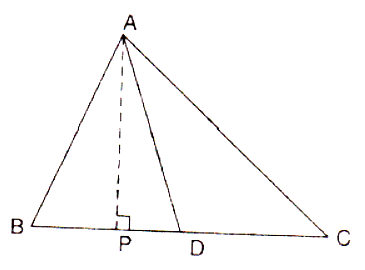
Consider the following figure :

Here$ AP ⊥ BC$
Since $Ar. (\triangle ABD )=\frac{1}{2} BD \times AP$
And, $Ar. (\triangle ADC )=\frac{1}{2} DC \times AP$
$\frac{\operatorname{Area}(\Delta ABD )}{\operatorname{Area}(\Delta ADC )}=\frac{\frac{1}{2} BD \times AP }{\frac{1}{2} DC \times AP }=\frac{ BC }{ DC }$
Hence proved
View full question & answer
Question 83 Marks
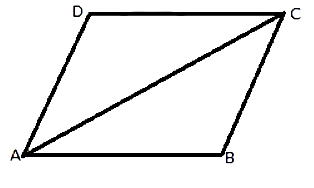
Show that:A diagonal divides a parallelogram into two triangles of equal area.
Answer
Suppose $ABCD$ is a parallelogram $...($given$)$

Consider the triangles $ABC$ and $ADC :$
$AB = CD ......[ \text{ABCD}$ is a parallelogram$ ]$
$ADE = BC ......[\text{ABCD}$ is a parallelogram$ ]$
$AD = AD .....[$ common $]$
By Side$-$ Side $-$Side criterion of congruence, we have,
$\triangle ABC ≅ \triangle ADC$
Area of congruent triangles are equal.
Therefore, Area of $ABC =$ Area of $ADC$
View full question & answer
Question 93 Marks
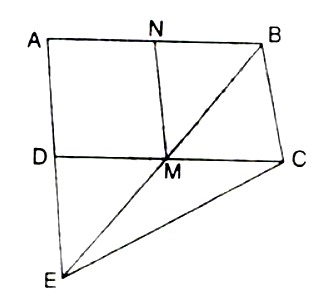
In the given figure, $M$ and $N$ are the mid-points of the sides $DC$ and $AB$ respectively of the parallelogram $\text{ABCD}.$

If the area of parallelogram $\text{ABCD}$ is $48 \ cm^2;$
$(i)$ State the area of the $\triangle BEC.$
$(ii)$ Name the parallelo gram which is equal in area to the triangle $BEC.$
Answer
$(i)$ Since$ \triangle BEC$ and parallelogram $\text{ABCD}$ are on the same base $BC$ and between the same parallels
i.e. $BC \| AD$.
So Area $(\triangle B E C)=\frac{1}{2} \times$ Area$(\square ABCD)$
$=\frac{1}{2} \times 48=24 cm ^2$
$(ii)$ Area$(\square \text { ANMD })=$Area$(\square \text { BNMC ) }$
$=\frac{1}{2}$ Area$(\square \text { ABCD) }$
$=\frac{1}{2} \times 2 \times Area(\triangle BEC )$
= Area $(\triangle BEC )$
Therefore, Parallelograms $\text{ANMD}$ and $\text{NBCM}$ have areas equal to $\triangle BEC.$
View full question & answer
Question 103 Marks
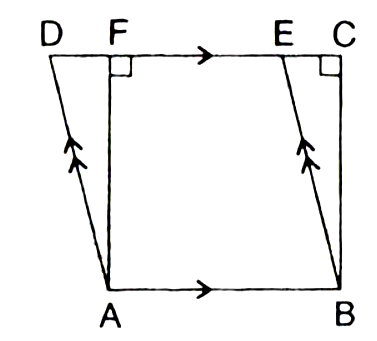
In the given figure, if the area of $\triangle ADE$ is $60 \ cm^2$, state, given reason, the area of :
$(i)$ Parallelogram $ABED;$
$(ii)$ Rectangle $ABCF;$
$(iii)$ Triangle $ABE.$​​​​​​​
​​​​​​​
Answer
$(i) \triangle ADE$ and parallelogram $ABED$ are on the same base $AB$ and between the same parallels $DE\|AB,$
so an area of the triangle $\triangle ADE$ is half the area of parallelogram $ABED.$
Area of $ABED = 2 ($Area of $ADE) = 120 \ cm^2$
$(ii)$Area of the parallelogram is equal to the area of a rectangle on the same base and of the same altitude
i.e, between the same parallels
Area of $\text{ABCF} =$ Area of $\text{ABED} = 120 \ cm^2​​​​​​​$​​​​​​​
$(iii)$We know that area of triangles on the same base and between same parallel lines are equalArea of $ABE =$ Area of $ADE = 60 \ cm^2​​​​​​​$
View full question & answer
Question 113 Marks
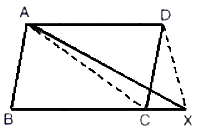
In the given figure, $ABCD$ is a parallelogram; $BC$ is produced to point $X$.Prove that: area $( \triangle ABX ) =$ area $(`\square`ACXD )$
Answer
Given:
$\text{ABCD}$ is a parallelogram.
We know that
Area of $ΔABC =$ Area of $ΔACD$
Consider $ΔABX,$
Area of $ΔABX =$ Area of $ΔABC +$ Area of $ΔACX$
We also know that the area of triangles on the same base and between the same parallel lines are equal.
Area of $ΔACX =$ Area of $ΔCXD$
From the above equations, we can conclude that
Area of $ΔABX =$ Area of $ΔABC +$ Area of $ΔACX$
$=$ Area of $ΔACD+$ Area of $ΔCXD$
$=$ Area of $\text{ACXD}$ Quadrilateral
Hence Proved.
View full question & answer
Question 123 Marks
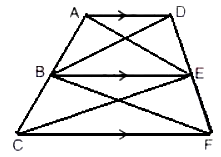
In the given figure, $AD \| BE \| CF.$
Prove that area $(\triangle AEC) =$ area $(\triangle DBF)$
Answer
We know that the area of triangles on the same base and between the same parallel lines are equal. Consider $ABED$ quadrilateral; $AD \| BE.$
With the common base, $BE$ and between $AD$ and $BE$ parallel lines,
we have
Area of $\triangle ABE =$ Area of $\triangle BDE$ Similarly, in $\text{BEFC}$ quadrilateral,
$BE \| CF$ With common base $BC$ and between $BE$ and $CF$ parallel lines,
we have
Area of $\triangle BEC = $Area of $\triangle BEF$ Adding both equations, we have
Area of $\triangle ABE +$ Area of $\triangle BEC =$ Area of $\triangle BEF +$ Area of $\triangle BDE$
$\Rightarrow $ Area of $AEC =$ Area of $DBF$
​​​​​​​Hence Proved.
View full question & answer
Question 133 Marks
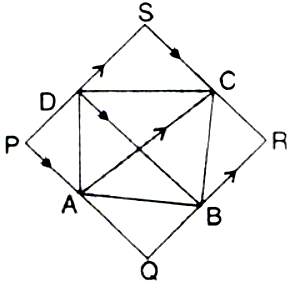
In the following, $AC \| PS\| QR$ and $PQ \| DB \| SR.$

Prove that: Area of quadrilateral $\text{PQRS} = 2 \times$ Area of the quad. $\text{ABCD}.$
Answer
In Parallelogram $\text{PQRS},$
$AC \| PS \| QR$ and $PQ \| DB \| SR.$
Similarly, $\text{AQRC}$ and $\text{APSC}$ are also parallelograms.
Since $\triangle ABC$ and parallelogram $\text{AQRC}$ are on the same base $AC$ and between the same parallels,
then
$A( \triangle ABC ) = `1/2`A(\text{AQRC}) ......(i)$
Similarly,
$A( \triangle ADC ) = `1/2`A({ APSC} ) .......(ii)$
Adding $(i)$ and $(ii),$ we get
Area of quadrilateral $\text{PQRS} = 2 x$ Area of the quad.$ \text{ABCD}.$
View full question & answer
[3 marks sum] - MATHEMATICS STD 9 Questions - Vidyadip