Questions

[3 marks sum]

🎯

Test yourself on this topic

10 questions · timed · auto-graded

Question 13 Marks
In the figure, $\text{PQR}$ is a straight line. $SQ$ is parallel to $Tp.$ Prove that the quadrilateral $\text{PQST}$ is equal in area to the $\triangle PSR.$
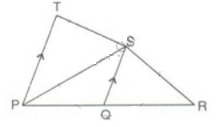
Image ​​​​​​​
Answer
In quadrilateral $\text{PQST},$
$\operatorname{ar}(\triangle PQS )=\frac{1}{2} \times \operatorname{ar} ($quadrilateral $\text{PQST})$
$\operatorname{ar}($ quadrilateral $\text{PQST})=2 \operatorname{ar}(\triangle PQS ) \quad \ldots . . .( i )$
In $\triangle P S R$,
$\operatorname{ar}(\triangle PSR )=\operatorname{ar}(\triangle PQS )+\operatorname{ar}(\triangle QSR )$
but $\operatorname{ar}(\triangle PQS )=\operatorname{ar}(\triangle QSR ) \quad...$(since $QS$ is median as $QS \| TP )$
$\operatorname{ar}(\triangle PSR )=2 \operatorname{ar}(\triangle PQS ) \quad........(ii)$
From $(i)$ and $(ii)$
$\operatorname{ar}($ quadrilateral $P Q S T)=\operatorname{ar}(\triangle P S R)$.
View full question & answer
Question 23 Marks
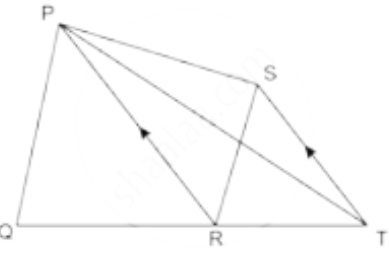
In the given figure, $ST \| PR.$ Prove that: area of quadrilateral $\text{PQRS} =$ area of $\triangle P Q T$.
Image
Answer
We have,
$A(\triangle PSR) = A(\triangle PTR)$
$($Triangle on the same base $PR$ and between the same parallel lines $PR$ and $ST)$
Adding $A(\triangle PQR)$ on both sides, we get
$A(\triangle PSR) + A(\triangle PQR) = A(\triangle PTR) + A(\triangle PQR)$
$\Rightarrow A($Quadrilateral $\text{PQRS}) = A(\triangle PQT).$
View full question & answer
Question 33 Marks
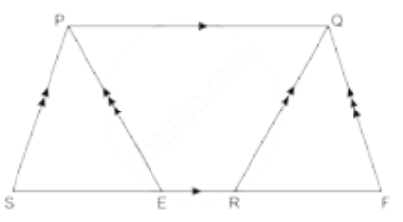
In the given figure area of $\| gm\ \text{PQRS}$ is $30 \ cm ^2$. Find the height of $\| gm\ \text{PQFE}$ if $P Q=6 \ cm$.
Image
Answer
Area$(\| gm\ \text{PQRS}) =$ Area$(\| gm\ PQFE)$
$(\| gm$ on same base $PQ$ and between same parallel lines$)$
$\therefore$ Area( $(\| gm\ \text{PQEF})=30 \ cm ^2$
$\Rightarrow$ Base $\times$ Height $=30$
$\Rightarrow 6 \times$ Height $=30$
$\Rightarrow$ Height $=\frac{30}{6}=5 \ cm$
$\therefore$ The height of a parallelogram $\text{PQEF}$ is $5 \ cm$.
View full question & answer
Question 43 Marks
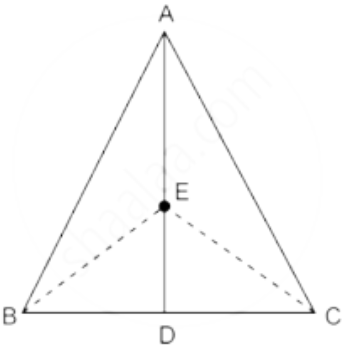
In the given figure,$ ABC$ is a triangle and $AD$ is the median.
Image
If $E$ is any point on the median $A D$. Show that: Area of $\triangle A B E=$ Area of $\triangle A C E$.
Answer
$AD$ is the median of $\triangle ABC.$
Therefore it will divide $\triangle ABC$ into two triangles of equal areas.
$\therefore $ Area$(\triangle ABD) =$ Area$(\triangle ACD) ….(i)$
Similarly, $ED$ is the median of $\triangle EBC.$
$\therefore $ Area$(DEBD) =$ Area$(DECD) ….(ii)$
Subtracting equation $(ii)$ from $(i),$
we have
Area$(\triangle ABD) -$ Area$(\triangle EBD) =$ Area$(\triangle ACD) -$ Area$(\triangle ECD)$
$\Rightarrow $ Area$(\triangle ABE) =$ Area$(\triangle ACE).$
View full question & answer
Question 53 Marks
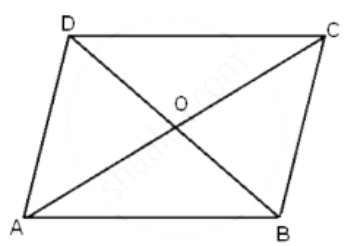
Prove that the area of a rhombus is equal to half the rectangle contained by its diagonals.
Answer
Image
Since the diagonals of a rhombus intersect at right angles,
Therefore, $O B \perp A C$ and $O D \perp A C$
Now, $\operatorname{ar}($rhombus $A B C D)$
$=\operatorname{ar}(\triangle ABC )+\operatorname{ar}(\triangle ADC ) $
$=\frac{1}{2}( AC \times BO )+\frac{1}{2}( AC \times DO ) $
$=\frac{1}{2}\{ AC \times( BO + DO )\} $
$=\frac{1}{2}( AC \times BD )$
Therefore, the area of a rhombus is equal to half the rectangle contained by its diagonals.
View full question & answer
Question 63 Marks
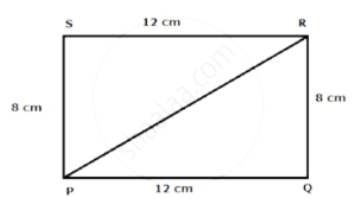
$\text{PQRS}$ is a rectangle in which $PQ = 12\ cm$ and $PS = 8\ cm.$ Calculate the area of $\triangle PRS.$
Answer
Image
Since $\text{PQRS}$ is a rectangle,
$\therefore P Q=S R$.
$ \text { SR }=12 \ cm$
$\operatorname{PS}=8 \ cm$
$\operatorname{ar}(\triangle P R S)=\frac{1}{2} \times$ base $\times$ height
$\operatorname{ar}(\triangle P R S)=\frac{1}{2} \times SR \times PS$
$\operatorname{ar}(\triangle PRS )=\frac{1}{2} \times 12 \times 8$
$\operatorname{ar}(\triangle PRS )=48 \ cm ^2 .$
View full question & answer
Question 73 Marks
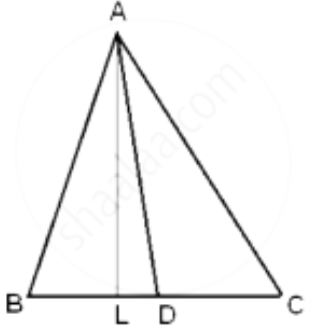
Prove that the median of a triangle divides it into two triangles of equal area.
Answer
Image
Draw $AL$ perpendicular to $B C$.
Since $A D$ is median of $\triangle A B C$.
Therefore, $D$ is the mid$-$point of $B C$.
$\Rightarrow BD = DC $
$\Rightarrow BD \times AL = DC \times AL \ldots ($multiplying by $AL ) $
$\Rightarrow \frac{1}{2}( BD \times AL ) $
$=\frac{1}{2}( DC \times AL ) $
$\Rightarrow \operatorname{ar}(\triangle ABD )=\operatorname{ar}(\triangle ADC )$
View full question & answer
Question 83 Marks
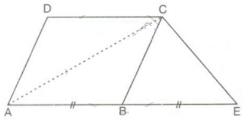
In the figure, $A E=B E$. Prove that the area of triangle $A C E$ is equal in area to the parallelogram $\text{ABCD}$.
Image
Answer
In parallelogram $\text{ABCD}$,
$\operatorname{ar}(\triangle ABC )=\frac{1}{2} \times \operatorname{ar}($ parallelogram $\text{ABCD})$
$($The area of a triangle is half that of a parallelogram on the same base and between the same parallels$)$
$\operatorname{ar}($ parallelogram $\text {ABCD})=2 \operatorname{ar}(\triangle A B C) \ldots . . . .(i)$
In $\triangle A C E$,
$\operatorname{ar}(\triangle ACE )=\operatorname{ar}(\triangle ABC )+\operatorname{ar}(\triangle BCE )$
but $\operatorname{ar}(\triangle A B C)=\operatorname{ar}(\triangle B C E) \quad$...(since $B C$ is median)
$\operatorname{ar}(\triangle ACE )=2 \operatorname{ar}(\triangle ABC )$
From $(i)$ and $(ii)$
$\operatorname{ar}($ parallelogram $\text { ABCD})=\operatorname{ar}(\triangle A C E).$
View full question & answer
Question 93 Marks
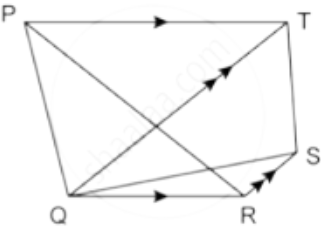
In the given figure, $P T \| Q R$ and $Q T \| R S$. Show that: area of $\triangle P Q R=$ area of $\triangle T Q S$.
Image
$*$Question modified
Answer
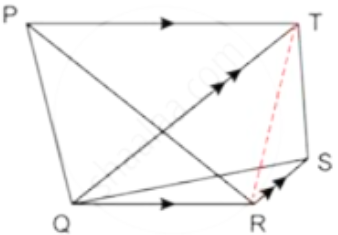
Joining $TR,$ we get
Image
$\triangle P Q R$ and $\triangle Q T R$ are on the same base $Q R$ and between the same parallel lines $Q R$ and $P T$.
$\therefore A (\triangle PQR )= A (\triangle QTR ) \ldots (i) $
$\triangle Q T R$ and $\triangle T Q S$ are on the same base $QT$ and between the same parallel lines $QT$ and $RS.$
$\therefore A (\triangle QRT )= A (\triangle TQS )$
From $(i)$ and $(ii),$ we get
$A (\Delta PQR )= A (\Delta TQS )$
View full question & answer
Question 103 Marks
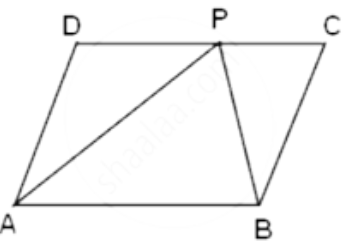
$ABCD$ is a parallelogram having an area of $60\ cm^2. P$ is a point on $CD.$ Calculate the area of $\triangle APB.$
Answer
Image
$\operatorname{ar}(\triangle APB )=\frac{1}{2} \times \operatorname{ar}$( parallelogram $\text{ABCD})$
$($The area of a triangle is half that of a parallelogram on the same base and between the same parallels$)$
$\operatorname{ar}(\triangle APB )=\frac{1}{2} \times 60 \ cm ^2$
$\operatorname{ar}(\triangle APB )=30 \ cm ^2$
View full question & answer
[3 marks sum] - MATHEMATICS STD 9 Questions - Vidyadip