Questions

[5 marks sum]

🎯

Test yourself on this topic

15 questions · timed · auto-graded

Question 15 Marks
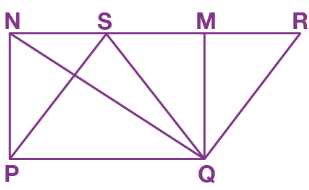
In the figure, if the area of $\| gm \text{PQRS}$ is $84 \ cm ^2$; find the area of $(i)\| gm \text{PQMN};(ii)\triangle PQS;(iii)\triangle PQN$
Image
Answer
$(i)$ Area of a rectangle and area of a parallelogram on the same base is equal.
Here,
For rectangle $\text{PQMN}$, base $= PQ$
For parallelogram $\text{PQRS}$, base $= PQ$
Therefore, Area of rectangle $\text{PQMN}=$ Area of parallelogram $\text{PQRS}$
Area of rectangle $\text{PQMN}=84 \ cm ^2$
$\text { (ii) } \operatorname{ar}(\triangle P Q S)=\frac{1}{2} \times \operatorname{ar}($par$)$
$\operatorname{ar}(\triangle P Q S)=\frac{1}{2} \times 84 \ cm ^2$
$\operatorname{ar}(\triangle P Q S)=42 \ cm ^2$
$(iii)\operatorname{ar}(\triangle PQN )=\frac{1}{2} \times \operatorname{ar}($rectangle $\text{PQMN})$
$\operatorname{ar}(\triangle PQN )=\frac{1}{2} \times 84 \ cm ^2$
$\operatorname{ar}(\triangle PQN )=42 \ cm ^2$
View full question & answer
Question 25 Marks
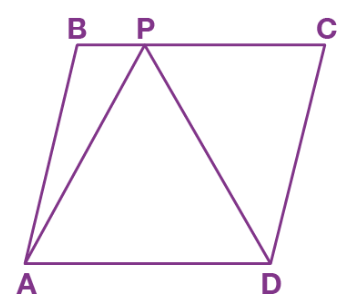
In the figure, $\text{ABCD}$ is a parallelogram and $\text{APD}$ is an equilateral triangle of side $80\ cm$, Calculate the area of parallelogram $\text{ABCD}.$
Image
Answer
$\operatorname{ar}(\triangle APD)=\frac{\sqrt{3} s ^2}{4}$
$\operatorname{ar}(\triangle APD)=\frac{\sqrt{3} \times 8^2}{4}$
$\operatorname{ar}(\triangle APD)=\frac{\sqrt{3} \times 64}{4}$
$\operatorname{ar}(\triangle APD)=\sqrt{3} \times 16=16 \sqrt{3} \ cm ^2$
$\operatorname{ar}(\triangle APD)=\frac{1}{2} \times \operatorname{ar}($parallelogram $\text{ABCD}) $
$($The area of a triangle is half that of a parallelogram on the same base and between the same parallels$)$
$\Rightarrow \operatorname{ar}($parallelogram $\text{ABCD})=2 \times \operatorname{ar}(\triangle APD)$
$\Rightarrow \operatorname{ar}($parallelogram $\text{ABCD})=2 \times 16 \sqrt{3} \ cm ^2$
$\Rightarrow \operatorname{ar}($parallelogram $\text{ABCD})=32 \sqrt{3} \ cm ^2$.
View full question & answer
Question 35 Marks
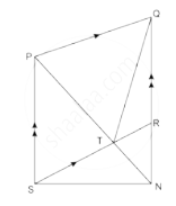
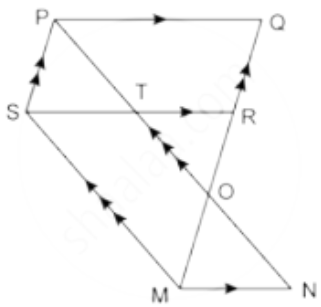
In the given figure, $\text{PQRS}$ is a $∥ gm$. A straight line through $P$ cuts $SR$ at point $T$ and $QR$ produced at $N$. Prove that area of $\triangle QTR$ is equal to the area of $\triangle STN.$
Image
Answer
$\triangle PQT$ and parallelogram $\text{PQRS}$ are on the same base $PQ$ and between the same parallel lines $PQ$ and $SR.$
$\therefore \Delta(\Delta PQT )=\frac{1}{2} A ($parallelogram $\text{PQRS}) \ldots...(i)$
$\triangle PSN$ and parallelogram $\text{PQRS}$ are on the same base $PS$ and between the same parallel lines $PS$ and $QN.$
$\therefore \Delta(\Delta P S N)=\frac{1}{2} A($parallelogram $\text{PQRS}) \ldots. (ii)$
Adding equations $(i)$ and $(ii),$ we get
$\therefore A(\triangle PQT) + A(\triangle PSN) = A($parallelogram $\text{PQRS})$
$\Rightarrow A(quad. \text{PSNQ}) - A(\triangle QTN) = A($parallelogram $\text{PQRS})$
$\Rightarrow A(quad. \text{PSNQ}) - A(\triangle QTN) = A(quad. \text{PSNQ}) - A(\triangle SRN)$
$\Rightarrow A(\triangle QTN = A(\triangle SRN)$
Subtracting $A(\triangle RTN)$ from both the sides, we get
$A(\triangle QTN) - A(\triangle RTN) = A(\triangle SRN) - A(\triangle RTN)$
$\Rightarrow A(\triangle QTR) = A(\triangle STN).$
View full question & answer
Question 45 Marks
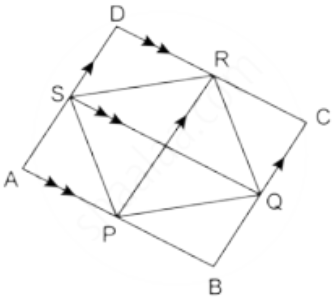
In the given figure, $A B \| S Q\| D C$ and $A D \| P R \| B C$. If the area of quadrilateral $\text{ABCD}$ is $24$ square units, find the area of quadrilateral $\text{PQRS}.$
Image
Answer
Image
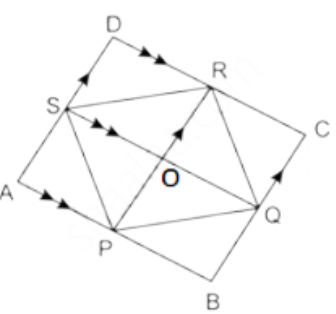
Let $S Q$ and $P R$ intersect at point $O$.
Now,
$D C \| S Q$ and $R P \| B C C$
$\Rightarrow R C \| O Q$ and $R O \| Q C$
$\Rightarrow$ Quadrilateral $\text{ROQC}$ is a parallelogram.
Similarly,
Quadrilateral $\text{ROSD, APOS}$ and $\text{POQB}$ are parallelograms.
$\triangle R O Q$ and parallelogram $\text{ROQC}$ are on the same base and between the same parallel lines.
$\therefore A(\triangle R O Q)=\frac{1}{2} \times A\left(\left.\right \|^{g m} \text{ROQC}\right)$
Similarly,
$A (\triangle POQ)=\frac{1}{2} \times A \left(\|^{9m} \text{POQB} \right)$
$A (\triangle SOR)=\frac{1}{2} \times A \left(\|^{ gm } \text{ROSD} \right)$
$A (\triangle POS)=\frac{1}{2} \times A \left(\|^{9m} \text{APOS} \right)$
Adding equations $(i), (ii), (iii)$ and $(iv),$ we get
$ A(\triangle R O Q)+A(\triangle P O Q)+A(\triangle P O S)+A(\triangle S O R)$
$=\frac{1}{2}\left[A\left(\|^{g m} \text{ROQC}\right)+A\left(\|^{g m} \text{POQB}\right)+A\left(\|^{g m} \text{APOS}\right)+A\left(\|^{g m} \text{ROSD}\right)\right]$
$=A\left(\|^{g m} \text{PQRS}\right)$
$=\frac{1}{2} \times A\left(\|^{g m} \text{ABCD}\right)$
$=\frac{1}{2} \times 24$
$=12 \text { sq.}$ units.
View full question & answer
Question 55 Marks
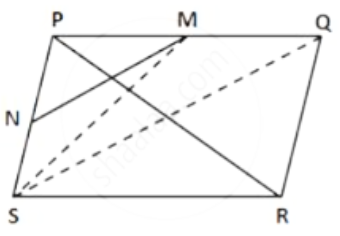
In a parallelogram $\text{PQRS, M}$ and $N$ are the midpoints of the sides $PQ$ and $PS$ respectively. If area of $\triangle PMN$ is $20$ square units, find the area of the parallelogram $\text{PQRS}.$
Answer
Construction: Join $SM$ and $SQ.$
Image
In a parallelogram $\text{PQRS, SQ}$ is the diagonal.
So, it bisects the parallelogram.
$\therefore$  Area $(\text{DPSQ})=\frac{1}{2} \times$ Area$($parallelogram $\text{PQRS})$
$S M$ is the median of $\triangle P S Q$.
$ \therefore$ Area$(\Delta PSM )=\frac{1}{2} \times$ Area$(\Delta PSQ)$
$=\frac{1}{2} \times \frac{1}{2} \times$ Area$($parallelogram $\text{PQRS})$
$=\frac{1}{4} \times$ Area$($parallelogram $\text{PQRS})$
Again, $M N$ is the median of $\triangle P S M$.
$\therefore$ Area$(\triangle PMN )=\frac{1}{2} \times$ Area$(\triangle PSM )$
$=\frac{1}{2} \times \frac{1}{4} \times$ Area$($parallelogram $\text{PQRS })$
$=\frac{1}{8} \times$ Area$($parallelogram $PQRS)$
$\Rightarrow 20=\frac{1}{8} \times$ Area$($parallelogram $\text{PQRS})$
$\Rightarrow$ Area$($parallelogram $\text{PQRS})=160$ square units.
View full question & answer
Question 65 Marks
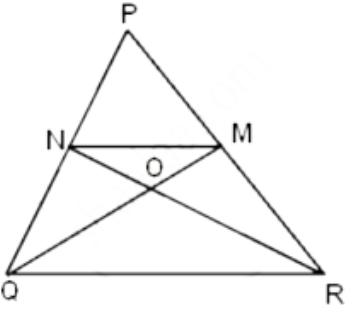
The medians $QM$ and $RN$ of $\triangle PQR$ intersect at $O.$ Prove that: area of $\triangle ROQ =$ area of quadrilateral $\text{PMON}.$
Answer
Image
Join $MN.$ Since the line segment joining the mid$-$points of two sides of a triangle is parallel to the third side; so, $M N \| Q R$
Clearly, $\triangle Q M N$ and $\triangle R N M$ are on the same base $M N$ and between the same parallel lines.
Therefore, $area(\triangle QMN )=$area$(\triangle RNM)$
$\Rightarrow$ area$(\triangle QMN )-$area$(\triangle ONM)=$area$(\triangle RNM)-$area$(\triangle ONM)$
$\Rightarrow$ area$(\triangle QON)=$area$(\triangle ROM)....(i)$
We know that a median of a triangle divides it into two triangles of equal areas.
Therefore, area$(\triangle QMR)=$area$(\triangle PQM)$
$\Rightarrow$ area$(\triangle R O Q)+$area$(\triangle R O M)=$area$(\text { quad, } \text{PMON})+$area$(\triangle Q O N)$
$\Rightarrow$ area$(\triangle R O Q)+$area$(\triangle R O M)=$area$(quad.\text { P M O N })+$area$(\triangle R O M) \ldots($from $(i))$
$\Rightarrow$ area$(\triangle R O Q)=$area$(quad.\text { PMON }) $
View full question & answer
Question 75 Marks
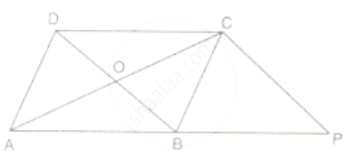
In the figure, $\text{ABCD}$ is a parallelogram and $C P$ is parallel to $D B$. Prove that: Area of $\text{OBPC}=\frac{3}{4}$ area of $\text{ABCD}$
Image
Answer
Since the diagonals of a parallelogram divide it into four triangles of equal area
Therefore, area of $\triangle A O D=$ area $\triangle B O C=$ area $\triangle A B O=$ area $\triangle C D O$.
$\Rightarrow$ area $\triangle B O C=\frac{1}{4}$ area( $\mid$ gm $\left.\text{ABCD}\right)$
In $\|$ gm $\text{ABCD, B D}$ is the diagonal
Therefore, area$(\triangle A B D)=$area$(\triangle B C D)$
$\Rightarrow$ area$(\triangle B C D)=\frac{1}{2}$area$(\| gm \text{ABCD})$
In $\| gm \text{BPCD, B C}$ is the diagonal
Therefore, area$(\triangle B C D)=$area$(\triangle B P C)$
From $(iii)$ and $(ii)$
$\Rightarrow$ area $(\triangle B P C)=\frac{1}{2}$ area(||$\left.gm \text{ABCD}\right)$
adding $(i)$ and $(iv)$
area$(\triangle B P C)+$area $\triangle B O C=\frac{1}{2}$area$(\| gm \text{ABCD})+\frac{1}{4} \operatorname{area}(\| gm \text{ABCD})$
Area of $\text{OBPC}=\frac{3}{4}$ area of $\text{ABCD}.$
View full question & answer
Question 85 Marks
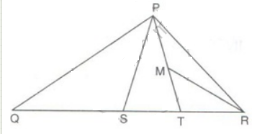
In $\triangle P Q R, P S$ is a median. $T$ is the mid$-$point of $S R$ and $M$ is the mid$-$point of $P T$. Prove that: $\triangle P M R=\frac{1}{8} \Delta PQR$
Image
Answer
Area$(\triangle PQR )=$Area$(\triangle PQS)+$Area$(\triangle PSR) \ldots(i)$
Since $P S$ is the median of $\triangle P Q R$ and median divides a triangle into two triangles of equal area.
Therefore, Area$(\triangle P Q S)=$Area$(\triangle P S R)$
Substituting in $(i)$
Area$(\triangle P Q R)=$Area$(\triangle P S R)+$Area$(\triangle P S R)$
Area $(\triangle P Q R)=2$ Area$(\triangle P S R) \ldots \ldots . (iii)$
Area$(\triangle P S R)=$Area$(\triangle P S T)+$Area$(\triangle P T R)$
Since $PT$ is the median of $\triangle P S R$ and median divides a triangle into triangles of equal area.
Therefore,Area$(\triangle P S T)=$Area$(\triangle P T R)$
Substituting in $(v)$
Area$(\triangle P S R)=2$ Area$(\triangle P T R)$
Substituting in $(iii)$
Area $(\triangle P Q R)=2 \times 2$ Area$(\triangle P T R)$
Area $(\triangle P Q R)=4$ Area$(\triangle P T R) ..(vii)$
Area$(\triangle P Q R)=$Area$(\triangle P M R)+$Area$(\triangle M T R)$
Since $MR$ is the median of $\triangle P T R$ and median divides a triangle into two triangles of equal area.
Therefore, Area$(\triangle P M R)=$Area$(\triangle M T R)$
Substituting in $(viii)$
Area $(\triangle P Q R)=4 \times 2$ Area$(\triangle P M R)$
Area$(\triangle PQR)=8 \times$ area $(\triangle PMR )$
Area$(\Delta PMR)=\frac{1}{8}$Area$(\Delta PQR)$
View full question & answer
Question 95 Marks
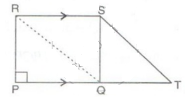
In the figure, $PT$ is parallel to $SR. \text{QTSR}$ is a parallelogram and $\text{PQSR}$ is a rectangle. If the area of $\triangle Q T S$ is $60 \ cm^2$, find:$(i)$ the area o $\| gm \ \text{QTSR};(ii)$ the area of the rectangle $\text{PQRS};(iii)$ the area of the triangle $PQS.$
Image ​​​​​​​
Answer
$(i)\operatorname{ar}(\triangle QTS )=\frac{1}{2} \times ar($parallelogram $\text{QTSR})$
$($The area of a triangle is half that of a parallelogram on the same base and between the same parallels$)$
$\Rightarrow \operatorname{ar}($parallelogram $\text{QTSR}) =2 \times \operatorname{ar}(\triangle QTS)$
$\Rightarrow \operatorname{ar}\left(\right.$ parallelogram $\text{QTSR}) =2 \times 60 \ cm ^2$
$\Rightarrow \operatorname{ar}\left(\right.$ parallelogram $\text{QTSR}) =120 \ cm ^2$
$(ii) \operatorname{ar}(\triangle QTS )=\frac{1}{2} \times \operatorname{ar}($ parallelogram $\text{QTSR})$
$\operatorname{ar}(\triangle QTS )=\operatorname{ar}(\triangle RSQ )=60 \ cm ^2$
Now,
$\operatorname{ar}(\triangle RSQ )=\frac{1}{2} \times \operatorname{ar}($rectangle $\text{PQRS})$
$\Rightarrow \operatorname{ar}($ rectangle $\text{PQRS})=2 \times \operatorname{ar}(\triangle R S Q)$
$\Rightarrow \operatorname{ar}($ rectangle $\text{PQRS})=2 \times 60 \ cm ^2$
$\Rightarrow \operatorname{ar}($ rectangle $\text{PQRS})=120 \ cm ^2$
$(iii)$ Since $\text{PQRS}$ is a rectangle,
Therefore $RS = PQ .....(i)$
$\text{QTSR}$ is a parallelogram,
Therefore, $RS = QT .$
From $(i)$ and $(ii)$
$P Q=Q T$
In $\triangle P S Q$ and $\triangle Q S T$
$Q S=Q S$
$PQ = QT \quad...($from $(iii))$
$\angle PQS =\angle SQT =90^{\circ}$
Therefore, $\triangle P S Q \cong \triangle Q S T$
Area of two congruent triangles is equal.
Hence, $\operatorname{ar}(\triangle PSQ )=\operatorname{ar}(\triangle QTS )=60 \ cm ^2$.
View full question & answer
Question 105 Marks
In the given figure, $PQ \| SR \| MN, PS \|| QM$ and $SM \| PN$. Prove that: $ar. (\text{SMNT}) = ar. (\text{PQRS).}$
Image
Answer
$SM \| PN$
$\Rightarrow SM \| TN$
Also, $SR \| MN$
$\Rightarrow ST \| MN$
Hence, $\text{SMNT}$ is a parallelogram.
$SM \| PN$
$\Rightarrow SM \| PO$
Also, $PS \| QM$
$\Rightarrow PS \| OM$
Hence, $\text{SMOP}$ is a parallelogram.
Now, parallelograms $\text{SMNT}$ and $\text{SMOP}$ are on the same base $SM$ and between the same parallels $SM$ and $PN.$
$\therefore A($parallelogram $\text{SMNT}) = A($parallelogram $\text{SMOP}) ….(i)$
Similarly, we can show that quadrilaterals $\text{PQRS}$ is a parallelogram.
Now, parallelograms $\text{PQRS}$ and $\text{SMOP}$ are on the same base $PS$ and between the same parallels $PS$ and $QM.$
$\therefore A($parallelogram $\text{PQRS}) = A($parallelogram $\text{SMOP}) ….(ii)$
From $(i)$ and $(ii)$, we have
$A($parallelogram $\text{SMNT}) = A($parallelogram $\text{PQRS}).$
View full question & answer
Question 115 Marks
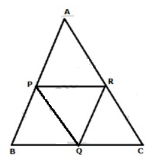
In $\triangle ABC$, the mid$-$points of $AB, BC$ and $AC$ are $P, Q$ and $R$ respectively. Prove that $\text{BQRP}$ is a parallelogram and that its area is half of $\triangle ABC.$
Answer
Image
Since $P$ and $R$ are mid$-$points of $A B$ and $A C$ respectively.
Therefore, $P R \| B C$ and $P R=\frac{1}{2} B C$
Also $Q$ is mid$-$point of $B C$,
$\Rightarrow QC =\frac{1}{2} BC$
From $(i)$ and $(ii)$
$P R \| B C$ and $P R=Q C$
$\Rightarrow P R \| Q C$ and $P R=Q C$
Similarly $Q$ and $R$ are mid$-$point of $B C$ and $A C$ respectively
Therefore, $Q R \| B P$ and $Q R=B P$
$\Rightarrow P Q$ is a digonal of $\| gm \text{BQRP}$
$\operatorname{ar}(\triangle P Q R)=\operatorname{ar}(\triangle B Q P) \ldots(v) ($diagonal of a llgm divides it into two triangles of equal areas$)$
Similarly $\text{QCRP}$ and $\text{QRAP}$ are $\| gm$ and
$\operatorname{ar}(\triangle P Q R)=\operatorname{ar}(\triangle QCR)=\operatorname{ar}(\triangle APR)$
From $(v)$ and $(vi)$
$\operatorname{ar}(\triangle P Q R)=\operatorname{ar}(\triangle B Q P)=\operatorname{ar}(\triangle Q C R)=\operatorname{ar}(\triangle APR)$
Now,
$\operatorname{ar}(\triangle ABC)=\operatorname{ar}(\triangle PQR)+\operatorname{ar}(\triangle B Q P)+\operatorname{ar}(\triangle QCR)+\operatorname{ar}(\triangle APR)$
$\Rightarrow \operatorname{ar}(\triangle A B C)=4 \operatorname{ar}(\triangle P Q R)$
$\Rightarrow \operatorname{ar}(\triangle PQR)=\frac{1}{4} \operatorname{ar}(\triangle ABC)$
$\operatorname{ar}(\| g m \text{BQRP})=\operatorname{ar}(\triangle P Q R)+\operatorname{ar}(\triangle B Q P)$
$\Rightarrow \operatorname{ar}(\| g m \text{BQRP})=\operatorname{ar}(\triangle P Q R)+\operatorname{ar}(\triangle P Q R) . .($from $(v))$
$\Rightarrow \operatorname{ar}(\| gm \text{BQRP})=2 \operatorname{ar}(\triangle PQR)$
$\Rightarrow \operatorname{ar}(\| g m \text{BQRP})=2 \times \frac{1}{4} \operatorname{ar}(\triangle A B C) \ldots($from $(vii))$
$\Rightarrow \operatorname{ar}(\| gm \text{BQRP})=\frac{1}{2} \operatorname{ar}(\triangle ABC)$
View full question & answer
Question 125 Marks
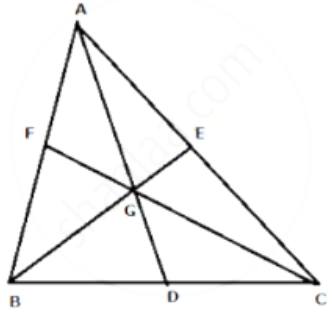
If the medians of a $\triangle A B B C$ intersect at $G$, show that $\operatorname{ar}(\triangle A G B)=\operatorname{ar}(\triangle A G C)=\operatorname{ar}(\triangle B G C)=\frac{1}{3} \operatorname{ar}(\triangle A B C)$.
Answer
Image
The median of a triangle divides it into two triangles of equal areas.
In $\triangle A B C, A D$ is the median
$\Rightarrow \operatorname{ar}(\triangle A B D)=\operatorname{ar}(\triangle A C D)$
In $\triangle G B C, G D$ is the medan
$\Rightarrow \operatorname{ar}(\triangle G B D)=\operatorname{ar}(\triangle G C D)$
Subtracting $(ii)$ and $(i),$
$\operatorname{ar}(\triangle A B D)-\operatorname{ar}(\triangle G B D)=\operatorname{ar}(\triangle A C D)-\operatorname{ar}(\triangle G C D) $
$\Rightarrow \operatorname{ar}(A G B)=\operatorname{ar}(\triangle A G C)$
Similarly, $\operatorname{ar}(\triangle A G B)=\operatorname{ar}(\triangle B G C)$
From $(iii)$ and $(iv),$
$\operatorname{ar}(\triangle AGB )=\operatorname{ar}(\triangle B G C)=\operatorname{ar}(\triangle AGC )$
But $\operatorname{ar}(\triangle A G B)=\operatorname{ar}(\triangle B G C)=\operatorname{ar}(\triangle A G C)=\operatorname{ar}(\triangle A B C)$
Therefore, $3 \operatorname{ar}(\triangle A G B)=\operatorname{ar}(\triangle A B C)$
$\Rightarrow \operatorname{ar}(\triangle AGB )=\frac{1}{3} \operatorname{ar}(\triangle ABC )$
Hence, $\operatorname{ar}(\triangle A G B)=\operatorname{ar}(\triangle A G C)=\operatorname{ar}(\triangle B G C)=\frac{1}{3} \operatorname{ar}(\triangle A B C)$.
View full question & answer
Question 135 Marks
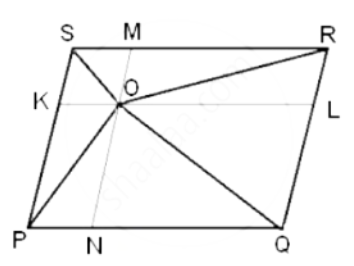
$\text{PQRS}$ is a parallelogram and $O$ is any point in its interior. Prove that: area$(\triangle POQ)+$area$(\triangle ROS)-$area$(\triangle QOR)+$area$(\triangle SOP)=\frac{1}{2}$ area$(\| gm\  \text{PQRS})$
Answer
Image
Let us draw a line segment $KL$, Passing through point $O$ and parallel to line segment $PQ$.
In parallelogram $PQRS$,
$PQ \| KL...($By construction$)$
$\text{PQRS}$ is a parallelogram.
$\therefore PS \| QR ...($Opposite sides of a parallelogram$)$
$\Rightarrow PK \| Ql$
From equation $(1)$ and $(2)$, we obtain
$PQ \| KL$ and $PK \| QL$
Therefore, quadrilateral $\text{PQLK}$ is a parallelogram.
It can be observed that $\triangle P O Q$ and parallelogram $\text{PQLK}$ are lying on the same base $P Q$ and between the same parallel lines $PK$ and $QL.$
$\therefore$ Area $(\triangle P O Q)=\frac{1}{2}$ Area $($parallelogram $\text{PQLK})$
Similarly, for $\triangle$ ROS and parallelogram $\text{KLRS},$
Area( $\triangle$ ROS) $=\frac{1}{2}$ Area $($parallelogram $\text{KLRS})$
Adding equations $(3)$ and $(4)$, we obtain
Area$(\triangle POQ )+$Area$(\triangle ROS )$
$=\frac{1}{2}$ Area $($parallelogramm $\text{PQLK}) +\frac{1}{2}$ Area $($parallelogram $\text{KLRS})$
Area$(\triangle POQ )+$Area$(\triangle ROS )=\frac{1}{2}$ Area$(\text{PQRS})$
Let us draw a line segment $M N$, passing through point $O P$ and parallel to line segment $P S$.
In parallelogram $\text{PQRS},$
$NN \| PS ...($By construction$) ...(6)$
$\text{PQRS}$ is a parallelogram.
$\therefore PQ \| RS...($Opposite sides of a parallelogram$)$
$\Rightarrow PN \| SN \ldots(7)$
From equations $(6)$ and $(7)$, we obtain
$MN \| PS$ and $PN \| SN$
Therefore, quadrilateral $\text{PNMS}$ is a parallelogram.
It can be observed that $\triangle POS$ and parallelogram $\text{PNMS}$ are lying on the same base $PS$ and between the same parallel lines $PS$ and $MN.$
$\therefore$ Area $(\triangle S O P)=\frac{1}{2}$ Area $(\text{PNMS})$
Similarly, for $\triangle Q O R$ and parallelogram $\text{MNQR}$,
Area $(\triangle QOR )=\frac{1}{2}$ Area $(\text{MNQR})$
Adding equations $(8)$ and $(9)$, we obtain
Area$(\triangle S O P)+$Area$(\triangle QOR )$
$=\frac{1}{2}$ Area $(\text{PNMS}) +\frac{1}{2}$ Area $(\text{MNQR})$
Area$(\triangle SOP )+$Area$(\triangle QOR )=\frac{1}{2}$ Area$(\text{PQRS})$
On comparing equation $(5)$ and $(10)$, we obtain
Area$(\triangle POQ )+$Area$(\triangle ROS )$
$=$Area$(\triangle S O P)+$Area$(\triangle Q O R)$
$=\frac{1}{2}$ Area $(\| gm\ \text{PQRS}):$
View full question & answer
Question 145 Marks
The diagonals of a parallelogram $\text{ABCD}$ intersect at $O$. $A$ line through $O$ meets $A B$ in $P$ and $C D$ in $Q$. Show that:$(a)$ Area of $\text{APQD}=\frac{1}{2}$ area of $\| gm\ \text{ABCD};(b)$ Area of $\text{APQD} =$ Area of $\text{BPQC}$
Answer
Image
$(a)$ A diagonal divides a parallelogram into two triangles of equal areas.
$\Rightarrow A (\triangle ADB )=\frac{1}{2} A (\| gm \text{ABCD})$
In $\triangle D O Q$ and $\triangle B O P$,
$\angle DOQ =\angle BOP...($Vertically opposite angles$)$
$DO = BO \quad...($Diagonals of a $\| gm$ bisect each other$)$
$\angle ODQ =\angle OBP...($Alternate angles$)$
$\therefore \triangle DOQ \cong \triangle BOP...(\text{ASA}$ test of congruency$)$
$\Rightarrow A (\triangle DOQ )= A (\triangle BOP )$
Adding $A(D O Q)$ on both sides, we get
$A(\triangle D O Q)+A(\text{DOPA})=A(\triangle B O P)+A(\text{DOPA})$
$\Rightarrow$ Area of $\text{APQD}=A(A D B)$
$\Rightarrow$ Area of $\text{APQD}=\frac{1}{2} A(\| gm\\text{ABCD}) [$From $(i)] ....(ii)$
$(b) A(\triangle A B C)=\frac{1}{2} A(\| gm\ \text{ABCD})$
In $\triangle C O Q$ and $\triangle A O P$,
$\angle C O Q=\angle A O P \ldots ($Vertically opposite angles$)$
$CCO = AO .. ($Diagonals of a $\| gm$ bisect each other$)$
$\angle OCQ =\angle OAP \ldots ($Alternate angles$)$
$\therefore \triangle C O Q \cong \triangle A O P...(\text{ASA}$ test of congruency$)$
$\Rightarrow A (\triangle COQ )= A (\triangle AOP )$
Adding $A(\text{COPB})$ on both sides, we get
$A(\triangle C O Q)+A(\text{COPB})=A(\triangle A O P)+A(\text{COPB})$
$\therefore$ Area of $B P Q C=A(A B C)$
$\Rightarrow$ Area of $B P Q C=\frac{1}{2} A(\| g m\ \text{ABCD})$
$\therefore$ Area of $\text{APQD} =$ Area of $\text{BPQC}. ...[$From $(ii)$ and $(iii)]$
View full question & answer
Question 155 Marks
In the given figure, $\triangle P Q R$ is right$-$angled at $P . \text{PABQ}$ and $\text{QRST}$ are squares on the side $P Q$ and hypotenuse $Q R$. If $P N \perp T S$, show that:$(a) \triangle Q R B \cong \triangle P Q T(b)$ Area of square $\text{PABQ} =$ area of rectangle $\text{QTNM}.$
Image
Answer
$\angle BQR =\angle BQP +\angle PQR$
$\Rightarrow \angle BQR =90^{\circ}+\angle PQR$
$\angle PQT =\angle TQR +\angle PQR$
$\Rightarrow \angle PQT =90^{\circ}+\angle PQR$
$\Rightarrow \angle BQR =\angle PQT$
$(a)$ In $\triangle Q R B$ and $\triangle P Q T$,
$ B Q=P Q....($sides of a square $\text {PABQ})$
$Q R=Q T ....($sides of a square $\text {QRST})$
$\angle B Q R=\angle P Q T . .[$From $(i)]$
$\therefore \triangle Q R B \cong \triangle P Q T ...($by $\text {SAS}$ congruence criterion$)$
$\Rightarrow A(\triangle B Q R)=A(\triangle P Q T) . . . \text { (ii) } $
$(b) \triangle P Q T$ and rect. $\text{QTNM}$ are on the same base $QT$ and between the same parallel lines $QT$ and $PN.$
$\therefore A (\triangle PQT)=\frac{1}{2} A ($ rect. $\text{QTNM})$
$ \Rightarrow A ($rect.$\text{QTMN})= \times A(\triangle PQT)$
$\Rightarrow A ($rect.$\text{QTMN})= \times \operatorname{ar}(\triangle BQR) \quad[$From $(ii)]....(iii)$
$\triangle B Q R$ and $sq. \text{PABQ}$ are on the same base $B Q$
and between the same parallel lines $B Q$ and $A R$.
$\therefore 2 \times A (\triangle BQR)= A (sq . PABQ )$
From $(i)$ and $(iv),$
$A( sq. \text{PABQ})=A($ rect. $\text{QTNM})$
View full question & answer
[5 marks sum] - MATHEMATICS STD 9 Questions - Vidyadip