Questions

[5 marks sum]

🎯

Test yourself on this topic

20 questions · timed · auto-graded

Question 15 Marks
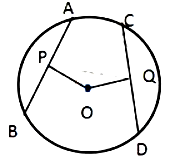
In the given figure, $AB$ and $CD$ are two equal chords of a circle, with centre $O$. If $P$ is the mid$-$point of chord $AB, Q$ is the mid$-$point of chord $CD$ and $\angle POQ = 150^\circ ,$ find $\angle APQ.$
​​​​​​​
Answer
It is given in the question that point.
$P$ is the mid-point of the chord $AB$ and Point $Q$ is the mid$-$point of the $CD.$
$\Rightarrow \angle APO = 90^\circ\dots ...($as the straight line drawn from the center of a circle to bisect a chord, which is not a diameter, is at the right angle to the chord.$)$
As chords, $AB$ and $CD$ are equal therefore they are equidistant from the center i.e;$ PO = OQ \dots...(\because $ Equal chords of a circle are equidistant from the center$)$
Now, the $\triangle POQ$ is an isosceles triangle with $OP = OQ$ as its two equal sides of an isosceles triangle.
The sum of all the angles of a triangle is $180^\circ .$
$\Rightarrow \angle POQ + \angle OPQ + \angle PQO = 180^\circ $
$\Rightarrow \angle OPQ + \angle POQ + 150^\circ = 180^\circ\dots ...($Given: $\angle POQ = 150^\circ)$
$\Rightarrow 2\angle OPQ = 180^\circ - 150^\circ\dots ...($As, $\angle OPQ = \angle PQO)$
$\Rightarrow 2\angle OPQ = 30^\circ $
$\Rightarrow \angle OPQ = 15^\circ $ As $\angle APO = 90^\circ $
$\Rightarrow \angle APQ + \angle OPQ = 90^\circ $
$\Rightarrow \angle APQ = 90^\circ - 15^\circ \dots....($As, $\angle OPQ = 15^\circ)$
$\Rightarrow \angle APQ = 75^\circ .$
View full question & answer
Question 25 Marks
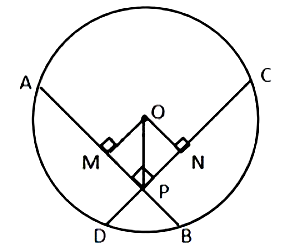
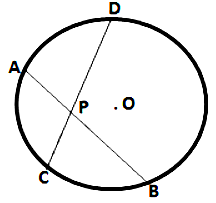
Given two equal chords $AB$ and $CD$ of a circle with center $O$, intersecting each other at point $P.$Prove that:$(i) AP = CP;(ii) BP = DP$
Answer

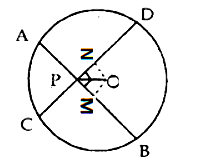
In $\triangle OMP$ and $\triangle ONP,$
$OP = OP \dots...($common sides$)$
$\angle OMP = \angle ONP \dots...($both are right angles$)$
$OM = OM \dots...($side both the chords are equal, so the distance of the chords from the centre are also equal$)$
$\triangle OMP \cong \triangle ONP \dots...(\text{RHS}$ congruence criterion$)$
$\Rightarrow MP = PN \dots...(\text{c.p.c.t }) \dots....(a)$
$(i)$ Since $AB = CD\dots ...($given$)$
$\Rightarrow AM = CN\dots ...($drawn from the centre to the chord bisects the chord$)$
$\Rightarrow AM + MP = CN + NP \dots.....($from $a)$
$\Rightarrow AP = CP \dots....(b)$
$ (ii)$ Since $AB = CD$
$\Rightarrow AP + BP = CP + DP$
$\Rightarrow BP = DP\dots....($from $b)$
Hence proved.
View full question & answer
Question 35 Marks
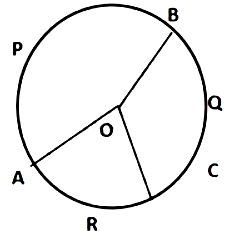
The circumference of a circle, with center $O$, is divided into three arcs $\text{APB, BQC}$, and $\text{CRA}$ such that:$\frac{\operatorname{arc} APB }{2}=\frac{\operatorname{arc} BQC }{3}=\frac{\operatorname{arc} CRA }{4}$Find $\angle BOC.$
Answer
From the given conditions given in the question
We can draw the circle with arc $\text{APB}$, arc $\text{BQC}$, and arc $\text{CRA}$
​​​​​​​
The given equation is
$\frac{\operatorname{arc} APB }{2}=\frac{\operatorname{arc} BQC }{3}=\frac{\operatorname{arc} CRA }{4}$
Let
$\frac{\operatorname{arc} APB }{2}=\frac{\operatorname{arc} BQC }{3}=\frac{\operatorname{arc} CRA }{4} = k ($say$)$
then
Arc $\text{APB} = 2k,$ Arc $\text{BQC} = 3k,$ Arc $\text{CRA} = 4k$
or
Arc $\text{APB} :$ Arc $\text{BQC} :$ Arc $\text{CRA} = 2 : 3 : 4$
$\Rightarrow \angle AOB : \angle BOC : \angle AOC = 2 : 3 : 4$
and therefore,
and $\angle AOB = 2k^\circ , \angle BOC = 3k^\circ$ and $\angle AOC = 4k^\circ$
Now,
Angle in a circle is $360^\circ$
So, $2k + 3k + 4k = 360^\circ$
$\Rightarrow 9k = 360^\circ$
$\Rightarrow k = 40^\circ$
Hence,
$\angle BOC = 3 \times 40^\circ = 120^\circ .$
View full question & answer
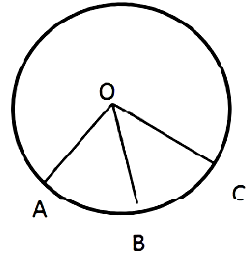
Question 45 Marks
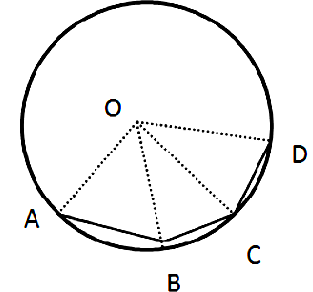
In the given figure, $AB = BC = DC$ and $\angle AOB = 50^\circ .(i) \angle AOC,(ii) \angle AOD,(iii) \angle BOD,(iv) \angle OAC,(v) \angle ODA$
​​​​​​​
Answer
Since arc $AB$ and $BC$ are equal.
So, $\angle AOB = \angle BOC = 50^\circ $
Now,
$\angle AOC = \angle AOB + \angle BOC = 50^\circ + 50^\circ = 100^\circ $
As arc $AB$, arc $BC$ and arc $CD$ so,
$\angle AOB = \angle BOC = \angle COD = 50^\circ $
$\angle AOD = \angle AOB + \angle BOC + \angle COD = 50^\circ + 50^\circ + 50^\circ = 150^\circ $
Now, $\angle BOD = \angle BOC + \angle COD$
$\angle BOD = 50^\circ + 50^\circ $
$\angle BOD = 100^\circ $
The triangle thus formed, $\triangle AOC$ is an isosceles triangle with $OA = OC$ as they are radii of the same circle.
Thus $\angle OAC = \angle OCA$ as they are opposite angles of equal sides of an isosceles triangle.
The sum of all the angles of a triangle is $180^\circ $
So, $\angle AOC + \angle OAC + \angle OCA = 180^\circ $
$2\angle OAC + 100^\circ = 180^\circ $ as, $\angle OAC = \angle OCA$
$2\angle OAC = 180^\circ - 100^\circ $
$2\angle OAC = 80^\circ $
$\angle OAC = 40^\circ $
as $\angle OCA = \angle OAC$ So,
$\angle OCA = \angle OAC = 40^\circ $
The triangle thus formed, $\triangle AOD$ is an isosceles triangle with $OA = OD$ as they are radii of the same circle.
Thus, $\angle OAD = \angle ODA$ as they are opposite angles of equal sides of an isosceles triangle.
The sum of all the angles of a triangle is $180^\circ $
So, $\angle AOD + \angle OAD + \angle ODA = 180^\circ $
$2\angle OAD + 150^\circ = 180^\circ $ as, $\angle OAD = \angle ODA$
$2\angle OAD = 180^\circ - 150^\circ $
$\angle OAD = 30^\circ $
as $\angle OAD = \angle ODA$ So,
$\angle OAD = \angle ODA = 15^\circ .$
View full question & answer
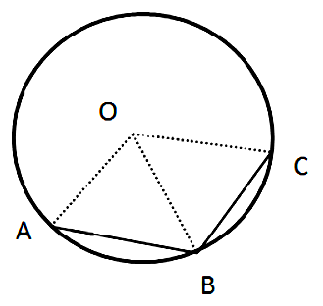
Question 55 Marks
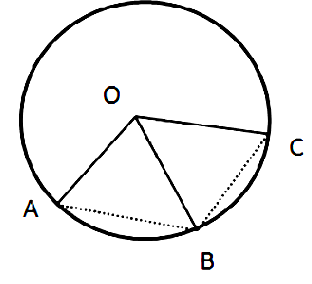
In the given figure, the lengths of arcs $AB$ and $BC$ are in the ratio $3:2.$ If $\angle AOB = 96^\circ $,find: $(i) \angle BOC ;(ii) \angle ABC$
Answer
We know that for two arcs are in ratio $3: 2$ then
$\angle AOB: \angle BOC = 3: 2$
As give $\angle AOC = 96^\circ $
So,$ 3x = 96$
$x = 32$
There $\angle BOC = 2 \times 32 = 64^\circ $
The triangle thus formed, $\triangle AOB$ is an isosceles triangle with $OA = OB$ as they are radii of the same circle.Thus $\angle OBA = \angle BAO$ as they are opposite angles of equal sides of an isosceles triangle.
The sum of all the angles of a triangle is $180^\circ $
So, $\angle AOB + \angle OBA + \angle BAO = 180^\circ $
$2\angle OBA + 96^\circ = 180^\circ $ as, $\angle OBA = \angle BAO$
$2\angle OBA = 180^\circ - 96^\circ $
$2\angle OBA = 84^\circ $
$\angle OBA = 42^\circ $
as, $\angle OBA = \angle BAO$ So,
$\angle OBA = \angle BAO = 42^\circ $
The triangle thus formed, $\triangle BOC$ is an isosceles triangle with $OB = OC$ as they are radii of the same circle.
Thus $\angle OBC = \angle OCB$ as they are opposite angles of equal sides of an isosceles triangle.
The sum of all the angles of a triangle is $180^\circ $
So, $\angle BOC + \angle OBC + \angle OCB = 180^\circ $
$2\angle OBC + 64^\circ = 180^\circ $ as, $\angle OBC = \angle OCB$
$2\angle OBC = 180^\circ - 64^\circ $
$2\angle OBC = 116^\circ $
$\angle OBC = 58^\circ $
As $\angle OBC = \angle OCB$ So,
$\angle OBC = \angle OCB = 58^\circ $
$\angle ABC = \angle BOA + \angle OBC = 42^\circ + 58^\circ = 100^\circ $
View full question & answer
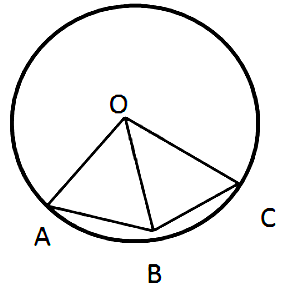
Question 65 Marks
In the given figure, arc $AB$ and arc $BC$ are equal in length. If $\angle AOB = 48^\circ $, find:$(i) \angle BOC;(ii) \angle OBC;(iii) \angle AOC;(iv) \angle OAC$
​​​​​​​
Answer
We know that the arc of equal lengths subtends equal angles at the center.

hence $\angle AOB = \angle BOC = 48^\circ $
Then $\angle AOC = \angle AOB + \angle BOC = 48^\circ + 48^\circ = 96^\circ $
The triangle thus formed, $\triangle BOC$ is an isosceles triangle with $OB = OC$ as they are radii of the same circle.Thus $\angle OBC = \angle OCB$ as they are opposite angles of equal sides of an isosceles triangle.
The sum of all the angles of a triangle is $180^\circ .$
So, $\angle BOC + \angle OBC + \angle OCB = 180^\circ $
$2\angle OBC + 48^\circ = 180^\circ $ as $\angle OBC = \angle OCB$
$2\angle OBC = 180^\circ - 48^\circ $
$2\angle OBC = 132^\circ $
$\angle OBC = 66^\circ $
as $\angle OBC = \angle OCB$
So,$ \angle OBC = \angle OCB = 66^\circ $
The triangle thus formed, $\triangle AOC $is an isosceles triangle with $OA = OC$ as they are radii of the same circle.
Thus $\angle OAC = \angle OCA $as they are opposite angles of equal sides of an isosceles triangle.
The sum of all the angles of a triangle is $180^\circ .$
So, $\angle COA + \angle OAC + \angle OCA = 180^\circ $
$2\angle OAC + 96^\circ = 180^\circ $ as, $\angle OAC = \angle OCA$
$2\angle OAC = 180^\circ - 96^\circ $
$2\angle OAC = 84^\circ $
$\angle OAC = 42^\circ $
as $\angle OCA = \angle OAC$
So, $\angle OCA = \angle OAC = 42^\circ .$
View full question & answer
Question 75 Marks
In the given figure, $AB$ is a side of regular pentagon and $BC$ is a side of regular hexagon.$(i) \angle AOB;(ii) \angle BOC;(iii) \angle AOC;(iv) \angle OBA;(v) \angle OBC;(vi) \angle ABC$
Answer
As given that $AB$ is the side of a pentagon the angle subtended by each arm of the pentagon at the center of the circle is = $\frac{360^{\circ}}{5}= 72^\circ$
Thus angle $\angle AOB = 72^\circ$
Similarly, as $BC$ is the side of a hexagon hence the angle subtended by $BC$ at the center is $= \frac{360^{\circ}}{6}$
i.e. $60^\circ$
$\angle BOC = 60^\circ$
Now $\angle AOC = \angle AOB + \angle BOC =72^\circ + 60^\circ = 132^\circ$
The triangle thus formed, $\triangle AOB$ is an isosceles triangle with $OA = OB$ as they are radii of the same circle.
Thus $\angle OBA = \angle BAO$ as they are opposite angles of equal sides of an isosceles triangle.
The sum of all the angles of a triangle is $180^\circ$
so, $\angle AOB + \angle OBA + \angle BAO = 180^\circ$
$\Rightarrow 2\angle OBA + 72^\circ = 180^\circ$ as, $\angle OBA = \angle BAO$
$\Rightarrow 2\angle OBA = 180^\circ - 72^\circ$
$\Rightarrow 2\angle OBA = 180^\circ$
$\Rightarrow 2\angle OBA =54^\circ$
as, $\angle OBA = \angle BAO$ So,
$\angle OBA = \angle BAO = 54^\circ$
The triangle thus formed, $\triangle BOC$ is an isosceles triangle with $OB = OC$ as they are radii of the same are.
Thus $\angle OBC = \angle OCB$ as they are opposite angles of equal sides of an isosceles triangle.
The sum of all the angles of a triangle is $180^\circ$
so,$ \angle BOC + \angle OBC + \angle OCB = 180^\circ$
$2\angle OBC + 60^\circ = 180^\circ$ as ,$ \angle OBC = \angle OCB$
$2\angle OBC = 180^\circ - 60^\circ$
$2\angle OBC = 120^\circ$
$\angle OBC = 60^\circ$
as $\angle OBC = \angle OCB$
So,$ \angle OBC = \angle OCB = 60^\circ$
$\angle ABC = \angle OBA + \angle OBC = 54^\circ + 60^\circ = 114^\circ$
View full question & answer
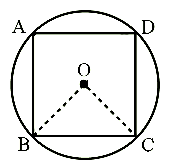
Question 85 Marks
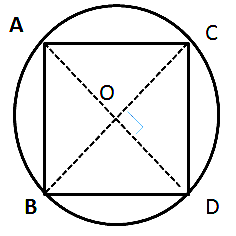
In the given figure, a square is inscribed in a circle with center $O$. Find:
  1. $∠BOC$
  2. $∠OCB$
  3. $∠COD$
  4. $∠BOD$
    Is $BD$ a diameter of the circle?
Answer
In the given figure we can extend the straight line $OB$ to $BD$ and $CO$ to $CA$.Then we get the diagonals of the square which intersect each other at $90$ by the property of Square.

From the above statement, we can see that
$\angle COD = 90^\circ $
The sum of the angle$ \angle BOC$ and $\angle COD$ is $180^\circ $ as $BD$ is a straight line.
Hence $\angle BOC + \angle OCD = \angle BOD = 180^\circ $
$\angle BOC + 90^\circ = 180^\circ $
$\angle BOC + 180^\circ - 90^\circ $
$\angle BOC = 90^\circ $
We can see that the $\text{OCB}$ is an isosceles triangle with sides $OB$ and $OC$ of EQual length as they are the radii of the same are.
In $\triangle OCB,$
$\angle OBC = \angle OCB$ as they are opposite angles to the two equal sides of an isosceles triangle.Sum of all the angles of a triangle is $180^\circ $
so, $\angle OBC + \angle OCB + \angle BOC =180^\circ $
$\angle OBC + \angle OBC + 90^\circ = 180^\circ $ as, $\angle OBC = \angle OCB$
$2\angle OBC = 180^\circ - 90^\circ $
$2\angle OBC = 90^\circ $
$2\angle OBC = 45^\circ $
as $\angle OBC = \angle OCB$ So,
$\angle OBC = \text{OCB} = 45^\circ $
Yes $BD$ is the diameter of the order.
View full question & answer
Question 95 Marks
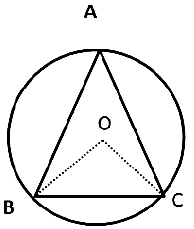
In the given figure, an equilateral $\triangle ABC$ is inscribed in a circle with center $O$.Find: $(i) \angle BOC;(ii) \angle OBC$
Answer
In the given figure, $\text{ABC}$ is an equilateral triangle.
Hence all the three angles of the triangle will be equal to $60^\circ $
i.e. $\angle A = \angle B = \angle C = 60^\circ $
As the triangle is an equilateral triangle, $BO$ and $CO$ will be the angle bisectors of $B$ and $C$ respectively.
Hence $\angle OBC = \frac{\angle ABC }{2}= 30^\circ $
and as given in the figure we can see that $OB$ and $OC$ are the radii of the given circle.
Hence they are of equal length.
The $\triangle OBC$ is an isosceles triangle with $OB = OC$
In $\triangle OBC,$
$\angle OBC = \angle OCB$ as they are angles opposite to the two equal sides of an isosceles triangle.
Hence, $\angle OBC = 30^\circ $ and $\angle OCB = 30^\circ $
Since the sum of all angles of a triangle is $180^\circ $
Hence in $\triangle OBC, \angle OCB + \angle OBC + \angle BOC + BOC = 180^\circ $
$30^\circ + 30^\circ + \angle BOC= 180^\circ $
$60^\circ + BOC = 180^\circ $
$\angle BOC = 180^\circ - 60^\circ $
$\angle BOC = 120^\circ $
Hence $\angle BOC =120^\circ $ and $\angle OBC =30^\circ $
View full question & answer
Question 105 Marks
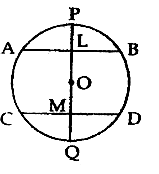
The line joining the midpoints of two chords of a circle passes through its center.Prove that the chords are parallel.
Answer

Given: $AB$ and $CD$ are the two chords of a circle with center $O.$
$L$ and $M$ are the mid$-$points of $AB$ and $CD$ and $O$ lies in the line joining $ML.$
To prove: $AB \| CD.$
Proof:
$AB$ and $CD$ are two chords of a circle with center $O.$
Line $\text{LOM}$ bisects them at $L$ and $M.$
Then,$OL \perp AB$
and, $OM \perp CD$
$\therefore \angle ALM = \angle LMD = 90^\circ $
But they are alternate angles
$\therefore AB \| CD.$
View full question & answer
Question 115 Marks
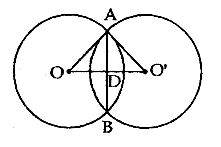
The length of the common chord of two intersecting circles is $30 \ cm$. If the diameters of these two circles are $50 \ cm$ and $34 \ cm$, calculate the distance between their centers.
Answer

$OA = 25 \ cm$ and $AB = 30 \ cm$
$\therefore AD =\frac{1}{2} \times AB =\left(\frac{1}{2} \times 30\right)cm = 15 \ cm$
Now in right angled $\text{ADO}$
$OA^2 + AD^2 + OD^2$
$\Rightarrow OD^2 = OA^2 - OD^2 = 25^2 - 15^2$
$= 625 - 225 = 400$
$\therefore OD =\sqrt{400} = 20 \ cm$
Again, we have $O\ 'A = 17 \ cm.$
In right$-$angle $\text{ADO}'$
$O'A^2 = A\ 'D^2 + O\ 'D^2$
$\Rightarrow O\ 'D^2 = O\ 'A^2 - AD^2$
$= 17^2 - 15^2$
$= 289 - 225 = 64$
$\therefore O\ 'D = 8 \ cm$
$\therefore OO\ ' = ( OD + O\ 'D )$
$= ( 20 + 8 ) = 28 \ cm$
$\therefore$ the distance between their centres is $28 \ cm.$
View full question & answer
Question 125 Marks
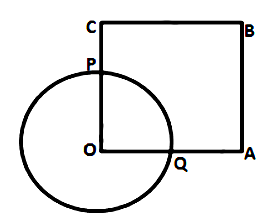
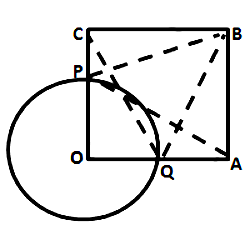
In the following figure, $\text{OABC}$ is a square. $A$ circle is drawn with $O$ as centre which meets $OC$ at $P$ and $OA$ at $Q$.Prove that:$(i) \triangle OPA \cong \triangle OQC;(ii) \triangle BPC \cong \triangle BQA$
​​​​​​​
Answer

$(i)$ In $\triangle OPA$ and $\triangle OQC,$
$OP = OQ\dots ....($radii of same circle$)$
$\angle AOP = \angle COQ\dots ... ($both $90^\circ )$
$OA = OC \dots... ($sides of the square$)$
By Side$-$ Angle$-$Side criterion of congruence.
$\therefore \triangle OPA \cong \triangle OQC ...($by $\text{SAS})$
$(ii)$ Now, $OP = OQ \dots...($radii$)$
and $OC = OA\dots ...($sides of the square$)$
$\therefore OC - OP = OA - OQ$
$\Rightarrow CP = AQ\dots ....(i)$
In $\triangle BPC$ and $\triangle BQA,$
$BC = BA \dots...($sides of the square$)$
$\angle PCB = \angle QAB\dots ...($both $90^\circ )$
$PC = QA\dots ...($by $(i))$
By Side$-$ Angle$-$Side criterion of congruence,
$\therefore \triangle BPC \cong \triangle BQA\dots ...($by $\text{SAS})$
View full question & answer
Question 135 Marks
Two equal chords $A B$ and $C D$ of a circle with center $O$, intersect each other at point $P$ inside the circle.Prove that: $(i) AP = CP; (ii) BP = DP$
Answer
Drop $O M$ and $O N$ perpendicular on $A B$ and $C D$. Join $OP, OB$, and $OD.$

$\therefore OM$ and $ON$ bisect $AB$ and $CD$ respectively$\dots.....($ Perpendicular drawn from the centre of a circle to a chord bisects it. $)$
$\therefore MB = =\frac{1}{2} AB =\frac{1}{2} CD = ND \ldots (i)$
In right $\triangle OMB,$
$OM^2 = OB^2 - MB^2\dots....(ii)$
In right $\triangle OND,$
$ON^2 = OD^2 - ND^2\dots ....(iii)$
From $(i), (ii),$ and $(iii),$
$OM = ON$
In $\triangle OPM$ and $\triangle OPN,$
$\angle OMP = \angle ONP\dots....($ both $90^\circ)$
$OP = OP\dots...($common$)$
$OM = ON\dots ....($proved above$)$
By Right Angle$-$Hypotenuse$-$Side criterion of congruence,
$\therefore \triangle OPM \cong \triangle OPN ....($by $\text{RHS})$
The corresponding parts of the ongruent triangles are congruent.
$\therefore PM = PN\dots ....(\text{c.p.c.t.})$
Adding $(i)$ to both sides,
$MB + PM = ND + PN$
$\Rightarrow BP = DP$
Now, $AB = CD$
$\therefore AB - BP = CD - DP\dots...( \because BP = DP )$
$\Rightarrow AP = CP.$
View full question & answer
Question 145 Marks
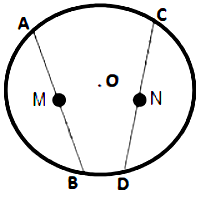
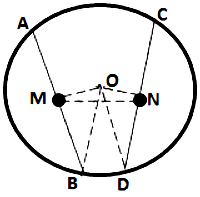
$M$ and $N$ are the mid$-$points of two equal chords $AB$ and $CD$ respectively of a circle with center $O.$Prove that: $(i) \angle BMN = \angle DNM;(ii) \angle AMN = \angle CNM$
​​​​​​​
Answer

Drop $OM \perp AB$ and $ON \perp CD.$
$\therefore OM$ bisects $AB$ and $ON$ bisects $CD\dots. ...($Perpendicular drawn from the centre of a circle to a chord bisects it.$)$
$\Rightarrow BM = \frac{1}{2} AB =\frac{1}{2} CD = DN\dots ....(1)$
Applying Pythagoras theorem,
$OM^2 = OB^2 - BM^2$
$= OD^2 - DN^2\dots....$(By $1)$
$= ON^2$
$\therefore OM = ON$
$\Rightarrow \angle OMN = \angle ONM\dots ....(2)$
$($Angles opp to equal sides are equal.$)$
$(i) \angle OMB = \angle OND \dots.....($both $90^\circ )$
Subtracting $(2)$ from above,
$\angle BMN = \angle DNM$
$(ii) \angle OMA = \angle ONC \dots.....($both $90^\circ )$
Adding $(2)$ to above,
$\angle AMN = \angle CNM.$
View full question & answer
Question 155 Marks
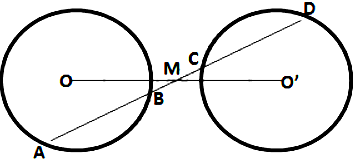
A straight line is drawn cutting two equal circles and passing through the mid$-$point $M$ of the line joining their centers $O$ and $O'$. Prove that the chords $AB$ and $CD,$ which are intercepted by the two circles, are equal.
Answer

Given: A straight line $AD$ intersects two circles of equal radii at $A, B, C$ and $D.$
The line joining the centers $OO\ '$ intersect $AD$ at $M$ and $M$ is the midpoint of $OO\ '.$
To Prove: $AB = CD$.
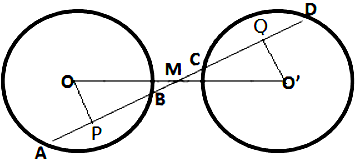
Construction: From $O$, draw $OP \perp AB$ and from $O\ '$, draw $O\ 'Q \perp CD.$
Proof:
In $\triangle OMP$ and $\triangle O\ 'MQ,$
$\angle OMP = \angle O\ ' MQ\dots ...($Vertically Opposite angles$)$
$\angle OPM = \angle O\ ' QM \dots...($each $= 90^\circ)$
$OM = O'M ...($ Given $)$
By Angle$-$Angle$-$Side criterion of congruence,
$\therefore \triangle OMP \cong \triangle O\ 'MQ, ...($by $\text{AAS})$
The corresponding parts of the congruent triangles are congruent.
$\therefore OP = O\ 'Q\dots ...(\text{c.p.c.t.})$
We know that two chords of a circle or equal circles which are equidistant from the center are equal.
$\therefore AB = CD.$
View full question & answer
Question 165 Marks
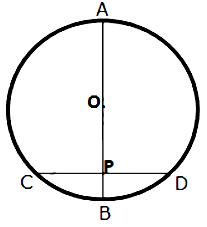
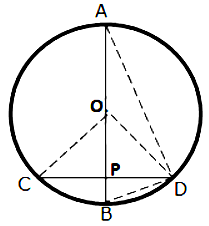
$A$ chord $C D$ of a circle whose center is $O$ is bisected at $P$ by a diameter $A B$. Given $O A=O B=15 \ cm$ and $O P=9 \ cm$. Calculate the lengths of: $(i)C D;(ii) A D:(iii)C B$.
Answer

$(i) OP \perp CD$
$\therefore OP$ bisects $CD\dots. ....($ Perpendicular drawn from the centre of a circle to a chord bisects it. $)$
$\Rightarrow CP =$
$\frac{C D}{2}$
In right $\triangle OPC,$
$OC^2 = OP^2 + CP^2$
$\Rightarrow CP^2 = OC^2 - OP^2$
$\Rightarrow 15^2 - 9^2 = 144$
$\therefore CP = 12 \ cm$
$\therefore CD = 12 \times 2 = 24 \ cm$
$(ii)$ Join $BD,$
$\therefore BP = OB - OP = 15 - 9 = 6 \ cm.$
In right $\triangle BPD,$
$BD^2 = BP^2 + PD^2$
$= 6^2 + 12^2 = 180$
In $\triangle ADB,$
$\angle ADB = 90^\circ\dots ...($ Angle in a semi$-$circle is a right angle$)$
$\therefore AB^2 = AD^2 + BD^2$
$\Rightarrow AD^2 = AB^2 - BD^2$
$= 30^2 - 180 = 720$
$\therefore AD =$
$\sqrt{720} = 26.83 \ cm$
$(iii)$ Also, $BC = BD = \sqrt{180}=13.42 \ cm.$
View full question & answer
Question 175 Marks
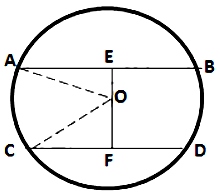
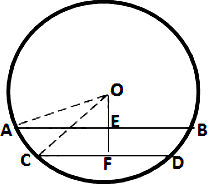
Two parallel chords are drawn in a circle of diameter $30.0 \ cm$. The length of one chord is $24.0 \ cm$ and the distance between the two chords is $21.0 \ cm;$find the length of another chord.
Answer
Since the distance between the chords is greater than the radius of the circle $(15 \ cm),$
so the chords will be on the opposite sides of the center.

Let $O$ be the center of the circle and $A B$ and $C D$ be the two parallel chords such that $A B=24 \ cm$.
 Let the length of the $C D$ be $2 x \ cm$.
Drop $O E$ and $O F$ perpendicular on $A B$ and $C D$ from the center $O$.
$O E \perp A B$ and $O F \perp C D$
$\therefore OE$ bisects AB and OF bisects $CD . \ldots. ($Perpendicular drawn from the center of a circle to a chord bisects it.$)$
$\Rightarrow AE = \frac{24}{2} = 12 \ cm ;$
$CF = \frac{2 x}{2} = x \ cm$
In right $\triangle OAE,$
$OA^2 = OE^2 + AE^2$
$\Rightarrow OE^2 = OA^2 - AE^2 = 15^2 - 12^2 = 81$
$\therefore OE = 9 \ cm$
$\therefore OF = EF - OE = 21 - 9 = 12 \ cm$
In right $\triangle OCF,$
$OC^2 = OF^2 + CF^2$
$\Rightarrow x^2 = OC^2 - OF^2 = 15^2 - 12^2 = 81$
$\therefore x = 9 \ cm$
Hence, length of chord $CD = 2x = 2 \times 9 = 18 \ cm.$
View full question & answer
Question 185 Marks
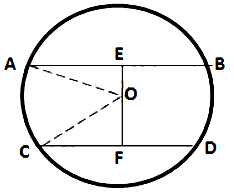
In a circle of radius $17 \ cm$, two parallel chords of lengths $30 \ cm$ and $16 \ cm$ are drawn. Find the distance between the chords,if both the chords are:$(i)$ on the opposite sides of the centre;$(ii)$ on the same side of the centre.
Answer
Let $O$ be the center of the circle and $AB$ and $CD$ be the two parallel chords of length $30 \ cm$ and $16 \ cm$ respectively.
Drop $OE$ and $OF$ perpendicular on $AB$ and $CD$ from the center $O.$

$OE \perp AB$ and $OF \perp CD.$
$\therefore OE$ bisects $AB$ and $OF$ bisects $CD\dots. ...($Perpendicular is drawn from the centre of a circle to a chord bisects it.$)$
$\Rightarrow AE =\frac{30}{2} = 15 \ cm;$
$CF = \frac{16}{2}= 8 \ cm$
In right $\triangle OAE,$
$OA^2 = OE^2 + AE^2$
$\Rightarrow OE^2 = OA^2 - AE^2 = 17^2 - 15^2 = 64$
$\therefore OE = 8 \ cm$
In right $\triangle OCF,$
$OC^2 = OF^2 + CF^2$
$\Rightarrow OF^2 = OC^2 - CF^2 = 17^2 - 8^2 = 225$
$\therefore OF = 15 \ cm$
$(i)$ The chord are on the opposite sides of the centre :
$\therefore EF = EO + OF = 8 + 15 = 23\ cm$
$(ii)$ The chord are on the same side of the centre :
$\therefore EF = OF - OE = 15 - 8 = 7 \ cm.$
View full question & answer
Question 195 Marks
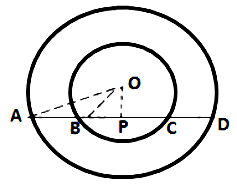
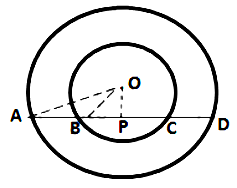
In the following figure, $A D$ is a straight line, $O P \perp A D$ and $O$ is the centre of both circles. If $O A=34 \ cm, O B=20 \ cm$ and $O P=16 \ cm$;find the length of $AB.$
Answer

For the inner circle, $BC$ is a chord and $OP \perp BC.$
We know that the perpendicular to a chord, from the center of a circle, bisects the chord.
$\therefore BP = PC$
By Pythagoras theorem,
$OB^2 = OP^2 + BP^2$
$\Rightarrow BP^2 = 20^2 - 16^2 = 144$
$\therefore BP = 12 \ cm$
For the outer circle,$ AD$ is the chord and $OP \perp AD.$
We know that the perpendicular to a chord, from the center of a circle, bisects the chord.
$\therefore AP = PD$
By Pythagoras Theorem,
$OA^2 = OP^2 + AP^2$
$\Rightarrow AP^2 = (34)^2 - (16)^2= 900$
$\Rightarrow AP = 30 \ cm$
$AB = AP - BP = 30 - 12 = 18 \ cm$
View full question & answer
Question 205 Marks
A chord of length $24 \ cm$ is at a distance of $5 \ cm$ from the center of the circle. Find the length of the chord of the same circle which is at a distance of $12 \ cm$ from the center.
Answer
Let $AB$ be the chord of length $24\ cm$ and $O$ be the center of the circle.
Let $OC$ be the perpendicular drawn from $O$ to $AB.$
We know, that the perpendicular to a chord, from the center of a circle, bisects the chord.
$\therefore AC = CB = 12 \ cm$
In $OCA$,
$OA^2 = OC^2 + AC^2\dots ....($By Pythagoras theorem$)$
$=(5)^2 + ( 12 )^2 = 169$
$\Rightarrow OA = 13 \ cm$
$\therefore$ radius of the circle = $13 \ cm$.
Let $A\ ' B\ '$ be the new chord at a distance of $12 \ cm$ from the center.
$\therefore ( OA\ ' )^2 = ( OC\ ' )^2 + ( A\ 'C\ ' )^2$
$\Rightarrow ( A\ 'C\ ' )^2 = ( 13 )^2 - ( 12 )^2 = 25$
$\therefore A\ 'C\ ' = 5 \ cm$
Hence, length of the new chord =$2 \times 5 = 10 \ cm$.
View full question & answer
[5 marks sum] - MATHEMATICS STD 9 Questions - Vidyadip