Question 15 Marks
Draw the graph of the line $x + y = 5$. Use the graph paper drawn to find the inclination and the $y-$intercept of the line.
AnswerGiven line is
$x + y = 5$
The graph of the given line is shown below.
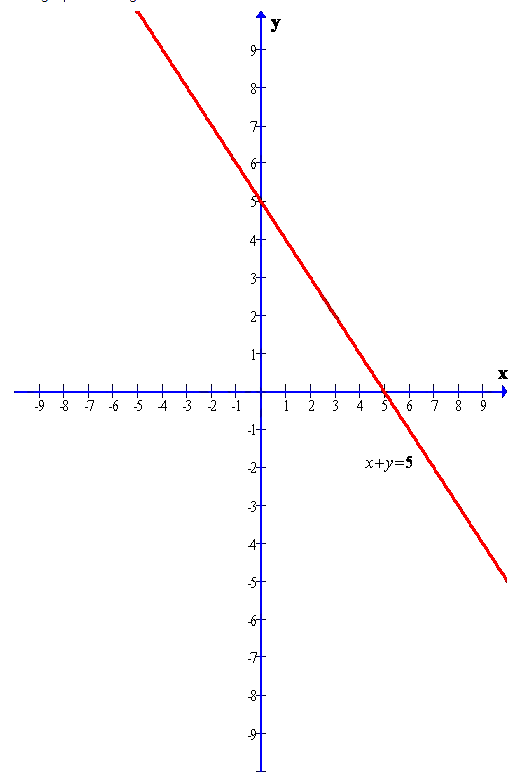
From the given line $x + y = 5$, we get
$x + y = 5$
$y = - x + 5$
$y = (-1) . x + 5\dots .......(A)$
Again we know that equation of any straight line in the form $y = mx + c$,
where m is the gradient and $c$ is the intercept.
Again we have if slope of a line is $\tan \theta $ then inclination of the line is $\theta $
Now from the equation $(A)$, we have
$m = - 1$
$\tan \theta = - 1$
$\tan \theta = \tan 135^\circ $
$\theta = 135^\circ $
And $c = 5$
$Therefore$ the required inclination is $\theta = 135^\circ $ and $y-$intercept is $c = 5$ View full question & answer→Question 25 Marks
For the pair of linear equations given below, draw graphs and then state, whether the lines drawn are parallel or perpendicular to each other.$2x - 3y = 6;\frac{x}{2}+\frac{y}{3}=1$
AnswerTo draw the graph of $2x - 3y = 6$ and $\frac{x}{2}+\frac{y}{3}=1$ follows the steps:
First prepare a table as below:
| $X$ |
$-1$ |
$0$ |
$1$ |
| $Y=\frac{2}{3} \times 2$ |
$-\frac{8}{3}$ |
$-2$ |
$-\frac{4}{3}$ |
| $Y=-\frac{3}{2} \times+3$ |
$\frac{9}{2}$ |
$3$ |
$\frac{3}{2}$ |
Now sketch the graph as shown:
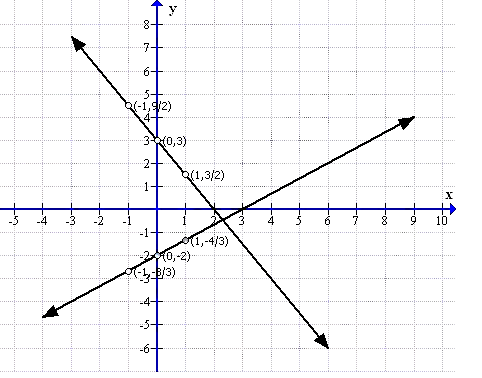
From the graph it can verify that the lines are perpendicular. View full question & answer→Question 35 Marks
Use the graphical method to show that the straight lines given by the equations $x + y = 2, x - 2y = 5$ and $\frac{x}{3}+y=0$ pass through the same point.
AnswerThe equations can be written as follows:
$y = 2 - x$
$ y =\frac{1}{2}(x-5)$
$y =-\frac{x}{3}$
First prepare a table as follows:
| $X$ |
$Y = 2 - x$ |
$Y=\frac{1}{2}(x-5)$ |
$Y =-\frac{x}{3}$ |
| $- 1$ |
$3$ |
$- 3$ |
$\frac{1}{3}$ |
| $0$ |
$2$ |
$-\frac{5}{2}$ |
$0$ |
| $1$ |
$1$ |
$- 2$ |
$-\frac{1}{3}$ |
Thus the graph can be drawn as follows:
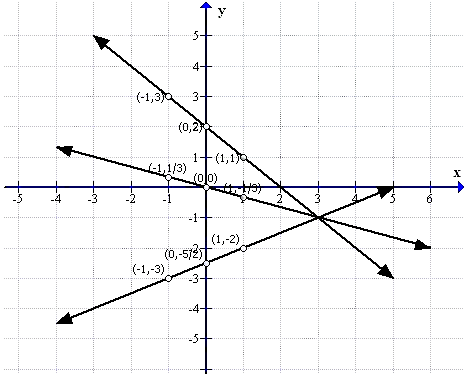
From the graph it is clear that the equation of lines are passes through the same point. View full question & answer→Question 45 Marks
$A (-2, 4),C(4, 10)$ and $D(-2, 10)$ are the vertices of a square $\text{ABCD}$. Use the graphical method to find the co$-$ordinates of the fourth vertex $B$. Also, find:$(i)$ The co$-$ordinates of the mid$-$point of $BC;(ii)$ The co$-$ordinates of the mid$-$point of $CD$ and $(iii)$ The co$-$ordinates of the point of intersection of the diagonals of the square $\text{ABCD}.$
AnswerGiven $A(-2, 4), C(4,10)$ and $D(-2,10)$ are the vertices of a square $\text{ABCD}$
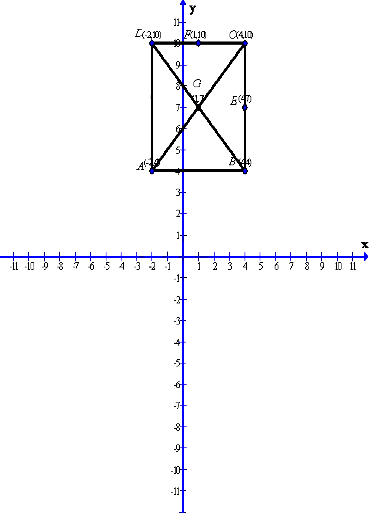
After plotting the given points $A(- 2, 4), C(4,10)$ and $D(- 2,10)$ on a graph paper;
joining $D$ with $A$ and $D$ with $C$.
Now complete the square $\text{ABCD}$
As is clear from the graph $B(4, 4)$
Now from the graph we can find the midpoints of the sides $BC$ and $CD$ the co$-$ordinates of the diagonals of the square.
Therefore the coordinates of the mid$-$point of $BC$ is $E(4, 7)$ and the coordinates of the mid$-$point of $CD$ is $F(1,10)$ and the coordinates of the diagonals of the square is $G(1, 7).$ View full question & answer→Question 55 Marks
$A (- 2, 2), B(8, 2)$ and $C(4, - 4)$ are the vertices of a parallelogram $\text{ABCD}$.
By plotting the given points on a graph paper; find the co$-$ordinates of the fourth vertex $D$.
Also, form the samegraph,state the co$-$ordinates of the mid$-$points of the sides $AB$ and $CD$.
AnswerPlot the points $A, B,$ and $C$ on the graph paper.
Join the points to complete the parallelogram $\text{ABCD}$.
As the distance between points $A$ and $B$ is $10$ units,
distance between the corners of the opposite side $C$ and $D$ will also be $10$ units.
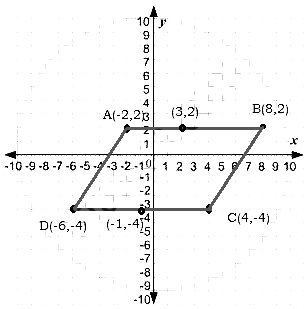
Hence, the fourth point $D = (- 6, - 4)$
Mid point of $AB$ will lie at $5$ units distance from $A$ and $B$ both which is $= (3, 2)$
Mid point of $CD$ will lie at $5$ units distance from $C$ and $D$ both which is $= (-1, -4)$ View full question & answer→Question 65 Marks
In the following, the coordinates of the three vertices of a rectangle $\text{ABCD}$ are given. By plotting the given points; find, in case, the coordinates of the fourth vertex:$B (10, 4),C(0, 4)$ and $D(0, -2).$
Answer$B(10, 4),C(0, 4)$ and $D(0, -2)$
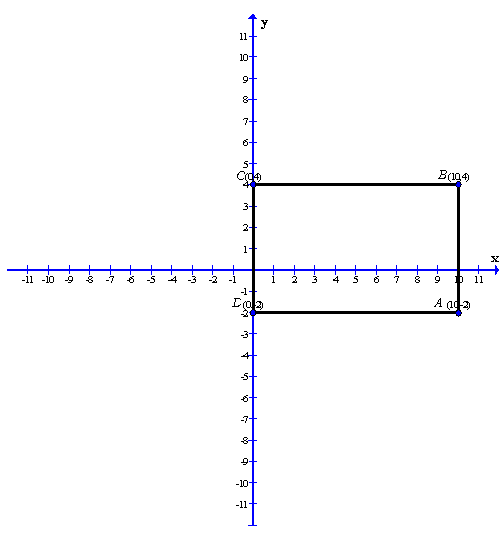
After plotting the given points $B(10, 4), C(0, 4)$ and $D(0, - 2)$ on a graph paper;
joining $C$ with $B$ and $C$ with $D$.
From the graph it is clear that the vertical distance between the points $C(0, 4)$ and $D(0, - 2)$ is $6$ units and the horizontal distance between the points $C(0, 4)$ and $D(0, - 2)$ is $10 $units,
$\therefore$ the vertical distance between the points $B (10, 4)$ and $A$ must be $6$ units and the horizontal distance between the points $D(0, - 2)$ and $A$ must be $10$ units.
Now complete the rectangle $\text{ABCD}$
As is clear from the graph $A(10, - 2).$ View full question & answer→Question 75 Marks
In the following, the coordinates of the three vertices of a rectangle $\text{ABCD}$ are given. By plotting the given points; find, in case, the coordinates of the fourth vertex:$A (- 4, - 6), C(6, 0)$ and $D(- 4, 0).$
Answer$A (- 4, - 6), C(6, 0)$ and $D(- 4, 0)$
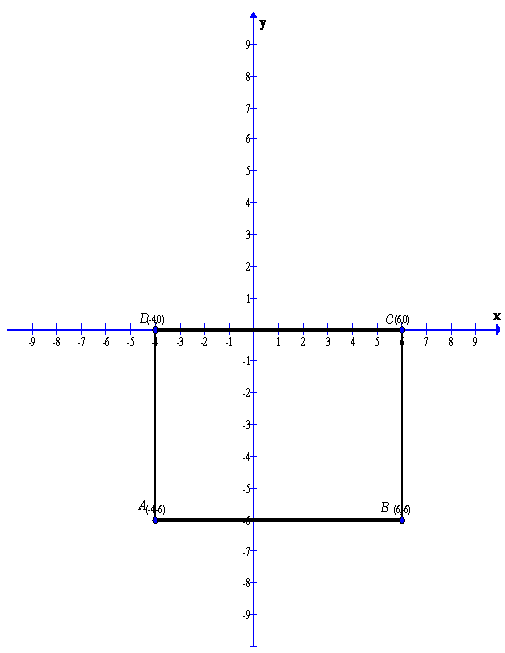
After plotting the given points $A(- 4, - 6), C(6, 0)$ and $D(- 4, 0)$ on a graph paper;
joining $D$ with and $A$ with $C$.
From the graph it is clear that the vertical distance between the points $D( - 4, 0)$ and $A(- 4, - 6)$ is $6$ units and the horizontal distance between the points $D(- 4, 0)$ and $C(6, 0)$ is $10$ units,
$\therefore$ the vertical distance between the points $C(6, 0)$ and $B$ must be $6$ units and the horizontal distance between the points $A(- 4, - 6)$ and $B$ must be $10$ units.
Now complete the rectangle $\text{ABCD}$
As is clear from the graph $B(6, - 6)$ View full question & answer→Question 85 Marks
In the following, the coordinates of the three vertices of a rectangle $\text{ABCD}$ are given. By plotting the given points; find, in case, the coordinates of the fourth vertex:$A (4, 2),B(-2, 2)$ and $D(4, -2).$
Answer$A(4,2), B(-2,-2)$ and $D(4,-2)$
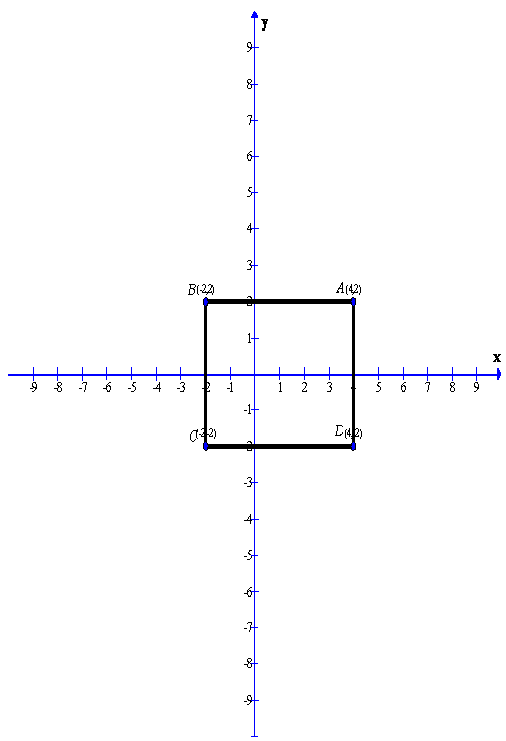
After plotting the given points $A(4,2), B(-2,2)$ and $D(4,-2)$ on a graph paper;
joining $A$ with $B$ and $A$ with $D$.
From the graph it is clear that the vertical distance between the points $A(4,2)$ and $D(4,-2)$ is $4$ units and the horizontal distance between the points $A(4,2)$ and $B(-2,2)$ is $6$ units,
$\therefore$ the vertical distance between the points $B(-2,2)$ and $C$ must be $4$ units and the horizontal distance between the points $B(-2,2)$ and $C$ must be $6$ units.
Now complete the rectangle $\text{ABCD}$
As is clear from the graph $C(-2,2)$ View full question & answer→Question 95 Marks
In the following, the coordinates of the three vertices of a rectangle $\text{ABCD}$ are given. By plotting the given points; find, in case, the coordinates of the fourth vertex:$A(2, 0), B(8, 0)$ and $C(8, 4).$
Answer$A(2, 0), B(8, 0)$ and $C(8, 4).$
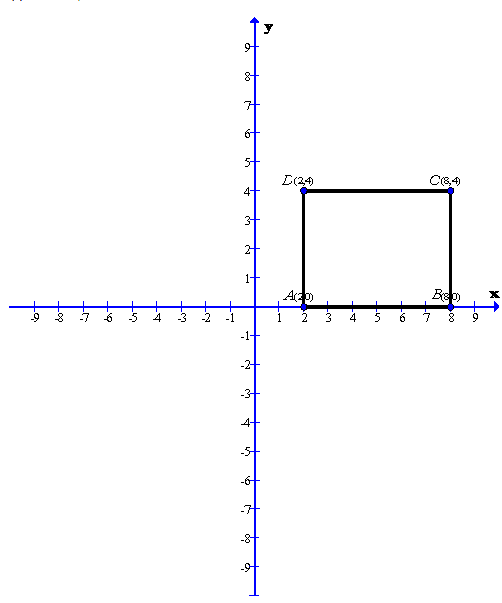
After plotting the given points $A(2,0), B(8,0)$ and $C(8,4$) on a graph paper;
joining Awith Band Bwith $C$.
From the graph it is clear that the vertical distance between the points $B(8,0)$ and $C(8,4)$ is $4$ units,
$\therefore$ the vertical distance between the points $A(2,0)$ and $D$ must be $4$ units.
Now complete the rectangle $\text{ABCD}$
As is clear from the graph $D(2,4)$ View full question & answer→Question 105 Marks
Use the graph given alongside, to find the coordinates of the point $(s)$ satisfying the given condition:
$(i)$ The abscissa is $2.(ii)$The ordinate is $0.(iii)$ The ordinate is $3.(iv)$ The ordinate is $-4.(v)$ The abscissa is $5.(vi)$ The abscissa is equal to the ordinate.$(vii)$ The ordinate is half of the abscissa.
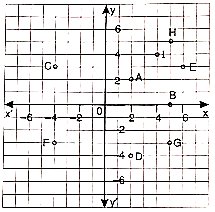
Answer$(i)$ The abscissa is $2$
Now using the given graph the co$-$ordinate of the given point Ais given by $(2,2)$
$(ii)$ The ordinate is $0$
Now using the given graph the co$-$ordinate of the given point Bis given by $(5,0)$
$(iii)$ The ordinate is $3$
Now using the given graph the co$-$ordinate of the given point $C$ and $E$ is given by $(- 4, 3) (6, 3)$
$(iv)$The ordinate is $-4$
Now using the given graph the co$-$ordinate of the given point $D$ is given by $( 2,- 4)$
$(v)$ The abscissa is $5$
Now using the given graph the co$-$ordinate of the given point $H, B$ and $G$ is given by $(5, 5),(5, 0) (5, -3)$
$(vi)$The abscissa is equal to the ordinate.
Now using the given graph the co$-$ordinate of the given point I, $A H$ is given by $(4, 4),(2, 2) (5, 5)$
$(vii)$The ordinate is half of the abscissa
Now using the given graph the co$-$ordinate of the given point $E$ is given by $(6, 3)$
View full question & answer→Question 115 Marks
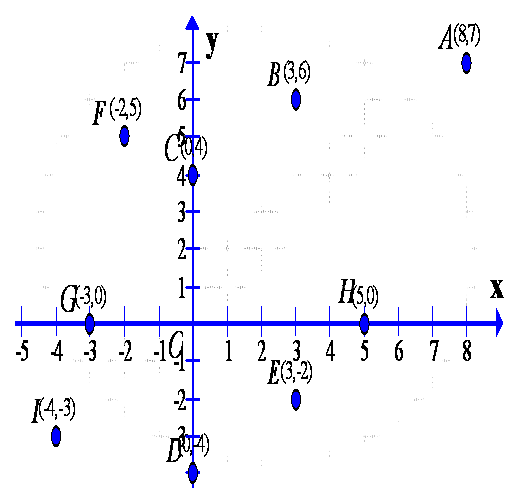
Plot the following points on the same graph paper:$(i) (8, 7);(ii) (3, 6);(iii) (0, 4);(iv) (0, -4);(v) (3, -2);(vi) (-2, 5);(vii) (-3, 0);(viii) (5, 0);(ix) (-4, -3)$
AnswerLet us take the point as
$A(8,7), B(3,6), C(0,4), D(0,4), E(3,-2), F(-2,5), G(-3,0), H(5,0), I(-4,-3)$
On the graph paper, let us draw the co-ordinate axes $XOX\ '$ and $YOY\ '$ intersecting at the origin $O$.
With proper scale, mark the numbers on the two co$-$ordinate axes.
Now for the point $A(8,7)$
Step $1$
Starting from origin $O$, move 8units along the positive direction of $X-$axis, to the right of the origin $O$
Step $2$
Now from there, move $7$ units up and place a dot at the point reached.
Label this point as $A(8,7)$
Similarly plotting the other points
$B(3,6), C(0,4), D(0,-4), E(3,-2), F(-2,5), G(-3,0), H(5,0), I(-4,-3)$
View full question & answer→Question 125 Marks
In square $\text{ABCD}; A = (3, 4), B = (-2, 4)$ and $C = (-2, -1)$. By plotting these points on a graph paper, find the co$-$ordinates of vertex $D$. Also, find the area of the square.
AnswerGiven that in square $\text{ABCD} ; A(3,4), B(-2,4)$ and $C(-2,-1)$
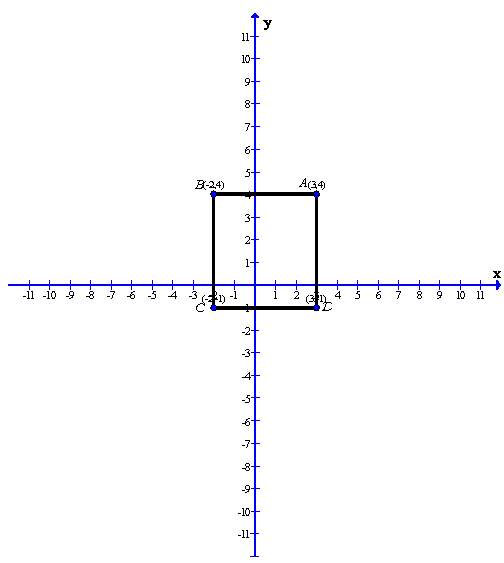
After plotting the given points $A(3,4), B(-2,4)$ and $C(-2,-1)$ on a graph paper;
joining $B$ with $C$ and $B$ with $A$.
From the graph it is clear that the vertical distance between the points $B (-2,4)$ and $C (-2,-1)$ is $5$ units and the horizontal distance between the points $B (-2,4)$ and $A (3,4)$ is $5$ units,
$\therefore$ the vertical distance between the points $A (3,4)$ and $D$ must be 5 units and the horizontal distance between the points $C(-2,-1)$ and $D$ must be $5$ units. Now complete the square $\text{ABCD}$
As is clear from the graph $D(3,-1)$
Now the area of the square $\text{ABCD}$ is given by area of $\text{ABCD}=(\text { side })^2=(5)^2=25$ units View full question & answer→Question 135 Marks
Plot point $A(5, -7)$. From point $A$, draw $AM$ perpendicular to the $x-$axis and $AN$ perpendicular to the $y-$axis. Write the coordinates of points $M$ and $N.$
AnswerGiven $A(5, -7)$
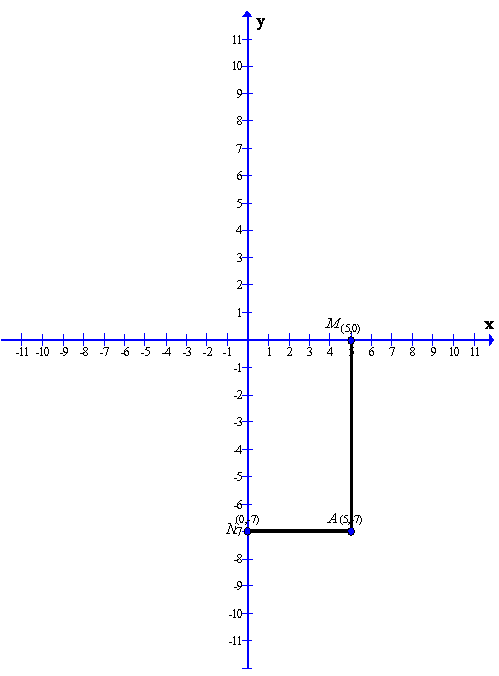
After plotting the given point $A(5,-7)$ on a graph paper.
Now let us draw a perpendicular $AM$ from the point $A(5,-7)$ on the $x-$axis and a perpendicular $AN$ from the point $A(5,-7)$ on the $y-$axis.
As from the graph clearly we get the co$-$ordinates of the points $M$ and $N$
Co$-$ordinate of the point $M$ is $(5,0)$
Co$-$ordinate of the point $N$ is $(0,-7)$ View full question & answer→