Question 13 Marks
Find the coordinates of the points on the $y-$axis, which are at a distance of $10\ units$ from the point $(-8, 4).$
AnswerLet the coordinates of the point on $y-$axis be $(0, y).$
From the given information, we have:
$\sqrt{(0+8)^2+(y-4)^2}=10$
$(0 + 8)^2 + (y - 4)^2 = 100$
$64 + y^2 + 16 - 8y = 100$
$y^2 - 8y - 20 = 0$
$y^2 - 10y + 2y - 20 = 0$
$y(y - 10) + 2(y - 10) = 0$
$(y - 10)(y + 2) = 0$
$y = 10, - 2$
Thus, the required co-ordinates of the points on $y-$axis are $(0, 10)$ and $(0, -2).$
View full question & answer→Question 23 Marks
Find the co$-$ordinates of points on the $x-$axis which are at a distance of $17\ units$ from the point $(11, -8).$
AnswerLet the coordinates of the point on $x-$axis be $(x, 0).$
From the given information, we have:
$\sqrt{(x-11)^2+(0+8)^2}=17$
$(x - 11)^2 + (0 + 8)^2 = 289$
$x^2 + 121 - 22x + 64 = 289$
$x^2 - 22x - 104 = 0$
$x^2 - 26x + 4x - 104 = 0$
$x(x - 26) + 4(x - 26) = 0$
$(x - 26)(x + 4) = 0$
$x = 26, -4$
Thus, the required co$-$ordinates of the points on $x-$axis are $(26, 0)$ and $(-4, 0).$
View full question & answer→Question 33 Marks
The distances of point $P (x, y)$ from the points $A (1, - 3)$ and $B (- 2, 2)$ are in the ratio $2: 3.$Show that: $5x^2+ 5y^2- 34x + 70y + 58 = 0.$
AnswerIt is given that $PA: PB = 2: 3$
$\frac{ PA }{ PB }=\frac{2}{3}$
$\frac{ PA ^2}{ PB ^2}=\frac{4}{9}$
$\frac{(x-1)^2+(y+3)^2}{(x+2)^2+(y-2)^2}=\frac{4}{9}$
$\frac{x^2+1-2 x+y^2+9+6 y}{x^2+4+4 x+y^2+4-4 y}=\frac{4}{9}$
$9(x^2 - 2x + y^2 + 10 + 6y) = 4(x^2 + 4x + y^2 + 8 - 4y)$
$9x^2 - 18x + 9y^2+ 90 + 54y = 4x^2 + 16x + 4y^2 + 32 - 16y$
$5x^2 + 5y^2 - 34x + 70y + 58 = 0$
Hence, proved.
View full question & answer→Question 43 Marks
Point $P (2, -7)$ is the center of a circle with radius $13\ unit, PT$ is perpendicular to chord $AB$ and $T = (-2, -4);$ calculate the length of: $AT$
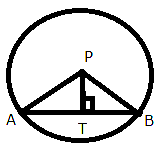
AnswerGiven, radius $= 13\ units$
$PA = PB = 13\ units$
Using distance formula,
$\text { PT }=\sqrt{(-2-2)^2+(-4+7)^2}$
$=\sqrt{16+9}$
$=\sqrt{25}$
$= 5$
Using Pythagoras theorem in $\triangle PAT,$
$AT^2 = PA^2- PT^2$
$AT^2 = 169 - 25$
$AT^2 = 144$
$AT = 12\ units.$
View full question & answer→Question 53 Marks
The length of line $PQ$ is $10$ units and the co$-$ordinates of $P$ are $(2, -3);$ calculate the co-ordinates of point $Q$, if its abscissa is $10.$
AnswerLet the co$-$ordinates of point $Q$ be $(10, y).$
$PQ = 10$
$PQ^2= 100$
$(10 - 2)^2+ (y + 3)^2= 100$
$64 + y^2+ 9 + 6y = 100$
$y^2+ 6y - 27 = 0$
$y^2+ 9y - 3y - 27 = 0$
$y(y + 9) - 3(y + 9) = 0$
$(y + 9) (y - 3) = 0$
$y = -9, 3$
Thus, the required co$-$ordinates of point $Q$ are $(10, -9)$ and $(10, 3).$
View full question & answer→Question 63 Marks
The centre of a circle is $(2x - 1, 3x + 1).$ Find $x$ if the circle passes through $(-3, -1)$ and the length of its diameter is $20\ unit.$
AnswerDistance between the points $A (2x - 1, 3x + 1)$ and $B (- 3, - 1) =$ Radius of circle
$AB = 10 ($Since, diameter $= 20$ units, given$)$
$AB^2 = 100$
$(-3 - 2x + 1)^2 + (-1 - 3x - 1)^2 = 100$
$(-2 - 2x)^2 + (-2 - 3x)^2 = 100$
$4 + 4x^2 + 8x + 4 + 9x^2 + 12x = 100$
$13x^2 + 20x - 92 = 0$
$x=\frac{-20 \pm \sqrt{400+4784}}{26}$
$x=\frac{-20 \pm 72}{26}$
$x=2,-\frac{46}{13}$
View full question & answer→Question 73 Marks
Points $A (-3, -2), B (-6, a), C (-3, -4)$ and $D (0, -1)$ are the vertices of quadrilateral $\text{ABCD};$ find a if $'a\ '$ is negative and $AB = CD.$
Answer$AB = CD$
$AB^2= CD^2$
$(- 6 + 3)^2+ (a + 2)^2= (0 + 3)^2 + (- 1 + 4)^2$
$9 + a^2+ 4 + 4a = 9 + 9$
$a^2+ 4a - 5 = 0$
$a^2- a + 5a - 5 = 0$
$a(a - 1) + 5 (a - 1) = 0$
$(a - 1) (a + 5) = 0$
$a = 1$ or $- 5$
It is given that a is negative, thus the value of a is $- 5.$
View full question & answer→Question 83 Marks
Show that $(-3, 2), (-5, -5), (2, -3)$ and $(4, 4)$ are the vertices of a rhombus.
AnswerLet the given points be $A (-3, 2), B (-5, -5), C (2, -3)$ and $D (4, 4).$
$AB =\sqrt{(-5+3)^2+(-5-2)^2}$
$=\sqrt{4+49}=\sqrt{53}$
$BC =\sqrt{(2+5)^2+(-3+5)^2}$
$=\sqrt{49+4}=\sqrt{53} $
$CD =\sqrt{(4-2)^2+(4+3)^2}$
$=\sqrt{4+49}=\sqrt{53}$
$DA =\sqrt{(-3-4)^2+(2-4)^2}$
$=\sqrt{49+4}=\sqrt{53}$
$AC =\sqrt{(2+3)^2+(-3-2)^2}$
$=\sqrt{25+25}=5 \sqrt{2} $
$ BD =\sqrt{(4+5)^2+(4+5)^2}$
$=\sqrt{81+81}=9 \sqrt{2}$
Since, $AB = BC = CD = DA$ and $AC \neq BD$
The given vertices are the vertices of a rhombus.
View full question & answer→Question 93 Marks
Show that the points $A (5, 6), B (1, 5), C (2, 1)$ and $D (6, 2)$ are the vertices of a square $\text{ABCD}.$
Answer$ AB =\sqrt{(1-5)^2+(5-6)^2}$
$=\sqrt{16+1}=\sqrt{17}$
$BC =\sqrt{(2-1)^2+(1-5)^2}$
$=\sqrt{1+16}=\sqrt{17}$
$ CD ==\sqrt{(6-2)^2+(2-1)^2}$
$=\sqrt{16+1}=\sqrt{17} $
$DA ==\sqrt{(5-6)^2+(6-2)^2}$
$=\sqrt{1+16}=\sqrt{17} $
$AC ==\sqrt{(2-5)^2+(1-6)^2}$
$=\sqrt{9+25}=\sqrt{34} $
$ BD ==\sqrt{(6-1)^2+(2-5)^2}$
$=\sqrt{25+9}=\sqrt{34}$
Since, $AB = BC = CD = DA$ and $AC = BD,$
$A, B, C$ and $D$ are the vertices of a square.
View full question & answer→Question 103 Marks
Prove that the points $P (0, -4), Q (6, 2), R (3, 5)$ and $S (-3, -1)$ are the vertices of a rectangle $\text{PQRS}.$
Answer$PQ =\sqrt{(6-0)^2+(2+4)^2}=6 \sqrt{2} $ units
$QR =\sqrt{(6-3)^2+(2-5)^2}=3 \sqrt{2}$ units
$RS =\sqrt{(3+3)^2+(5+1)^2}=6 \sqrt{2} $ units
$ PS =\sqrt{(-3-0)^2+(-1+4)^2}=3 \sqrt{2}$ units
$ PR =\sqrt{(3-0)^2+(5+4)^2}=3 \sqrt{10}$ units
$ QS =\sqrt{(6+3)^2+(2+1)^2}=3 \sqrt{10}$ units
$\because PQ = RS$ and $QR = PS,$
Also $PR = QS$
$\therefore \text{PQRS}$ is a rectangle.
View full question & answer→Question 113 Marks
Show that the points $P (0, 5), Q (5, 10)$ and $R (6, 3)$ are the vertices of an isosceles triangle.
Answer$P Q=\sqrt{(5-0)^2+(10-5)^2}$
$=\sqrt{25+25}$
$=\sqrt{50}$
$=5 \sqrt{2}$
$QR =\sqrt{(6-5)^2+(3-10)^2} $
$ =\sqrt{1+49} $
$ =\sqrt{50} $
$ =5 \sqrt{2}$
$\text { RP }=\sqrt{(0-6)^2+(5-3)^2}$
$=\sqrt{36+4}$
$=\sqrt{40}$
$=2 \sqrt{10}$
Since, $PQ = QR, \triangle PQR$ is an isosceles triangle.
View full question & answer→