Questions

[4 marks sum]

🎯

Test yourself on this topic

8 questions · timed · auto-graded

Question 14 Marks
$D$ is a point on the side of the $BC$ of $\triangle ABC$. Prove that the perimeter of $\triangle ABC$ is greater than twice of $AD$.
Answer
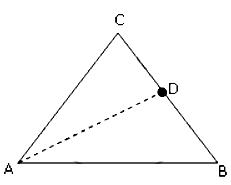
Construction: Join $AD$
In $\triangle ACD,$
$AC + CD > AD ...(i)$
$($Sum of two of a triangle greater than the third side$)$
Similarly, in $\triangle ADB,$
$AB + BD > AD ...(ii)$
Adding $(i)$ and $(ii),$
$AC + CD + AB + BD > AD$
$AB + BC + AC > 2AD. ...($Since, $CD + BD = BC)$
View full question & answer
Question 24 Marks
Arrange the sides of the following triangles in an ascending order:$\triangle ABC, \angle A = 45^\circ , \angle B = 65^\circ .$
Answer
In $\triangle ABC,$
$\angle A + \angle B + \angle C = 180^\circ $
$45^\circ + 65^\circ + \angle C = 180^\circ $
$110^\circ +\angle C = 180^\circ $
$\angle C = 180^\circ - 110^\circ $
$\angle C = 70^\circ $
Hence, $\angle A = 45^\circ , \angle B = 65^\circ , \angle C = 70^\circ $
$45^\circ < 65^\circ < 70^\circ $
Hence, ascending order of the angles in the
given triangle is $\angle A < \angle B < \angle C.$
Hence, ascending order of sides in triangle
$BC, AC, AB.$
View full question & answer
Question 34 Marks
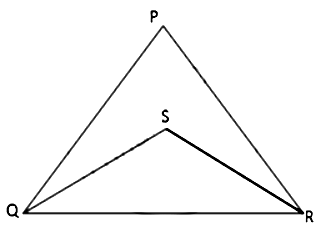
In $\triangle PQR$ is a triangle and $S$ is any point in its interior. Prove that $SQ + SR < PQ + PR.$
Answer
In $\triangle P Q R$,
$P Q+P R>Q R\dots....($Sum of two sides of a triangle is always greater than the third side.$)$
Also, in $\triangle S Q R$,
$S Q+S R>Q R\dots.... ( \because$ Sum of two sides of a triangle is always greater than the third side.$)$
Dividing $(i)$ by $(ii),$
$ \frac{ PQ + PR }{ SQ + SR }>\frac{ QR }{ QR }$
$\frac{ PQ + PR }{ SQ + SR }>1$
$PQ + PR > SQ + SR$
i.e.$SQ + SR < PQ + PR .$
View full question & answer
Question 44 Marks
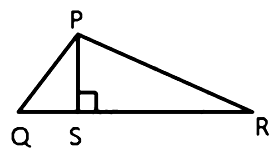
In $\triangle PQR, PS \perp QR$ ; prove that: $PQ + PR > QR$ and $PQ + QR >2PS.$
​​​​​​​
Answer
In $\triangle PQR,$
$PQ + PR > QR (\because $ Sum of two sides of a triangle is always greater than third aside$.)$
In $\triangle PQS,$
$PQ + QS > PS (\because $ Sum of two sides of a triangle is always greater than third aside.$) \dots.....(i)$
In $\triangle PRS,$
$PR + SR > PS (\because $ Sum of two sides of a triangle is always greater than third aside.$) \dots.....(ii)$
Adding $(i)$ and $(ii),$
$PQ + QS + PR + SR > 2PS$
$PQ + (QS + SR) + PR > 2PS$
$PQ + QR + PR > 2PS$
Since $PQ + PR > QR$
$\Rightarrow PQ + QR > 2PS.$
View full question & answer
Question 54 Marks
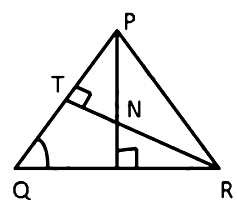
In the given figure, $\angle QPR = 50^\circ $ and $\angle PQR = 60^\circ $. Show that: $SN < SR$
​​​​​​​
Answer
In $\triangle RTQ,$
$\angle RTQ + \angle TQR + \angle TRQ = 180^\circ $
$90^\circ + 60^\circ +\angle TRQ = 180^\circ $
$150^\circ + \angle TRQ = 180^\circ $
$\angle TRQ = 180^\circ - 150^\circ $
$\angle TRQ = 30^\circ $
$\angle TRQ = \angle SRN = 30^\circ ....(i)$
In $NSR,$
$\angle RNS + \angle SRN = 90^\circ ....(\because \angle NSR = 90^\circ )$
$\angle RNS + 30^\circ = 90^\circ ....[$from $(iii)]$
$\angle RNS = 90^\circ - 30^\circ $
$\angle RNS = 60^\circ ....(ii)$
$\angle SRN < \angle RNS ....($from$ (iii)$ and $(iv))$
$SN < SR.$
View full question & answer
Question 64 Marks
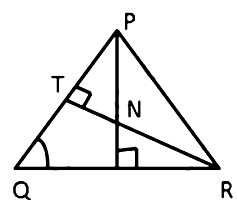
In the given figure, $\angle QPR = 50^\circ $ and $\angle PQR = 60^\circ $. Show that : $PN < RN$
Answer
In the given $\triangle P Q R$,
$PS < PR \dots.....($Of all the straight lines that can be drawn to a given straight line from a point outside it, the perpendicular is the shortest$)$
$\text { PN }<\text { PR } \ldots . \text { (i) } \quad(\because PN < PS )$
Also,
$R T< PR \dots.....($Of all the straight lines that can be drawn to a given straight line from a point outside it, the perpendicular is the shortest$)$
$RN < PR$
Dividing $(i)$ bt $(ii)$,
$ \frac{ PN }{ PN }<\frac{ PR }{ PR }$
$\frac{ PN }{ RN }<1$
$PN < RN . $
View full question & answer
Question 74 Marks
Name the greatest and the smallest sides in the following triangles:$\triangle XYZ, \angle X = 76^\circ , \angle Y = 84^\circ .$
Answer
In $\triangle XYZ,$
$\angle X + \angle Y + \angle Z = 180^\circ $
$76^\circ + 84^\circ + \angle Z = 180^\circ $
$160^\circ + \angle Z = 180^\circ $
$\angle Z = 180^\circ - 160^\circ $
$\angle Z = 20^\circ $
Hence, $\angle X = 76^\circ , \angle Y = 84^\circ , \angle Z = 20^\circ $
In the given $\triangle XYZ$ the greatest angle is $\angle Y$ and
the opposites side to the $\angle Y$ is $XZ.$
Hence, the greatest side is $XZ.$
The smallest angle in the $\triangle XYZ$ is $\angle Z$ and the
opposite side to the $\angle Z$ is $XY.$
Hence, the smallest side is $XY.$
View full question & answer
Question 84 Marks
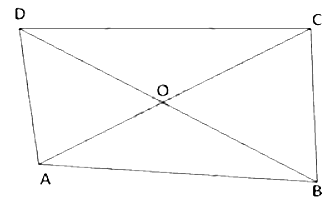
$\text{ABCD}$ is a quadrilateral in which the diagonals $AC$ and $BD$ intersect at $O$. Prove that $AB + BC + CD + AD < 2(AC + BC).$
Answer
In $\triangle AOB$, we have
$OA + OB > AB ...(i)$
In $\triangle BOC$, we have
$OB + OC > BC ...(ii)$
In $\triangle COD$, we have
$OC + OD > CD ...(iii)$
In $\triangle AOD$, we have
$OA + OD > AD ....(iv)$
Adding $(i), (ii), (iii)$ and $(iv),$ we get
$2 (OA + OB + OC + OD) > AB + BC + CD + AD$
$\Rightarrow 2 [(OA + OC) + (OB + OD)] > AB + BC + CD + AD$
$\Rightarrow 2 (AC + BD) > AB + BC + CD + AD$
$[\because OA + OC = AC$ and $OB + OD = BD]$
$\Rightarrow AB + BC + CD + AD < 2 (AC + BD).$
View full question & answer
[4 marks sum] - MATHEMATICS STD 9 Questions - Vidyadip