Questions

[3 marks sum]

🎯

Test yourself on this topic

8 questions · timed · auto-graded

Question 13 Marks
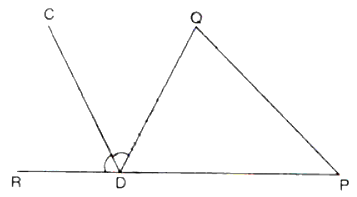
$\text{DPQ}$ is an isosceles triangle with $DP = DQ$. A straight line $CD$ bisects the exterior $\angle QDR.$ Prove that $DC$ is parallel to $PQ.$
Answer
In $\triangle QDP,$
$DP = DQ$
$\therefore \angle Q = \angle P$
$\angle QDR = \angle Q + \angle P$
$2\angle QDC = \angle Q + \angle P ....(DC$ bisects angle $QDR)$
$2\angle QDC = \angle Q + \angle Q = 2\angle Q$
$\angle QDC = \angle Q$
But these are alternate angles.
$\therefore DC \| PQ.$
View full question & answer
Question 23 Marks
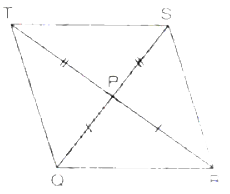
In the given figure :if $\angle PQS = 60^\circ $,show that $PQ = PS = QS = SR.$
Answer
In $\triangle PQS,$
$\angle PQS = 60^\circ , \angle QPS = 60^\circ $ and $\angle QSP = 60^\circ $
$\Rightarrow \triangle PQS$ is an equilateral triangle
$\Rightarrow PQ = QS = PS$
And, $PS = SR$
$\Rightarrow PQ = PS = QS = SR.$
View full question & answer
Question 33 Marks
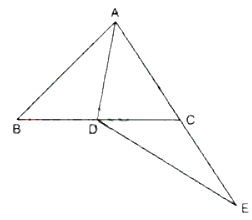
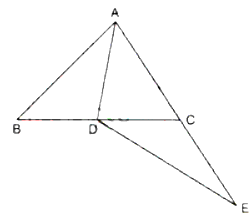
In $ΔABC, D$ is the mid$-$point of $BC, AD$ is equal to $AC. AC$ is produced to $E$, such that $CE = AC.$ Prove that$:AB = CE$
Answer
In $\triangle ABD$ and $\triangle DCE$
$BD = CD ...(D$ is mid$-$point of $BC)$
$\angle ADB = \angle DCE ...($proved$)$
$AD = CE ...($since $AD = AC$ and $AC = CE)$
Therefore, $\triangle ABD ≅ \triangle DCE$
Hence, $AB = CE.$
View full question & answer
Question 43 Marks
In $\triangle ABC, D$ is the mid$-$point of $BC, AD$ is equal to $AC. AC$ is produced to $E,$ such that $CE = AC.$ Prove that:$\angle ADB = \angle DCE$
Answer
In $\triangle ADC,$
$AD = AC ...($given$)$
Therefore, $\angle ADC = \angle ACD ..........(i)$
But $\angle ADB + \angle ADC = 180^\circ ........(ii)$
And $\angle ACD + \angle DCE = 180^\circ ........(iii)$
From $(i), (ii)$ and $(iii)$
$\angle ADB = \angle DCE.$
View full question & answer
Question 53 Marks
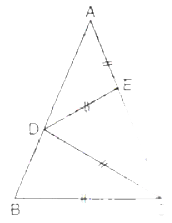
In the figure $\triangle ABC$ is isosceles with $AB = AC.$ Prove that:$\angle ADE = \angle BCD$
​​​​​​​
Answer
In $\triangle ADE,$
$\angle ADE = a ...($from $(i))$
In $\triangle BCD,$
$\angle BCE = b ...(AB = AC \Rightarrow \angle B = \angle C) .........(vii)$
$\angle BCD = \angle BCE - \angle DCE$
$\angle BCD = b - 2a ...($from $(vii)$ and $(ii))$
But $b = 3a ...($from $(vi))$
Therefore, $\angle BCD = 3a - 2a = a$
Hence, $\angle ADE = \angle BCD.$
View full question & answer
Question 63 Marks
Equal sides $QP$ and $RP$ of an isosceles $\triangle PQR$ are produced beyond $P$ to $S$ and $T$ such that $\triangle PST$ is an isosceles triangle with $PS = PT.$ Prove that $TQ = SR.$
Answer
In $\triangle PTQ$ and $\triangle PSR$
$PQ = PR ...($given$)$
$PT = PS ...($given$)$
$\angle TPQ = \angle SPR ...($vertically opposite angles$)$
Therefore, $\triangle PTQ ≅ \triangle PSR$
Hence, $TQ = SR.$
View full question & answer
Question 73 Marks
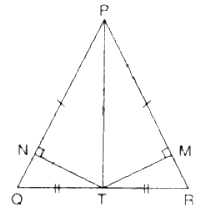
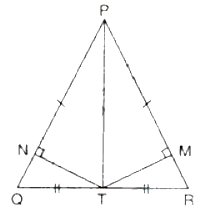
$\triangle PQR$ is isosceles with $PQ = PR. T$ is the mid$-$point of $QR,$ and $TM$ and $TN$ are perpendiculars on $PR$ and $PQ$ respectively. Prove that,$PT$ is the bisector of $\angle P.$
​​​​​​​
Answer
In $\triangle PNT$ and $\triangle PMT$
$TN = TM ...($proved$)$
$PT = PT ...($common$)$
$\angle PNT = \angle PMT ...(90^\circ )$
Therefore, $\triangle PNT ≅ \triangle PMT$
Hence, $\angle NPT = \angle MPT$
Thus, $PT$ bisects $\angle P.$
View full question & answer
Question 83 Marks
$\triangle PQR$ is isosceles with $PQ = PR. T$ is the mid$-$point of $QR,$ and $TM$ and $TN$ are perpendiculars on $PR$ and $PQ$ respectively. Prove that,
$TM = TN$
Answer
In $\triangle PQR,$
$PQ = PR ...($given$)$
$\therefore \angle R = \angle Q .................(i)$
Now in $\triangle QNT$ and $\triangle RMT$
$\angle QNT =\angle RMT ...(90^\circ )$
$\angle Q = \angle R ...($from $(i))$
$QT = TR ...($given$)$
$\therefore \triangle QNT ≅ \triangle RMT ...(\text{AAS}$ criteria$)$
$\therefore TN = TM.$
View full question & answer
[3 marks sum] - MATHEMATICS STD 9 Questions - Vidyadip