Questions

[3 marks sum]

🎯

Test yourself on this topic

13 questions · timed · auto-graded

Question 13 Marks
In the given figure, $\text{AB}=\text{AC}$ and $\angle DBC=\angle ECB=90^{\circ}$
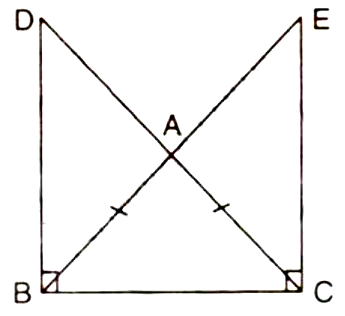


Prove that:
(i) $BD = CE$
(ii) $AD = AE$
Answer
In $\triangle ABC,$
$\text{AB} = \text{AC} ......[$Given$]$
$\therefore \angle ACB = \angle ABC ......[$angles opp. to equal sides are equal$]$
$\Rightarrow \angle ABC = \angle ACB .....(i)$
$\angle DBC =\angle ECB = 90^\circ ......[$Given$]$
$\Rightarrow \angle DBC = \angle ECB ….(ii)$
Subtracting $(i)$ from $(ii)$
$\angle DCB − \angle ABC = \angle ECB − \angle ACB$
$\Rightarrow \angle DBA = \angle ECA ........(iii)$
In $\triangle DBA$ and $\triangle ECA,$ 
$\angle DBA = \angle ECA ......[$From $(iii)]$
$\angle DAB = \angle EAC .......[$Vertically opposite angles$]$
$\text{AB} = \text{AC} ......[$Given$]$
$\therefore \triangle DBA ≅ \triangle ECA .......[\text{ASA}]$  
$\Rightarrow \text{BD} = \text{CE} ...[$c. p. c. t$]$
Also,
$\text{AD} = \text{AE} ...[$c. p. c. t$]$
View full question & answer
Question 23 Marks
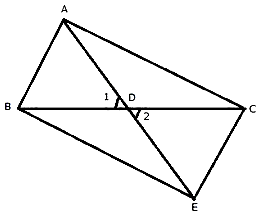
If the bisector of an angle of a triangle bisects the opposite side, prove that the triangle is isosceles.
Answer

Produce $\text{AD}$ up to $E$ such that $\text{AD}= \text{DE}$. In $\triangle ABC$ and $\triangle EDC$,
$\text{AD} = \text{DE}........[$by construction$]$
$\text{BD}=\text{CD}.......[$Given$]$
$\angle 1=\angle 2.....[$verticaly opposite angles$]$
$ \therefore \triangle ABD \cong \triangle EDC \ldots . . .[ \text{SAS} ]$
$ \Rightarrow \text{AB}=\text{CE} \ldots \ldots . .( i )$
and $\angle BAD =\angle CED$
But,$\angle BAD =\angle CAD \ldots . . .[ \text{AD}$  is bisector of  $\angle BAC ]$
$ \therefore \angle CED =\angle CAD $
$\Rightarrow \text{AC}=\text{CE} \ldots \ldots . .( ii )$
From $(i)$ and $(ii)$
$\text{AB}=\text{AC}$
Hence, $\text{ABC}$ is an isosceles triangle.
View full question & answer
Question 33 Marks
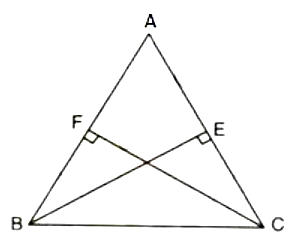
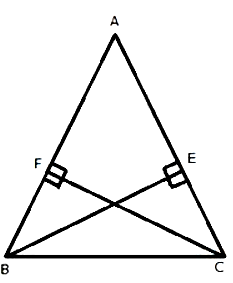
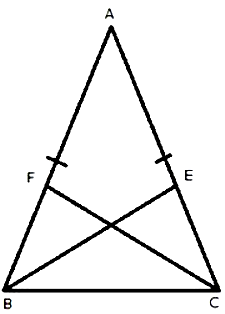
In $\triangle ABC , \text{AB} = \text{AC} ; \text{BE} \perp \text{AC}$ and $\text{CF} \perp \text{AB}$.


Prove that:
$(i) \text{BE} =\text{ CF}$
$(ii) \text{AF} = \text{AE}$
Answer
$(i)$
In $\triangle AEB$ and $\triangle AFC,$
$\angle A = \angle A .......[$Common$]$
$\angle AEB = \angle AFC = 90^\circ ......[$Given: $\text{BE} \perp \text{AC}]......[$Given: $\text{CF} \perp \text{AB}]$
$\text{AB} =\text{ AC} .......[$Given$]$
$\Rightarrow \triangle AEB ≅ AFC .......[\text{AAS}]$
$\therefore \text{BE}= \text{CF} .......[$C.p.c.t$]$
$(ii)$ Since $\triangle AEB ≅ AFC$
$\angle ABE = \angle AFC$
$\therefore \text{AF} = \text{AE} ........[$congruent angles of congruent triangles$]$
View full question & answer
Question 43 Marks
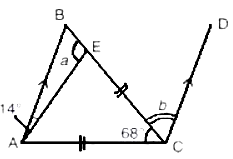
Using the information given of the following figure, find the values of $a$ and $b. [$Given: $\text{CE}=\text{AC}]$

Answer
In $\triangle CAE$,
$ \angle CAE=\angle AEC=\frac{180^{\circ}-68^{\circ}}{2}$
$=56^{\circ} \quad[\because \text{CE}=\text{AC}]$
In $\angle B E A,$
$a=180^{\circ}-56^{\circ}$
$=124^{\circ}$
In $\angle ABE, \angle ABE=180^{\circ}-(a+\angle BAE)$
$=180^{\circ}-\left(124^{\circ}+14^{\circ}\right)$
$=180^{\circ}-138^{\circ}$
$=42^{\circ}$
$\angle ABE=\angle b=42^{\circ} $
View full question & answer
Question 53 Marks
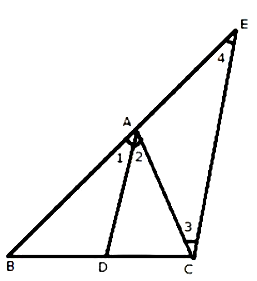
In $\triangle ABC$ the internal bisector of angle $A$ meets the opposite side $\text{BC}$ at point $D.$ Through vertex $C,$ line $\text{CE}$ is drawn parallel to $\text{DA}$ which meets $\text{BA}$ produced at point $E$. Show that $\triangle ACE$ is isosceles.
Answer


$\text{DA} \| \text{CE} ... [$Given$]$
$\Rightarrow \angle 1=\angle 4 ...(i) ($ Corresponding angles$)$
$\angle 2=\angle 3 ....(ii) ($ Alternate angles$)$
But $\angle 1=\angle 2 ....(iii) ( \text{AD}$ is the bisector of $\angle A$ )
From $(i), (ii)$ and $(iii)$
$\angle 3=\angle 4$
$ \Rightarrow \text{AC}=\text{AE}$
$\Rightarrow \triangle ACE$ is an isosceles triangle.
View full question & answer
Question 63 Marks
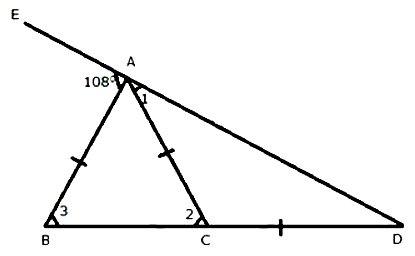
Sides $\text{AB}$ and $\text{AC}$ of a $\triangle ABC$ are equal. $\text{BC}$ is produced through $C$ up to a point $D$ such that $\text{AC} = \text{CD}. D$ and $A$ are joined and produced $($through vertex $A)$ up to point $E$. If $\angle BAE = 108^\circ ;$ find $\angle ADB.$
Answer


In $\triangle ABD$,
$\angle BAE =\angle 3+\angle ADB$
$ \Rightarrow 108^{\circ}=\angle 3+\angle ADB$
But $\text{AB} = \text{AC}$
$ \Rightarrow \angle 3=\angle 2$
$\Rightarrow 108^{\circ}=\angle 2+\angle ADB .(i)$
Now,
In $\triangle ACD$,
$\angle 2=\angle 1+\angle ADB$
But  $\text{AC} = \text{CD}$
$ \Rightarrow \angle 1=\angle ADB$
$ \Rightarrow \angle 2=\angle ADB +\angle ADB$
$ \Rightarrow \angle 2=2 \angle ADB$
 Putting this value in $(i)$
$ \Rightarrow 108^{\circ}=2 \angle ADB +\angle ADB$
$ \Rightarrow 3 \angle ADB =108^{\circ}$
$ \Rightarrow \angle ADB =36^{\circ}$
View full question & answer
Question 73 Marks
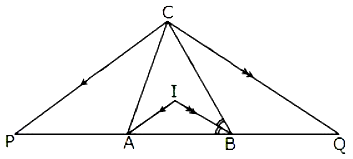
In the following figure$; \text{IA}$ and $\text{IB}$ are bisectors of angles $\text{CAB}$ and $\text{CBA}$ respectively. $\text{CP}$ is parallel to $\text{IA}$ and $\text{CQ}$ is parallel to $\text{IB}$.


Prove that:
$\text{PQ}=$ The perimeter of the $\triangle ABC$.
Answer
Since $\text{IA} \|\text{CP}$ and $\text{CA}$ is a transversal.
$\therefore \angle CAI = \angle PCA ........[$Alternate angles$]$
Also, $\text{IA} \| \text{CP}$ and $\text{AP}$ is a transversal.
$\therefore \angle IAB = \angle APC .......[$Corresponding angles$]$
But $\therefore \angle CAI = \angle IAB ........[$Given$]$
$\therefore \angle PCA = \angle APC$
$\Rightarrow \text{AC} = \text{AP}$
Similarly,
$\text{BC} = \text{BQ}$
Now,
$\text{PQ} =\text{AP} + \text{AB} + \text{BQ}$
$\text{PQ} =\text{ AC} + \text{AB} + \text{BC}$
$\text{PQ} =$ Perimeter of $\triangle ABC.$
View full question & answer
Question 83 Marks
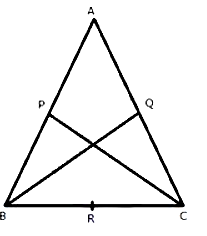
In $\triangle ABC;\text{AB} =\text{ AC}. P, Q,$ and $R$ are mid$-$points of sides $\text{AB},\text{ AC},$ and $\text{BC}$ respectively.Prove that$: \text{BQ} = \text{CP}$
Answer


$\text{ AB} = \text{AC}$
$ \Rightarrow \angle B =\angle C$
Also,
$ \frac{1}{2} \text{AB} =\frac{1}{2} \text{AC} $
$\Rightarrow \text{BP}=\text{CQ}\ldots[P$ and $Q$ are mid$-$points of $\text{AB}$ and $\text{AC}]$
In $\triangle BPC$ and $\triangle CQB$,
$\text{BP}= \text{CQ}$
$ \angle B =\angle C$
$\text{BC} = \text{BC}$
Therefore, $\triangle BPC \cong \triangle CBB \quad...[\text{SAS} ]$
$\text{BP}=\text{CP} .$
View full question & answer
Question 93 Marks
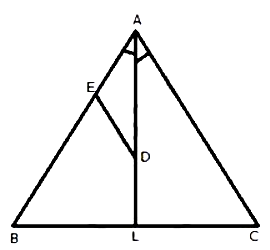
Through any point in the bisector of an angle, a straight line is drawn parallel to either arm of the angle. Prove that the triangle so formed is isosceles.
Answer


$\text{AL}$ is the bisector of angle $A$. Let $D$ is any point on $\text{AL}$. From $D$, a straight line $\text{DE}$ is drawn parallel to $\text{AC}$.
$\text{DE}  \| \text{AC} .........[$Given$]$
$\therefore \angle ADE =\angle DAC..(i) [$Alternate angles$]$
$\angle DAC =\angle DA......(ii) [\text{AL}$ is bisector of $A ]$ 
From $(i)$ and $(ii)$
$\angle ADE =\angle DAE$
$\therefore \text{AE} = \text{ED} \ldots . .. [$Sides opposite to equal angles are equal$]$
Therefore, $AED$ is an isosceles triangle.
View full question & answer
Question 103 Marks
In $\triangle ABC,$ altitudes $\text{BE}$ and $\text{CF}$ are equal. Prove that the triangle is isosceles.
Answer


In $\triangle ABE$ and $\triangle ACF$,
$\angle A=\angle A ~ \ldots . . . . . .[$Common$]$
$\angle AEB =\angle AFC =90^{\circ} \ldots . .[$ Given: $\text{BE} \perp \text{AC} ; \text{CF} \perp \text{AB} ]$
$\text{BE} = \text{CF} ..........[$Given$]$
$\therefore \triangle ABE \cong \triangle ACE \ldots . . . . .[ \text {AAS}$ Criterion] 
$ \Rightarrow \text{AB} = \text{AC}$
Therefore, $\text{ABC}$ is an isosceles triangle.
View full question & answer
Question 113 Marks
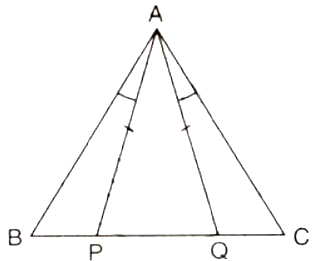
Use the given figure to prove that, $\text{AB}=\text{AC}$.

Answer
In $\triangle APQ,$
$\text{AP} = \text{AQ} .........[$Given$]$
$\therefore \angle APQ = \angle AQP .........(i) [$angles opposite to equal sides are equal$]$
In $\triangle ABP,$
$\angle APQ = \angle BAP + \angle ABP .......(ii) [$Ext. the angle is equal to the sum of opp. int. angles$]$
In $\triangle AQC,$
$\angle AQP = \angle CAQ + \angle ACQ ...(iii) [$Ext. angle is equal to sum of opp. int. angles$]$
From $(i), (ii)$ and $(iii)$
$\angle BAP + \angle ABP = \angle CAQ + \angle ACQ$
But, $\angle BAP = \angle CAQ .......[$Given$]$
$\Rightarrow \angle CAQ + \angle ABP = \angle CAQ + \angle ACQ$
$\Rightarrow \angle ABP = \angle CAQ + \angle ACQ − \angle CAQ$
$\Rightarrow \angle ABP = \angle ACQ$
$\Rightarrow \angle B = \angle C ...........(iv)$
In $\triangle ABC,$
$\angle B = \angle C$
$\Rightarrow \text{AB} = \text{AC} ......[$Sides opposite to equal angles are equal$]$
View full question & answer
Question 123 Marks
Prove that the medians corresponding to equal sides of an isosceles triangle are equal.
Answer


In $ \triangle ABC,$
$\text{AB}=\text{AC}.......($Given$)$
$\therefore \angle C =\angle B \ldots .. .(i) [$angles opp. to equal sides are equal$]$
$ \Rightarrow \frac{1}{2}\text{AB} =\frac{1}{2} \text{AC}$
$ \Rightarrow \text{BF} = \text{CE} . \ldots . . . \text { (ii) }$
In $\triangle BCE$ and $\triangle CBF$,
$\angle C =\angle B \ldots . . .[$From $(i)] $
$\text{BF} =\text{CE} \ldots . . . .[$ From $(ii)] $
$ \text{BC}= \text{BC} \ldots . . .[$ Common$]$
$ \therefore \triangle BCE \cong \triangle CBF \ldots . . .[\text{ SAS} ]$
$ \Rightarrow \text{BE} = \text{CF} \ldots . . .[$ c.p.c.t.$] $
View full question & answer
Question 133 Marks
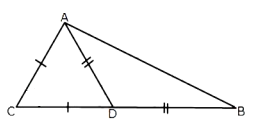
In the figure given below, if $\text{AC}=\text{AD}=\text{CD}=\text{BD};$ find angle $\text{ABC}$.

Image
Answer
In $\triangle ACD,$
$\text{AC} =\text{ AD} = \text{CD} ......[$Given$]$
Hence, $\text{ACD}$ is an equilateral triangle.
$\therefore \angle ACD = \angle CDA = \angle CAD = 60^\circ $
$\angle CDA = \angle DAB + \angle ABD ........[$Ext angle is equal to the sum of opp. int. angles$]$
But,
$\angle DAB = \angle ABD ......[$Given$: \text{AD} =\text{ DB}]$
$\therefore \angle ABD + \angle ABD = \angle CDA$
$\Rightarrow 2\angle ABD = 60^\circ $
$\Rightarrow \angle ABD = \angle ABC = 30^\circ $
View full question & answer
[3 marks sum] - MATHEMATICS STD 9 Questions - Vidyadip