Question 15 Marks
In an election there were two candidates. A total of $9791$ votes were polled. $116$ votes were declared invalid. The successful candidate got $5$ votes for every $4$ votes his opponent had. By what margin did the successful candidate win?
AnswerTotal number of votes polled $=9791$
Number of invalid votes $=116$
Number of valid votes
$=9791-116$
$=9675$
Number of votes received by successful candidate
$=\frac{5}{9} \times 9675=5375 \ldots \text { (i) }$
Number of votes received by successful candidate
$=\frac{4}{9} \times 9675=4300 \ldots \text { (i) }$
Substracting $(ii)$ from $(i)$
$5375-4300=1075$
Therefore, the successful candidate won by $1075$ votes.
View full question & answer→Question 25 Marks
A $700\ g$ dry fruit pack costs $Rs. 72$. It contains some cashew kernels and the rest as dry grapes. If cashew kernels cost $Rs. 96$ per $kg$ and dry grapes costs $Rs. 112$ per $kg$, what were the quantities of the two dry fruits separately.
AnswerLet quantities of cashew kernels and fry grapes be $x$ and $y$ respectively.
Therefore,
$ x+y=700 g$
$\Rightarrow y=700-x $
Cost of cashew kernels
$ =\frac{96}{ \ kg }$
$=\frac{0.096}{ g } $
Cost of dry grapes
$ =\text { Rs } \frac{112}{ \ kg }$
$=\frac{0.112}{ g } $
Cost of dry fruit pack $= Rs. 72$
Therefore,
$0.096 x+0.112 y=72 \text {. }$
Substituting $(i)$ in $(ii)$
$ 0.096 x+0.112(700-x)=72$
$\Rightarrow 0.096 x+78.4-0.112 x=72$
$\Rightarrow 0.016 x=6.4$
$\Rightarrow x=400 $
Substituting value of $x$ in $(i)$
$ 400+y=700$
$\Rightarrow y=300 $
Therefeore, cashew kernels $=400 g$ and dry grapes $=300 g$.
View full question & answer→Question 35 Marks
A man buys two articles at $Rs.410.$ He sells both at the same price. On one he makes a profit of $15\%$ and on the other a loss of $10\%.$ Find the cost price of both.
AnswerLet $x$ and $y$ be the cost price of first and second article respectively and $z$ be the selling price of both
Therefore, $x+y=410$
For first article: profit $=15 \%$
$ \frac{ z -x}{x}=0.15$
$\Rightarrow z - x =0.15 x$
$\Rightarrow z =1.15 x \ldots \ldots . . $
For second article: loss $=10 \%$
$\frac{y- z }{y}=0.10$
$ \Rightarrow y - z =0.10 y$
$\Rightarrow z =0.9 y . \ldots . . . . $
Selling price of both are equal, therefore
$ 0.9 y=1.15 x$
$y=\frac{1.15 x}{0.9} \ldots $
Substituting $(iv)$ in $(i)$
$ x+\frac{1.15 x}{0.9}=410$
$\Rightarrow 0.9 x+1.15 x=410 \times 0.9$
$\Rightarrow 2.05 x=369$
$\Rightarrow x=180 $
Substituting value of $x$ in $(i)$
$ 180+ y =410$
$\Rightarrow y =410-180$
$=230 . $
Therefore, cost price of two articles $= Rs. 180$ and $Rs. 230 .$
View full question & answer→Question 45 Marks
A man sells an article and makes a profit of $6\%$. Had he bought the article at a price $4\%$ less and sold at a price higher by $Rs 7.60$, he would have made a profit of $12\%$. Find his cost price.
AnswerLet $s$ be the selling price and $c$ be the cost price.
$ \frac{ s - c }{ c }=6 \%$
$\Rightarrow s - c =0.06 c$
$\Rightarrow s =1.06 c \ldots \ldots \text { (i) } $
If he bought at $4 \%$ less cost price $=c-4 \%, c=0.96 c$ and sold at $Rs. 7.60$ higher
$\Rightarrow$ selling price $= s +7.60$
Therefore.
$ \frac{ s +7.60-00.96 c}{0.96 c}=12 \%$
$\Rightarrow \frac{ s +7.60-0.96 c}{0.96 c}=0.12 . $
Substituting $(i)$ in $(ii)$
$ \Rightarrow \frac{(10.6 c)+7.60-0.96 c}{0.96 c}=0.12$
$\Rightarrow \frac{0.1 c+7.60}{0.96 c}=0.12$
$\Rightarrow 0.1 c+7.60=0.12 \times 0.96 c$
$\Rightarrow 0.1 c+7.60=0.1152 c$
$\Rightarrow 0.0152 c=7.60$
$\Rightarrow c=500 $
Therefore, his cost price is $Rs.500.$
View full question & answer→Question 55 Marks
In a class there are a certain number of seats. If each student occupies one seat, $9$ students remain standing and if $2$ students occupy one seat, $7$ seats are left empty. Find the number of seats in the class.
AnswerLet $x$ be the digit at ten's place and $y$ be the digit at unit's place.
Then, the number is $10x + y.$
Number obtained by reversing the digit $= 10y + x$
According to given information, we have
$(10x + y) + (10y + x) = 110$
$\Rightarrow 11x + 11y = 110$
$\Rightarrow 11(x + y) = 9$
$\Rightarrow x + y = 10 ....(i)$
Also, $x - y = 2 ....(ii)$
Adding eqns. $(i)$ and $(ii)$, we get
$2x = 12$
$\Rightarrow x = 6$
$\Rightarrow 6 + y = 10$
$\Rightarrow y = 4$
$\therefore $ Required number
$= 10x + y$
$= 10 x 6 + 4$
$= 60 + 4$
$= 64.$
View full question & answer→Question 65 Marks
$5$ years ago, the age of a man was $7$ times the age of his son. The age of the man will be $3$ times the age of his son in $5$ years from now. How old are the man and his son now?
AnswerLet the present age of the son be $x$ years.
Then, the man's present age $=y$ years.
$5$ years ago, their ages were
$(x-5)$ and $(y-5)$ respectively.
As per given conditions,
$ \frac{(x-5)}{(y-5)}=\frac{1}{7}$
$\Rightarrow 7 x -25= y -5$
$\Rightarrow 7 x - y =30-\cdots $
Also, $5$ years hence, their ages are
$(x+5)$ and $(y+5)$ respectively.
Given, The age of the man will be $3$ times the age
of his son in $5$ years from now.
$ \Rightarrow(y+5)=3(x+5)$
$\Rightarrow y-3 x=10 \cdots-(2) $
Adding $(1)$ and $(2),$ we get:
$ 4 x =40$
$\Rightarrow x =10$ years.
$\Rightarrow y =3 x +10$
$=30+10$
$=40$ years.
Thus, the present age of the son is $10$ years.
Then, the man's age $=40$ years.
View full question & answer→Question 75 Marks
The difference between the ages of two brothers is $10$ years, and $15$ years ago their ages were in the ratio $2:1.$ Find the ratio of their ages $15$ years hence.
AnswerGiven, The difference between the ages of two brothers is $10$ years.
So, let their ages be $x$ and $(x-10)$ years respectively.
Their ages $15$ years ago are, $(x-15)$ and $(x-25)$ respectively.
Also, given $15$ years ago their were in the ratio $2: 1$.
As per given conditions,
$ \frac{(x-15)}{(x-25)}=\frac{2}{1}$
$\Rightarrow x-15=2 x-50$
$\Rightarrow x=50-15=35$ years.
Thus, their present ages are $x=35$ years and $20$ years respectively.
Also, their ages $15$ years hence are,
$(x+15)$ and $x+5$ respectively $=50$ and $40$ years.
Thus, the ratio of their ages $15$ years hence
$\frac{(x+15)}{(x)=\frac{50}{40}=\frac{5}{4}}$
View full question & answer→Question 85 Marks
Tap $A$ can empty a tank in $6$ hours. Tap $A$ along with Tap $B$ together can empty the tank in $3 \frac{3}{7}$ hours. Find the time Tap $B$ alone will take to empty the tank.
AnswerTime taken bt Tap $A$ to empty the tank $=6$ hours
Amount of work done by tap $A$ in $1$ hour $=\frac{1}{6}$
Let $B$ takes $x$ hour to empty the tank alone.
Amount of work done by tap $B$ in $1$ hour $=\frac{1}{x}$
$\therefore$ Amount of work done by $(A+b)$ in $1$ hour $=\frac{1}{x}+\frac{1}{6}$
Tap $A$ along with Tap $B$ together can empty the tank in $3 \frac{3}{7}$ hours $=\frac{24}{7}$ hours
$\therefore$ In $1$ hour amount of work done by $A$ and $B=\frac{1}{\frac{24}{7}}=\frac{7}{24}$
Now, according to the question
$ \frac{1}{x}+\frac{1}{6}=\frac{7}{24}$
$\Rightarrow \frac{1}{x}=\frac{7}{24}-\frac{1}{6}$
$=\frac{7-4}{24}$
$=\frac{3}{24}$
$=\frac{1}{8}$
$\Rightarrow x=8 \text { hrs. } $
View full question & answer→Question 95 Marks
A tap can fill a tank in $12$ hrs while another tap can fill the same tank in $x$ hours. Both the taps if opened together fill the tank in $6$ hrs and $40$ minutes. Find the time the second tap will take to fill the tank.
AnswerNumber of hours $A$ takes alone to fill the tank $=12 hrs$.
$\therefore$ Amount of water filled by trap $A$ in $1 hr =\frac{1}{12}$
Number of hours tap $B$ takes alone to fill the tank $=x$
$\therefore$ Amount of water filled by tap $B$ in $1 hr =\frac{1}{x}$
No o hours Tap $A$ and $B$ take together to fill the tank $=6$ hrs and $40$ minutes
$ =6 hrs +\frac{40}{60} hrs$
$=6 hrs +\frac{2}{3} hrs $
$\therefore$ Amount of work done by both Tap $A$ and $B$ in $1 hr =\frac{1}{4}$
$ \Rightarrow \frac{1}{12}+\frac{1}{x}=\frac{1}{4}$
$\Rightarrow \frac{1}{x}=\frac{1}{4}-\frac{1}{12}$
$=\frac{3-1}{12}$
$=\frac{2}{12}$
$=\frac{1}{6}$
$\Rightarrow x=6$ days.
Thus, the number of Days $B$ working alone $=6$ days.
View full question & answer→Question 105 Marks
$A$ and $B$ together can complete a piece of work in $4$ days, but $A$ alone can do it a in $12$ days. How many days would $B$ alone take to do the same work.
AnswerNumber of days $A$ takes alone to complete the work $=12$ Days.
$\therefore$ Amount of work done by $A$ in $1$ day $=\frac{1}{12}$
Let the number of Days $B$ working alone $=x$
$\therefore$ Amount of work done by $B$ in $1$ day $=\frac{1}{x}$
No of Days they take working together $=4$ days
$\therefore$ Amount of work done by both in $1$ day $=\frac{1}{4}$
$\Rightarrow \frac{1}{12}+\frac{1}{x}=\frac{1}{4} $
$\Rightarrow \frac{1}{x}=\frac{1}{4}-\frac{1}{12} $
$=\frac{3-1}{{ }^{12}} $
$=\frac{2}{12} $
$=\frac{1}{6} $
$\Rightarrow x=6$ days.
Thus, the number of Days $B$ working alone $=6$ days.
View full question & answer→Question 115 Marks
$A$ and $B$ together can complete a piece of work in $6$ days. $A$ can do it alone in $10$ days. Find the number of days in which $B$ alone can do the work.
AnswerLet the number of days in which $B$ alone can do the work be $x$ days.
So, $B$ can do $\frac{1}{x}$ part of the work in a day.
Given that the number of days in which $A$ alone can do the work is $10$ days.
So. $A$ can do $\frac{1}{10}$ part of the work in a day.
Together they can complete the work in $6$ days.
So, together they can do $\frac{1}{10}$ part of the work in a day.
As per the given condition,
$ \frac{1}{x}+\frac{1}{10}=\frac{1}{6}$
$\Rightarrow \frac{10+x}{10 x}=\frac{1}{6}$
$\Rightarrow 6(10+ x )=10 x$
$\Rightarrow 60+6 x =10 x$
$\Rightarrow 4 x =60$
$\Rightarrow x =15 $
Hence, $B$ can complete the work in $15$ days.
View full question & answer→Question 125 Marks
The perimeter of a rectangular field is $100\ m$. If its length is decreased by $2\ m$ and breadth increased by $3 \ m$, the area of the field is increased by $44m^2.$ Find the dimensions of the field.
AnswerLet the length of the rectangular field be $x \ m$ and breadth be $y \ m.$
Given, the perimeter of a rectangular field is $80\ m.$
$\Rightarrow 2(x + y) = 100\ m$
$\Rightarrow x + y = 50\ m\dots...(1)$
Original area $= xy \ m^2$
New increased length $= (x - 2)\ m$
New deacreased breadth $= (y + 3)\ m$
Then, new area $= (x - 2)(y + 3)\ m^2$
Also, its length is decreased by $2\ m$ and breadth increased by $3\ m$, the area of the field us uncreased by $44\ m^2$
$\Rightarrow (x - 2)(y + 3)\ m^2 = (xy + 44)\ m^2$
$\Rightarrow (xy - 2y + 3x - 6)\ m^2 = (xy + 44)\ m^2$
$\Rightarrow 3x - 2y = 50 \dots....(2)$
Solving $(1)$ and $(2)$, we get:
$y = 20\ m$ and $x = 30\ m.$
Thus, the length of the rectangular field is $30\ m$ and breadth is $20\ m.$
View full question & answer→Question 135 Marks
The perimeter of a rectangular field is $140 \ m$. If the length of the field is increased by $2 \ m$ and the breadth decreased by $3\ m$, the area is decreased by $66\ m^2$. Find the length and breadth of the field.
AnswerLet the length of the rectangular field be $x \ m$ and breadth be $y \ m.$
Given, the perimeter of a rectangular field is $140\ m.$
$\Rightarrow 2(x + y) = 140\ m$
$\Rightarrow x + y = 70\ m \dots...(1)$
Original area $= xy\ m^2$
New increased length $= (x + 2)\ m$
New decreased breadth $= (y - 3)\ m$
Then, new area $= (x + 2)(y - 3)\ m^2$
Also, given the length of the field is incresased by $2\ m$ and the breadth decreased by $3\ m$, the area is decreased by $66\ m^2$
$\Rightarrow (x + 2)(y - 3)\ m^2 = (xy - 66)\ m^2$
$\Rightarrow (xy + 2y - 3x - 6)\ m^2 = (xy - 66)\ m^2$
$\Rightarrow (2y - 2x) = -60$
$\Rightarrow (2y - 3x) = -60\dots...(2)$
Solving $(1)$ and $(2)$, we get:
$x = 40\ m$ and $y = 30\ m.$
Thus, the length of the rectangular field is $40\ m$ and breadth is $30\ m.$
View full question & answer→Question 145 Marks
The perimeter of a rectangular field is $80\ m$. If the breadth is increased by $2 \ m$ and the length is decreased by $2 \ m$, the area of the field increases by $36\ m^2$.Find the length and breadth of the field.
AnswerLet the length of the rectangular field be $x\ m$ and breadth be $y\ m.$
Given, the perimeter of a rectangular field is $80\ m.$
$\Rightarrow 2(x + y) = 80\ m$
$\Rightarrow x + y = 40\ m \dots...(1)$
Original area $= xy\ m^2$
New increased length $= (x + 2)\ m$
New decreased breadth $= (y - 2)\ m$
Then, new area $= (x + 2) (y - 2)\ m^2$
Also, given the breadth is increased by $2\ m$ and the length is decreased by $2\ m$, the area of the field in creases by $36\ m^2$
$\Rightarrow (x + 2)(y - 2)\ m^2 = (xy + 36)\ m^2$
$\Rightarrow (Xy + 2y - 2x - 4)\ m^2 = (xy + 36)\ m^2$
$\Rightarrow 2(y - x) = 40\ m^2$
$\Rightarrow (y -x) = 20 \dots..(2)$
Solving $(1)$ and $(2)$, we get:
$y = 30\ m$ and $x = 10\ m.$
Thus, the length of the rectangular field is $10\ m$ and breadth is $30\ m.$
View full question & answer→Question 155 Marks
A tap can fill a tank in $12$ hours while another tap can fill the same tank in $x$ hours. Both the taps if opened together can fill the tank in $6$ hours and $40$ minutes. Find the time the second tap will take to fill the tank.
AnswerLet the time taken by the second tap be $x$ hours.
So, the second tap can fill $\frac{1}{x}$ part of the tank in an hour.
Given that the time taken by the first tap to fill the tank is $12$ hours.
So, the first tap can fill $\frac{1}{12}$ part of the tank in an hour.
Together they can fill the tank in $6$ hours $40$ minutes
$ =\left(6+\frac{40}{60}\right)$ hours
$=\left(6+\frac{2}{3}\right)$ hours
$=\frac{20}{3}$ hours
So, together they can fill $\frac{3}{20}$ part of the tank in an hour.
As per the given condition.
$ \frac{1}{x}+\frac{1}{12}=\frac{3}{20}$
$\Rightarrow \frac{12+x}{12 x}=\frac{3}{20}$
$\Rightarrow 20(12+x)=36 x$
$\Rightarrow 240+20 x=36 x$
$\Rightarrow 16 x=240$
$\Rightarrow x=15 $
Hence, the time taken by the second tap is $15$ hours.
View full question & answer→Question 165 Marks
$A$ and $B$ together can do a piece of work in $4$ days, but $A$ alone can do it in $12$ days. How many days would $B$ alone take to do the same piece of work?
AnswerLet the number of days in which $B$ alone can do the work be $x$ days.
So, $B$ can do $\frac{1}{x}$ part of the work in a day.
Given that the number of days in which $A$ alone can do the work is $10$ days.
So. $A$ can do $\frac{1}{12}$ part of the work in a day.
Together they can complete the work in $6$ days.
So, together they can do $\frac{1}{4}$ part of the work in a day.
As per the given condition,
$ \frac{1}{x}+\frac{1}{12}=\frac{1}{4}$
$\Rightarrow \frac{12+x}{12 x}=\frac{1}{4}$
$\Rightarrow 4(12+x)=12 x$
$\Rightarrow 48+4 x=12 x$
$\Rightarrow 8 x=48$
$\Rightarrow x=6 $
Hence, $B$ can complete the work in $6$ days.
View full question & answer→Question 175 Marks
$A$ and $B$ together can complete a piece of work in $6$ days. $A$ can do it alone in $10$ days. Find the number of days in which $B$ alone can do the work.
AnswerLet the number of days in which $B$ alone can do the work be $x$ days.
So, $B$ can do $\frac{1}{x}$ part of the work in a day.
Given that the number of days in which $A$ alone can do the work is $10$ days.
So. $A$ can do $\frac{1}{10}$ part of the work in a day.
Together they can complete the work in $6$ days.
So, together they can do $\frac{1}{10}$ part of the work in a day.
As per the given condition,
$ \frac{1}{x}+\frac{1}{10}=\frac{1}{6}$
$\Rightarrow \frac{10+x}{10 x}=\frac{1}{6}$
$\Rightarrow 6(10+x)=10 x$
$\Rightarrow 60+6 x=10 x$
$\Rightarrow 4 x=60$
$\Rightarrow x=15 $
Hence, $B$ can complete the work in $15$ days.
View full question & answer→Question 185 Marks
The perimeter of a rectangular field is $100 \ m$. If its length is decreased by $2 \ m$ and breadth increased by $3 \ m$, the area of the field is increased by $44 m^2.$ Find the dimensions of the field.
AnswerLet the breadth of the rectangle be $x \ cm.$
Perimeter of the rectangle $= 100$
$\Rightarrow 2(l + x) = 100$
$\Rightarrow 1 + x = 50$
$\Rightarrow l = 50 - x$
So, the area $= lb = x(50 - x) = 50x - x^2$
breadth $= (x + 3)\ m$
length $= (50 - x - 2)\ m = (48 - x)\ m$
So, area
$l= (48 - x)(x + 3)$
$= 48x + 144 - x^2 - 3x$
$= -x^2 + 45x + 144$
As per the given condition,
$-x^2 + 45x + 144 - (50x - x^2) = 44$
$\Rightarrow -x^2+ 45x + 144 - 50x + x^2 = 44$
$\Rightarrow -5x = -100$
$\Rightarrow x = 20$
So, breadth $= 20\ m$ and length $= 50 - x = 30\ m$
Hence, the breadth is $20\ m$ and the length is $30\ m.$
View full question & answer→Question 195 Marks
The perimeter of a rectangular field is $80 \ m$. If the breadth is increased by $2 \ m$ and the length is decreased by $2 \ m$, the area of the field increases by $36 m^2$. Find the length and the breadth of the field.
AnswerLet the breadth of the rectangle be $x \ cm .$
Perimeter of the rectangle $=80$
$\Rightarrow 2(l + x) = 80$
$\Rightarrow l + x = 40$
$\Rightarrow l = 40 - x$
So, the area $= lb = x (40- x )=40 x - x ^2$
breadth $= (x + 2)\ m$
length $= (40 - x - 2)\ m = (38 - x)\ m$
So, area
$= (38 - x)(x + 2)$
$= 38x + 76 - x^2 - 2x$
$= x^2 + 36x + 76$
As per the given condition,
$-x^2 + 36x + 76 - (40x - x^2)$
$\Rightarrow -x^2 + 36x + 76 - 40x + x^2 = 36$
$\Rightarrow 36x + 76 - 40x = 36$
$\Rightarrow -4x = -40$
$\Rightarrow x = 10$
So, breadth $=10 \ m$ and length $=40- x =30 \ m$
Hence, the breadth is $10 \ m$ and the length is $30 \ m$
View full question & answer→Question 205 Marks
$A 12$ litre solution is $33 \frac{1}{2}$ acid. How much water must be added to get the solution having $20 \%$ acid?
AnswerLet the amount of water be $x$ litres.
Volume of acid in the solution
$ =33 \frac{1}{3} \%$ of $12$ litres
$=\frac{100}{3} \% \times 12$
$=\frac{100}{300} \times 12$
$=4$ litres
Concentration of acid in ( $12+x)$ litres of solution $=20 \%$
$ \Rightarrow \frac{4}{12+x}=\frac{20}{100}$
$\Rightarrow \frac{4}{12+x}=\frac{1}{5}$
$\Rightarrow 12+x=20$
$\Rightarrow x=8$ litres
Hence, $8$ litres of water should be added.
View full question & answer→Question 215 Marks
$A 700\ g$ dry fruit pack costs $Rs. 72$. It contains some cashew kernels and the rest as dry grapes. If cashew kernel costs $Rs. 96$ per $kg$ and dry grapes cost $Rs. 112$ per $kg$, what were the quantities of the two dry fruits separately?
AnswerLet the quantity of cashew kernels be $x \ kg$ in $700 g \left(\right.$ that is,$\left.\frac{700}{1000} \ kg \right)$ and the quantity of dry grapes by $\left(\frac{700}{1000}-x\right) \ kg =(0.7- x ) \ kg$
Since the cashew kernels cost $Rs. 96$ per $\ kg,$
so $kg$ of cashew kernels cost $Rs. 96 x$
Since the dry grapes cost $Rs. 112$ per $\ kg,$
so $(0.7 - x) \ kg$ cost $Rs. 112(0.7 - x)$
As per the given condition,
$112(0.7-x)+96 x=72$
$\Rightarrow 78.4-112 x+96 x=72$
$\Rightarrow-16 x=-6.4$
$\Rightarrow x=0.4$
$0.7-x$
$=0.7-0.4$
$=0.3 \ kg$
So, the quantity of cashew kernels is $0.54 \ kg =400\ g$
and the quantity of dry grapes is $300\ g$.
View full question & answer→Question 225 Marks
A man invested $Rs. 35000,$ a part of it at $12\%$ and the rest at $14\%.$ If he received a total annual interest of $Rs. 4460,$ how much did he invest at each rate?
AnswerLet the amount he invested at $12 \%$ interest be $Rs. x$ and the amount he invested at $14 \%$ interest be $Rs. ( 35000 - x).$
As per the given condition,
$ \frac{12 x}{100}+\frac{14(35000-x)}{100}=4460 \ldots .[$Using $S.I.=\frac{\text { PNR }}{100}]$
$\Rightarrow \frac{12 x}{100}+\frac{490000-14 x}{100}=4460$
$\Rightarrow \frac{12 x+490000^{-14 x}}{100}=4460$
$\Rightarrow 490000-2 x =446000$
$\Rightarrow-2 x =-44000$
$\Rightarrow x =22000$
And
$ 35000-x$
$=35000-22000$
$=\text { Rs. } 13000 $
Hence, the amount he invested at $12 \%$ is $Rs. 22000$
and the amount he invested at $14 \%$ is $Rs. 13000 .$
View full question & answer→Question 235 Marks
A man sells an article and makes a profit of $6\%$. Had he bought the article at a price $4\%$ less and sold at a price higher by $Rs. 7.60$, he would have made a profit of $12\%$. Find his cost price.
AnswerLet the $C.P.$ be $Rs, x$ and the profit is $6 \%$.
$\therefore \text { S.P. }=\left(1+\frac{6}{100}\right)$ of $\text {Rs. } x =\text { Rs. } \frac{53 x}{50}$
If he buys the article are $4 \%$ less, then
$\therefore \text { C.P. }=\left(1-\frac{4}{100}\right)$ of $\text {Rs. } x=\text { Rs. } \frac{24 x}{50}$
New profit $=12 \%$
$\therefore$ New $S.P. =\left(1-\frac{6}{100}\right)$ of $Rs. \frac{24 x}{50}$
$=\operatorname{Rs} .\left(\frac{28}{25} \times \frac{24 x}{50}\right)$
As per the given condition,
$ \text { Rs. }\left(\frac{28}{25} \times \frac{24 x}{50}\right)=\text { Rs. } \frac{53 x}{50}+\text { Rs. } 7.60$
$\Rightarrow \frac{672}{625} x=\frac{53 x}{50}+\frac{76}{10}$
$\Rightarrow \frac{672}{625} x-\frac{53 x}{50}=\frac{76}{10}$
$\Rightarrow(2 \times 672-25 \times 53) x=125 \times 76$
$\Rightarrow 19 x=125 \times 76$
$\Rightarrow x=500 $
Hence, the $C.P.$ of the article is $Rs. 500.$
View full question & answer→Question 245 Marks
There are certain benches in a classroom. If $4$ students sit on each bench, $3$ benches are left vacant; and if $3$ students sit on each bench, $3$ students are left standing. What is the total number of students in the class?
AnswerLet the number of benches in the class $= x$
Number of students sitting in one bench $= 4$
Number of benches left $= 3$
Total number of students $= 4(x - 3)$
Number of students sitting in one bench $= 3$
Number of students left $= 3$
Total number of students $= 3x + 3$
Since the total number of students is the same,
so $4(x - 3) = 3x + 3$
$\Rightarrow 4x - 12 = 3x + 3$
$\Rightarrow x = 15$
Therefore, the number of benches $= 15$
Number of students
$= 4(x - 3)$
$= 4(15 - 3)$
$= 4(12)$
$= 48.$
View full question & answer→Question 255 Marks
In a factory a worker is paid $Rs. 20$ per hour for normal work and double the rate for overtime work. If he worked for $56$ hours in a week, find the number of hours of his normal work if he receives $Rs. 1440$ in all.
AnswerLet the number of normal hours of work be $x$ hours.
So, in a week the number of overtime work hours $=(56-x)$ hours
So, for $x$ hours of normal work, the worker is paid Rs.20x and for ( $56-x)$ hours of overtime work the worker gets paid Rs. $40(56- x )=$ Rs. $(2240-40 x )$
As per the given condition,
$ 2240-40 x+20 x=1440$
$\Rightarrow 2240-20 x=1440$
$\Rightarrow-20 x=-800$
$\Rightarrow x=\frac{800}{20}$
$\Rightarrow x=40 $
Hence, the number of hours of normal work is $40$ hours.
View full question & answer→Question 265 Marks
The sum of two numbers is $99.$ If one number is $20\%$ more than the others, find the two numbers.
AnswerLet the one number be $x$.
So, the other number is $99-x$
As per the given condition,
$ 99- x =20 \% \text { of } x + x$
$\Rightarrow 99- x =\frac{20}{100} x \times+x$
$\Rightarrow 99=\frac{20 x}{100}+2 x$
$\Rightarrow 99=\frac{220 x}{100}$
$\Rightarrow x =\frac{99 \times 100}{220}$
$\Rightarrow x =45$
and
$99- x$
$=99-45$
$=54 $
Hence, the numbers are $45$ and $54 .$
View full question & answer→Question 275 Marks
The length of a rectangle is $30 \ cm$ more than its breadth. The perimeter of the rectangle is $180 \ cm$. Find the length and the breadth of the rectangle.
AnswerLet the breath of the rectangle be $x \ cm.$
So, the length of the rectangle $= (30 + x) \ cm$
As per the given condition,
Perimeter of the rectangle $= 180$
$\Rightarrow 2(l + b) = 180$
$\Rightarrow 2(30 + x + x) = 180$
$\Rightarrow 2(30 + 2x) = 180$
$\Rightarrow 60 + 4x = 180$
$\Rightarrow 4x = 180 - 60$
$\Rightarrow 4x = 120$
$\Rightarrow x = 30$
breadth $= x \ cm = 30 \ cm$
length $= (30 + x) \ cm = (30 + 30) \ cm = 60 \ cm$
Hence, the breadth is $30 \ cm$ and the length is $60 \ cm.$
View full question & answer→Question 285 Marks
A steamer goes in downstream from one port to another in $4$ hours. It covers the same distance in upstream in $5$ hours. If the speed of the stream be $2 \ km/h$, find the distance between the two ports.
AnswerLet the distance between the two ports $=x \ km$.
Given, the speed of the stream is $2 \ km / h$
Let the speed of man in still water $=y \ km / h$.
Relative speed upstream $=( y -2) \ km / h$
Relative speed downstream $=(y+2) \ km / h$
Then, time taken to go upstream $=\frac{x}{y-2} hrs$
Then, time taken to go downstream $=\frac{x}{y+2} hrs$
Also, given steamer goes in downstream from one port to another in $4$ hours.
$ \Rightarrow \frac{x}{y+2}=4$
$\Rightarrow x=4 y+8\dots..(1) $
Also, It covers the same distance in upstream in $5$ hours
$ \Rightarrow \frac{x}{y-2}=5$
$\Rightarrow x =5 y -10 \ldots(2) $
Solving, $(1)$ and $(2)$, we get:
$ 4 y+8=5 y-10$
$\Rightarrow y=18 \ km / hr$
$x=(4 \times 18+8) \ km$
$=(72+8) \ km$
$=80 \ km . $
View full question & answer→Question 295 Marks
Two planes start from a city and fly in opposite directions, one averaging a speed of $40\ km/h$ more than that of the other. If they are $3400\ km$ apart after $5$ hours, find their average speeds.
AnswerLet the average speed of the ait plane $=x \ km / hr$.
Then, the average speed of the other airplane $=(x+40) \ km / hr$
As the planes are moving in opposite directions we will add the average speed of the plane to get the total speed $=x+x+40=(2 x+40) \ km / hr$
Distance between the airplanes $=3400 \ km$.
After $5$ hours they are $3400 \ km$ apart
$ \therefore 5=\frac{3400}{2 x+40}$
$\Rightarrow 10 x +200=3400$
$\Rightarrow 10 x -3200$
$\Rightarrow x =320 m / hr $
Therefore, the average speed of the plane $=320 \ km / hr$
And average speed of the other plane $=(320+40)=360 \ km / hr$.
View full question & answer→Question 305 Marks
If a boy walks to his school at a speed of $4 \ km/h$, he reaches the school $10$ minutes before time. If he walks at $3 \ km/h$, he reaches the school $10$ minutes late. Find the distance between his house and school.
AnswerLet the total time taken by the boy from home to his school be $=x$ hrs
Speed $=4 \ km / h$
Also, the distance of his office to home $=$ Speed $x$ time
Speed $=3 \ km / h$
Given, Walking at $4 \ km / hr$, a boy reaches his school $10$ minutes early.
Therefore, time taken by him in reaching the school $=\left(x-\frac{10}{60}\right) hr$ And walking at $3 \ km / hr$, he will reach $10$ minutes late to the school.
Therefore, time taken by him in reaching the school $=\left(x+\frac{6}{60}\right) hr$
We, know that distance between the home and school will remain the same
$ \therefore 4\left(x-\frac{10}{60}\right)=3\left(x+\frac{10}{60}\right)$
$\Rightarrow 4(60 x-10)=3(60 x+10)$
$\Rightarrow 240 x-40=180 x+30$
$\Rightarrow 60 x=70$
$\Rightarrow x=\frac{70}{60}=\frac{7}{6} hr $
Therefore, the distance between house and school
$ =4\left(\frac{7}{6}+\frac{10}{60}\right) \ km$
$=4\left(\frac{7}{6}+\frac{1}{6}\right) \ km$
$=4 \ km . $
View full question & answer→Question 315 Marks
If a motorcyclist drives at the rate of $24 \ km/h$, he reaches his destination $5$ minutes too late. If he drives at the rate of $30\ km/h$, he reaches his destination 4minutes too soon. How far is his destination?
AnswerLet the total taken by the motorcyclist to reach his destination $= x$ hrs
Speed $=24 \ km / h$
Also, the distance of his destination from the start $=$ Speed $x$ time
Speed $=30 \ km / h$
Given, driving at $24 \ km / hr$, a person reaches his destination $5$ minutes late.
Therefore, time taken by him in reaching the destination $=\left(x+\frac{5}{60}\right) hr$
And driving at $24 \ km / hr$, he will reach $4$ minutes early to the destination.
Therefore, time taken by him in reaching the destination $=\left(x-\frac{4}{60}\right) hr$
We, know that distance between the start and destination will remain the same
$ \therefore 24\left(x+\frac{5}{60}\right)=30\left(x-\frac{4}{60}\right)$
$\Rightarrow 24(60 x+5)=30(60 x-4)$
$\Rightarrow 1440 x+120=1800 x-120$
$\Rightarrow 360 x=240$
$\Rightarrow x=\frac{240}{360}=\frac{2}{3} $
Therefore, the distance of his destination
$ =30\left(\frac{2}{3}-\frac{4}{60}\right) \ km$
$=30\left(\frac{40-4}{60}\right)$
$=18 \ km . $
View full question & answer→Question 325 Marks
$A$ takes $4$ hours more than $B$ in walking $30 \ km$. If $A$ doubles his speed, he will take $1\ hr$ less than $B.$ Find the speeds of $A$ and $B.$
AnswerDistance $=30 \ km$.
Let the speed of $A$ be $x \ km / hr$.
And, the speed of $B$ be $y \ km / hr$.
Then, time taken by $A =\left(\frac{30}{x}\right) hrs$,
Also, time taken by $B =\left(\frac{30}{y}\right) hrs$,
As per given question, $A$ takes $4$ hours more than $B$ in walking $30 \ km$.
$\Rightarrow\left(\frac{30}{x}\right)=4+\left(\frac{30}{y}\right) \cdots(1)$
Also, if $A$ doubles his speed, he will take $1\ hr$ less than $B$.
$\Rightarrow\left(\frac{30}{2 x}\right)+1=\left(\frac{30}{y}\right) \cdots(2)$
Using $(2)$ in $(1)$, gives:
$ \left(\frac{30}{x}\right)=4+\left(\frac{30}{2 x}\right)+1$
$\Rightarrow\left(\frac{30}{x}\right)-\left(\frac{15}{x}\right)=5$
$\Rightarrow \frac{15}{x}=5$
$\Rightarrow x=3 \ km / hr . $
From $(1),$
$ \Rightarrow\left(\frac{30}{3}\right)=4+\left(\frac{30}{y}\right)$
$\Rightarrow 6=\left(\frac{30}{y}\right)$
$\Rightarrow y=5 \ km / hr . $
Thus, the speed of $A$ is $3 \ km / hr$.
And, the speed of $B$ is $5 \ km / hr$.
View full question & answer→Question 335 Marks
A man went to market at a speed of $4 \ km/h$ and returned at a speed of $3 \ km/h$. If he took $30$ minutes more in returning, find the distance of the market from his home.
AnswerLet the distance of the market from his home $=x \ km$.
Speed $=4 \ km / h$
Time taken $=\frac{x}{4} hrs$
Also, distance of the market to home $=x \ km$.
Speed $=3 \ km / h$
Time taken $=\frac{x}{3}$ hrs
As per the condition, he took $30$ minutes more in returning from the market.
$ \frac{x}{3}-\frac{x}{4}=\frac{30}{60}$
$\Rightarrow \frac{4 x-3 x}{12}=\frac{1}{2}$
$\Rightarrow \frac{x}{12}=\frac{1}{2}$
$\Rightarrow x=6 \ km . $
View full question & answer→Question 345 Marks
Shweta's age is six times that of Jayeeta's age. $15$ years hence Shweta will be three times as old as Jayeeta; find their ages.
AnswerLet Jayeeta's age be $x$ years and Shweta's age be $6x$ years.
$15$ years hence, means after $15$ years.
As per the given condition,
$6x + 15 = 3(x + 15)$
$\Rightarrow 6x + 15 = x + 45$
$\Rightarrow 3x = 30$
$\Rightarrow x = 10$
Jayeeta's age $= x$ years $= 10$ years
Shweta's age $= 6x = 6(10) = 60$ years
Hence, Jayeeta's age is $10$ years and Shweeta's age is $60$ years.
View full question & answer→Question 355 Marks
A man covers a distance of $95 \ km$ in $5$ hours; partly on foot at the rate of $5 \ km/h$ and partly on a motorcycle at $40\ km/h$. Find the distance travelled by him on the motorcycle.
AnswerLet the distance covered by walking $= x \ km$.
Then, the distance covered on the motorcycle $=(95-x) \ km$
Speed when walking $=5 \ km / hr$.
Time taken $=\frac{x}{5}$ hrs
Speed on motorcycle $=40 \ km / h$
Time taken on motorcycle $=\frac{95-x}{40} hrs$
As the total time is $3$ hours.
Thus, we get:
$\frac{x}{5}+\frac{95-x}{40}=5$
Taking $\text{LCM}$, we get:
$ \Rightarrow \frac{8 x+95-x}{40}=$
$\Rightarrow 7 x +95=200$
$\Rightarrow 7 x =105$
$\Rightarrow x =15 \ km . $
Then, the distance covered on the motorcycle $=(95-x) \ km$
$=(95-15) \ km =80 \ km \text {. }$
View full question & answer→Question 365 Marks
The side of a square is $\frac{1}{2}(x+1)$ units, and its diagonals is $\frac{3-x}{\sqrt{2}}$
Answer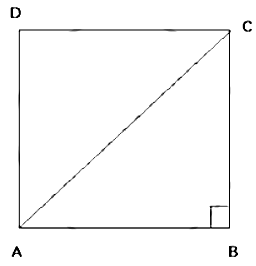
By Pythagoras theorem, Inrt $\triangle ABC$ :
Solution is as follow:
$AC ^2= AB ^2+ BC ^2$
${\left[\frac{(x+1)}{2}\right]^2+\left[\frac{(x+1)}{2}\right]^2=\left[\frac{3-x}{\sqrt{2}}\right]^2} $
$\Rightarrow\left[\frac{(x+1)}{4}\right]^2+\left[\frac{(x+1)}{4}\right]^2=\left[\frac{(3-x)}{2}\right]^2 $
$\Rightarrow\left[\frac{(x+1)^2}{2}\right]=\left[\frac{\left(9+x^2-6 x\right)}{2}\right] $
$\Rightarrow\left( x ^2+1+2 x \right)-\left(9+ x ^2-6 x \right)=0 $
$\Rightarrow 8 x -8=0 $
$\Rightarrow x =1$ units. View full question & answer→Question 375 Marks
In a two digit number, the ratio of the digits at the unit's place and the ten's place is $3:2.$ If the digits are reversed, the resulting number is $27$ more than the original number. Find the two digit number.
AnswerLet the units place be $x$ and tens place be $y$.
Then, the two$-$digit number is $10 y + x$.
Glven, $x: y=3: 2$
If the digits are reversed,
The reversed number is $10 x+y$.
The original number is $10 y + x$.
Given the resulting number with reversed digits is $27$ more than the original number.
$\Rightarrow 10 x+y-27=10 y+x $
$\Rightarrow 9 x-9 y-27=0 $
$\Rightarrow x=y+3 \cdots(2) $
Using $(2)$ in $(1)$, gives:
$\frac{y+3}{y}=\frac{3}{2} $
$\Rightarrow 2 y+6=3 y $
$\Rightarrow y=6$
Thus, $x=y+3=9$
The number is $10 y+x=10 \times 6+9=69$.
View full question & answer→Question 385 Marks
In a two$-$digit number, the digit at the ten's place is $4$ times the digit at the unit's place.The sum of the digits and the number is $92$. Find the two digit number.
AnswerLet the units place be $x$ and tens place be $y.$
Then, the two$-$digit number is $10y + x.$
Given, the digit at the ten's place is $4$ times the digit at the unit's place.
$\Rightarrow y = 4x\dots...(1)$
Also, sum of the digits and the number is $92.$
$\Rightarrow x + y + (10y + x) = 92$
$\Rightarrow 11y + 2x = 92\dots...(2)$
Solving $(1)$ and $(2)$, we get:
$11 \times 4x + 2x = 92$
$46x = 92$
$\Rightarrow x = 2$
So, $y = 8$
Then, the two$-$digit number is $10 x 8 + 2 = 82..$
View full question & answer→Question 395 Marks
The denominator of a fraction is $18$ more than the numerator. If $1$ is added to both the numerator and denominator, the value of the fraction equals the value of fraction obtained by adding $8$ to the numerator and $15$ to the denominator. Find the fraction.
AnswerLet the fraction be $\frac{x}{y}$.
Given, The denominator of a fraction is $18$ more than the numerator.
i.e. $x=y-18$
or $y-x=18$
Also, If is added to both the numerator and denominator, the value of the fraction equals the value of fraction obtained by adding $8$ to the numerator and $15$ to the denominator.
$\Rightarrow \frac{x+1}{y+1}=\frac{x+8}{y+15} $
$\Rightarrow \frac{x+1-(y+1)}{y+1}=\frac{x+8-(y+15)}{y+15} $
$\Rightarrow \frac{x-y}{y+1}=\frac{x-y-7}{y+15} $
$\Rightarrow \frac{-18}{y+1}=\frac{-18-7}{y+15} $
$\Rightarrow \frac{18}{y+1}=\frac{25}{y+15} $
$\Rightarrow 18 y+18 \times 15=25 y+25 $
$\Rightarrow 7 y=245 $
$\Rightarrow y=35 .$
Hence, $x=y-18=35-18=17$
The fraction is $\frac{17}{35}$.
View full question & answer→Question 405 Marks
For two consecutive odd natural numbers, the square of bigger number exceeds the square of smaller number by $72.$ Find the two numbers.
AnswerLet the two consecutive even natural number be $2 x+1$ and $2 x+3$.
As per the given condition,
$(2 x+3)^2-(2 x+1)^2=72 $
$\Rightarrow 4 x^2+12 x+9-\left[4 x^2+4 x+1\right]=72 $
$\Rightarrow 4 x^2+12 x+9-4 x^2-4 x-1=72 $
$\Rightarrow 12 x+9-4 x-1=72 $
$\Rightarrow 8 x=64 $
$\Rightarrow x=\frac{64}{8} $
$\Rightarrow x=8 $
$2 x+1=2(8)+1=16+1=17$ and $2 x+3=2(8)+3=16+3=19$
Hence, the numbers are $17$ and $19 .$
View full question & answer→Question 415 Marks
The sum of the squares of two consecutive odd natural numbers is $650$. Find the two numbers.
AnswerLet the two consecutive od number be $2n + 1$ and $2n + 3$,
where $n$ is a natural number.
Given, $(2n + 3)^2 + (2n + 1)^2 = 650$
$\Rightarrow (4n^2 + 9 + 12n) + (4n^2 + 1 + 4n) = 650$
$\Rightarrow 8n^2 + 10 + 16n = 650$
$\Rightarrow 8n^2 + 16n - 640 = 0$
$\Rightarrow n^2 + 2n - 80 = 0$
$\Rightarrow n^2+ 10n - 8n - 80 = 0$
$\Rightarrow n(n + 10) - 8(n + 10) = 0$
$\Rightarrow (n - 8) (n + 10) = 0$
Thus, $n = 8$ as $n = -10$ is not possible.
Thus, the two consecutive od natural numbers are $17$ and $19.$
View full question & answer→Question 425 Marks
The difference of the squares of two consecutive even natural numbers is $68.$ Find the two numbers.
AnswerLet the two consecutive even natural numbers be $2 x$ and $2 x+2$.
As per the given condition,
$(2 x+2)^2-(2 x)^2=68 $
$\Rightarrow 4 x^2+8 x+4-4 x^2=68 $
$\Rightarrow 8 x+4=68 $
$\Rightarrow 8 x=64 $
$\Rightarrow x=\frac{64}{8} $
$\Rightarrow x=8 $
$2 x=2(8) $
$=16$ and $2 x+2 $
$=2(8)+2 $
$=16+2 $
$=18$
Hence, the numbers are $16$ and $18.$
View full question & answer→Question 435 Marks
If $a =\frac{2 x-3}{5}, b =\frac{3 x-2}{3}$ and $2(3 a - b )+1=0$, find the value of $' x\ '.$
AnswerGiven $a =\frac{2 x-3}{5}, b =\frac{3 x-2}{3}$
Consider,
$2(3 a-b)+1=0$
Substituting the expressions for $a$ and $b$ in the equation, we get
$2\left[3\left(\frac{2 x-3}{5}\right)-\frac{3 x-2}{3}\right]+1=0 $
$\Rightarrow 2\left[\frac{6 x-9}{5}-\frac{3 x-2}{3}\right]+1=0 $
$\Rightarrow 2\left[\frac{3(6 x-9)-5(3 x-2)}{15}\right]+1=0 $
$\Rightarrow 2\left[\frac{18 x-27-15 x+10}{15}\right]+1=0 $
$\Rightarrow 2\left[\frac{3 x-7}{15}\right]+1=0 $
$\Rightarrow 2\left[\frac{3 x-7}{15}\right]=-1 $
$\Rightarrow 3 x-7=-1\left(\frac{15}{2}\right) $
$\Rightarrow 3 x-7=-\frac{15}{2} $
$\Rightarrow 3 x=-\frac{15}{2}+7 $
$\Rightarrow 3 x=\frac{-15+14}{2} $
$\Rightarrow x=-\frac{1}{6}$
View full question & answer→Question 445 Marks
If $7(3 - 4x) = 1,$ evaluate $2x^2 + 7x + 6$
Answer$7(3-4 x)=1$
$\Rightarrow 21-28 x=1$
$\Rightarrow 20=28 x$
$\Rightarrow x=\frac{20}{28}$
$\Rightarrow x=\frac{5}{7}$
$2 x^2+7 x+6$
$=2\left(\frac{5}{7}\right)^2+7\left(\frac{5}{7}\right)+6$
$=2\left(\frac{25}{49}\right)+7\left(\frac{5}{7}\right)+6$
$=\frac{50}{49}+5+6$
$=\frac{50}{49}+11$
$=\frac{50+539}{49}$
$=\frac{589}{49} .$
View full question & answer→Question 455 Marks
If $\frac{2}{ m } \times 1 \frac{1}{5}=\frac{3}{7}$ of $2 \frac{1}{2}$, find the value of $' m\ '$.
Answer$\frac{2}{ m } \times 1 \frac{1}{5}=\frac{3}{7}$ of $2 \frac{1}{2} $
means $\frac{2}{ m } \times 1 \frac{1}{5}=\frac{3}{7} \times 2 \frac{1}{2}$
$ \Rightarrow \frac{2}{ m } \times \frac{6}{5}=\frac{3}{7} \times \frac{5}{2} $
$ \Rightarrow \frac{12}{5 m }=\frac{15}{14}$
$\Rightarrow(12)(14)=(15)(5\ m ) $
$ \Rightarrow \frac{12 \times 14}{15 \times 15}= m$
$\Rightarrow m =\frac{56}{25} .$
View full question & answer→Question 465 Marks
Solve the following equations for the unknown: $2 \sqrt{\frac{x-3}{x+5}}=\frac{1}{3}$
Answer$2 \sqrt{\frac{x-3}{x+5}}=\frac{1}{3} $
$ \Rightarrow\left(2 \sqrt{\frac{x-3}{x+5}}\right)^2=\left(\frac{1}{3}\right)^2$
$ \Rightarrow 4\left(\frac{x-3}{x+5}\right)=\frac{1}{9} $
$ \Rightarrow \frac{4 x-12}{x+5}=\frac{1}{9} $
$ \Rightarrow 9(4 x-12)=x+5$
$ \Rightarrow 36 x-108=x+5$
$ \Rightarrow 35 x=113 $
$\Rightarrow x=\frac{113}{35} .$
View full question & answer→Question 475 Marks
Solve the following equations for the unknown: $\frac{7 x-1}{4}-\frac{1}{3}\left(2 x-\frac{1-x}{2}\right)=5 \frac{1}{3}$
Answer$\frac{7 x-1}{4}-\frac{1}{3}\left(2 x-\frac{1-x}{2}\right)=5 \frac{1}{3} $
$\Rightarrow \frac{7 x-1}{4}-\frac{2 x}{3}+\frac{1-x}{6}=\frac{16}{3}$
$\text{LCM}$ of all the denominators is $12.$
Multiply the equation throughout by the $\text{LCM}.$
$\Rightarrow \frac{3(7 x-1)}{12}-\frac{4(2 x)}{12}+\frac{2(1-x)}{12}=16(4) $
$\Rightarrow \frac{21 x-3}{12}-\frac{8 x}{12}+\frac{2-2 x}{12}=64 $
$\Rightarrow 21 x-3-8 x+2-2 x=64 $
$\Rightarrow 11 x=64+3-2 $
$\Rightarrow 11 x=65 $
$\Rightarrow x=\frac{65}{11}$
View full question & answer→Question 485 Marks
Solve the following equations for the unknown: $2+\frac{3 x-2}{3 x+2}=\frac{3 x+2}{x+1}$
Answer$2+\frac{3 x-2}{3 x+2}=\frac{3 x+2}{x+1} $
$ \Rightarrow 2=\frac{3 x+2}{x+1}-\frac{3 x-2}{3 x+2} $
$ \Rightarrow 2=\frac{(3 x+2)(3 x+2)-(3 x-2)(x+1)}{(x+1)(3 x+2)} $
$\Rightarrow 2(x+1)(3 x+2)=(3 x+2)(3 x+2)-(3 x-2)(x+1)$
$ \Rightarrow 2\left[3 x^2+2 x+3 x+2\right]=\left[9 x^2+6 x+6 x+4\right]-\left[3 x^2+3 x-2 x-2\right] $
$ \Rightarrow 6 x^2+4 x+6 x+4=9 x^2+6 x+6 x+4-3 x^2-3 x+2 x+2 $
$ \Rightarrow 4 x=6 x-3 x+2 x+2$
$ \Rightarrow-x=2 $
$ \Rightarrow x=-2$
View full question & answer→Question 495 Marks
Solve the following equations for the unknown: $\frac{1}{2}\left(y-\frac{1}{3}\right)+\frac{1}{4}\left(2 y+\frac{1}{5}\right)=\frac{3}{4}\left(y-\frac{1}{12}\right)$
Answer$\frac{1}{2}\left(y-\frac{1}{3}\right)+\frac{1}{4}\left(2 y+\frac{1}{5}\right)=\frac{3}{4}\left(y-\frac{1}{12}\right) $
$ \Rightarrow \frac{y}{2}-\frac{1}{6}+\frac{y}{2}+\frac{1}{20}=\frac{3 y}{4}-\frac{1}{16} $
$ \Rightarrow \frac{y}{2}+\frac{y}{2}-\frac{3 y}{4}=-\frac{1}{16}+\frac{1}{6}-\frac{1}{20} $
$ \Rightarrow y-\frac{3 y}{4}=-\frac{1}{16}+\frac{1}{6}-\frac{1}{20} $
$ \Rightarrow \frac{4 y-3 y}{4}=-\frac{-15+40-12}{240} $
$\Rightarrow \frac{y}{4}=\frac{13}{240} $
$ \Rightarrow y=\frac{13}{240} \times 4 $
$ \Rightarrow y=\frac{13}{60} .$
View full question & answer→Question 505 Marks
Solve the following equations for the unknown $:2 \frac{1}{5}-\frac{x-2}{3}=\frac{x-1}{3}$
Answer$2 \frac{1}{5}-\frac{x-2}{3}=\frac{x-1}{3} $
$ \Rightarrow \frac{11}{5}-\frac{x-2}{3}=\frac{x-1}{3}$
$ \Rightarrow \frac{11}{5}=\frac{x-1}{3}+\frac{x-2}{3}$
$\Rightarrow \frac{11}{5}=\frac{x-1+x-2}{3} $
$\Rightarrow \frac{11}{5}=\frac{2 x-3}{3}$
$ \Rightarrow 10 x-15=33$
$\Rightarrow 10 x=48 $
$ \Rightarrow x=4.8 .$
View full question & answer→