Questions

[3 marks sum]

🎯

Test yourself on this topic

10 questions · timed · auto-graded

Question 13 Marks
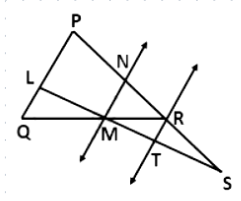
In the given figure, $PS = 3RS. M$ is the midpoint of $QR.$ If $TR \| MN \| QP,$ then prove that:
Image
$RT =\frac{1}{3} PQ$
Answer
Proof:
$R$ and $T$ are the mid-points of $NS$ and $MS$ respectively.
$ \Rightarrow RT =\frac{1}{2} MN $
$M$ and $N$ are the mid-points of $LT$ and $PR$ respectively.
$ \Rightarrow MN =\frac{1}{2} PQ $
So, $RT =\frac{1}{2}\left(\frac{1}{2} PQ \right)$
$ \Rightarrow RT =\frac{1}{4} PQ $
View full question & answer
Question 23 Marks
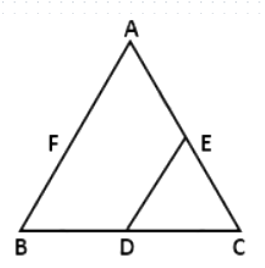
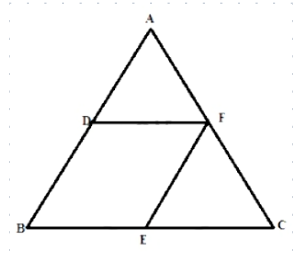
In $\triangle ABC, D$ and $E$ are the midpoints of the sides $AB$ and $BC$ respectively. $F$ is any point on the side $AC.$ Also, $EF$ is parallel to $AB.$ Prove that $\text{BFED}$ is a parallelogram.
Image
Remark: Figure is incorrect in Question
Answer
Image
From the figure $EF \| AB$ and $E$ is the midpoint of $BC.$
Therefore, $F$ is the midpoint of $AC.$
Here $EF \| BD, EF = BD$ as $D$ is the midpoint of $AB.$
$BE \| DF, BE = DF$ as $E$ is the midpoint of $BC.$
Therefore $\text{BEFD}$ is a parallelogram.
Remark: Figure modified.
View full question & answer
Question 33 Marks
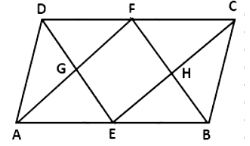
In a parallelogram $\text{ABCD}, E$ and $F$ are the midpoints of the sides $AB$ and $CD$ respectively. The line segments $AF$ and $BF$ meet the line segments $DE$ and $CE$ at points $G$ and $H$ respectively Prove that$: \triangle GEA \cong \triangle GFD$
Answer
Image
Since $\text{ABCD}$ is a parallelogram,
$AB = CD$ and $AD = BC$
Now, $E$ and $F$ are the mid$-$points of $AB$ and $CD$ respectively,
$\Rightarrow AE = EB = DF = FC ....(i)$
In $\triangle GEA$ and $\triangle GFD,$
$AE = DF ....[$From $(i)]$
$\angle AGE = \angle DGF ....($vertically opposite angles$)$
$\angle GAE = \angle GFD ....($Alternate interior angles$)$
$\therefore \triangle GEA ≅ \triangle GFD.$
View full question & answer
Question 43 Marks
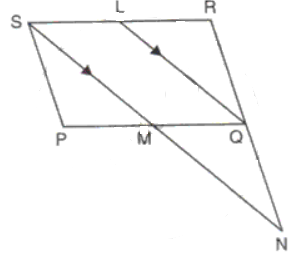
In parallelogram $\text{PQRS, L}$ is mid$-$point of side $SR$ and $SN$ is drawn parallel to $LQ$ which meets $RQ$ produced at $N$ and cuts side $PQ$ at $M.$ Prove that $M$ is the mid$-$point of $PQ.$
Image
Answer
ln $\triangle \text{NSR}$
$\ce{MQ =\frac{1}{2} SR}$
But $L$ is the mid$-$point of $\ce{SR}$ and $\ce{SR=PQ}...($ sides of a parallelogram$)$
$\ce{MQ =\frac{1}{2} PQ}$
$\ce{MQ = PM = LS = LR}$
Therefore, $M$ is the mid$-$point of $\ce{PQ}$.
View full question & answer
Question 53 Marks
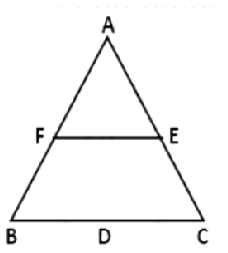
In $\triangle ABC, D, E, F$ are the midpoints of $BC, CA$ and $AB$ respectively. Find $DE,$ if $AB = 8 \ cm$
Answer
Image
$D$ is the mid $-$ point $B C$ and $E$ is the mid $-$ point of $A C$.
$\therefore DE =\frac{1}{2} AB \ldots .($Midpoint Theorem$)$
$=\frac{1}{2} \times 8$
$=4 \ cm .$
View full question & answer
Question 63 Marks
In $\triangle \text{ABC, D, E, F}$ are the midpoints of $\text{BC, CA}$ and $\text{AB}$ respectively. Find $\text{FE,}$ if $\text{BC} = 14 \ cm$
Answer
Image
$F$ is the mid$-$point $AB$ and $E$ is the mid$-$point of $A C$.
$\therefore \ce{FE =\frac{1}{2} BC} ....($ Mid$-$pointTheorem$)$
$=\frac{1}{2} \times 14$
$=7 \ cm .$
View full question & answer
Question 73 Marks
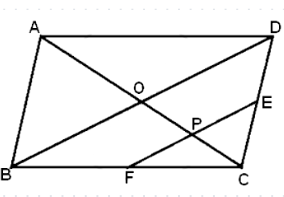
$A B C D$ is a parallelogram. $E$ is the mid-point of $C D$ and $P$ is a point on $A C$ such that $P C=\frac{1}{4} A C$. $E P$ produced meets $B C$ at $F$. Prove that: $2 E F=B D$.
Answer
Image
In $\triangle B C D, E$ and $F$ are the mid$-$points of $D C$ and $B C$ respectively.
Also $EF \| BD$
Therefore, $EF =\frac{1}{2} BD$
$\Rightarrow 2 EF = BD$
View full question & answer
Question 83 Marks
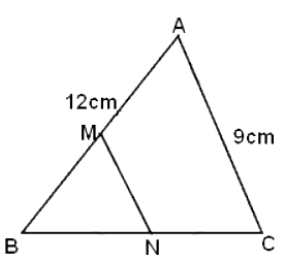
In $\triangle ABC, AB = 12 \ cm$ and $AC = 9 \ cm.$ If $M$ is the mid$-$point of $AB$ and a straight line through $M$ parallel to $AC$ cuts $BC$ in $N,$ what is the length of $MN$?
Answer
Image
$MN \| AC$ and $M$ is mid$-$point of $AB$
Therefore, $N$ is mid$-$point of $BC$
Hence, $MN =\frac{1}{2} AC =\frac{9}{2} \ cm =4.5 \ cm$.
View full question & answer
Question 93 Marks
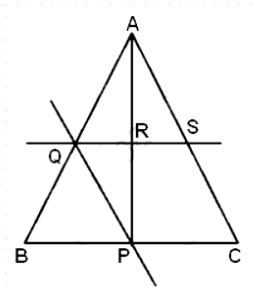
In $\triangle ABC, P$ is the mid$-$point of $BC.$ A line through $P$ and parallel to $CA$ meets $AB$ at point $Q,$ and a line through $Q$ and parallel to $BC$ meets median $AP$ at point $R.$ Prove that$: AP = 2AR$
Answer
Image
In $\triangle ABC,$
$P$ is the mid$-$point of $BC$ and $PQ$ is parallel to $AC$
Therefore, $Q$ is the mid$-$point of $AB.$
In $\triangle ABP,$
$Q$ is the mid$-$point of $AB$ and $QR$ is parallel to $BP$
Therefore, $R$ is the mid$-$point of $AP.$
$AR = RP$
But $AR + RP = AP$
$\Rightarrow AR + AR = AP$
$\Rightarrow 2AR = AP$ or $AP = 2AR.$
View full question & answer
Question 103 Marks
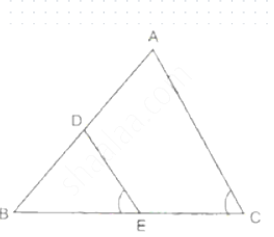
In $\triangle ABC, D$ is the mid$-$point of $AB$ and $E$ is the mid$-$point of $BC.$
Image
Calculate:
$(i) DE,$ if $AC = 8.6 \ cm$
$(ii) \angle DEB,$ if $\angle ACB = 72^\circ $
Answer
In $\triangle A B C$,
Since $D$ and $E$ are the mid$-$point of $A B$ and $B C$ respectively
Therefore, by mid$-$point theorem $DE \| AC$ and $DE = \frac{1}{2} AC$
(i) $DE =\frac{1}{2}, AC =\frac{1}{2} \times 8.6 cm =4.3 cm$
(ii) $\angle DEB =\angle C =72^{\circ}. ...($corresponding angles, since $D E \| A C)$
View full question & answer
[3 marks sum] - MATHEMATICS STD 9 Questions - Vidyadip