Questions

[5 marks sum]

🎯

Test yourself on this topic

14 questions · timed · auto-graded

Question 15 Marks
In $\triangle ABC, D$ and $E$ are the midpoints of the sides $AB$ and $AC$ respectively. $F$ is any point on the side $BC$. If $DE$ intersects $AF$ at $P$ show that $DP = PE$.
Answer
Note $:$ This question is incomplete.
According to the information given in the question,
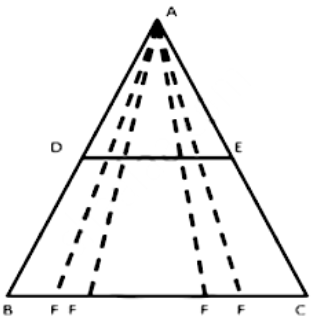
$F$ could be any point on $BC$ as shown below:
Image
So, this makes it impossible to prove that $DP = DE,$
Since $P$ too would shift as $F$ shift because $P$ too would be any point on $DE$ as $F$ is.
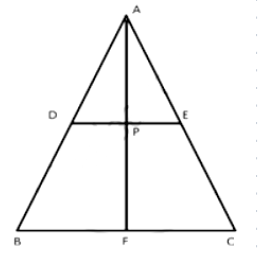
Note $:$If we are given $F$ to be the mid $-$ point of $BC,$ the result can be proved.
Image
$D$ and $E$ are the mid$-$points of $A B$ and $A C$ respectively.
$D E \| B C$ and $D E=\frac{1}{2} B C$ But $F$ is the mid $-$ point of $B C$.
$ \Rightarrow BF = FC =\frac{1}{2} BC = DE $
Since $D$ is the mid $-$ point of $A B$, and $D P \| E F, P$ is the midpoint of $AF$.
Since $P$ is the mid $-$ point of $A F$ and $E$ is the mid $-$ point of $AC$
$ PE =\frac{1}{2} FC $
Also, $D$ and $P$ are the mid $-$ points of $A B$ and $A F$ respectively.
$ \Rightarrow DP =\frac{1}{2} BF$
$=\frac{1}{2} FC$
$= PE \ldots .($Since $ BF = FC)$
$\Rightarrow DP = PE . $
View full question & answer
Question 25 Marks
The diagonals $AC$ and $BD$ of a quadrilateral $\text{ABCD}$ intersect at right angles. Prove that the quadrilateral formed by joining the midpoints of quadrilateral $\text{ABCD}$ is a rectangle.
Answer
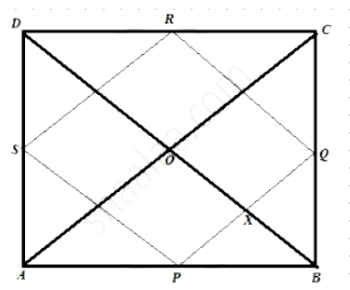
The figure is as below:
Image
Let $\text{ABCD}$ be a quadrilateral where $P, Q, R, S$ are the midpoint of sides $AB, BC, CD, DA$ respectively.
Diagonals $AC$ and $BD$ intersect at right angles at point $O$.
We need to show that $\text{PQRS}$ is a rectangle
Proof:
In $ΔABC$ and $ΔADC,$
$2PQ = AC$ and $PQ \| AC    ....(1)$
$2RS = AC$ and $RS \| AC     ....(2)$
From $(1)$ and $(2),$ we get
$PQ = RS$ and $PQ \| RS$
Similarly, we can show that
$PS = RQ$ and $PS \| RQ$
Therefore, $\text{PQRS}$ is a parallelogram.
Now, $PQ \| AC,$
$∴ ∠AOD = ∠PXO = 90°     ....($Corresponding angles$)$
Again, $BD \| RQ,$
$∴ ∠PXO = ∠RQX = 90°     ....($Corresponding angles$)$
Similarly, $∠QRS = ∠RSP = SPQ = 90°$
Therefore, $\text{PQRD}$ is a rectangle.
View full question & answer
Question 35 Marks
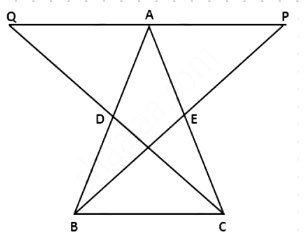
In $\triangle ABC$, the medians $BE$ and $CD$ are produced to the points $P$ and $Q$ respectively such that $BE = EP$ and $CD = DQ$. Prove that: $QA$ and $P$ are collinear.
Answer
Image
In $\triangle BDC$ and $\triangle ADQ,$
$CD = DQ ....($given$)$
$\angle BDC = \angle ADQ ....($vertically opposite angle$s)$
$BD = AD ....(D$ is the mid$-$point of $AB)$
$\therefore \triangle BDC \cong \triangle ADQ $
$\Rightarrow \angle DBC = \angle DAQ (\text{c.p.c.t})....(i)$
And, $BC = AQ (\text{c.p.c.t})....(ii)$
Similarly, we can prove $\triangle CEB \cong \triangle AEP$
$\Rightarrow \angle ECB = \angle EAP (\text{c.p.c.t})....(iii)$
And, $BC = AP (\text{c.p.c.t})....(iv)$
In $\triangle ABC,$
$\angle ABC + \angle ACB ++ \angle BAC = 180^\circ $
$\Rightarrow \angle DBC + \angle ECB + \angle BAC = 180^\circ $
$\Rightarrow \angle DAQ + \angle EAP + \angle BAC = 180^\circ ...[$From $(i)$ and $(iii)]$
$\Rightarrow Q, A, P$ are collinear.
View full question & answer
Question 45 Marks
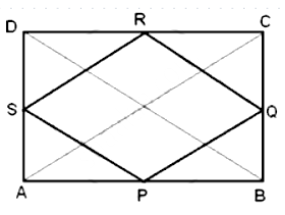
Prove that the figure obtained by joining the mid-points of the adjacent sides of a rectangle is a rhombus.
Answer
Image
Join $AC$ and $BC.$
In $\triangle A B C, P$ and $Q$ are the mid$-$point of $A B$ and $B C$ respectively.
$PQ =\frac{1}{2} AC .....(i)$ and $PQ \| AC$
In $\triangle B D C, R$ and $Q$ are the mid$-$points of $C D$ and $B C$ respectively.
$QR =\frac{1}{2} BD......(ii)$ and $QR \| BD$
But $A C=B D...($diagonals of a rectangle$)$
From $(i)$ and $(ii)$
$P Q=Q R$
Similarly, $Q R=R S, R S=S P$ and $R S\|A C, S P\| B D$
Hence, $PQ = QR = PS = SP$
Therefore, $\text{PQRS}$ is a rhombus.
View full question & answer
Question 55 Marks
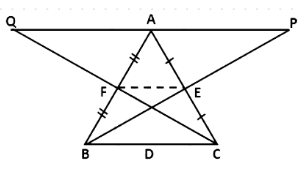
In $\triangle ABC, BE$ and $CF$ are medians. $P$ is a point on $BE$ produced such that $BE = EP$ and $Q$ is a point on $CF$ produced such that $CF = FQ$. Prove that : $A$ is the mid $-$ point of $PQ$.
Answer
Image
Since $B E$ and $C F$ are medians, $F$ is the mid $-$ point of $A B$ and $E$ is the mid $-$ point of $A C$.
Now, the line joining the mid $-$ point of any two sides is parallel and half of the third side, we have In $\triangle A C Q$,
$ EF \| AQ $ and $ EF =\frac{1}{2} AQ....(i) $
In $\triangle A B P$,
$ EF \| AP $ and $ EF =\frac{1}{2} AP....(ii)$
From $(i)$ and $(ii)$
$ EF =\frac{1}{2} AQ$ and $EF =\frac{1}{2} AP$
$\Rightarrow \frac{1}{2} AQ =\frac{1}{2} AP$
$\Rightarrow AQ = AP $
$\Rightarrow A$ is the mid $-$ point of $QP.$
View full question & answer
Question 65 Marks
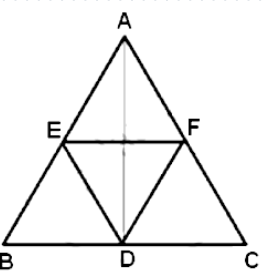
$\triangle ABC$ is an isosceles triangle with $AB = AC. D, E$ and $F$ are the mid $-$ points of $BC, AB$ and $AC$ respectively. Prove that the line segment $AD$ is perpendicular to $EF$ and is bisected by it.
Answer
Image
Since the segment joining the mid $-$ points of two sides of a triangle is parallel to third side and is half of it,
Therefore,
$ D E \| A B, D E=\frac{1}{2} A B $
Also,
$ D F \| A C, D F=\frac{1}{2} A C $
But $A B=A C$
$ \Rightarrow \frac{1}{2} AB =\frac{1}{2} AC$
$\Rightarrow DF = DE ....(i)$
$DE =\frac{1}{2} AB $
$ \Rightarrow DE = AF $
And $D F=\frac{1}{2} A C$
$ \Rightarrow DF = AE ....(ii) $
$\Rightarrow \text{DEAF}$ is a rhombus.
$\Rightarrow$ Diagonals $AD$ and $EF$ bisect each other at right angles.
$\Rightarrow AD$ perpendicular to $EF$ and $AD$ is bisected by $EF.$
View full question & answer
Question 75 Marks
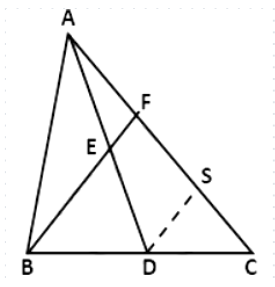
$AD$ is a median of side $BC$ of $\text{ABC}. E$ is the midpoint of $AD. BE$ is joined and produced to meet $AC$ at $F$. Prove that $AF: AC = 1 : 3$.
Answer
Construction: Draw $DS \| BF,$ meeting $AC$ at $S$.
Image
Proof:
In $\triangle B C F, D$ is the mid $-$ point of $AC$ and $DS \| B F$.
$\therefore S$ is the mid $-$ point of $CF$.
$\Rightarrow CS = SF...(i)$
In $\triangle A D S, E$ is the mid $-$ point of $A D$ and $E F \| D S$.
$\therefore F$ is the mid $-$ point of $A S$.
$ \Rightarrow AF = FS ...(ii) $
From $(i)$ and $(ii),$ we get
$ A F=F S=S C$
$\Rightarrow A C=A F=F S+S C$
$\Rightarrow A C=A F+A F+A F$
$\Rightarrow A C=3 A F$
$\Rightarrow \frac{A F}{A C}=\frac{1}{3}$
$\Rightarrow A F: A C=1: 3 . $
View full question & answer
Question 85 Marks
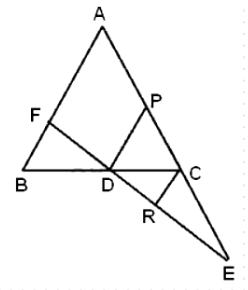
Side $A C$ of a $\text{ABC}$ is produced to point $E$ so that $C E= \frac{1}{2} A C$. $D$ is the mid $-$ point of $B C$ and $ED$ produced meets $A B$ at $F$. Lines through $D$ and $C$ are drawn parallel to $A B$ which meets $A C$ at point $P$ and $E F$ at point $R$ respectively. Prove that$: \ 4 C R=A B$.
Answer
Image
In $\triangle DEP,$
$C$ and $R$ are the mid $-$ points of $P E$ and $D E$ respectively.
Also, $DP \| RC$
$ \therefore CR =\frac{1}{2} DP \ldots . . . \text { (i) } $
In $\triangle ABC,$
$D$ and $P$ are the mid $-$ points of $B C$ and $A C$ respectively.
Also, $DP \| AB$
$ \therefore DP =\frac{1}{2} AB \ldots(ii) $
Substituting the value of $DP$ from $(ii)$ and $(i)$
$ \Rightarrow CR =\frac{1}{2}\left(\frac{1}{2} AB \right)$
$\Rightarrow CR =\frac{1}{4} AB$
$\therefore 4 CR = AB . $
View full question & answer
Question 95 Marks
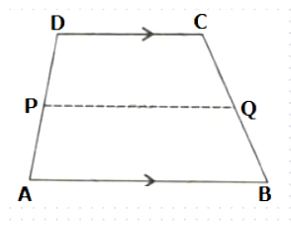
In the given figure, $\text{ABCD}$ is a trapezium. $P$ and $Q$ are the midpoints of non $-$ parallel side $AD$ and $BC$ respectively. Find: $DC,$ if $AB = 20 \ cm$ and $PQ = 14 \ cm$
Image
Answer
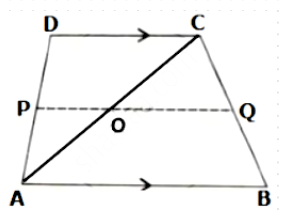
Let us draw a diagonal $AC$ which meets $PQ$ at $O$ as shown below$:$
Image
Given $A B=20 \ cm$ and $P Q=14 \ cm$
In $\triangle ABC$,
$ OQ =\frac{1}{2} AB \ldots .($ Mid $-$ point Theorem$)$
$\Rightarrow OP =\frac{1}{2} \times 20=10 \ cm $
Now,
$ O P=P Q-O Q$
$\Rightarrow O P=14-10$
$=4 \ cm $
In $\triangle ADC \text {, } $
$ OP =\frac{1}{2} DC \ldots .($Mid $-$ point Theorem$)$
$\Rightarrow DC =2 \times OP$
$=2 \times 4$
$=8 \ cm . $
View full question & answer
Question 105 Marks
In the given figure $, \text{ABCD}$ is a trapezium. $P$ and $Q$ are the midpoints of non $-$ parallel side $AD$ and $BC$ respectively. Find$: \ AB,$ if $DC = 8 \ cm$ and $PQ = 9.5 \ cm$
Image
Answer
Let us draw a diagonal $AC$ which meets $PQ$ at $O$ as shown below$:$
Image
Given $DC =8 \ cm$ and $PQ =9.5 \ cm$
In $\triangle ADC,$
$OP =\frac{1}{2} DC ....($Mid $-$ point Theorem$)$
$\Rightarrow OP =\frac{1}{2} \times 8=4 \ cm$
Now,
$ OQ = PQ - OP$
$\Rightarrow OQ =9.5-4$
$=5.5 \ cm $
In $\triangle ABC,$
$OQ =\frac{1}{2} AB ....($Mid $-$ point Theorem$)$
$ \Rightarrow AB =2 \times OQ$
$=2 \times 5.5$
$=11 \ cm $.
View full question & answer
Question 115 Marks
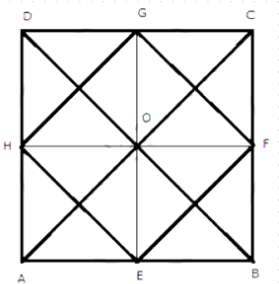
Show that the quadrilateral formed by joining the mid $-$ points of the adjacent sides of a square is also a square.
Answer
Image
Join $A C$ and $B D$
In $\triangle A C D, G$ and $H$ are the mid $-$ points of $D C$ and $A C$ respectively.
Therefore, $GH \| AC$ and $GH =\frac{1}{2} AC .....(i)$
In $\triangle A B C, E$ and $F$ are the mid $-$ points of $A B$ and $B C$ respectively.
Therefore, $EF \| AC$ and $EF =\frac{1}{2} AC ....(i)$
From $(i)$ and $(ii)$
$EF \| GH$ and $EF = GH =\frac{1}{2} AC....(iii)$
Similarly, it can be proved that
$EF \| GH$ and $EH = GF =\frac{1}{2} BD.......(iv)$
But $ AC = BD ...($diagonals of a square are equal$)$
Dividing both sides by $2 ,$
$\frac{1}{2} BD =\frac{1}{2} AC .....(iv)$
But $A C=B D . .($diagonals of a square are equal$)$
Dividing both sides by $2 ,$
$ \frac{1}{2} BD =\frac{1}{2} AC $
From $(iii)$ and $(iv)$
$ EF = Gh = EH = GF $
Therefore, $\text{EFGH}$ is a parallelogram.
Now in $\triangle GOH$ and $\triangle GOF$
$OH = OF...($diagonals of a parallelogram bisect each other$)$
$ OG = O \ldots ($common$)$
$GH = GF$
$\therefore \Delta GOH \cong \triangle GOF$
$\therefore \angle GOH =\angle GOF $
Now,
$ \angle GOH +\angle GOF =180^{\circ}$
$\Rightarrow \angle GOH +\angle GOH =180^{\circ}$
$\Rightarrow 2 \angle GOH =180^{\circ}$
$\Rightarrow \angle GOH =90^{\circ} $
Therefore, diagonals of parallelogram $\text{EFGH }$ bisect each other and are perpendicular to each other.
Thus $\text{EFGH }$ is a square.
View full question & answer
Question 125 Marks
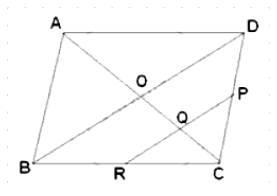
In parallelogram $\text{ABCD}, P$ is the mid $-$ point of $D C . Q$ is a point on $A C$ such that $C Q=\frac{1}{4} A C. P Q$ produced meets $B C$ at $R$. Prove that$:\ (i) R$ is the mid $-$ point of $B C$, and $(ii) PR =\frac{1}{2} DB$.
Answer
Image
$(i)$ Join $B$ and $D$.
Suppose $AC$ and $BD$ cut at $O$.
Then,
$ \text { OC }=\frac{1}{2} AC $
Now,
$ CQ =\frac{1}{4} AC$
$\Rightarrow CQ =\frac{1}{2} OC $
In $\triangle D C O, P$ and $Q$ are the mid $-$ points of $D C$ and $O C$ respectively.
$ \therefore PQ \| DO $
Also, in $\triangle C O B, Q$ is the mid $-$ point of $O C$ and $P Q \| O B$
Therefore $,R$ is the mid $-$ point of $B C, R$ being $P Q$ produced.
$(ii)$ In $\triangle B C D, P$ and $R$ are the mid $-$ points of $D C$ and $B C$ respectively.
Also $PR \| BD$
Therefore, $PR =\frac{1}{2} BD$.
View full question & answer
Question 135 Marks
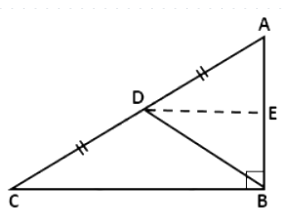
In a right$-$angled $\triangle A B C . \angle  B =90^{\circ}$ and $D$ is the midpoint of $A C$. Prove that$:\ B D=\frac{1}{2} A C$.
Answer
Image
Draw line segment $D E \| C B,$ which meets $A B$ at point $E$.
Now, $D E \| C B$ and $A B$ is the transversal,
$ \therefore \angle AED =\angle ABC ....($corrresponding angles$)$
$\angle ABC =90^{\circ} ....($given$)$
$\Rightarrow \angle AED =90^{\circ} $
Also, as $D$ is the mid $-$ point of $A C$ and $D E \| C B, $
$D E$ bisects side $A B,$
I.e.$ A E=B E ....(i) $
In $\triangle A E D$ and $\triangle B E D$,
$\angle AED =\angle BED \quad....($Each $\left.90^{\circ}\right)$
$AE = BE \quad....[$From $(i)]$
$DE = DE \quad....($Common$)$
$\therefore \triangle AED \cong \triangle BED ....($By $\text{SAS}$ Test$)$
$\Rightarrow A D=B D ....\ (\text{C.P.C.T.C})$
$\Rightarrow B D=A C$
$\Rightarrow BD =\frac{1}{2} AC$
View full question & answer
Question 145 Marks
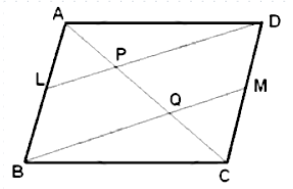
If $L$ and $M$ are the mid$-$points of $AB,$ and $DC$ respectively of parallelogram $\text{ABCD}$. Prove that segment $DL$ and $BM$ trisect diagonal $AC.$
Answer
Image
Since $L$ and $M$ are the mid$-$points of $A B$ and $D C$ respectively.
$ BL =\frac{1}{2} AB$ and $Dm =\frac{1}{2} DC . . . \text { (i) } $
But $\text{ABCD}$ is a parallelogram
Therefore, $A B=C D$ and $A B \| D C$
$\Rightarrow B L=D M$ and $B L \| D m...($from $(i))$
$\Rightarrow \text{BLDM}$ is a parallelogram.
$\Rightarrow DL \| Dm$
$\Rightarrow LP \| BQ.....(ii)$
It is known that the segment drawn through the mid$-$point of one side of a triangle and parallel to the other side bisects the third side.
In $\triangle A B Q, L$ is the mid-point of $A B$ and $M Q \| P D$
Therefore, $P$ is mid$-$point of $A Q$
Hence, $A P=P Q...(iii)$
Similarly, in $\triangle C P D, M$ is the mid-point of $C D$ and $L P \| B Q$
Therefore, $Q$ is mid$-$point of $C P$
Hence, $PQ = QC.....(iv)$
From $(iii)$ and $(iv)$
$ A P=P Q=Q C $
Therefore, $P$ and $Q$ trisect $AC$
Thus, $DL$ and $BM$ trisect $AC.$
View full question & answer
[5 marks sum] - MATHEMATICS STD 9 Questions - Vidyadip