Questions

[5 marks sum]

🎯

Test yourself on this topic

11 questions · timed · auto-graded

Question 15 Marks
If the quadrilateral formed by joining the mid-points of the adjacent sides of quadrilateral $\text{ABCD}$ is a rectangle,show that the diagonals $AC$ and $BD$ intersect at the right angle.
Answer
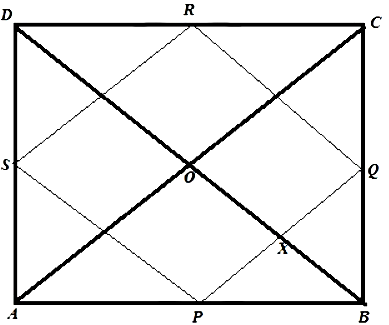
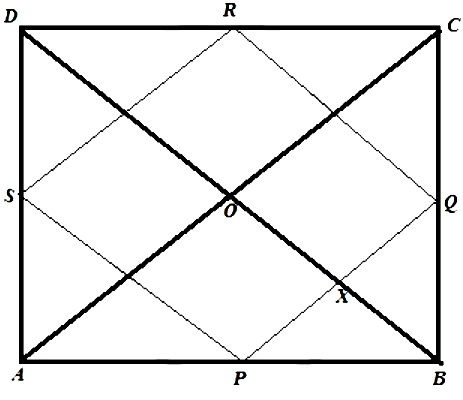
The figure is shown below

Let $\text{ABCD}$ be a quadrilateral where $P, Q, R, S$ are the midpoint of $A B, B C, C D, D A .$
$\text{PQRS}$ is a rectangle. Diagonal $A C$ and $B D$ intersect at point $O$.
We need to show that $AC$ and $BD$ intersect at a right angle.
Proof:
$PQ \| AC$, therefore $\angle AOD =\angle PXO\dots ...[$ Corresponding angle $]\dots...(1)$
Again $BD \| RQ$, therefore $\angle PXO =\angle RQX =90^{\circ} \ldots .[$ Corresponding
angle and angle of a rectangle $]\dots...(2)$
From $(1)$ and $(2)$ we get,
$\angle AOD =90^{\circ}$
Similarly,$\angle A O B=\angle B O C=\angle D O C=90^{\circ}$
Therefore diagonals $AC$ and $BD$ intersect at right angle.
Hence proved.
View full question & answer
Question 25 Marks
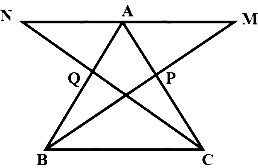
In $\triangle ABC$, the medians $BP$ and $CQ$ are produced up to points $M$ and $N$ respectively such that $BP = PM$ and $CQ = QN$. Prove that:
  1. $M, A$, and $N$ are collinear.
  2. $A$ is the mid$-$point of $MN.$
Answer
The figure is shown below

$(i)$ In $\triangle AQN \ \triangle BQC$
$AQ = QB ($Given$)$
$\angle AQN =\angle BQC$
$Q N=Q C$
$\therefore \triangle AQN \cong \triangle BQC\dots ...[$ by $\text{SAS }]$
$\therefore \angle QAN =\angle QBC\dots ...(1)$
And $B C=A N \ldots . .(2)$
Similarly, $\triangle APM \cong \triangle CPB\dots .....[$by $\text{SAS}]$
$\angle PAM =\angle PCB \dots...(3) [$by $\text{CPTC}]$
And $B C=A M\ldots . .(4)$
Now In $\triangle ABC _r$
$\angle ABC +\angle ACB +\angle BAC =180^{\circ}$
$\angle QAN +\angle PAM +\angle BAC =180^{\circ} \ldots[ (1), (2)$ we get $]$
Therefore $M , A , N$ are collinear.
$(ii)$ From $(3)$ and $(4) MA = NA$
Hence $A$ is the midpoint of $MN$.
View full question & answer
Question 35 Marks
The side $AC$ of a $\triangle ABC$ is produced to point $E$ so that $CE =AC. D$ is the mid$-$point of $BC$ and $ED$ produced meets $AB$ at $F$. Lines through $D$ and $C$ are drawn parallel to $AB$ which meet $AC$ at point $P$ and $EF$ at point $R$ respectively. Prove that: $(i) 3DF = EF;(ii) 4CR = AB.$
Answer
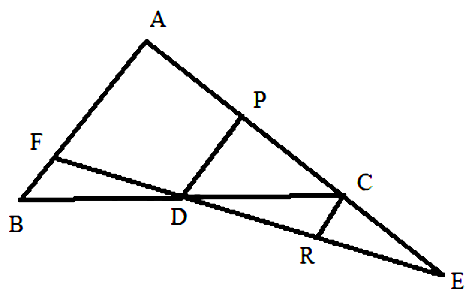
Consider the figure:

Here $D$ is the midpoint of $B C$ and $D P$ is parallel to $A B$, therefore $P$ is the midpoint of $A C$ and
$PD =\frac{1}{2} AB$
$(i)$ Again from the $\triangle AEF$, we have $AE \| PD \| CR$ and $AP =\frac{1}{3} AE$
Therefore $DF =\frac{1}{3} EF$ or we can say that $3 DF = EF$
Hence it is shown.
$(ii)$ From the $\triangle PED$, we have $PD \| C R$ and $C$ is the midpoint of $PE _t$
$\therefore CR =\frac{1}{2} PD$
Now,
$PD =\frac{1}{2} AB$
$ \frac{1}{2} PD =\frac{1}{4} AB$
$ CR =\frac{1}{4} AB$
$ 4 CR = AB$
Hence it is shown.
View full question & answer
Question 45 Marks
Adjacent sides of a parallelogram are equal and one of the diagonals is equal to any one of the sides of this parallelogram. Show that its diagonals are in ratio $\sqrt{3}:1.$
Answer
If adjacent sides of a parallelogram are equal, then it is a rhombus.
Now, the diagonals of a rhombus bisect each other and are perpendicular to each other.
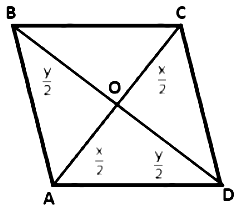
Let the lengths of the diagonals be $x$ and $y$.
Diagonal of length $y$ be equal to the sides of the rhombus.
Thus, each side of rhombus $=y$

Now, in right$-$angles $\triangle B O C$, by Pythagoras theorem
$OB ^2+ OC ^2= BC ^2$
$ \Rightarrow\left(\frac{y}{2}\right)^2+\left(\frac{x}{2}\right)^2=y^2$
$ \Rightarrow\left(\frac{x^2}{4}\right)=y^2-\frac{y^2}{4}$
$ \Rightarrow\left(\frac{x^2}{4}\right)=\frac{4 y^2-y^2}{4}$
$ \Rightarrow\left(\frac{x^2}{4}\right)=\frac{3 y^2}{4}$
$ \Rightarrow x^2=3 y^2$
$ \Rightarrow \frac{x^2}{y^2}=\frac{3}{1}$
$ \Rightarrow \frac{x}{y}=\frac{\sqrt{3}}{1}$
Thus, the diagonal are in the ratio $\sqrt{3}: 1$
View full question & answer
Question 55 Marks
A parallelogram $\text{ABCD}$ has $P$ the mid$-$point of $D C$ and $Q$ a point of Ac such that
$CQ =\frac{1}{4} AC . PQ$ produced meets $BC$ at $R$.

Prove that
$(i) R$ is the midpoint of $B C$
$(ii) PR =\frac{1}{2} DB$
Answer
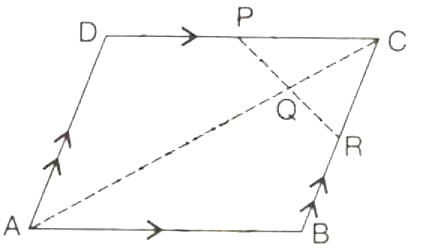
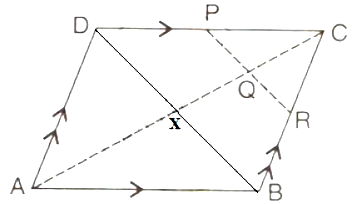
For help, we draw the diagonal $BD$ as shown below

The diagonal $AC$ and $BD$ cuts at point $X$.
We know that the diagonal of a parallelogram intersect equally with each other.
Therefore$A X=C X$ and $B X=D X$
Given,
$CQ =\frac{1}{4} AC$
$ CQ =\frac{1}{4} \times 2 CX$
$ CQ =\frac{1}{2} CX$
Therefore $Q$ is the midpoint of $CX$.
$(i)$ For $\triangle CDX PQ \| DX$ or $PR \| BD$
Since for triangle $C B X$
$Q$ is the midpoint of $C X$ and $Q R \| B X$.
Therefore $R$ is the midpoint of $B C$
$(ii)$ For triangle $B C D$
As $P$ and $R$ are the mid$-$point of $C D$ and $B C$,
 $\therefore P R=\frac{1}{2} D B$
View full question & answer
Question 65 Marks
The diagonals of a quadrilateral intersect at right angles. Prove that the figure obtained by joining the mid$-$points of the adjacent sides of the quadrilateral is rectangle.
Answer
The figure is shown below

Let $\text{ABCD}$ be a quadrilateral where $P, Q, R, S$ are the midpoint of $A B$, $B C, C D, D A$. Diagonal $A C$ and $B D$ intersect at a right angle at point $O$.
We need to show that $\text{PQRS}$ is a rectangle
Proof:
From and $\triangle ABC$ and $\triangle ADC$
$2 P Q=A C$ and $P Q \| A C\ldots . .(1)$
$2 RS = AC$ and $RS \| AC\ldots . .(2)$
From $(1)$ and $(2)$ we get,
$P Q=R S$ and $P Q \| R S$
Similarly, we can show that $P S=R Q$ and $P S \| R Q$
Therefore $\text{PQRS}$ is a parallelogram.
Now $PQ \| AC$, therefore $\angle AOD =\angle PXO =90^{\circ} \ldots[$ Corresponding angel $]$
Again $BD \| RQ$, therefore $\angle PXO =\angle RQX =90^{\circ} \ldots[$ Corresponding angel$]$
Similarly $\angle QRS =\angle RSP =\angle SPQ =90^{\circ}$
Therefore $\text{PQRS}$ is a rectangle.
Hence proved.
View full question & answer
Question 75 Marks
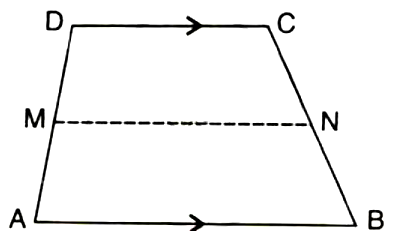
The figure, given below, shows a trapezium $\text{ABCD} . M$ and $N$ are the mid-point of the non$-$parallel sides $A D$ and $B C$ respectively. Find :

$(i) MN$, if $AB =11 \ cm$ and $DC =8 \ cm.(ii) A B$, if $D C=20 \ cm$ and $M N=27 \ cm.(iii) DC$, if $MN =15 \ cm$ and $AB =23 \ cm$.
Answer
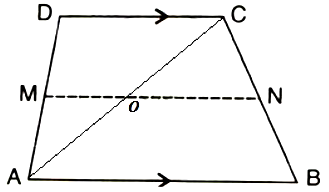
Let we draw a diagonal $AC$ as shown in the figure below,

$(i)$ Given that $AB =11 \ cm , CD =8 \ cm$ From$\triangle A B C$
$ON =\frac{1}{2} AB =\frac{1}{2} \times 11=5.5 \ cm$
From $\triangle A C D$
$OM =\frac{1}{2} CD =\frac{1}{2} \times 8=4 \ cm$
Hence $MN = OM + ON =(4+5.5)=9.5 \ cm$
$(ii)$ Given that $C D=20 \ cm , M N=27 \ cm$
From $\triangle A C D$
$OM =\frac{1}{2} CD =\frac{1}{2} \times 20=10 \ cm$
Therefore $O N=27-10=17 \ cm$
From $\triangle ABC$
$A B=2 O N=2 \times 17=34 \ cm$
$(iii)$ Given that $A B=23 \ cm , M N=15 \ cm$
From $\triangle ABC$
$ON =\frac{1}{2} AB =\frac{1}{2} \times 23=11.5 \ cm$
Therefore $OM =15-11.5=3.5 \ cm$
From $\triangle A C D$
$C D=20 M=2 \times 3.5=7 \ cm$
View full question & answer
Question 85 Marks
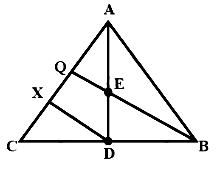
In $\triangle ABC, E$ is the mid$-$point of the median $AD$, and $BE$ produced meets side $AC$ at point $Q$.Show that $BE: EQ = 3: 1.$
Answer

Construction: Draw $DY \| BQ$
In $\triangle BCQ$ and $\triangle DCY$,
$\angle BCQ =\angle DCY \quad \ldots... ($Common$)$
$\angle BQC =\angle DYC \ldots ($Corresponding angles$)$
So, $\triangle BCQ \sim \triangle DCY \quad \ldots....($ AA Similarity criterion $)$
$\Rightarrow \frac{B Q}{D Y}=\frac{B C}{D C}=\frac{C Q}{C Y} \ldots ..($Corresponding sides are proportional. $)$
$\Rightarrow \frac{B Q}{D Y}=\frac{2 C D}{C D}\ldots(D$ is the mid$-$point of $B C)$
$\Rightarrow \frac{B Q}{D Y}=2 \ldots ...(i)$
Similarly, $\triangle AEQ \sim \triangle ADY$,
$\Rightarrow \frac{E Q}{D Y}=\frac{A E}{E D}=\frac{1}{2} \ldots(E$ is the mid$-$point of $A D)$
that is $\frac{ EQ }{ DY }=\frac{1}{2} \ldots ....(ii)$
Dividing $(i)$ by $(ii)$, We get
$\Rightarrow \frac{ BQ }{ EQ }=4$
$\Rightarrow BE + EQ =4 EQ$
$ \Rightarrow BE =3 EQ$
$ \Rightarrow \frac{ BQ }{ EQ }=\frac{3}{1}$
View full question & answer
Question 95 Marks
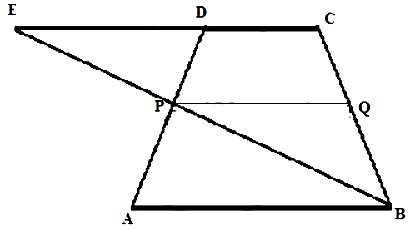
In trapezium $\text{ABCD, AB}$ is parallel to $DC; P$ and $Q$ are the mid$-$points of $AD$ and $BC$ respectively. $BP$ produced meets $CD$ produced at point $E.$
Prove that:
  1. Point $P$ bisects $BE,$
  2. $PQ$ is parallel to $AB.$
Answer
The required figure is shown below

$(i)$ From $\triangle PED$ and $\triangle ABP$,
$P D=A P\ldots ...[P$ is the mid$-$point of $A D]$
$\angle DPE =\angle APB\ldots....[$Opposite angle$]$
$\angle PED =\angle PBA$
$\ldots[A B \| C E]$
$\therefore \triangle PED \cong \triangle ABP\ldots ...[\text{ASA}$ postulate$]$
$\therefore EP = BP$
$(ii)$ In $\triangle ECB$,
$P$ is a mid point of $B E$ and
$Q$ is a mid point of $BC$
$\therefore P Q \| C E \quad\ldots...(i) ($by mid point theorem$)$
and $C E \| A B \ldots (ii)$
From equation $(i)$ and $(ii)$
$P Q \| A B$
Hence proved.
View full question & answer
Question 105 Marks
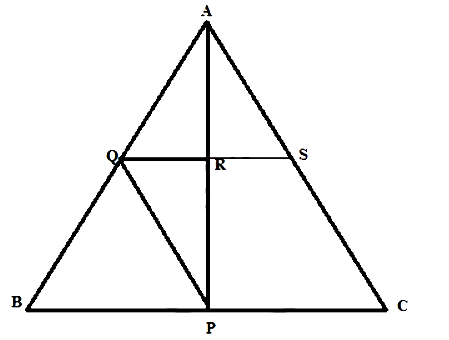
In $\triangle ABC, P$ is the mid$-$point of side $BC$. A line through $P$ and parallel to $CA$ meets $AB$ at point $Q$, and a line through $Q$ and parallel to $BC$ meets median $AP$ at point $R$.Prove that :$ (i) AP = 2AR;(ii) BC = 4QR$
Answer
The required figure is shown below

From the figure, it is seen that $P$ is the midpoint of $BC$ and $PQ \| AC$ and $QR \| BC$
Therefore $Q$ is the midpoint of $A B$ and $R$ is the midpoint of $A P$
$(i)$ Therefore $AP =2 AR$
$(ii)$ Here we increase $Q R$
so that it cuts $A C$ at $S$ as shown in the figure.
$(iii)$ From $\triangle PQR$ and $\triangle ARS$
$\angle PQR =\angle ARS\ldots...($ Opposite angle $)$
$P R=A R$
$P Q=A S$
$\ldots\left[ PQ = AS =\frac{1}{2} AC \right]$
$\triangle PQR \cong \triangle ARS\ldots ...( SAS$ Postulate$)$
Therefore $QR = RS$
Now,
$B C=2 Q S$
$ B C=2 \times 2 Q R$
$ B C=4 Q R$
Hence proved.
View full question & answer
Question 115 Marks
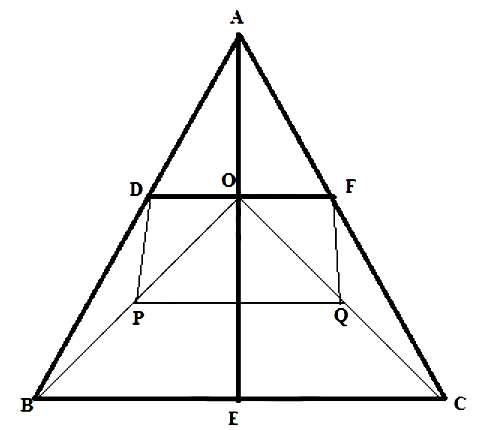
$D, E,$ and $F$ are the mid$-$points of the sides $AB, BC,$ and $CA$ respectively of $\triangle ABC. AE$ meets $DF$ at $O. P$ and $Q$ are the mid$-$points of $OB$ and $OC$ respectively. Prove that $\text{DPQF}$ is a parallelogram.
Answer

Given: $\triangle A B C, D, E, F$ are midpoints of $A B, B C, A C$ respectively.
$A B$ and $D F$ meet at $O .$
$P$ and $Q$ are midpoints of $O B$ and $O C$ respectively.
To Prove: $\text{DPFQ}$ is a parallelogram.
Proof:
In $\triangle A B C$,
$D$ is the mid$-$point of $A B$ and $F$ is the mid$-$point of $A C$
Hence, $DF \| BC$ and $DF =\frac{1}{2} BC \ldots... (1) ($Mid$-$point theorem$)$
In $\triangle O B C$
$P$ is the mid$-$point of $O B$ and $Q$ is the mid$-$point of $O C$
Hence, $PQ \| BC$ and $PQ =\frac{1}{2} BC \ldots... (2) ($mid$-$point theorem$)$
thus, from $(1)$ and $(2)$
$DF \| PQ$ and $DF = PQ\ldots .(3)$
Now, In $\triangle A O B$,
$D$ is the mid$-$point of $A B$ and $P$ is the mid$-$point of $O B$
Thus, $D P \| A E$ and $D P=\frac{1}{2} A E \ldots....(4) ($midpoint theorem$)$
Now, In $\triangle A O C$,
$F$ is the midpoint of $A C$ and $Q$ is the midpoint of $O C$
Thus, $F Q \| A E$ and $Q F=\frac{1}{2} A E\ldots .....(5) ($midpoint theorem$)$
thus, from $(4)$ and $(5)$
$DP \| FQ$ and $DP = FQ\ldots . .(6)$
$\text{DPFQ}$ is a parallelogram $\ldots......($from $(3)$ and $(6))$
Hence proved.
View full question & answer
[5 marks sum] - MATHEMATICS STD 9 Questions - Vidyadip