Question 14 Marks
Find the area of the biggest circle that can be cut from a rectangular piece $44\ cm$ by $28\ cm$. also, find the area of the paper left after cutting out the circle.
AnswerThe area of a rectangle with length $I$ and breadth $b=A=I \times b$
The area of a rectangle with length $44 \ cm$ and breadth $28 \ cm$
$= A$
$=44 \times 28$
$=1232 \ cm ^2$
The largest circle that can be cut from a rectangle of length $44 \ cm$ and
breadth $28 \ cm$ can have diameter $28 \ cm$ or
radius $\frac{28}{2}=14 \ cm$
The Area of a Circle with radius $r=\pi r^2$
The Area of a Circle with radius $14$
$=\pi(14)^2$
$=616 \ cm ^2$
Remaining area
$=1232 \ cm ^2-616 \ cm ^2$
$=616 \ cm ^2$
View full question & answer→Question 24 Marks
The cost of fencing a circular field at the rate of $Rs.250$ per metre is $Rs.55000.$ The field is to be ploughing at the rate of $Rs.15$ per $m^2.$ Find the cost of ploughing the field.
AnswerLet the radius of the circular field $=r m$
$\Rightarrow$ Circumference of the field $=2 \pi r$
Now, the cost of fencing the circular field at $Rs. 250 / m=R s .55000$
$\Rightarrow 2 \pi r \times 250=55000 $
$\Rightarrow 2 \times \frac{22}{7} \times r \times 250=55000 $
$\Rightarrow r=\frac{55000 \times 7}{2 \times 22 \times 250} $
$=35\ m$
Now, the area of the field
$=\pi r^2 $
$=\frac{22}{7} \times 35 \times 35 $
$=3850\ m ^2$
Thus, the cost of ploughing the field at the rate of $Rs. 15 / m ^2$
$=\text { Rs. } 15 \times 3850 $
$=\text { Rs. } 57750 .$
View full question & answer→Question 34 Marks
A lawn is in the shape of a semicircle of diameter $42\ m.$ the lawn is surrounded by a flower bed of width $7\ m$ all round. Find the area of the flower bed in $m^2.$
Answer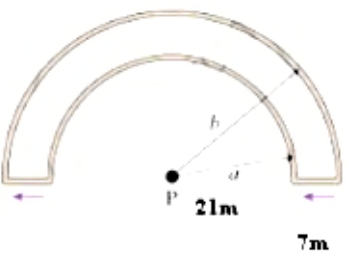
There are two concentric semi circles.
The diameter of the inner circle $=42$ or radius, $a=21 m$.
The radius of the outer circle, $b=21+7=28 m$.
Because the radius of a Circle with diameter $d$ is $r=\frac{d}{2}$
The Area of the inner Semi$-$circle with radius $a=\frac{\pi a ^2}{2}=\frac{\pi 21^2}{2}$
$\therefore$ The Area of the outer Semi$-$circle with radius $b =\frac{\pi b ^2}{2}=\frac{\pi 28^2}{2}$ and
The Area of a Semi$-$circle with radius $r=\frac{\pi r ^2}{2}$
The Area of the flower bed
$=\frac{\pi 28^2}{2}-\frac{\pi 21^2}{2} $
$=\frac{\pi}{2}\left(28^2-21^2\right) $
$=\frac{\pi}{2}(784-441) $
$=\frac{\pi}{2}(343) $
$=\frac{22}{7 \times 2}(343) $
$=539\ m ^2 .$ View full question & answer→Question 44 Marks
A wire in the form of a circle of radius $42\ cm$. It is bent into a square. Determine the side of the square and compare the area of the regions enclosed in the two cases.
AnswerLet the side of the square $= s$ and the radius of the circle $= r$
The Circumference of a circle with radius $r = 2\pi r$
The Circumference of a Circle with radius $42$
$= 2\pi \times 42$
$= 264\ cm$
The Area of a Circle with radius $r$
$= \pi r^2$
$= \pi (42)^2$
$= 5544\ cm^2$
The Circumference of the Circle
$=$ Perimeter of the square
$\Rightarrow $ Perimeter of the Square $= 264\ cm$
$\Rightarrow 4s = 264\ cm$
$\Rightarrow s = 66\ cm$
Area of a Square with side $s = 4s^2$
Area of a Square with side $66$
$= 4(66)^2$
$= 4356\ cm^2$
Ratio of Area of the Circle to the Area of the Square
$= 5544:4356$
$= 14:11.$
View full question & answer→Question 54 Marks
A wire bent in the form of an equilateral triangle has an area of $121 \sqrt{3} \ cm ^2$. If the same wire is bent into the form of a circle, find the area enclosed by the wire.
AnswerWe know that, Area of an equilateral $\triangle(A)$ of side $a$ is $A=\frac{\sqrt{3}}{4} a^2$
Here, $A=121 \sqrt{3}$
$\Rightarrow 121 \sqrt{3}=\frac{\sqrt{3}}{4} a ^2$
$\Rightarrow 121=\frac{ a ^2}{4}$
$\Rightarrow 11=\frac{ a ^4}{2}$
$\Rightarrow a =22$
$\Rightarrow 3 a =66 \ cm$
The Circumference of a Circle with radius $r=2 \pi r$
Here,
$66 \ cm =2 \pi r$
$\Rightarrow 66$
$\Rightarrow r =10.5 \ cm$
The Area of a Circle with radius $r=\pi r^2$
The Area of a Circle with radius $10.5$
$=\frac{22}{7}(10.5)^2$
$=346.5 \ cm ^2$
View full question & answer→Question 64 Marks
A wire when bent in the form of a square encloses an area of $484\ cm^2.$ If the same wire is bent into the form of a circle, find the area of the circle.
AnswerThe side of a square whose area is $484 \ cm ^2$
$=\sqrt{484}$
$=22\ cm $
$\Rightarrow$ The perimeter of the square$=4 \times 22\ cm $
The Circumference of a Circle with radius $r=2 \pi r $
Here,
$2 \pi r =4 \times 22\ cm $
$\Rightarrow r =\frac{88}{2 \pi} $
$=\frac{88 \times 7}{2 \times 22} $
$=14\ cm$
The Area of a Circle with radius $r=\pi r^2$
The Area of a Circle with radius $14=\pi(14)^2$
$=\frac{22}{7} \times(14)^2 $
$=22 \times 2 \times 14 $
$=616 \ cm ^2 .$
View full question & answer→Question 74 Marks
The area between the circumference of two concentric circles is $2464\ cm^2.$ If the inner circle has a circumference of $132\ cm, $ calculate the radius of the outer circle.
AnswerWe know,
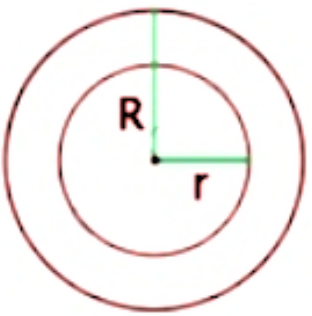
The area of the ring between two concentric circles equal the area of the larger circle minus the area of smaller circle.
Let the radius of the outer and inner ring be $R$ and $r$ respectively
The Area of a Circle with radius $r=\pi r^2$
area of the ring between two concentric circle
$=\pi\left(R^2-r^2\right) $
$=2464 \ cm ^2$
The Circumference of a Circle with radius $r=2 \pi r$
The Circumference of the inner Circle with radius $r=132$
$2 \pi r=132$
$\Rightarrow r=21 \ cm$
$\pi\left(R^2-21^2\right)=2464$
$\Rightarrow \frac{22}{7}\left(R^2-441\right)=2464$
$\Rightarrow\left(R^2-441\right)=784$
$\Rightarrow R^2=1225$
$\Rightarrow R=35 \ cm .$ View full question & answer→Question 84 Marks
Find the area and perimeter of the following semicircles: Radius $= 1.4\ cm$
AnswerThe Area of a Semi$-$circle with radius $r=\frac{\pi r^2}{2}$ the Perimeter of a Semi$-$circle with radius $r$
$=\pi r+2 r $
$=r(\pi+2) $
$=r\left(\frac{22}{7}+2\right) $
$=\frac{36}{7} \times r$
The Area of a Semi$-$circle with radius $1.4 \ cm$
$=\pi \frac{(1.4)^2}{2} $
$=\frac{22}{7} \times \frac{(1.4)^2}{2} $
$=3.08 \ cm ^2$
The Perimeter of a Semi$-$circle with radius $r$
$=\pi(1.4)+2 \times 1.4 $
$=1.4(\pi+2) $
$=14\left(\frac{22}{7}+2\right) $
$=\frac{36}{7} \times 1.4 $
$=7.2\ cm .$
View full question & answer→Question 94 Marks
Find the area enclosed between two concentric circles, If their radii are $6\ cm$ and $13\ cm$ respectively.
AnswerWe know,
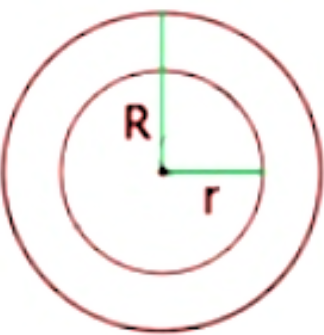
The area of the ring between two concentric circles equals the area of the larger circle minus the area of smaller circle.
Let the radius of the outer and inner ring be $R$ and $r$ respectively.
Here, the radius of the outer circle
$=13\ cm$ and the radius of the inner circle
$=6\ cm$
The Area of a Circle with radius $r=\pi r^2$
The area of the ring $=\pi(13)^2-6^2 )$
$=\frac{22}{7}(169-36) $
$=\frac{22}{7}(133)$
$=22 \times 9 $
$=418\ cm ^2$ View full question & answer→Question 104 Marks
The wheel of a car makes $10$ revolutions per second. If its diameter is $70\ cm,$ find the speed of the car in $km$ per $hr.$
AnswerThe Circumference of a Circle with diameter $d$ is $\pi d$
The Circumference of a Circle with diameter $70\ cm$ is $\pi \times 70$
$=\frac{22}{7} \times 70 $
$=22 \times 10$
$=220\ cm$
Total distance moved in $10$ revolutions
$=2.2 \ km $
$=2200 \ cm$
distance moved in $1$ second $=2200 \ cm$
$\Rightarrow$ distance moved in $1$ hour
$=2200 \ cm \times 60 \times 60 $
$=7920000 \ cm $
$=\frac{7920000}{100 \times 1000} $
$=79.2 \ km$
$\therefore$ Speed $=79.2 \ km / hr$.
View full question & answer→Question 114 Marks
The radii of two circles are in the ratio $5 : 8$. If the difference between their areas is $156p\ cm^2$, find the area of the bigger circle.
AnswerLet $r_1$ and $r_2$ be the radii of two circles.
$\Rightarrow r_1: r_2=5: 8$
$\Rightarrow \frac{r_1}{r_2}=\frac{5}{8}$
$\Rightarrow r_1=\frac{5}{8} r_2$
It is given that,
$\pi r_2^2-\pi r_1^2=156 \pi$
$\Rightarrow r_2^2-r_1^2=156$
$\Rightarrow r_2^2-\left(\frac{5}{8} r_1\right)^2=156$
$\Rightarrow r_2^2-\frac{25}{64} r_2^2=156$
$\Rightarrow \frac{64 r_2^2-25 r_2^2}{64}=156$
$\Rightarrow 39 r_2^2=64 \times 156$
$\Rightarrow r_2^2=\frac{64 \times 156}{39}=256$
$\Rightarrow r_2=16$
$\therefore$ Area of bigger circle
$=\pi r_2^2$
$=\frac{22}{7} \times 16 \times 16$
$=804.57 \ cm ^2$
View full question & answer→Question 124 Marks
Find the area of each of the following figure:
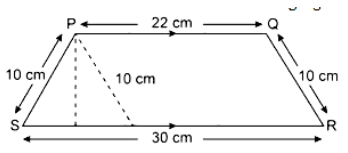
AnswerClearly opposite sides of quadrilateral $\text{PQRT}$ are parallel, it is a parallelogram.
$ST$
$= SR - TR$
$=30-22$
$=8 \ cm$
ln $\Delta PST$,
Let $a=P S=10 \ cm , b=S T=8 \ cm$ and $C=T P=10 \ cm$
$\therefore s=\frac{a+b+c}{2}$
$=\frac{10+8+10}{2}$
$=\frac{28}{2}$
$=14 \ cm$
Area of $\triangle P S R$
$=\sqrt{s(s-a)(s-b)(s-c)}$
$=\sqrt{14(14-10)(14-8)(14-10)}$
$=\sqrt{14 \times 4 \times 6 \times 4}$
$=8 \sqrt{21} \ cm ^2$
If $PM$ is taken height corresponding to base $S T$,
Area of $\triangle P S T$
$=\frac{1}{2} \times ST \times PM$
$\Rightarrow 8 \sqrt{21}=\frac{1}{2} \times 8 \times PM$
$\Rightarrow PM =2 \sqrt{21} \ cm$
$\therefore$ Area of given figure
$=\frac{1}{2} \times( PQ + SR ) \times PM$
$=\frac{1}{2} \times(22+30) \times 2 \sqrt{21}$
$=\frac{1}{2} \times 52 \times 2 \sqrt{21}$
$=52 \sqrt{21} \ cm ^2$
View full question & answer→Question 134 Marks
Find the shaded area in the given figure.
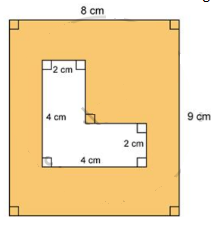
Answer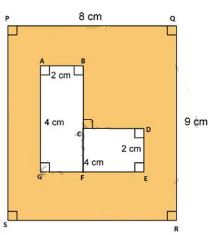
Area of shaded region
$=$Area of rectangle $\text {PQRS}-($Area of rectangle $\text { ABFG} +$ Area of SQuare $\text{CDEF})$
$=P Q \times Q R-\left[(A B \times A G)+(C D)^2\right]$
$=(8 \times 9) \ cm ^2-\left[(2 \times 4) \ cm ^2+(2) 2 \ cm ^2\right]$
$=72 \ cm ^2-\left[8 \ cm ^2+4 \ cm ^2\right]$
$=72 \ cm ^2-12 \ cm ^2$
$=60 \ cm ^2$ View full question & answer→Question 144 Marks
A wire when bent in the form of a square encloses an area of $16 \ cm^2$. Find the area enclosed by it when the same wire is bent in the form of an equilateral triangle
AnswerLet the side of a square $=x \ cm$
Its area$=16 \ cm ^2$
$\Rightarrow x ^2=16$
$\Rightarrow x =4 \ cm$
Clearly, the length of the wire
$=$Perimeter of a square
$=4 \times 4$
$=16 \ cm ^2$
Let the side of an equilateral triangle $=a \ cm$
Now, the perimeter of an equilateral triangle $=$ length of the wire
$\Rightarrow 3 a =16$
$\Rightarrow a =\frac{16}{3} \ cm$
$\therefore$ Area of an equilateral triangle
$=\frac{\sqrt{3}}{4} \times a ^2$
$=\frac{\sqrt{3}}{4} \times \frac{16}{3} \times \frac{16}{3}$
$=\frac{64 \sqrt{3}}{9} \ cm ^2$
View full question & answer→Question 154 Marks
A wire when bent in the form of a square encloses an area of $16 \ cm^2$. Find the area enclosed by it when the same wire is bent in the form of a rectangle whose sides are in the ratio of $1: 3$
AnswerLet the side of a square $= x \ cm$
Its area $= 16\ cm^2$
$\Rightarrow x^2 = 16$
$\Rightarrow x = 4\ cm$
Clearly, the length of the wire
$=$ Perimeter of a square
$= 4 \times 4$
$= 16\ cm^2$
Let the breadth of a rectangle $= b \ cm$
$\Rightarrow$ Its length $= 3b \ cm$
Now, the perimeter of a rectangle $=$ length of the wire
$\Rightarrow 2(3b + b) = 16$
$\Rightarrow 4b = 8$
$\Rightarrow b = 2\ cm =$ breadth
$\Rightarrow$ length
$= 3b$
$= 3\times2$
$= 6\ cm$
$\therefore$ Area of a rectangle
$= 6 \times 2$
$= 12\ cm^2.$
View full question & answer→Question 164 Marks
Find the diagonal of a quadrilateral whose area is $756\ cm^2$ and the perpendicular from the opposite vertices are $17\ cm$ and $19\ cm$.
Answer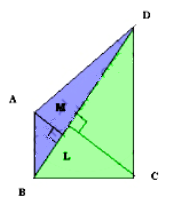
In Quadrilateral $\text{ABCD}, BD$ is a diagonal, $AM \perp BD , Cl \perp BD$
Let diagonal $B D=x \ cm$
$Ar($Quandrilateral $\text{ABCD})$
$=\frac{1}{2} \times BD ( Am + CL )$
$\Rightarrow 756=\frac{1}{2} \times(19+17)$
$\Rightarrow 756=18 x$
$\Rightarrow x=42 \ cm$. View full question & answer→Question 174 Marks
$PQRS$ is a square with each side $6 \ cm . T$ is a point on $Q R$ such that the area of $\triangle PQT\overline{\text { area of trapezium PTRS }}=\frac{1}{3}$ Find the length of $TR.$
Answer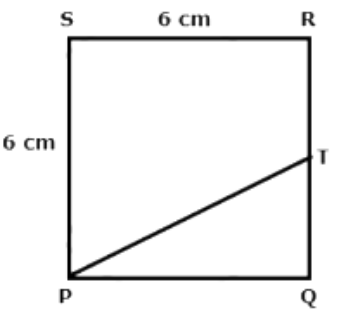
$\frac{\text { Area of } \Delta PQT }{\text { Area of trapezium PTRS }}=\frac{1}{3}$
$\Rightarrow \frac{\frac{1}{2} \times PQ \times QT }{\frac{1}{2} \times( TR + SP ) \times RS }=\frac{1}{3}$
$\Rightarrow \frac{ PQ \times( QR - TR )}{( TR + SP ) \times RS }=\frac{1}{3}$
$\Rightarrow \frac{6 \times(6- TR )}{( TR +6) \times 6}=\frac{1}{3}$
$\Rightarrow \frac{36-6 TR }{ TR +6}=2$
$\Rightarrow 36-6 TR =2 TR +12$
$\Rightarrow 8 TR =24$
$\Rightarrow TR =3 \ cm .$ View full question & answer→Question 184 Marks
How many tiles, each of area $625 \ cm^2$, will be needed to pave a footpath which is $1\ m$ wide and surrounds a grass plot of size $38\ m \times 14\ m$?
AnswerArea of grassy plot
$=38 \times 14$
$=532\ m ^2$
Length of a grass plot with footpath $=38+2=40\ m$
Width of a grass plot with footpath $=14+2=16\ m$
$\therefore$ Area of the grass plot with footpath $=40 \times 16=640\ m ^2$
Area of the footpath $=$ Area of the grass plot with footpath $-$ Area of grassy plot
$=(640-532)\ m ^2$
$=180\ m ^2$
$=1080000\ m ^2$
Area of each title $=625 \ cm ^2$
$\therefore$ Number of titles
$=\frac{\text { Area of the footpath }}{\text { Area of each title }}$
$=\frac{1080000}{625}$
$=1728 .$
View full question & answer→Question 194 Marks
A footpath of uniform width runs all around the inside of a rectangular garden of $40\ m \times 30\ m$. If the path occupies $136\ m^2$, find the width of the path.
Answer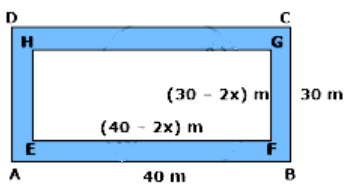
Let the given rectangular field be $\text{ABCD}$ with length $AB=40\ m$ and width $B C=30\ m$.
If the width of uniform path $=x m$,
the length of rectangle excluding path is $EF=(40-2 x) m$ and the width of rectangle excluding path is $FG =(30-2 x ) m$.
Now,
Area of rectangle $\text{ABCD}-$Area of rectangle $\text{EFGH}=$ Area of path
$\Rightarrow(40 \times 30)-[(40-2 x) \times(30-2 x)]=136$
$\Rightarrow 1200-\left[200-80 x-60 x+4 x^2\right]=136$
$\Rightarrow 1200-1200+140 x-4 x^2=136$
$\Rightarrow 4 x^2-140 x+136=0$
$\Rightarrow x^2-35 x+34=0$
$\Rightarrow x^2-34 x-x+34=0$
$\Rightarrow x(x-34)-1(x-34)=0$
$\Rightarrow(x-34)(x-1)=0$
$\Rightarrow x=34$ or $x=1$
Rejected $x=34 ($because it does not satisfy the calculation of the area of the path i.e. $136\ m ^2 )$,
we get $x$
$=1$
Thus, the width of the path is $1\ m$. View full question & answer→Question 204 Marks
The length and breadth of a rectangular field are in the ratio $8: 5. A 2\ m$ wide path runs all around outside the field. The area of the path is $848\ m^2$. Find the length and breadth of the field.
AnswerLet the sides of the rectangular field $= 8x$ and $5x$
So, the sides of the rectangular field after leaving the path of $2\ m$ on all sides $= 8x - 4$ and $5x - 4$
Area of the rectangular field $= (8x) (5x)$
Area of the rectangular field after leaving the path of $2m$ on all sides $= (8x - 4)(5x - 4)$
Area of the path of $2\ m$ on all sides
$= (8x)(5x) - (8x - 4)(5x - 4)$
$= 40x^2 - (40x^2 - 32x - 20x + 16)$
$= 848$
$52x + 16 = 848$
$x = 16$
The sides of the rectangular field
$= 8x$ and $5x$
$= 128m$ and $80\ m.$
View full question & answer→Question 214 Marks
A lawn in the shape of a rectangle is to be developed in front of a Marriage Hall. The length and breadth of the lawn are $44\ m$ and $32\ m$. A space of $2\ m$ is left on the two shoulder sides and one longer side for flower and in the remaining area grass is laid. Calculate the area of the flower space and the area on which grass is laid.
Answer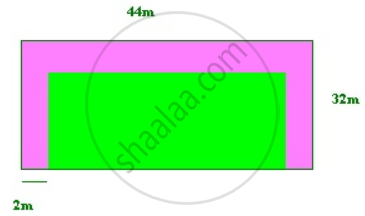
The dimensions of the rectangular Park are $44 \times 32$.
Area of the rectangular Park
$=44 \times 32$
$=1408\ m ^2$
The area of the rectangular Part in which grass has to be laid
$=(44-4) \times(32-2)$
$=40 \times 30$
$=1200\ m ^2$
The area of the Part in which flowers have to be planted
$=1408-1200$
$=208\ m ^2 .$ View full question & answer→Question 224 Marks
A quadrilateral field of unequal has a longer diagonal with $140\ m.$ The perpendiculars from opposite vertives upon this diagonal are $20\ m$ and $14\ m.$ Find the area of the field.
Answer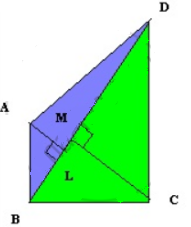
In quadrilateral $\text{ABCD}$, the sides $A B, B C, C D$ and $A D$ are unequal.
The longer diagonal $B D=140\ m$
$A M \perp B D, C L \perp B D$
$A M=20\ m$ and $C L=14\ m .$
We split a quadrilateral into triangles and find its area.
We know that,
Area of a Triangle$=\frac{1}{2}$b.h. i.e $\frac{1}{2}($Base $\times$ Height $)$
$\operatorname{Ar}(\triangle ABD )=\frac{1}{2} BD \times AL ;(\triangle CBD )=\frac{1}{2} BD \times CM$
$\operatorname{Ar}($Quad$\text{ABCD})=\operatorname{Ar}(\triangle ABD )+\operatorname{Ar}(\triangle CBD )$
$=\frac{1}{2} BD \times AL +\frac{1}{2} BD \times CM$
$=\frac{1}{2} BD \times( AL + CM )$
$=\frac{1}{2} \times 140 \times(20+14)$
$=70 \times 34$
$=2380\ m ^2 .$ View full question & answer→Question 234 Marks
Find the area of a rhombus, whose one side and one diagonal measure $20\ cm$ and $24\ cm$ respectively.
AnswerIn the given Rhombus diagonal $AC = 24\ cm.$
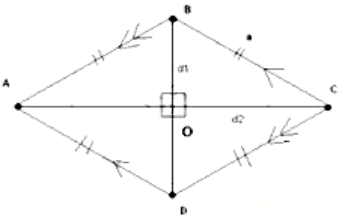
We know that, diagonals of a Rhombus bisect at right angles.
In Triangle $\text{AOB}.$
$\angle A O B=90^{\circ}, A B$ is the hypotenuse
$A O=12 \ cm \left(\frac{1}{2}(24 \ cm )\right)$
$A B^2=O B^2+O A^2$
$\Rightarrow OB$
$=\sqrt{ AB ^2- OA ^2}$
$=\sqrt{20^2-12^2}$
$=\sqrt{400-144}$
$=\sqrt{256}$
$=16$
We know that the area of a rhombus whose diagonals are $d_1$ and $d_2$ is
$A=\frac{1}{2} \times d_1 \times d_2$
$\therefore$ the area of a rhombus whose diagonals are 24 and 32 is,
$A=\frac{1}{2} \times 24 \times 32$
$=384 \ cm ^2 .$ View full question & answer→Question 244 Marks
The area of a square plot of side $80\ m$ is equal to the area of a rectangular plot of length $160\ m$. Calculate the width of the rectangular plot and the cost of fencing it $Rs.7.50$ per $m.$
AnswerThe area of a square plot with side $80\ m$
$=80^2$
$=6400\ m ^2$
Let the width of the rectangular plot $=b$
The area of a rectangle with length $I$ and breadth $b=A=1 \times b$
The area of a rectangle wit length $160$ and breadth $b=A=160 \times b=6400$
$\Rightarrow b=\frac{6400}{160}$
$=40\ m$
The perimeter of a rectangle with length $I$ and breadth $b=P=2(l+b)$
The perimeter of a rectangle with length $160\ m$ and breadth $40\ m$
$=P$
$=2(160+40)$
$=2(200)$
$=400\ m$
The cost of fencing at the rate of $Rs.7.50$ per $m$
$=400 \times 7.50$
$=R s .3000 .$
View full question & answer→Question 254 Marks
The perimeter of a square plot of land is $64\ m$. The area of a nearby rectangular plot is $24\ m^2$ more than the area of the given square. If the length of the rectangle is $14\ m$, find its breadth.
AnswerThe perimeter of a square with side $s=P=4 s$
$\therefore$ Here, the perimeter of the square $64\ m$
Let the side of the square $=s$
$\therefore 4 s=64$
$\Rightarrow s=16\ m$
We know, The area of a square with side $s=s^2$
$\therefore s ^2$
$=16^2$
$=256\ m ^2$
$\therefore$ The area of the rectangle
$=256+64$
$=280\ m ^2$
The area of a rectangle with length $I$ and breadth $b=A=1 \times b$
Here, $I =14\ m$, let breadth $= b$
The area of a rectangle with length $4$ and breadth $b=A=14 \times b$
$\Rightarrow 14 b=280$
$\Rightarrow b=\frac{280}{14}$
$=20\ m .$
View full question & answer→Question 264 Marks
Find the perimeter of a rhombus whose diagonals are $24\ cm$ and $10\ cm.$
AnswerIn the given Rhombus diagonal $AC = 24\ cm$ and diagonal $BD = 10\ cm$
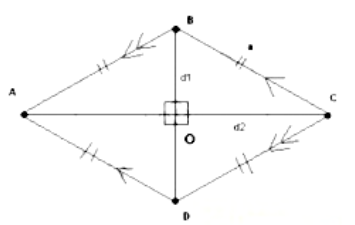
We Know that, diagonals of a Rhombus bisect at right angles.
In Triangle $\text{AOB}, \angle A O B=90^{\circ}, AB$ is the hypotenuse
$OB =12 \ cm \left(\frac{1}{2}(24 \ cm )\right)$ and
$AO =5 \ cm \left(\frac{1}{2}(10 \ cm )\right)$
$AB =\sqrt{ OB ^2+ OA ^2}$
$=\sqrt{12^2+5^2}$
$=\sqrt{144+25}$
$=\sqrt{169}$
$=13$
Further all sides of a Rhombus are equal by definition
So, $A B=B C=C D=A D=13 \ cm$
Perimeter
$=4(13)$
$=52 \ cm .$ View full question & answer→Question 274 Marks
A rectangular hall of $40\ m$ by $24\ m$ is covered with carpets of size $6\ m \times 4\ m$. Find the number of carpets required to cover the hall.
AnswerThe area of a rectangle with length $I$ and breadth $b=1 \times b$
The area of a rectangle with length $40 m$
and breadth $24 m$
$=A$
$=40 \times 24 m ^2$
|The area of the rectangular carpet with sides $6 m$ and $4 m$|
$=a$
$=6 \times 4$
Number of carpets required to cover the floor completely
$=\frac{ A }{ a }$
$=\frac{40 \times 24}{6 \times 4}$
$=40 .$
View full question & answer→Question 284 Marks
The length of a rectangular field is thrice of its width. If the perimeter of this field is $1.6\ km$, find its area in $sq.m.$
AnswerLet the breadth of the rectangle $= xm$ length and of the rectangle $=3 xm$
The perimeter of a rectangle with length $I$ and breadth $b=P=2(I+b)$
$\therefore$ The perimeter of a rectangle with length $3 x$ and breadth $x=P=2(3 x+x)$
$=2(4 x )=8 x$
$\Rightarrow 8 x =1.6 \ km$
$=1.6 \times 1000\ m$
$=1600\ m$
$\Rightarrow x =\frac{1600}{8}$
$=200 m$
$\Rightarrow$ the breadth of the rectangle $=200\ m$ length
and of the rectangle $=3(200)=600\ m$
The area of a rectangle with length $I$ and breadth $b=A=1 \times b$
The area of a rectangle with length $600$ and breadth $200=A=600 \times 200$
$=120000\ m ^2$.
View full question & answer→Question 294 Marks
Two adjacent sides of a parallelogram are $34 \ cm$ and $20 \ cm$. If one of its diagonal is $42 \ cm$, find: area of the parallelogram.
AnswerAt first we have to calculate the area of the triangle having sides $34 \ cm , 20 \ cm$ and $42 \ cm$.
Now,
$s=\frac{34+20+42}{2}$
$=48 \ cm$
$\therefore$ Area of triangle
$=\sqrt{48(48-34)(48-20)(48-42)}$
$=\sqrt{48 \times 14 \times 28 \times 6}$
$=\sqrt{4 \times 12 \times 2 \times 7 \times 4 \times 7 \times 2 \times 3}$
$=\sqrt{4 \times 4 \times 2 \times 2 \times 7 \times 7 \times 36}$
$=4 \times 2 \times 7 \times 6$
$=336 \ cm ^2$
$\therefore$ Area of parallelogram
$=2 \times$ Area of triangle
$=2 \times 336$
$=672 \ cm ^2 \text {. }$
View full question & answer→Question 304 Marks
Find the area of a right angled triangle whose hypotenuse is $15\ cm$ and the base is $9\ cm.$
AnswerThe perpendicular of a right triangle whose hypotenuse is $h$ and base is $b$, is given by
$\sqrt{h^2-b^2}$
The perpendicular of a right triangle whose hypotenuse is $15$ and base is $9 $, is given by
$\sqrt{15^2-9^2}$
$=\sqrt{225-81}$
$=\sqrt{144}$
$=12 \ cm$
We also know that, Area of a Triangle
$=\frac{1}{2} \text { b.h}.$ i.e. $\frac{1}{2} ($Base $\times$ Height$)$
Area of a Triangle with bas e
$=9 \ cm$ and height
$=$ perpendicular
$=12 \ cm$
$\Rightarrow \frac{1}{2} b \cdot h$
$=\frac{1}{2} \times 9 \times 12$
$=54 \ cm ^2$.
View full question & answer→Question 314 Marks
Find the perimeter of an equilateral triangle whose area is $16 \sqrt{3} \ cm$.
AnswerWe know that, Area of an equilateral triangle $(A)$ of side $a$ is
$A=\frac{\sqrt{3}}{4} a ^2$
Here, $A=16 \sqrt{3}$
$\Rightarrow 16 \sqrt{3}=\frac{\sqrt{3}}{4} a ^2$
$\Rightarrow 16=\frac{ a ^2}{4}$
$\Rightarrow 4 \times 16= a ^2$
$\Rightarrow a$
$=2 \times 4$
$=8$
i.e. side of the equilateral triangle is $8 \ cm$
The perimeter of an equilateral triangle of side $a=3 a$
$\Rightarrow$ The Perimeter of an equilateral triangle of side $8 \ cm$
$=3 \times 8$
$=24 \ cm \text {. }$
View full question & answer→Question 324 Marks
Find the area of a triangle whose sides are $27 \ cm, 45 \ cm$ and $36 \ cm.$
AnswerLet the sides of a triangle be $a=27 \ cm , b=45 \ cm$ and $c=36 \ cm$
Semi$-$perimeter of a tirangle $=s$
$=\frac{a+b+c}{2}$
$=\frac{27+45+36}{2}$
$=54 \ cm$
Area of a triangle
$=\sqrt{s(s-a)(s-b)(s-c)}$
$=\sqrt{54(54-27)(54-45)(54-36)}$
$=\sqrt{54 \times 27 \times 9 \times 18}$
$=\sqrt{6 \times 6 \times 3 \times 9 \times 9 \times 6 \times 3}$
$=\sqrt{6 \times 6 \times 3 \times 3 \times 9 \times 9 \times 9}$
$=6 \times 3 \times 9 \times 3$
$=486 \ cm ^2$
View full question & answer→Question 334 Marks
The base of a triangle field and its height are in the ratio $2:5.$ If the cost of cultivating the field at Rs.42 per $sq. m$ is $Rs.7560$, find its base and height.
AnswerLet the Area of the triangular plot of land $= A m ^2$
$\therefore A \times 42=7560$
$\Rightarrow A =\frac{7560}{42}$
$=180$
Let the base and height of the plot be $2 x$ and $5 x$ respectively
We know that, Area of a triangle
$=\frac{1}{2} b \cdot h$ i.e $\frac{1}{2}($Base $\times$ Height$)$
$\Rightarrow 180=\frac{1}{2}(2 x) \cdot(5 x)$
$\Rightarrow 5 x^2=180$
$\Rightarrow x^2=\frac{180}{5}$
$=36$
$\Rightarrow x=6$
$\Rightarrow$ Base$=2(6)=12\ m ;$
Height$=5(6)=30\ m .$
View full question & answer→Question 344 Marks
Find the area of an isosceles triangle whose perimeter is $50\ cm$ and the base is $24\ cm.$
AnswerThe sum of the equal sides of the given Isosceles triangle
$=50-24$
$=26$
So, each the equal sides of the given Isosceles triangle
$=\frac{1}{2}(26)$
$=13 \ cm$
We know that, Area of a Triangle whose sides are $a, b$, and $c$ and semiperimeter is $s$ is given by
$\sqrt{ s ( s - a )( s - b )( s - c )} ; s =\frac{ a + b + c }{2}$
Here, sides are $13 \ cm , 13 \ cm$ and $24 \ cm$
$s=\frac{P}{2}$
$=\frac{50}{2}$
$=25$
Area
$=\sqrt{25(25-13)(25-13)(25-24)}$
$=\sqrt{25(12)(12)(1)}$
$=5 \times 12$
$=60 \ cm ^2 .$
View full question & answer→Question 354 Marks
In a right$-$angled triangle $ABC$, if $\angle B = 90^\circ , AB - BC = 2 \ cm; AC - BC = 4$ and its perimeter is $24 \ cm$, find the area of the triangle.
AnswerGiven, Perimeter of $\triangle A B C=24 \ cm$
$\Rightarrow A B+B C+A C=24 \ cm$
$A B-B C=2 \ cm \ldots \text { (ii) }$
$A C-B C=4 \ cm \ldots \text { (iii) } $
Adding $(ii)$ and $(iii),$ we get
$A B+A C-2 B C=6 \ cm$
$\Rightarrow A B+A C=6+2 B C$
Substituing $(iv)$ un $(i),$ we get
$6+2 B C+B C=24$
$\Rightarrow 3 B C=18$
$\Rightarrow B C=6 \ cm$
$\Rightarrow A B=2+B C$
$=2+6$
$=8 \ cm $
$\therefore$ Area of right$-$angled $\triangle A B C$
$ =\frac{1}{2} \times BC \times AB$
$=\frac{1}{2} \times 8 \times 6$
$=24 \ cm ^2 . $
View full question & answer→