Questions

[3 marks sum]

🎯

Test yourself on this topic

3 questions · timed · auto-graded

Question 13 Marks
In equilateral $\triangle ABC, AD \perp BC$ and $BC = x \ cm.$ Find, in terms of $x,$ the length of $AD.$
Answer
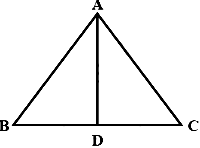

In equilateral $\triangle ABC , AD \perp BC$.
Therefore, $BC = xcm$.
Area of equilateral $\triangle ABC =\frac{\sqrt{3}}{4} \times side^2=\frac{1}{2} \times$ base $\times$ height
$=\frac{\sqrt{3}}{4} \times x^2=\frac{1}{2} \times x \times AD$
$AD =\frac{\sqrt{3}}{2} x$
View full question & answer
Question 23 Marks
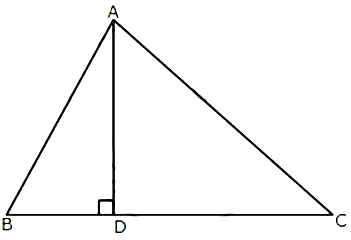
In the following figure, $AD$ is perpendicular to $BC$ and $D$ divides $BC$ in the ratio $1: 3$.

Prove that: $2 AC ^2=2 AB ^2+ BC ^2$
Answer
Here,
$BD : DC =1: 3 .$
$ \Rightarrow BD =\frac{1}{4} BC$ and  $CD=\frac{3}{4} BC$
$A C^2=A D^2+C D^2$ and $A B^2=A D^2+B D^2$
Therefore,
$A C^2-A B^2=C D^2-B D^2$
$=\left(\frac{3}{4} BC \right)^2-\left(\frac{1}{4} BC \right)^2$
$ =\frac{9}{16} BC ^2-\frac{1}{16} BC ^2$
$ =\frac{1}{2} BC ^2$
$ \therefore 2 AC ^2-2 AB ^2= BC ^2$
$ 2 AC ^2=2 AB ^2+ BC ^2$
Hence proved.
View full question & answer
Question 33 Marks
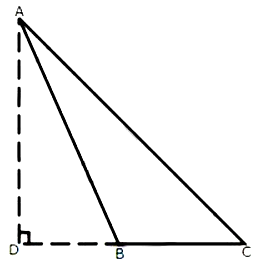
In figure $AB=BC$ and $AD$ is perpendicular to $CD$.
Prove that: $AC ^2=2BC . DC$.
Answer
Pythagoras theorem states that in a right$-$angled triangle, the square on the hypotenuse is equal to the sum of the squares on the remaining two sides.
We consider the $ΔACD$ and applying Pythagoras theorem we get,
$AC^2 = AD^2 + DC^2$
$= ( AB^2 - DB^2 ) + ( DB + BC )^2$
$= BC^2 - DB^2 + DB^2 + BC^2 + 2DB.BC ...($ Given, $AB = BC )$
$= 2BC^2 + 2DB.BC$
$= 2BC( BC + DB )$
$= 2BC . DC$
Hence proved.
View full question & answer
[3 marks sum] - MATHEMATICS STD 9 Questions - Vidyadip