Questions

[3 marks sum]

🎯

Test yourself on this topic

6 questions · timed · auto-graded

Question 13 Marks
A right triangle has hypotenuse $p \ cm$ and one side $q \ cm.$ If $p - q = 1,$ find the length of third side of the triangle.
Answer
Hypotenuse $= p\ cm$
One side $= q\ cm$
Let the length of the third side be $x \ cm$.
Using Pythagoras theorem,
$x^2=p^2-q^2=(p+q)(p-q) $
$=(p+q) \times 1 \ldots[\because p-q=1$, given $] $
$=p+q $
$\therefore x=\sqrt{p+q}$
Thus, the length of the third side of the triangle is $\sqrt{p+q}\ cm$.
View full question & answer
Question 23 Marks
Find the length of the hypotenuse of a triangle whose other two sides are $24\ cm$ and $7\ cm.$
Answer
The two sides $($excluding hypotenuse$)$ of a right$-$angled triangle are given as $24\ cm$ and $7\ cm.$
$($hypotenuse$)^2 = (24\ cm)^2 + (7\ cm)^2$
$($hypotenuse$)^2 = 576\ cm^2 + 49\ cm^2$
$($hypotenuse$)^2 = 625\ cm^2$
$($hypotenuse$)^2 = (25\ cm)^2$
Thus, the length of the hypotenuse of the triangle is $25\ cm.$
View full question & answer
Question 33 Marks
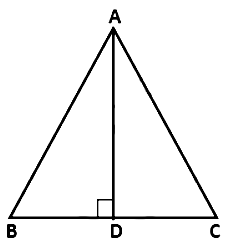
In $\triangle A B C$, $A D$ is perpendicular to $B C$. Prove that: $A B^2+C D^2=A C^2+B D^2$
Answer

Since $\triangle ABD$ and $ACD$ are right triangle right$-$angled at $D,$
$AB^2 = AD^2 + BD^2 ....(i)$
$AC^2= AD^2 + CD^2 ....(ii)$
Subtracting $(ii)$ and $(i),$
we get
$AB^2 - AC^2 = BD^2- CD^2$
$\Rightarrow AB^2 + CD^2 = AC^2 + BD^2.$
View full question & answer
Question 43 Marks
Each side of rhombus is $10 \ cm$. If one of its diagonals is $16 \ cm,$ find the length of the other diagonals.
Answer
Side of the rhombus $=10\ cm$
One diagonal, $d_1=16\ cm$
Let $d_2$ be the other diagonal of the rhombus
The diagonals of a rhombus bisect each other
$\therefore\left(\frac{ d _1}{2}\right)^2+\left(\frac{ d _2}{2}\right)^2=$ side$^2$
$8^2+\left(\frac{ d _2}{2}\right)^2=100 $
$\Rightarrow\left(\frac{ d _2}{2}\right)^2=100-64=(6)^2 $
$\Rightarrow \frac{ d _2}{2^2}=6 $
$\Rightarrow d _2=12$
Thus, the other diagonal of the rhombus is of length $12\ cm$.
View full question & answer
Question 53 Marks
The length of the diagonals of rhombus are $24\ cm$ and $10\ cm.$ Find each side of the rhombus.
Answer
It is given that the diagonals of a rhombus are of length $14 \ cm$ and $10 \ cm$ respectively
$\therefore d_1=24 \ cm , d_2=10 \ cm$
The diagonals of a rhombus bisect each other
$ \therefore\left(\frac{ d _1}{2}\right)^2+\left(\frac{ d _2}{2}\right)^2=$ side $^2$
side$^2$
$=122+52$
$=144+25$
$=132$
$\Rightarrow$Side $=13$
Thus, each side of the rhombus is of length $13 \ cm$.
View full question & answer
Question 63 Marks
Find the length of the perpendicular of a triangle whose base is $5\ cm$ and the hypotenuse is $13\ cm.$ Also, find its area.
Answer
Base $=5 \ cm$, Hypotenuse $=13 \ cm$
By Pythagoras theorem,
$($perpendicular$)^2=(13 \ cm )^2-(5 \ cm )^2$
$($perpendicular$)^2=169 \ cm ^2-25 \ cm ^2$
$($perpendicular$)^2=144 \ cm ^2$
$($perpendicular$)^2=(12 \ cm )^2$
$\therefore$ Perpendicular $=12 \ cm$
Area of the triangle
$=13 \ cm ^2 \times ($Base $\times$ Perpendicular$)$
$=\frac{1}{2} \times 5 \ cm \times 12 \ cm$
$=30 \ cm ^2$.
View full question & answer
[3 marks sum] - MATHEMATICS STD 9 Questions - Vidyadip