Question 14 Marks
Two poles of height $9\ m$ and $14\ m$ stand on a plane ground. If the distance between their $12\ m$, find the distance between their tops.
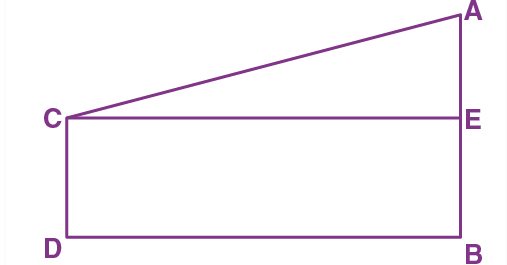
AnswerLet $AB$ and $CD$ be the two poles of height $14\ m$ and $9\ m$ respectively.
It is given that $BD = 12\ m$
$\therefore CE = 12\ m$
Now,
$AE = AB - BE$
$= 14\ m - 9\ m = 5\ m$
Using Pythagoras theorem in $\triangle ACE,$
$AC^2 = AE^2 + CE^2$
$= (5\ m)^2 + (12\ m)^2$
$= 25\ m^2 = 144\ m^2$
$= 169\ m^2$
$= 13\ m^2$
$\Rightarrow AC = 13\ m$
Thus, the distance between the tops of the poles is $13\ m.$
View full question & answer→Question 24 Marks
A ladder $25\ m$ long reaches a window of a building $20\ m$ above the ground. Determine the distance of the foot of the ladder from the building.
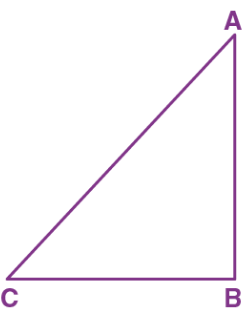
AnswerLet $AC$ be the ladder and $A$ be the position of the window.
Then, $AC = 25\ m, AB = 20\ m$
Using Pythagoras theorem,
$AC^2 = AB^2+ BC^2$
$\Rightarrow (25\ m)^2 = (20\ m)^2 + BC^2$
$\Rightarrow BC^2= 62\ m^2 - 400\ m^2$
$BC^2= 225\ m^2$
$BC^2 = (15\ m)^2$
$\Rightarrow BC = 15\ m$
Thus, the distance of the foot of the ladder from the building is $15\ m$.
View full question & answer→Question 34 Marks
A man goes $10\ m$ due east and then $24\ m$ due north. Find the distance from the straight point.
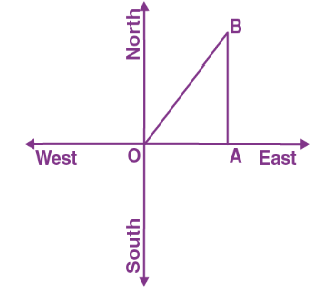
AnswerLet $O$ be the original position of the man.
From the figure, it is clear that $B$ is the final position of the man.
$\triangle AOB$ is right$-$angled at $A.$
By Pythagoras theorem,
$OB^2 = OA^2 + AB^2$
$OB^2 = (10\ m)^2 + (24\ m)^2$
$OB^2 = 100\ m^2 + 576\ m^2$
$OB^2= 676\ m^2$
$OB^2 = (26\ m)^2$
$OB = 26\ m$
Thus, the man is at a distance of $26\ m$ from the straight point.
View full question & answer→Question 44 Marks
Calculate the area of a right$-$angled triangle whose hypotenuse is $65\ cm$ and one side is $16\ cm$.
AnswerHypotenuse $= 65\ cm$
One side $= 16\ cm$
Let the other side be of length $x \ cm$
By Pythagoras theorem,
$(65\ cm)^2= (16\ cm)^2 + (x\ cm)^2$
$(x \ cm)^2 = 4225\ cm^2 - 256\ cm^2$
$= 3969\ cm^2$
$= (63\ cm)^2$
$\Rightarrow x = 63\ cm$
Area of the triangle
$=\frac{1}{2} \times($Base $\times$ Height$)$
$=\frac{1}{2} \times 16 \ cm \times 63 \ cm$
$=504 \ cm ^2 .$
View full question & answer→Question 54 Marks
$\text{PQR}$ is an isosceles triangle with $PQ = PR = 10 \ cm$ and $QR = 12 \ cm$. Find the length of the perpendicular from $P$ to $QR$.
Answer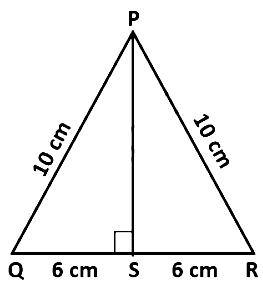
Since,$\text{PQR}$ is an isosceles triangle and $PS \perp QR,$
therefore it divides $QR$ into two equal parts.
In $\triangle PSQ, \angle S = 90^\circ$
$\therefore PQ^2 = PS^2+ QS^2\dots ....($By Pythagoras Theorem$)$
$\Rightarrow PS^2 = PQ^2 - QS^2$
$= 10^2 - 6^2$
$= 100 - 36$
$= 64$
$\Rightarrow PS = 8\ cm.$ View full question & answer→Question 64 Marks
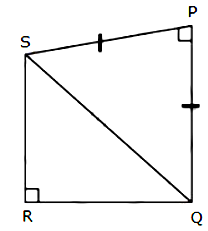
In the given figure. $PQ = PS, P =R = 90^\circ . RS = 20 \ cm$ and $QR = 21 \ cm$. Find the length of $PQ$ correct to two decimal places.
Answer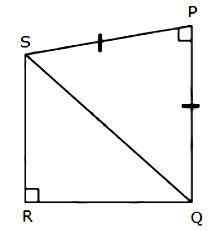
In $\triangle S R Q, \angle R=90^{\circ}$
$\therefore Q S^2=R S^2+Q R^2$
$=20^2+21^2$
$=440+441$
$=841\dots....($Pythagoras Theorem$)$
Now,
In $\triangle Q S P, \angle P=90^{\circ}$
$\therefore Q^2=P Q^2+P^2$
$\Rightarrow Q^2=P Q^2+P^2 \ldots .($ Pythagoras Theorem$)$
$\Rightarrow Q^2=2 PQ ^2 \ldots .($Given $P Q=P S)$
$\Rightarrow P Q 2=\frac{Q^2}{2}=\frac{841}{2}=420.5$
$\Rightarrow P Q=20.50 \ cm .$ View full question & answer→Question 74 Marks
In a $\triangle ABC$ right angled at $C , P$ and $Q$ are points of sides $CA$ and $CB$ respectively, which divide these sides the ratio $2: 1$. Prove that: $9\left(A Q^2+B P^2\right)=13 A B^2$
Answer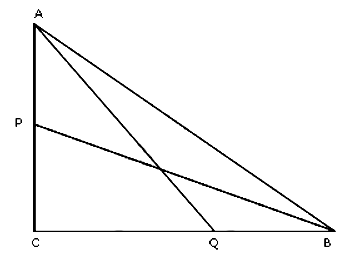
$P$ divides $A C$ in the ratio $2: 1$
So $C.P. =\frac{2}{3} AC\dots.......(i)$
$Q$ divides $B C$ in the ratio $2: 1$
$QC =\frac{2}{3} BC \dots......(ii)$
Adding $(iii)$ and $(iv),$ we get
$ 9\left(A Q^2+B P^2\right)=13\left(B C^2+A C^2\right)$
$\Rightarrow 9\left(A Q^2+B P^2\right)=13 A B^2 $ View full question & answer→Question 84 Marks
In a $\triangle ABC$ right angled at $C, P$ and $Q$ are points of sides $CA$ and $CB$ respectively, which divide these sides the ratio $2 : 1.$Prove that: $9BP^2 = 9BC^2 + 4AC^2$
Answer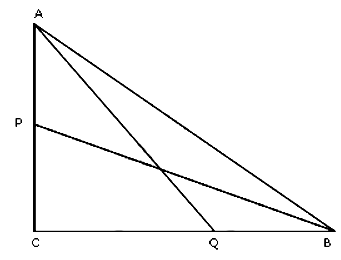
$P$ divides $AC$ in the ratio $2: 1$
So $C.P. =\frac{2}{3} AC$.
$Q$ divides $BC$ in the ratio $2: 1$
$QC =\frac{2}{3} BC \text {. }$
Applying Pythagoras theorem in right $\triangle B C P$,
we have
$ BP ^2= BC ^2+ CP ^2$
$\Rightarrow BP ^2= BC ^2+\frac{4}{9} A C ^2 \ldots($Using $0(i))$
$\Rightarrow 9 B P^2=9 B C^2+4 A C^2 $ View full question & answer→Question 94 Marks
In a $\triangle ABC$ right angled at $C, P$ and $Q$ are points of sides $CA$ and $CB$ respectively, which divide these sides the ratio $2 : 1.$Prove that: $9AQ^2= 9AC^2 + 4BC^2$
Answer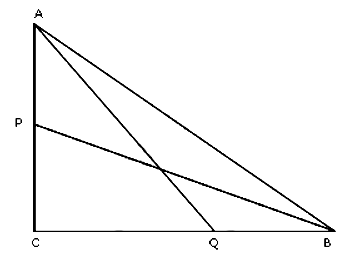
$P$ divides $A C$ in the ratio $2: 1$
So $C.P. =\frac{2}{3} AC$
$Q$ divides $BC$ in the ratio $2:1$
$QC =\frac{2}{3} BC \text {. }$
In $\triangle ACQ$
Using Pythagoras Theorem we have,
$ AQ ^2+ AC ^2+ CQ ^2$
$\Rightarrow AQ ^2= AC ^2+\frac{4}{9} BC ^2 \ldots($ using ($ii))$
$\Rightarrow 9 AQ ^2=9 AC ^2+4 BC ^2 \ldots \ldots \text { (iii) } $ View full question & answer→Question 104 Marks
$AD$ is perpendicular to the side $BC$ of an equilateral $\triangle ABC.$ Prove that $4AD^2 = 3AB^2.$
Answer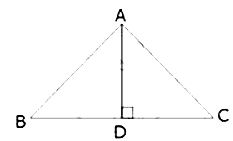
In equilateral triangle $AD \perp BC$.
$\Rightarrow BD = DC =\frac{ BC }{2} \dots...($In equilateral triangle altitude bisects the opposite side$)$
In right $\triangle A B D$,
$ A B^2=A D^2+B D^2$
$=A D^2+\left(\frac{B C}{2}\right)^2$
$=\frac{4 A D^2+B C^2}{4}$
$=\frac{4 A D^2+B C^2}{4} \ldots($ Since $A B=B C)$
$\Rightarrow 4 A B^2=4 A D^2+A B^2$
$\Rightarrow 3 A B^2=4 A D^2$
Hence proved.. View full question & answer→Question 114 Marks
In a $\triangle ABC, AC > AB, D$ is the midpoint $BC$, and $AE \perp BC$. Prove that: $AB^2 + AC^2 = 2(AD^2 + CD^2)$
Answer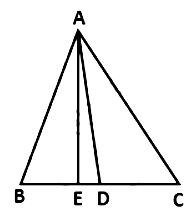
We have $\angle AED = 90^\circ$
$\therefore \angle ADE < 90^\circ$ and $\angle ADC > 90^\circ$
i.e. $\angle ADE$ is acute and $\angle ADC$ is obtuse.
From $(iii),$ we have
$ AB ^2+ AC ^2=2 AD ^2+\frac{1}{2} BC ^2$
$\Rightarrow AB ^2+ AC ^2=2 AD ^2+\frac{1}{2}(2 \times CD )^2$
$\Rightarrow AB ^2+ AC ^2=2 AD ^2+\frac{1}{2} \times 4 CD ^2$
$\Rightarrow A B^2+A C^2=2 A D^2+2 C D^2$
$\Rightarrow A B^2+A C^2=2\left(A D^2+C D^2\right)$ View full question & answer→Question 124 Marks
In a $\triangle A B C, A C>A B$, $D$ is the midpoint $B C$, and $A E \perp B C$. Prove that: $A C^2-A B^2=2 B C \times E D$
Answer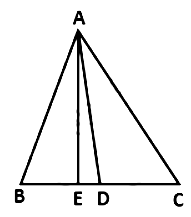
We have $\angle AED = 90^\circ$
$\therefore \angle ADE < 90^\circ$ and $\angle ADC > 90^\circ$
i.e. $\angle ADE$ is acute and $\angle ADC$ is obtuse.
Subtracting $(ii)$ from $(i),$ we have
$A C^2-A B^2=A D^2+B C \times D E+\frac{1}{4} B C^2-A D^2+B C \times D E-\frac{1}{4} B C^2$
$\Rightarrow A C^2-A B^2=2 B C \times D E$ View full question & answer→Question 134 Marks
In a $\triangle ABC , AC > AB , D$ is the midpoint $BC$, and $AE \perp BC$. Prove that: $AB ^2+ AC ^2=2 AD +\frac{1}{2} BC ^2$
Answer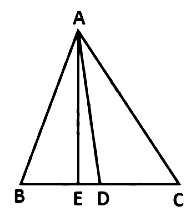
We have $\angle AED = 90^\circ$
$\therefore \angle ADE < 90^\circ$ and $\angle ADC > 90^\circ$
i.e. $\angle ADE$ is acute and $\angle ADC$ is obtuse.
Adding $(i)$ and $(ii)$, we have
$ AC ^2+ AB ^2=A D ^2+ BC \times DE +\frac{1}{4} BC ^2+ AD ^2- BC \times DE +\frac{1}{4} BC ^2$
$\Rightarrow AB ^2+ AC =2 AD ^2+\frac{1}{2} BC ^2 .$ View full question & answer→Question 144 Marks
In a $\triangle A B C, A C>A B, D$ is the midpoint $B C$, and $A E \perp B C$. Prove that: $A B^2=A D^2-B C \times C E+$
$\frac{1}{4} BC ^2$
Answer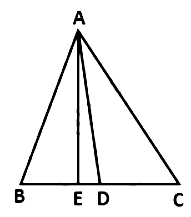
We have $\angle AED = 90^\circ$
$\therefore \angle ADE < 90^\circ$ and $\angle ADC > 90^\circ$
i.e. $\angle ADE$ is acute and $\angle ADC$ is obtuse.
In $\triangle ABD, \angle ADE$ is an acute angle.
$\therefore AB^2 = AD^2+ BD^2 - 2 \times BD \times DE$
$\Rightarrow AB ^2= AD ^2+\left(\frac{1}{2} BC \right)^2-2 \times \frac{1}{2} BC \times DE$
$\Rightarrow AB ^2= AD ^2+\frac{1}{4} BC ^2- BC \times DE$
$\Rightarrow A B^2=A D^2+B C \times D E-\frac{1}{4} B C^2 .$ View full question & answer→Question 154 Marks
In a $\triangle A B C, A C>A B, D$ is the midpoint $B C$, and $A E \perp B C$. Prove that: $A C^2=A D^2+B C \times D E+\frac{1}{4} BC ^2$
Answer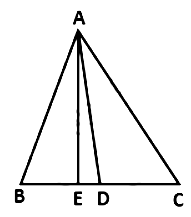
We have $\angle AED = 90^\circ$
$\therefore \angle ADE < 90^\circ$ and $ \angle ADC > 90^\circ$
i.e. $\angle ADE$ is acute and $\angle ADC$ is obtuse.
In $\triangle ADC, \angle ADC$ is an obtuse angle.
$\therefore AC^2 = AD^2 + DC^2+ 2 \times DC \times DE$
$\Rightarrow A C^2=A D^2+\left(\frac{1}{2} B C\right)^2+2 \times \frac{1}{2} B C \times D E$
$\Rightarrow A C^2=A D^2+\frac{1}{4} B C^2+B C \times D E$
$\Rightarrow A C^2=A D^2+B C \times D E+\frac{1}{4} B C^2 \ldots . .(i)$ View full question & answer→Question 164 Marks
From a point $O$ in the interior of a $\triangle ABC$, perpendicular $OD, OE$ and $OF$ are drawn to the sides $BC, CA$ and $AB$ respectively. Prove that: $AF^2 + BD^2 + CE^2= OA^2 + OB^2 + OC^2 - OD^2 - OE^2 - OF^2$
Answer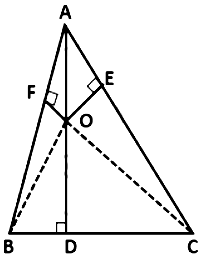
In right $\triangle OFA, ODB$ and $OEC$, we have
$OA^2 = AF^2 + OF^2$
$OB^2 = BD^2 + OD^2$
$OC^2= CE^2 + OE^2$
Adding all these results, we get
$OA^2 + OB^2+ OC^2$
$= AF^2 + BD^2 + CE^2 + OF^2 + OD^2+ OE^2$
$\Rightarrow AF^2 + BD^2+ CE^2$
$= OA^2 + OB^2 + OC^2 - OD^2- OE^2 - OF^2.$ View full question & answer→Question 174 Marks
In an equilateral $\triangle ABC$, the side $BC$ is trisected at $D$. Prove that $9\ AD^2= 7 AB^2$.
Answer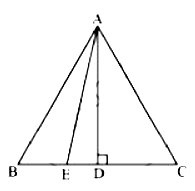
Let side of equilateral triangle be $a$. And $AE$ be the altitude of $\triangle ABC$
So, $BE = EC =\frac{ BC }{2}=\frac{ a }{2}$
And, $A E=\frac{a \sqrt{3}}{2}$
Given that $B D=\frac{1}{3} B C=\frac{a}{3}$
So, $D E=B D-B E=\frac{a}{2}-\frac{a^3}{3}=\frac{a}{6}$
Now, in $\triangle ADE$ by applying Pythagoras theorem
$ A D^2=A E^2+D E^2$
$A D^2=\left(\frac{a \sqrt{3}}{2}\right)^2+\left(\frac{a}{6}\right)^2$
$=\left(\frac{3 a ^2}{4}\right)+\left(\frac{ a ^2}{36}\right)=\frac{28 a ^2}{36} $
Or, $9 A D^2=7 A B^2 \text {. }$ View full question & answer→