Questions

[5 marks sum]

🎯

Test yourself on this topic

10 questions · timed · auto-graded

Question 15 Marks
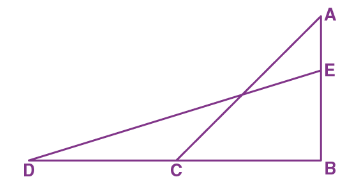
The foot of a ladder is $6\ m$ away from a wall and its top reaches a window $8\ m$ above the ground. If the ladder is shifted in such a way that its foot is $8\ m$ away from the wall to what height does its tip reach?
Image
Answer
Let $AC$ be the ladder and $A$ be the position of the window which is above the ground.
Now, the ladder is shifted such that its foot is at point $D$ which is away from the wall.
$\therefore BD = 8\ m$
At this instance, the position of the ladder is $DE.$
$\therefore AC = DE$
Using Pythagoras theorem in $\triangle ABC,$
$AC^2 = AB^2+ BC^2$
$= (8\ m)^2 + (6\ m)^2$
$= 64\ m^2 + 36\ m^2$
$= 100\ m^2$
$= (10\ m)^2$
$\therefore AC = DE = 10\ m$
Using Pythagoras theorem in $\triangle DBE,$
$BE^2 = DE^2 - BD^2$
$\Rightarrow BE^2= (10m^{)2} - (8\ m)^2$
$= 100\ m^2- 64\ m^2$
$= 36\ m^2$
$= (6\ m)^2$
$\Rightarrow BE = 6\ m$
Thus, the required height up to which the ladder reaches is $6\ m$ above the ground.
View full question & answer
Question 25 Marks
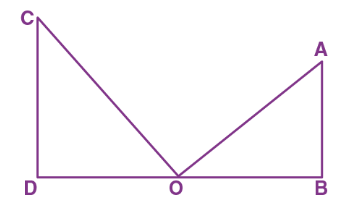
A ladder $15\ m$ long reaches a window which is $9\ m$ above the ground on one side of a street. Keeping its foot at the same point, the ladder is turned to other side of the street to reach a window $12\ m$ high. Find the width of the street.
Image
Answer
let $O$ be the foot of the ladder.
Let $AO$ be the position of the ladder when it touches the window at $A$ which is $9\ m$ high and $CO$ be the position of the ladder when it touches the window at $C$ which is $12\ m$ high.
Using Pythagoras theorem,
In $\triangle AOB,$
$BO^2= AO^2 - AB^2$
$BO^2 = (15\ m)^2 - (9\ m)^2$
$BO^2 = 225\ m^2 - 81\ m^2$
$BO2 = 144\ m^2$
$BO2 = (12\ m)^2$
$BO2 = 12\ m$
Using Pythagoras theorem in $\triangle COB,$
$DO^2 = CO^2 - CD^2$
$DO^2 = (15\ m)^2 - (12\ m)^2$
$DO^2 = 225\ m^2 - 144\ m^2$
$DO^2 = 81\ m^2$
$DO = 9\ m$
Width of the street
$= DO + BO$
$= 9\ m + 12\ m$
$= 21\ m.$
View full question & answer
Question 35 Marks
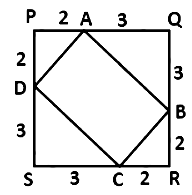
In a square $\text{PQRS}$ of side $5\ cm, A, B, C$ and $D$ are points on sides $PQ, QR, RS$ and $SP$ respectively such as $PA = PD = RB = RC = 2\ cm.$ Prove that $\text{ABCD}$ is a rectangle. Also, find the area and perimeter of the rectangle.
Answer


In $\triangle A P D, \angle P=90^{\circ}$
$\therefore A D^2=A P^2+P D^2$
$=2^2+2^2$
$=4+4$
$=8$
$\Rightarrow A D=2 \sqrt{2} \ cm $
Similarly, we can prove that in $\triangle B R C$,
$ B C=2 \sqrt{2} \ cm$
$\therefore A D=B C \ldots \text { (i) } $
In $\triangle A Q B, \angle Q=90^{\circ}$
$\therefore AB ^2= AQ ^2+ BQ ^2$
$=3^2+3^2$
$=9+9$
$=18$
$\Rightarrow AB =3 \sqrt{2} \ cm$
Similarly, we can prove that in $\triangle CSD$,
$ C D=3 \sqrt{2} \ cm$
$\therefore A B=C D $
Again, in $\triangle A P D$,
$ AP = PD$
$\Rightarrow \angle PAD =\angle PDA =45^{\circ} $
Also, in $\triangle A Q B$,
$A Q=B Q$
$\Rightarrow \angle QAB =\angle QBA =45^{\circ}$
Now, $\angle PAD +\angle DAB +\angle QAB =180^{\circ}$
$ \Rightarrow 45^{\circ}+\angle DAB +45^{\circ}=180^{\circ}$
$\Rightarrow \angle DAB =90^{\circ} $
Similarly, we can prove that $\angle A B C, \angle B C D$ and $\angle A D C$ are $90^{\circ}$ each.
Thus, $\text{ABCD}$ is a rectangle as opposite as opposite sides are equal and each angle is $90^{\circ}$.
Now,
Area of a rectangle $\text{ABCD}$
$ = AD \times AB$
$=2 \sqrt{2} \times 3 \sqrt{2}$
$=12 \ cm ^2 $
Perimeter of a rectangle $\text{ABCD}$
$ = AB + BC + CD + AD$
$=2 \sqrt{2}+3 \sqrt{2}+2 \sqrt{2}+3 \sqrt{2}$
$=10 \sqrt{2} \ cm . $
View full question & answer
Question 45 Marks
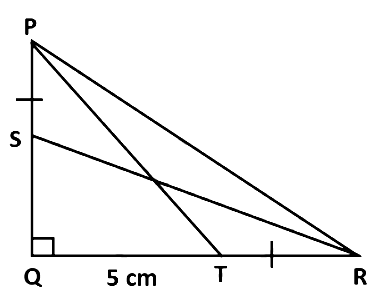
In a right$-$angled $\triangle P Q R$, right$-$angled at $Q, S$ and $T$ are points on $P Q$ and $Q R$ respectively such as $P T=S R=13\ cm , Q T=5 \ cm$ and $P S=T R$. Find the length of $P Q$ and $P S$.
Answer

In $\triangle PQT, \angle Q = 90^\circ$
$\therefore PT^2 = PQ^2 + QT^2 ....($By Pythagoras Theorem$)$
$\Rightarrow PQ^2 = PT^2 - QT^2$
$\Rightarrow PQ^2= PT^2 - QT^2$
$= 13^2 - 5^2$
$= 169 - 25$
$= 144$
$\Rightarrow PQ = 12\ cm$
Now, $PS = TR = a($say$)$
In $\triangle SQR, \angle Q = 90^\circ$
$\therefore SR^2 = QS^2 + QR^2 ....($By Pythagoras Theorem$)$
$\Rightarrow SR^2 = (PQ - PS)^2 + (QT + TR)^2$
$\Rightarrow SR^2 = (PQ - PS)^2 + (QT + PS)^2$
$\Rightarrow SR^2 = PQ^2 - 2 \times PQ \times PS + PS^2 + QT^2 + 2 \times QT \times PS + PS^2$
$\Rightarrow 13^2 = 12^2 - 2 \times 12 \times a + a^2 + 5^2 + 2 \times 5 \times a + a^2$
$\Rightarrow 169 - 144 - 24a + a^2 + 25 + 10a + a^2$
$\Rightarrow 169 = 169 - 14a + 2a^2$
$\Rightarrow 2a^2 = 14a$
$\Rightarrow a = 7$
Hence, $PS = 7\ cm.$
View full question & answer
Question 55 Marks
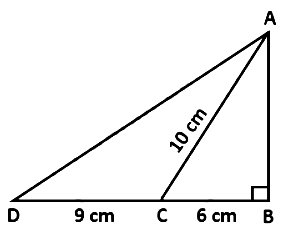
In a right$-$angled $\triangle A B C, A B C=90^{\circ}, A C=10 \ cm, B C=6 \ cm$ and $B C$ produced to $D$ such $C D=9 \ cm$. Find the length of $AD.$
Answer

In $\triangle ABC, \angle B = 90^\circ$
$\therefore AC^2 = AB^2 + BC^2 ....($Pythagoras Theorem$)$
$\Rightarrow 10^2 = AB^2 + 6^2$
$\Rightarrow AB^2= 10^2 - 6^2$
$= 100 - 36$
$= 64$
Now,
$BD = BC + CD$
$= 6 + 9$
$= 15\ cm$
$\Rightarrow BD^2 = 225$
In $\triangle ABD, \angle B = 90^\circ$
$\therefore AD^2 = AB^2 + BD^2$
$\Rightarrow AD^2 = 64 + 225 = 289$
$\Rightarrow AD = 17\ cm.$
View full question & answer
Question 65 Marks
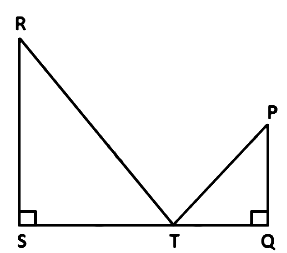
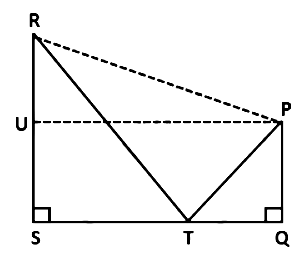
In the given figure, $P Q=\frac{R S}{3}=8 \ cm , 3 S T=4 Q T=48 \ cm$. SHow that $\angle R T P=90^{\circ}$.
Answer

$ P Q=\frac{R S}{3}=8 \ cm$
$\Rightarrow P Q=8 \ cm$ and $R S=3 \times 8=24 \ cm$
$3 S T=4 Q T=48 \ cm$
$\Rightarrow S T=\frac{48}{3}=16 \ cm$ and $Q T=\frac{48}{4}=12 \ cm $
In $\triangle PTQ$
$ PT ^2= PQ ^2+ QT ^2$
$=8^2+12^2$
$=64+144$
$=208 $
In $\triangle RTS$,
$ RT ^2= RS ^2+ ST ^2$
$=24^2+16^2$
$=576+256$
$=832 $
Now, $PT ^2+ RT ^2$
$ =208+832$
$=1040 $
Draw $PU \perp RS$ and Join $PR.$
$ PU = SQ$
$= ST + TQ$
$=16+12$
$=28 \ cm$
$RU = RS - US$
$= RS - PQ$
$=24-8$
$=16 \ cm $
In $\triangle RUP$,
$ PR ^2= RU ^2+ PU ^2$
$=16^2+28^2$
$=256+784$
$=1040 $
From $(i)$ and $(ii),$ we get
$PT ^2+ RT ^2= PR ^2$
Thus, $\angle R T P=90^{\circ}$.
View full question & answer
Question 75 Marks
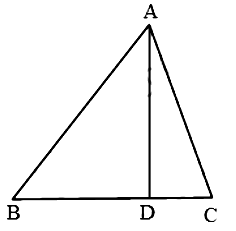
The perpendicular $A D$ on the base $B C$ of a $\triangle A B C$ intersects $B C$ at $D$ so that $D B=3 C D$. Prove that $2 AB ^2=2 AC ^2+ BC ^2$
Answer
We have

$ D B=3 C D$
$B C=B D+D C $
The perpendicular $A D$ on the base $B C$ of a $\triangle A B C$ intersects $B C$ at $D$
so that $D B=3 C D$.
Prove that $2 A C^2$ $+ BC^2$.
We have,
$ DB =3 CD$
$\therefore BC = BD + DC$
$\Rightarrow BC =3 CD + CD$
$\Rightarrow B D=4 C D$
$\Rightarrow C D=\frac{1}{4} B C $
$\therefore C D=\frac{1}{4} B C$ and $B D=3 C D=\frac{1}{4} B C \ldots$
Since $\triangle A B D$ is a right triangle right$-$angled at $D$.
$\therefore A B^2=A D^2+B D^2 \ldots(\text { ii })$
Similarly, $\triangle ACD$ is a right triangle right angled at $D$.
$\therefore A C^2=A D^2+C D^2 \ldots .(\text { iii })$
Subtracting equation $(iii)$ from equation $(ii)$ we get
$ A B^2-A C^2=B D^2-C D^2$
$\Rightarrow A B^2-A C^2=\left(\frac{3}{4} B C\right)^2-\left(\frac{1}{4} B C\right)^2$
$\Rightarrow A B^2-A C^2=\frac{9}{16} B C^2-\frac{1}{16} B C^2$
$\Rightarrow A B^2-A C^2=\frac{1}{2} B C^2$
$\Rightarrow 2\left(A B^2-A C^2\right)=B C^2$
$\Rightarrow 2 A B^2=2 A C^2+B C^2 $
View full question & answer
Question 85 Marks
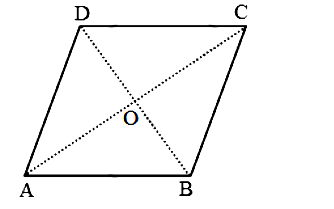
$\text{ABCD}$ is a rhombus. Prove that $AB^2 + BC^2 + CD^2 + DA^2= AC^2 + BD^2$
Answer
Let the diagonals $A C$ and $B D$ of rhombus $\text{ABCD}$ intersect at $O$.
Since the diagonals of a rhombus bisect each other at right angles.
$\therefore \angle A O B=\angle B O C=\angle C O D=\angle D O A=90^{\circ}$ and $A O=C O, B O=O D$.
Since $\triangle A O B$ is a right triangle right$-$angle at $O$.

$ \therefore AB ^2= OA ^2+ OB ^2$
$A B^2=\left(\frac{1}{2} A C\right)^2+\left(\frac{1}{2} B D\right)^2$
$\Rightarrow 4 AB ^2= AC ^2+ BD ^2 \ldots \text { (i) } $
Similarly, we have
$ 4 B C^2=A C^2+B D^2 \ldots(\text { ii })$
$4 C D^2=A C^2+B D^2 \ldots(\text { iii }) $
and,
$4 A D^2=A C^2+B D^2 \ldots(i v)$
Adding all these results, we get
$ 4\left(A B^2+B C^2+A D^2\right)=4\left(A C^2+B D^2\right)$
$\Rightarrow A B^2+B C^2+A D^2+D A^2=A C^2+B D^2 $
View full question & answer
Question 95 Marks
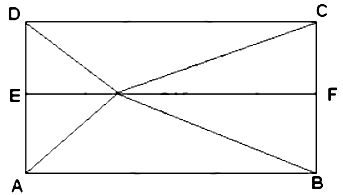
A point $OI$ in the interior of a rectangle $\text{ABCD}$ is joined with each of the vertices $A, B, C $ and $D$. Prove that $OB^2 + OD^2= OC^2 + OA^2$
Answer
Let $\text{ABCD}$ be the given rectangle and let $O$ be a point within it.
Join $OA, OB, OC$ and $OD.$

Through $O$, draw EOF $\| A B$.
Then, $\text{ABFE}$ is a rectangle.
In right triangles $\triangle O E A$ and $\triangle O F C$, we have
$ O A^2=O E^2+A E^2$ and $O C^2=O F^2+C F^2$
$\Rightarrow O A^2+O C^2=\left(O E^2+A E^2\right)+\left(O F^2+C F^2\right)$
$\Rightarrow O A^2+O C^2=O E^2+O F^2+A E^2+C F^2 $
Now, in right triangles $\text{OFB}$ and $\text{ODE}$, we have
$ O B^2=O F^2+F B^2$ and $O D^2=O E^2+D E^2$
$\Rightarrow O B^2+O D^2=\left(O F^2+B^2\right)+\left(O E^2+D E^2\right)$
$\Rightarrow O B^2+O D 2=O E^2+O F^2+D E^2+B F^2$
$\Rightarrow O B^2+O D^2=O E^2+O F^2+C F^2+A E^2[\because D E=C F$ and $A E=B F \ldots \text { (ii) }]$
From $(i)$ and $(ii)$, we get
$O A^2+O C^2=O B^2+O D^2$
View full question & answer
Question 105 Marks
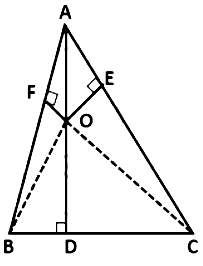
From a point $O$ in the interior of a $\triangle ABC$, perpendicular $OD, OE$ and $OF$ are drawn to the sides $BC, CA$ and $AB$ respectively. Prove that: $AF^2 + BD^2 + CE^2 = AE^2 + CD^2 + BF^{2 }$
Answer

In right triangles $\text{ODB}$ and $\text{ODC}$, we have
$OB^2 = OD^2 + BD^2$
$OC^2 = OD^2 + CD^2$
$\therefore OB^2 - OC^2 = (OD^2 + BD^2) - (OD^2 + CD^2)$
$\Rightarrow OB^2 - OC^2 = BD^2 - CD^2 ....(i)$
Similarly, we have
$OC^2- OA^2 = CE^2 - AE^2 ....(ii)$
$OA^2 - OB^2= AF^2 - BF^2 ....(iii)$
Adding $(i), (ii)$ and $(iii)$, we get
$(OB^2 - OC^2) + (OC^2- OA^2) + (OA^2 - OB^2) = (BD^2 - CD^2) + (CE^2 - AE^2) + (AF^2 - BF^2)$
$\Rightarrow (BD^2 + CE^2 + AF^2) - (AE^2 + CD^2 + BF^2) = 0$
$\Rightarrow AF^2 + BD^2+ CE^2 = AE^2 + CD^2 + BF^2.$
View full question & answer
[5 marks sum] - MATHEMATICS STD 9 Questions - Vidyadip