Question 15 Marks
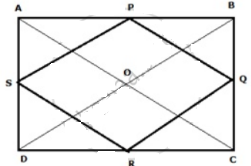
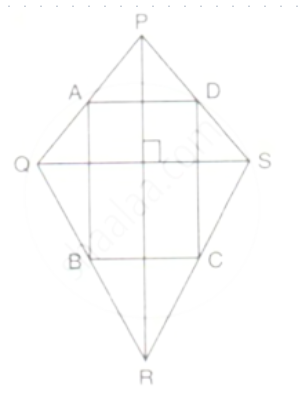
Prove that the quadrilateral formed by joining the mid$-$points of consecutive sides of a rhombus is a rectangle.
Answer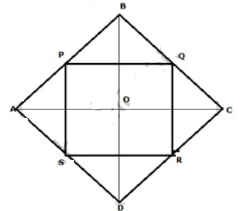
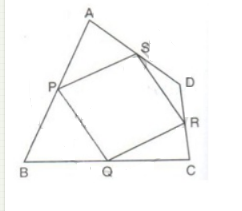
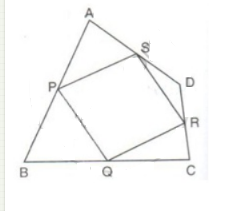
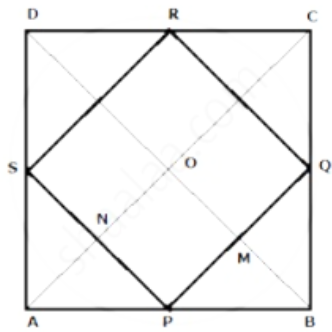
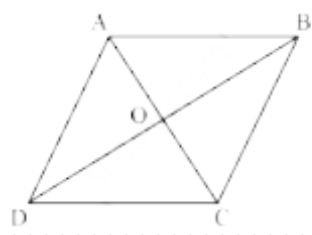
In $\triangle A B C, P$ and $Q$ are mid points of sides $A B$ and $B C$ respectively.
Therefore, $PQ \| AC$ and $PQ =\frac{1}{2} AC ($using mid$-$point theorem$) ...(1)$
In $\triangle ADC$
$R$ and $S$ are the mid points of $C D$ and $A D$ respectively
Therefore, $RS \| AC$ and $RS = \frac{1}{2} A C ($using mid$-$point theorem$) ...(2)$
From equations $(1)$ and $(2),$ we have
$P Q \| R S$ and $P Q=R S$
As in quadrilateral $\text{PQRS}$ one pair of opposite sides are equal and parallel to each other, so, it is a parallelogram.
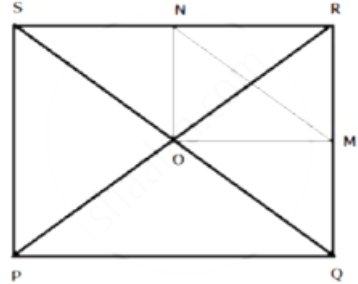
Let diagonals of rhombus $\text{ABCD}$ intersects each other at point $O$.
Now in quadrilateral $\text{OMQN}$
$MQ \| ON \ldots( PQ \| AC )$
$QN \| OM \ldots( QR \| BD )$
So, $\text{OMQN}$ is parallelogram
$\angle MQN =\angle NOM$
$\angle PQR =\angle NOM$
But, $\angle NOM =90^{\circ}...($diagonals of a rhombus are perpendicular to each other$)$
$\angle PQR =90^{\circ}$
Clearly $\text{PQRS}$ is a parallelogram having one of its interior angle as $90^{\circ}$.
Hence, $\text{PQRS}$ is rectangle.
View full question & answer→In $\triangle A B C, P$ and $Q$ are mid points of sides $A B$ and $B C$ respectively.
Therefore, $PQ \| AC$ and $PQ =\frac{1}{2} AC ($using mid$-$point theorem$) ...(1)$
In $\triangle ADC$
$R$ and $S$ are the mid points of $C D$ and $A D$ respectively
Therefore, $RS \| AC$ and $RS = \frac{1}{2} A C ($using mid$-$point theorem$) ...(2)$
From equations $(1)$ and $(2),$ we have
$P Q \| R S$ and $P Q=R S$
As in quadrilateral $\text{PQRS}$ one pair of opposite sides are equal and parallel to each other, so, it is a parallelogram.
Let diagonals of rhombus $\text{ABCD}$ intersects each other at point $O$.
Now in quadrilateral $\text{OMQN}$
$MQ \| ON \ldots( PQ \| AC )$
$QN \| OM \ldots( QR \| BD )$
So, $\text{OMQN}$ is parallelogram
$\angle MQN =\angle NOM$
$\angle PQR =\angle NOM$
But, $\angle NOM =90^{\circ}...($diagonals of a rhombus are perpendicular to each other$)$
$\angle PQR =90^{\circ}$
Clearly $\text{PQRS}$ is a parallelogram having one of its interior angle as $90^{\circ}$.
Hence, $\text{PQRS}$ is rectangle.