Questions

[5 marks sum]

🎯

Test yourself on this topic

5 questions · timed · auto-graded

Question 15 Marks
Ms Mehta teaches maths in a school. One day after teaching the lesson of number system, she wanted to check the understanding of the students of her class. So, she wrote two numbers, $\frac{3}{11}$ and $0 . \overline{52}$ on the blackboard and asked few questions based on them. You please try to answer the following questions asked by Ms Mehta.
Q.1. The decimal expansion of $\frac{3}{11}$ is:
(a) terminating
(b) non-terminating
(c) non-terminating non-repeating
(d) non-terminating repeating
Q.2. $0 . \overline{52}$ is:
(a) non-terminating non repeating
(b) non-terminating repeating
(c) non-terminating
(d) terminating
Q.3. The decimal form of $\frac{3}{11}$ is:
(a) 0.27 (b) 0.2727 (c) $0 . \overline{27}$ (d) 0.3
Q.4. $0 . \overline{52}$ as a vulgar fraction becomes:
(a) $\frac{52}{99}$ (b) $\frac{52}{100}$ (c) $\frac{26}{25}$ (d) $\frac{13}{25}$
Q.5. The sum of $0 . \overline{52}$ and $\frac{3}{11}$ is:
(a) $\frac{79}{99}$ (b) $\frac{70}{99}$ (c) $\frac{52}{99}$ (d) $\frac{40}{99}$
Answer
1. (d) 2. (b) 3. (c) 4. (a) 5. (a)
View full question & answer
Question 25 Marks
Answer
1. (d) 2. (d) 3. (c) 4. (c) 5. (b)
View full question & answer
Question 35 Marks
Case Study II: Ms Mehta teaches maths in a school. One day after teaching the lesson of number system, she wanted to check the understanding of the students of her class. So, she wrote two numbers, $\frac{3}{11}$ and $0 . \overline{52}$ on the blackboard and asked few questions based on them. You please try to answer the following questions asked by Ms Mehta.
1. The decimal expansion of $\frac{3}{11}$ is:
(a) terminating (b) non-terminating
(c) non-terminating non-repeating (d) non-terminating repeating
2. $0 . \overline{52}$ is:
(a) non-terminating non repeating (b) non-terminating repeating
(c) non-terminating (d) terminating
3. The decimal form of $\frac{3}{11}$ is:
(a) 0.27 (b) 0.2727 (c) $0 . \overline{27}$ (d) 0.3
4. $0 . \overline{52}$ as a vulgar fraction becomes:
(a) $\frac{52}{99}$ (b) $\frac{52}{100}$(c) $\frac{26}{25}$ (d) $\frac{13}{25}$
5. The sum of $0 . \overline{52}$ and $\frac{3}{11}$ is:
(a) $\frac{79}{99}$ (b) $\frac{70}{99}$ (c) $\frac{52}{99}$ (d) $\frac{40}{99}$
Answer
Case Study II (1. d), (2. b), (3. c), (4. a), (5. a)
View full question & answer
Question 45 Marks
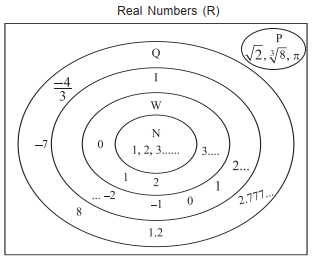
Image
Case Study I: The union of the set of rational numbers (Q) and irrational numbers (P) form the set of real numbers (R). Rational numbers are the set of numbers which can be written in the form $\frac{a}{b}$ , where a and b are integers and $b \neq 0$. The decimal expansion of a rational number is either terminating or non-terminating repeating. The number which cannot be expressed in the form $\frac{a}{b}$ are called irrational numbers. The decimal expansion of irrational numbers is non-terminating non-repeating.
Based on the above information, answer the following questions:
1. Every rational number is:
(a) a natural number (b) a whole number
(c) an integer (d) a real number
2. Every real number is:
(a) an integer
(b) a rational number
(c) an irrational number
(d) either a rational number or an irrational number.
3. The sum of two irrationals is:
(a) irrational (b) rational
(c) either rational or irrational (d) neither rational nor irrational
4. The product of a rational and an irrational number is:
(a) an irrational number
(b) a rational number
(c) either a rational number or an irrational number
(d) neither a rational number nor an irrational number
5. The number of irrational numbers is:
(a) finite (b) infinite
(c) neither finite nor infinite (d) none of these
Answer
Case Study I  (1. d),  (2. d),  (3. c),  (4. c),  (5. b)
View full question & answer
Question 55 Marks
Classify the rational and irrational numbers from the following:
[(i)5, (ii)$\frac{9}{14}$, (iii)$\sqrt{3}$, (iv)$\pi$, (v)3.1416, (vi)$\sqrt{4}$, (vii)$-\sqrt{5}$, (viii)$\sqrt[3]{8}$,(ix) $\sqrt[3]{3}$, (x)$2 \sqrt{6}$, (xi)$0 . \overline{36}$,(xii) 0.202202220…, (xiii)$\frac{2}{\sqrt{3}}$, (xiv) $\frac{22}{7}$]
Answer
rationals :- 5, $\frac{9}{14}$, 3.1416, $\sqrt{4}$, $\sqrt[3]{8}$, $0 . \overline{36}$, $\frac{22}{7}$
irrationals :-$\sqrt{3}$, $\pi$, $-\sqrt{5}$, $\sqrt[3]{3}$, $2 \sqrt{6}$, 0.202202220…, $\frac{2}{\sqrt{3}}$
View full question & answer
[5 marks sum] - MATHEMATICS STD 9 Questions - Vidyadip