Questions

[4 marks sum]

🎯

Test yourself on this topic

16 questions · timed · auto-graded

Question 14 Marks
Find the angles of a quadrilateral whose angles are in the ratio $1: 4: 5: 2.$
Answer
A quadrilateral is a polygon with four sides
$\therefore $ Sum of interior angles
$= (n - 2) \times 180^\circ $
$= (4 - 2) \times 180^\circ $
$= 2 \times 180^\circ $
$= 360^\circ $
Ratio of the angles
$= 1: 4: 5: 2$
$\therefore $ The interior angles are $x^\circ , 4x^\circ , 5x^\circ $ and $2x^\circ .$
$\therefore x + 4x^\circ + 5x^\circ + 2x^\circ = 360^\circ $
$\Rightarrow 12x^\circ = 360^\circ $
$\Rightarrow x^\circ = 30^\circ $
$\therefore $ The interior angles of the quadrilateral are $30^\circ , 120^\circ , 150^\circ $ and $60^\circ .$
View full question & answer
Question 24 Marks
Find the angles of a pentagon which are in the ratio $4: 4: 6: 7: 6.$
Answer
A pentagon has $5$ sides
$\therefore $ Sum of interior angles
$= (n - 2) \times 180^\circ $
$= (5 - 2) \times 180^\circ $
$= 3 \times 180^\circ $
$= 540^\circ $
Ratio of the angles
$= 4: 4: 6: 7: 6$
$\therefore $ The interior angles are $4x^\circ , 4x^\circ , 6x^\circ , 7x^\circ $ and $6x^\circ .$
$\therefore 4x^\circ + 4x^\circ + 6x^\circ + 7x^\circ + 6x^\circ = 540^\circ $
$\Rightarrow 27x^\circ = 540^\circ $
$\Rightarrow x^\circ = 20^\circ $
The interior angles of the pentagon are $80^\circ , 80^\circ , 120 , 140^\circ $ and $120^\circ .$
View full question & answer
Question 34 Marks
The three angles of a quadrilateral are $71^\circ , 110^\circ , 95^\circ $. Find its fourth angle.
Answer
A quadrilateral is a polygon with four sides
$\therefore $ Sum of interior angles
$= (n - 2) \times 180^\circ $
$= (4 - 2) \times 180^\circ $
$= 2 \times 180^\circ $
$= 360^\circ $
Given, the three interior angles are $71^\circ , 110^\circ , 95^\circ $
Let the forth angle be $x$
$\therefore 71^\circ + 110^\circ + 95^\circ + x = 360^\circ $
$\Rightarrow x + 276^\circ = 360^\circ $
$\Rightarrow x$
$= 360^\circ - 276^\circ $
$= 84^\circ $
$\therefore $ The forth angle is $84^\circ .$
View full question & answer
Question 44 Marks
Each interior angle of a regular polygon is $162^\circ.$ Another regular polygon has number of sides double the first polygon. Find each interior angle of the second polygon.
Answer
For the given polygon:
Each interior angle $=162^{\circ}$
$\Rightarrow$ Each exterior angle
$=180^{\circ}-162^{\circ}$
$=18^{\circ}$
$\therefore$ Number of sides in it
$=\frac{360^{\circ}}{18}$
$=20$
For the other polygon:
Number of sides
$=2 \times 20$
$=40 $
$\therefore$ Each ecterior anle
$=\frac{360^{\circ}}{40}$
$=9^{\circ}$
And, each interior angle
$=180^{\circ}-9^{\circ} $
$=171^{\circ}$
View full question & answer
Question 54 Marks
Each exterior angle of a regular polygon is $\frac{1}{ P }$ times of its interior angle. Find the number of sides in the polygon.
Answer
Each interior angle of a regular polygon of $n$ sides $=\frac{(n-2) \times 180^{\circ}}{n}$
Each interior angle of a regular polygon of $n$ sides $=\frac{360^{\circ}}{n}$
Now,
$\frac{360^{\circ}}{n}=\frac{1}{p} \times \frac{(n-2) \times 180^{\circ}}{n} $
$360^{\circ}=\frac{1}{p} \times(n-2) \times 180^{\circ} $
$\Rightarrow n=2=p \times \frac{360^{\circ}}{180^{\circ}} $
$\Rightarrow n-2=2 p $
$\Rightarrow n=2 p+2 $
$\Rightarrow n=2(p+1)$
Thus, the number of sides of a goven regular polygon is $2(p+1)$.
View full question & answer
Question 64 Marks
The sum of the interior angles of a polygon is $6.5$ times the sum of its exterior angles. Find the number of sides of the polygon.
Answer
Sum of the interior angles of a polygon $= (n - 2) \times 180^\circ $
Sum of the exterior angles of a polygon $= 360^\circ $
Given,
Sum of the interior angles of a polygon
$= 6.5\dots...($Sum of the exterior angles of a polygon$)$
$\therefore (n - 2) \times 180^\circ $
$= 6.5 \times 360^\circ $
$\Rightarrow n - 2 = 13$
$\Rightarrow n = 15$
$\therefore $ The polygon has $15$ sides.
View full question & answer
Question 74 Marks
The number angle of a regular polygon is double the exterior angle. Find the number of sides of the polygon.
Answer
Let the exterior angle be $x$
Then, the interior angle is $2 x$
$x+2 x=180^{\circ}\dots...[$Interior angle and exterior angle form a linear pair$]$
$\Rightarrow 3 x =180^{\circ} $
$\Rightarrow x =\frac{180^{\circ}}{3} \times 60^{\circ}$
$\therefore$ Exterior angle $=60^{\circ}$
Each exterior angle
$=\frac{360^{\circ}}{n} $
$\Rightarrow \frac{30^{\circ}}{n}=60^{\circ} $
$\Rightarrow n =6 $
$\therefore$ the regular polygon has $6$ sides.
View full question & answer
Question 84 Marks
The exterior angle of a regular polygon is one$-$third of its interior angle. Find the number of sides of the polygon.
Answer
Let the interior angle be $x$
Then, the exterior angle is $\frac{x}{3}$
$\therefore x+\frac{x}{3}=180^{\circ}\dots...[$Interior angle and exterior angle form a linear pair$]$
$\Rightarrow \frac{4 x}{3}=180^{\circ} $
$\Rightarrow x =\frac{3}{4} \times 180^{\circ} $
$=135^{\circ}$
$\therefore$ Exterior angle
$=\frac{135^{\circ}}{3}$
$=45^{\circ}$
Each exterior angle
$=\frac{360^{\circ}}{ n } $
$\Rightarrow \frac{360^{\circ}}{ n }=45^{\circ} $
$\Rightarrow n =8$
$\therefore$ the regular polygon has $8$ sides.
View full question & answer
Question 94 Marks
Find the value of each angle of an octagon if four of its angles are equal and the other four are each greater than these by $20^\circ .$
Answer
An octagon has $8$ sides, hence eight angles.
Sum of interior angles
$= (n - 2) \times 180^\circ $
$= (8 - 2) \times 180^\circ $
$= 6 \times 180^\circ $
$= 1080^\circ $
Given four of its angles are equal.
Let each of the equal angles be $x^\circ $
$\therefore $ Other four angles are $= (x + 20)^\circ $
$\therefore x^\circ + x^\circ + x^\circ + x^\circ + (x + 20)^\circ + (x + 20)^\circ + (x + 20)^\circ + (x + 20)^\circ = 1080^\circ $
$\Rightarrow 8x^\circ + 80^\circ = 1080$
$\Rightarrow 8x^\circ = 1000^\circ $
$\therefore x^\circ = 125^\circ $
$\therefore $ The four equal angles are $125^\circ $
The other four angles are
$= 125^\circ + 20^\circ $
$= 145^\circ .$
View full question & answer
Question 104 Marks
Find the value of each angle of an octagon if two of its angles are $148^\circ $ and $152^\circ $ and the remaining angles are all equal.
Answer
An octagon has $8$ sides.
$\therefore $ Sum of interior angles
$= (n - 2) \times 180^\circ $
$= (8 - 2) \times 180^\circ $
$= 6 \times 180^\circ $
$= 1080^\circ $
Given, six of its angles are equal.
Let the equal angles be $x$ each.
$148^\circ + 152^\circ + x + x + x + x + x + x = 1080^\circ $
$\Rightarrow 6x + 300^\circ = 1080^\circ $
$\Rightarrow 6x = 780^\circ $
$\Rightarrow x = 130^\circ $
Each of the equal angles are equal to $130^\circ .$
View full question & answer
Question 114 Marks
Find the value of each angle of a heptagon If three of its angles measure $132^\circ $ each and the remaining four.
Answer
A heptagon has $7$ sides.
$\therefore $ Sum of interior angles
$= (n - 2) \times 180^\circ $
$= (7 - 2) \times 180^\circ $
$= 5 \times 180^\circ $
$= 900^\circ $
Given, four of its angles are equal
Let the equal angles be $x$ each.
$\therefore 132^\circ + 132^\circ + 132^\circ + x + x + x + x = 900^\circ $
$\Rightarrow 4x + 396^\circ = 900^\circ $
$\Rightarrow 4x = 504^\circ $
$\Rightarrow x = 126^\circ $
$\therefore $ Measure of each equal angle is $126^\circ .$
View full question & answer
Question 124 Marks
If the difference between an exterior angle of a regular polygon of $'n\ '$ sides and an exterior angle of another regular polygon of $'(n + 1)'$ sides is equal to $4^\circ$; find the value of $'n\ '.$
Answer
Each exterior angle of a regular polygon of $n$ sides $=\frac{360^{\circ}}{n}$
Each exterior angle of a regular polygon of $(n+1)$ sides $=\frac{360^{\circ}}{n+1}$
Difference between the two exterior angles $=4^{\circ}$
$\frac{360^{\circ}}{n}-\frac{360^{\circ}}{n+1}=4^{\circ}$
$\frac{\frac{90}{n}-\frac{90}{n+1}=1}{n(n+1)}=1$
$\Rightarrow 90=n^2+n$
$\Rightarrow n^2+n-90=0$
$\Rightarrow n^2+10 n-9 n-90=0$
$\Rightarrow n(n+10)-9(n+10)=0$
$\Rightarrow(n+10)(n-9)=0$
$\Rightarrow n+10=0$ or $n-9=0$
$\Rightarrow n=-10$ or $n=9$
Since the number of sides cannot be negative, we have $n =9$.
View full question & answer
Question 134 Marks
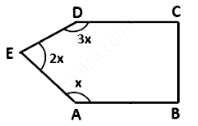
$\text{ABCDE}$ is a pentagon in which $AB$ is parallel to $DC$ and $\angle A : \angle E : \angle D = 1 : 2 : 3.$ Find angle $A.$
Answer
Image
Given $AB \| DC$
$\Rightarrow \angle B + \angle C = 180^\circ $
Also,
$\angle A : \angle E : \angle D = 1 : 2 : 3$
$\Rightarrow \angle A = x, \angle E = 2x$ and $\angle D = 3x$
Since,
$\angle A + \angle B + \angle C + \angle D + \angle E = (5 - 2) \times 180^\circ $
$\Rightarrow \angle A + (\angle B + \angle C) + \angle D + \angle E = 3 \times 180^\circ $
$\Rightarrow x + 180^\circ + 3x + 2x = 540^\circ $
$\Rightarrow 6x + 180^\circ = 540^\circ $
$\Rightarrow 6x = 360^\circ $
$\Rightarrow x = 60^\circ $
Hence,
$\angle A = 60^\circ .$
View full question & answer
Question 144 Marks
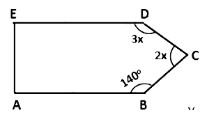
In a pentagon $\text{ABCDE}, AB \| ED$ and $\angle B = 140^\circ , \angle C = 2x^\circ $ and $\angle D = 3x^\circ $. Find $\angle C$ and $\angle D$
Answer
Image
Since $AB \| ED$, we have
$\angle A + \angle E = 180^\circ $
Now,
$\angle A + \angle B + \angle C + \angle D + \angle E = (5 - 2) x 180^\circ $
$\Rightarrow (\angle A + \angle E) + 140^\circ + 2x + 3x = 3 x 180^\circ $
$\Rightarrow 180^\circ + 140^\circ + 5x = 540^\circ $
$\Rightarrow 320^\circ + 5x = 540^\circ $
$\Rightarrow 5x = 220^\circ $
$\Rightarrow x = 44^\circ $
Hence,
$\angle C = 2x = 2 \times 44^\circ = 88^\circ $
$\angle D = 3x = 3 \times 44^\circ = 132^\circ .$
View full question & answer
Question 154 Marks
A heptagon has three angles equal to $120^\circ $, and the other four angles are equal. Find all the angles.
Answer
The sum of the interior angles of heptagon
$=(n-2) \times 180^{\circ} $
$=(7-2) \times 180^{\circ} $
$=5 \times 180^{\circ} $
$=900^{\circ}$
Since, three angles are equal to $120^{\circ}$,
The sum of remaining four angles
$=900^{\circ}-3 \times 120^{\circ} $
$=900^{\circ}-360^{\circ} $
$=540^{\circ}$
Since, these angles are equal,
The measure of each equal angle
$=\frac{540^{\circ}}{4} $
$=135^{\circ}$
Thus, the angles of heptagon are $120^{\circ}, 120^{\circ}, 120^{\circ}, 135^{\circ}, 135^{\circ}, 135^{\circ}, 135^{\circ}$.
View full question & answer
Question 164 Marks
One angle of a hexagon is $140^\circ$ and the remaining angles are in the ratio $4 : 3 : 4 : 5 : 4.$ Calculate the measures of the smallest and the largest angles.
Answer
A hexagon has $6$ sides
$\therefore$ Sum of interior angles
$ =(n-2) \times 180^{\circ}$
$=(6-2) \times 180^{\circ}$
$=4 \times 180^{\circ}=720^{\circ}$
One angle is given to be $140^{\circ}$
Ratio of the remaining five angles
$=4: 3: 4: 5: 4$
$\therefore$ The interior angles are $4 x^{\circ}, 3 x^{\circ}, 4 x^{\circ}, 5 x^{\circ}$ and $4 x^{\circ}$
$ \therefore 140^{\circ}+4 x ^{\circ}+3 x ^{\circ}+4 x ^{\circ}+5^{\circ}+4 x ^{\circ}=720^{\circ}$
$\Rightarrow 20 x ^{\circ}+140^{\circ}=720^{\circ}$
$\Rightarrow x ^{\circ}=\frac{580^{\circ}}{20}=29^{\circ}$
The smallest angle is $3 x^{\circ}=3.29^{\circ}=87^{\circ}$
The largest angle is $5 x^{\circ}=5.29^{\circ}=145^{\circ}$.
View full question & answer
[4 marks sum] - MATHEMATICS STD 9 Questions - Vidyadip