Questions

[5 marks sum]

🎯

Test yourself on this topic

8 questions · timed · auto-graded

Question 15 Marks
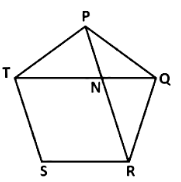
In a regular pentagon $\text{PQRST}, PR = QT$ intersect at $N.$ Find the $\angle RQT$ and $\text{QNP}.$
Answer
Image
Each interior angle of a regular pentagon
$=\frac{(5-2) \times 180^{\circ}}{5}$
$=3 \times 36^{\circ}$
$=108^{\circ} $
Now, In $\triangle PQT$,
$ \Rightarrow PT = PQ \ldots...($sides of a regular pentagon$)$
$\angle PQT =\angle PTQ = x($say$)$
Now, $\angle QT +\angle TQ +\angle QPT =180^{\circ}$
$\Rightarrow x + x +108^{\circ}=180^{\circ} $
$\Rightarrow 2 x =72^{\circ} $
$\Rightarrow x =36^{\circ}$
$\Rightarrow \angle PQT =\angle PTQ =36^{\circ}$
Similarly, we can prove that in $\triangle P Q R$,
$\angle Q P R=\angle Q R P=36^{\circ}$
Now, $\angle R Q T$
$=\angle R Q P-\angle P Q T$
$=108^{\circ}-36^{\circ} $
$=72^{\circ}$
In $\triangle QNP$,
$ \angle PQN +\angle QPN +\angle QNP =180^{\circ}$
$\Rightarrow 36^{\circ}+36^{\circ}+\angle QNP =180^{\circ}$
$\Rightarrow \angle QNP =180^{\circ}-72^{\circ}$
$\Rightarrow \angle QNP =108^{\circ}$
View full question & answer
Question 25 Marks
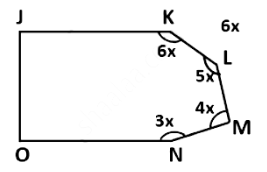
In a hexagon $\text{JKLMNO}$, side $JK \| ON$ and $\angle K : \angle L : \angle M : \angle N = 6 : 5 : 4 : 3$. Find the angle $\angle K$ and $\angle M.$
Answer
Image
Given $JK \| ON$
$\Rightarrow \angle+\angle O=180^{\circ}$
Also,$\angle K : \angle L : \angle M : \angle N =6: 5: 4: 3$
$\Rightarrow \angle K =6 x , \angle L =5 x , \angle M =4 x$ and $\angle N =3 x$
Since, $\angle J +\angle K +\angle L +\angle M +\angle N =4 \times 180^{\circ}$
$\Rightarrow(\angle O +\angle O )+\angle K +\angle L +\angle M +\angle N =4 \times 180^{\circ}$
$\Rightarrow 180^{\circ}+6 x +5 x +4 x +3 x =720^{\circ}$
$\Rightarrow 18 x +180^{\circ}=720^{\circ}$
$\Rightarrow 18 x =540^{\circ}$
$\Rightarrow x =30^{\circ}$
Hence,
$\angle K=6 x$
$=6 \times 30^{\circ}$
$=180^{\circ}$
and
$\angle M=4 x$
$=4 \times 30^{\circ}$
$=120^{\circ} .$
View full question & answer
Question 35 Marks
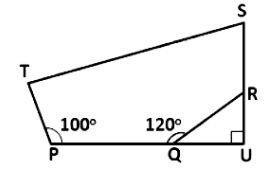
In a pentagon $\text{PQRST}, \angle P = 100^\circ , \angle Q = 120^\circ $ and $\angle S = \angle T.$ The sides $PQ$ and $SR,$ when produced meet at right angle. Find $\angle QRS$ and $\angle PTS.$
Answer

In the figure, $P Q$ and $S R$ produced meet at point $P$,
$ \therefore \angle U =90^{\circ}$
$\angle Q =120^{\circ}$
$\Rightarrow \angle UQR =180^{\circ}-120^{\circ}=60^{\circ}$
$\therefore \angle URQ =90^{\circ}-\angle UQR =90^{\circ}-60^{\circ}=30^{\circ}$
$\therefore QRS =180^{\circ}-\angle URQ =180^{\circ}-30^{\circ}=150^{\circ}$
Let $\angle S =\angle T = x$
Since,$\angle P +\angle Q +\angle QRS +\angle S +\angle T =(5-2) \times 180^{\circ}$
$\Rightarrow 100^{\circ}+120^{\circ}+150^{\circ}+ x + x =3 \times 180^{\circ}$
$\Rightarrow 370^{\circ}+2 x =540^{\circ}$
$\Rightarrow 2 x =170^{\circ}$
$\Rightarrow x =85^{\circ} $
Hnce, $\angle PTS =85^{\circ}$.
View full question & answer
Question 45 Marks
The difference between an exterior angle of $(n - 1)$ sided regular polygon and an exterior angle of $(n + 2)$ sided regular polygon is $6^\circ.$ Find the value of $n.$
Answer
Each exterior angle of a regular polygon of $n$ sides $=\frac{360^{\circ}}{n}$
$\therefore$ Each exterior angle of a regular polygon of $(n-1)$ sides $=\frac{360^{\circ}}{n-1}$
$\therefore$ Each exterior angle of a regular polygon of $(n+2)$ sides $=\frac{360^{\circ}}{n+2}$
Difference between the two exterior angles $=6^{\circ}$
$ \therefore \frac{360^{\circ}}{n-1}-\frac{360^{\circ}}{n+2}=6$
$\Rightarrow 360^{\circ}\left[\frac{n+2-n+1}{(n-1)(n+2)}\right]=6^{\circ}$
$\Rightarrow 60 \times 3=(n-1)(n+2)$
$\Rightarrow 180=n^2+n-2$
$\Rightarrow n^2+n-182=0$
$\Rightarrow n^2+14 n-13 n-182=0$
$\Rightarrow(n+14)(n-13)=0$
$\therefore n =-14($rejected as number of sides can't be negative$)$ or $n =13$
$\therefore$ The value of $n$ is $13 .$
View full question & answer
Question 55 Marks
The ratio between the number of sides of two regular polygon is $3 : 4$ and the ratio between their interior angles is $2 : 3$. Find the number of sides of each polygon.
Answer
Ratio of the sides is $3: 4$
$\therefore$ Number of sides in each polygon is $3 x$ and $4 x$.
Each interior angle of a regular polygon $=\frac{(n-2) \times 180^{\circ}}{n}$
$\therefore$ Interior angle of a regular polygon of $3 x$ sides $=\frac{(3 x-2) \times 180^{\circ}}{3 x}$
And Interior angle of a regular polygon of $4 x$ sides $=\frac{(4 x-2) \times 180^{\circ}}{4 x}$
Ratio of the interior angles is $2: 3$
$\Rightarrow\left\{\frac{(3 x-2) \times 180^{\circ}}{3 x}\right\}:\left\{\frac{(4 x-2) \times 180^{\circ}}{4 x}\right\}=2: 3$
$\Rightarrow\left\{\frac{(3 x-2) \times 180^{\circ}}{3 x}\right\}:\left\{\frac{4 x}{(4 x-2) \times 180^{\circ}}\right\}=\frac{2}{3}$
$\Rightarrow \frac{(3 x-2)}{(4 x)} \times \frac{4}{3}=\frac{2}{3}$
$\Rightarrow \frac{(3 x-2)}{(4 x-2)} \times \frac{4}{3}=\frac{2}{3}$
$\Rightarrow 2(3 x -2)=(5 x -2)$
$\Rightarrow 2 x =2$
$\therefore x =1$
So, the number of sides of each of the polygons are $3$ and $4.$
View full question & answer
Question 65 Marks
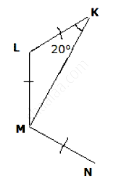
$KL, LM$ and $MN$ are three consecutive sides of a regular polygon. If $\angle LKM = 20^\circ ,$ find the interior angle of the polygon and the number of sides of the polygon.
Answer
Image
In $\triangle LMK , LM = LK ...[$Sides of a regular polygon$]$
$\therefore \angle L M K=\angle L K M=20^{\circ}...[$Angles opp to equal sides are equal$]$
$\therefore \angle LKM +\angle LMK +\angle KLM =180^{\circ}$
$\Rightarrow 20^{\circ}+20^{\circ}+\angle KLM =180^{\circ}$
$\Rightarrow \angle KLM =140^{\circ}$
$\therefore$ Each interior angle of the polygon is $140^{\circ}$.
$\therefore$ Each interior angle of a regular polygon
$ =\frac{( n -2) \times 180^{\circ}}{ n }$
$\Rightarrow \frac{( n -2) \times 180^{\circ}}{ n }=140^{\circ}$
$\Rightarrow 180^{\circ}( n -2)=140^{\circ} n$
$\Rightarrow 40^{\circ} n =360^{\circ}$
$\therefore n =9 $
$\therefore$ Number of sides of the polygon $=9$.
 
View full question & answer
Question 75 Marks
The number of sides of two regular polygons are in the ratio $2 : 3$ and their interior angles are in the ratio $9 : 10$. Find the number of sides of each polygon.
Answer
Ratio of the sides $=2: 3$.
$\therefore$ Number of sides in each polygon is $2 x$ and $3 x$.
Number angle of a regular polygon of $n$ sides $=\frac{(n-2) \times 180^{\circ}}{n}$
$\therefore$ Interior angle of a regular polygon of $2 x$ sides $=\frac{(2 x-2) \times 180^{\circ}}{2 x}$
And, interior of a regular polygon of $3 x$ sides $=\frac{(3 x-2) \times 180^{\circ}}{3 x}$
Ratio of the interior angles $=9: 10$
$\Rightarrow \frac{(2 x-2) \times 180^{\circ}}{2 x}: \frac{(3 x-2) \times 180^{\circ}}{3 x}=9: 10$
$\Rightarrow \frac{(2 x-2) \times 180^{\circ}}{2 x} \times \frac{3 x}{(3 x-2) \times 180^{\circ}}=\frac{9}{10}$
$\Rightarrow \frac{(x-1) \times 180^{\circ}}{x} \times \frac{3 x}{(3 x-2) \times 180^{\circ}}=\frac{9}{10}$
$\Rightarrow \frac{3(x-1)}{(3 x-2)}=\frac{9}{10}$
$\Rightarrow \frac{x-1}{3 x-2}=\frac{3}{10}$
$\Rightarrow 10 x -10=9 x -6$
$\Rightarrow x =4$
$\therefore$ Number of sides in each polygon
$=2(4)=8$ and $3(4)$
$=12$.
View full question & answer
Question 85 Marks
One angle of a pentagon is $160^\circ $ and the rest are all equal angles. Find the measure of the equal angles.
Answer
A pentagon has $5$ sides
$\therefore $ Sum of interior angles
$= (n - 2) \times 180^\circ $
$= (5 - 2) \times 180^\circ $
$= 3 \times 180^\circ $
$= 540^\circ $
One angle is given to be $160^\circ $
Ratio of the remaining four angles
$= 1 : 1 : 1 : 1$
$\therefore $ The interior angles are $x^\circ , x^\circ , x^\circ $ and $x^\circ $
$\therefore 160^\circ + x^\circ + x^\circ + x^\circ + x^\circ = 540^\circ $
$\Rightarrow 4x^\circ = 540^\circ - 160^\circ = 380^\circ $
$\Rightarrow x^\circ = 95^\circ $
$\therefore $ Each equal angle is $95^\circ .$
View full question & answer
[5 marks sum] - MATHEMATICS STD 9 Questions - Vidyadip