Question 13 Marks
Two figures are similar. If the ratio of their perimeters is $8:16.$ What will be the ratio of the corresponding sides?
AnswerWe know that,
for two similar triangles, ratio of the corresponding sides is equal to ratio of the perimeters of the triangles.
$\Rightarrow$ Ratio of the corresponding sides $=\frac{8}{16}=\frac{1}{2}$
that is, ratio of the corresponding sides is $1: 2$.
View full question & answer→Question 23 Marks
On a map drawn to a scale of $1:25000,$ a triangular plot of land is right angled and the sides forming the right angle measure $225\ cm$ and $64\ cm.$ Find: The area of the plot in sq. km.
AnswerScale $=1: 25000$
Area $\text{ABC}$
$=\frac{1}{2} \times 12 \times 16 \times 25000 \times 25000\ cm ^2 $
$=\frac{1 \times 2225 \times 64 \times 25000 \times 25000}{2 \times 100 \times 1000 \times 100 \times 1000}\ km ^2 $
$=\frac{9000000}{2 \times 10000}\ km ^2$
$=450\ km ^2$
View full question & answer→Question 33 Marks
On a map drawn to a scale of $1:25000,$ a triangular plot of land is right angled and the sides forming the right angle measure $225\ cm$ and $64\ cm.$ Find: The actual length of the sides in $km$
AnswerScale$=1: 25000$
Let $AB=225\ cm$ and $B C=64\ cm$
Actual length of $A B$ -
$ =\frac{225 \times 25000}{100 \times 1000}\ km$
$=\frac{5625}{100}\ km$
$=56.25\ km$
Actual length of $B C -$
$ =\frac{64 \times 25000}{100 \times 1000}\ km$
$=\frac{16}{100}\ km$
$=16\ km . $
View full question & answer→Question 43 Marks
On a map drawn to a scale of $1:25000,$ a rectangular plot of land has sides $12\ cm \times 16\ cm.$ Calculate: The area of the plot in $sq \ km$
Answerscale $=1: 25000$
Area $\text{ABCD}$
$=12 \times 16 \times 25000 \times 25000\ cm ^2 $
$=\frac{12 \times 6 \times 25000 \times 25000}{100 \times 1000 \times 100 \times 1000}\ km$
$=\frac{120000}{10000}\ km^2$
$=12\ km ^2$
View full question & answer→Question 53 Marks
On a map drawn to a scale of $1:25000,$ a rectangular plot of land has sides $12\ cm \times 16\ cm.$ Calculate: The diagonal distance of the plot in $km$
Answerscale $=1: 25000$
In rectangle $\text{ABCD}$,
$AB=12 \ cm , BC=16 \ cm$
$AC$ is the diagonal.
By Pythagoras theorem
$ A C^2=A B^2+B C^2$
$A C^2=12^2+16^2$
$A C^2=144+256=400$
$\Rightarrow A C=20 \ cm$
$\because$ Scale $=1: 25000$
$A C=20 \times 25000 \ cm$
$\Rightarrow A C=\frac{20 \times 25000}{100 \times 1000}\ km$
$\Rightarrow A C=5\ km .$
View full question & answer→Question 63 Marks
A model of a ship is made to a scale of $1:500.$ Find: The volume of the model when the volume of the ship is $1\ km^3$
AnswerScale $=1: 500$
$\frac{\text { Area }(\text { deckmodel })}{\text { Area }(\text { decckship })}=$ Scale
$ \frac{1.6 \times 100 \times 100}{\text { Area }(\text { deckship }) \times 100 \times(1000)^2}=\frac{1}{(500)^2} $
Area$($deckship$) =\frac{1.6 \times 2500}{10000}$
Area$($deckship$) =0.4\ km^2 .$
View full question & answer→Question 73 Marks
A model of a ship is made to a scale of $1:500.$ Find: The area other deck o the ship, if the area of the deck of its model is $m^2$
AnswerScale $=1: 500$
$ \frac{\text { Area }(\text { deckmodel })}{\text { Area }(\text { decckship })}=$ Scale
$ \frac{1.6 \times 100 \times 100}{\text { Area }(\text { deckship }) \times 100 \times(1000)^2}=\frac{1}{(500)^2} $
Area$($deckship$) =\frac{1.6 \times 2500}{10000}$
Area$($deckship$) =0.4\ km ^2 .$
View full question & answer→Question 83 Marks
A model of cargo tuck is made to a scale of $1:40.$ The length of the model is $15\ cm.$ Calculate: The base area of the truck, if the base area of the model is $30\ m^2$
AnswerScale$ =1: 40$
$\frac{\text { Area }(\text { model })}{\text { Area }(\text { truck })}=$ Scale
$\frac{30 \times(100)^2}{\text { Area }(\text { truck })}=\frac{1}{(40)^2}$
Area$($truck$) =30 \times 1600 \times 10^4$
Area$($truck$) =4 . \times 10^8 cm ^2 .$
View full question & answer→Question 93 Marks
A model of cargo tuck is made to a scale of $1:40.$ The length of the model is $15\ cm.$ Calculate: The volume of the model if the volume of the truck is $6\ m^3$
AnswerScale $=1: 40$
$\text { Volume of the truck }=64 m ^3$
$\frac{\text { volume }(\text { model })}{\text { volume }(\text { truck })}=$ Scale
$\frac{\text { volume }(\text { model })}{64 \times(100)^3}=\frac{1}{(40)^3}$
Volume $($model $)=\frac{64000000}{64000}$
Volume $($ model $)=1000\ cm ^3 \text {. }$
View full question & answer→Question 103 Marks
In $\triangle ABC, DE \| BC$ such that $AD =1.5\ cm, DB = 3\ cm$ and $AE = 1\ cm.$Find $AC.$
Answer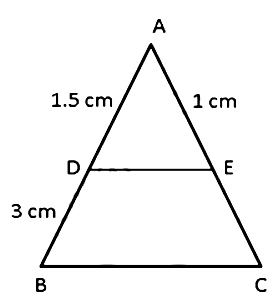
$DE \| BC$
$\frac{ AD }{ AB }=\frac{ AE }{ AC }$
$\Rightarrow \frac{1.5}{4.5}=\frac{1}{ AC }$
$\Rightarrow AC =3\ m .$ View full question & answer→Question 113 Marks
A map is drawn to scale of $1:20000.$ Find: The area of the lake on the map which has an actual area of $12\ km^2$
AnswerScale$=1: 20000 $
area of lake represented on the map:
$12\ Sq\ km =12 \times(100 \times 1000)^2[$as $1\ km =100000\ cm ] $
$=12 \times 10^{10} $
$ \frac{\text { Area }( map )}{\text { Area }(\text { land })}=$ Scale
$ \frac{\text { Area }( map )}{12 \times 10^{10}}=\frac{1}{(20000)^2} $
Area$ ($map$) =\frac{12 \times 10^{10}}{(20000)^2}=\frac{1200}{4} $
Area$($map$) =300\ cm ^2 .$
View full question & answer→Question 123 Marks
A map is drawn to scale of $1:20000.$ Find: The distance on the map representing $4 \ km$
AnswerScale $=1: 20000 $
$ 1 \ km =100000 \ cm $
$ 4 \ km =400000 \ cm$
$\frac{\text { distance }( map )}{\text { distance }(\text { land })}$= Scale
$ \frac{\text { distance }(\text { land })}{400000}=\frac{1}{20000}$
$ 4 \ km$ distance on map
$=\frac{400000}{20000}$
$ =20 \ cm .$
View full question & answer→Question 133 Marks
A map is drawn to scale of $1:20000.$ Find: The distance covered by $6\ cm$ on the map
AnswerScale $=1: 20000$
$1 \ cm$ on the map $=20000 \ cm$ on the land $($as the scale is $1: 20000) 1\ km =100000\ cm$
$\frac{\text { distance }(\text { map })}{\text { distance }(\text { land })}=$ Scale
$\frac{6}{\text { distance }(\text { land }) \times(100000)}=\frac{1}{(20000)}$
Hence $6 \ cm$ on map
$=\frac{6 \times 20000}{100000}$
$=1.2 \ km$.
View full question & answer→Question 143 Marks
A plot of land of area $20\ km^2$ is represented on the map with a scale factor of $1:200000.$ Find: The area on the map that represented the plot of land.
Answerarea of land represented on the map:
$20\ Sq\ km =20 \times(100 \times 1000)^2 [$as $1\ km =100000\ cm ]$
$=20 \times 10^{10}$
$\frac{\text { Area }(\text { map })}{\text { Area }(\text { land })}=\text { Scale }$
$\frac{\text { Area }(\text { map })}{20 \times 10^{10}}=\frac{1}{(200000)^2}$
Area$($map$)=\frac{20 \times 10^{10}}{(200000)^2}=\frac{20}{4} $
Area $($ map $)=5\ cm ^2$.
View full question & answer→Question 153 Marks
A plot of land of area $20 \ km^2$ is represented on the map with a scale factor of $1:200000$. Find: The number of $KM$ represented by $2 \ cm$ on the map.
Answer$1 \ cm$ on the map $=200,000 \ cm$ on the land $($as the scale is $1: 200000)$
$1 \ km =100000 \ cm $
$\frac{\text { distance }( map )}{\text { distance }(\text { land })}=$ Scale
$\frac{2}{\text { distance }(\text { land }) \times(100000)}=\frac{1}{(200000)} $
Hence $2 \ cm$ on map
$=\frac{2 \times 200000}{100000} $
$=4 \ km .$
View full question & answer→Question 163 Marks
The scale of a map is $1 : 50000.$ The area of a city is $40 sq \ km$ which is to be represented on the map. Find: The length of a scale in $km$ represented by $1\ cm$ on the map.
Answer$1 \ cm$ on the map $=50,000 \ cm$ on the land $($as the scale is $1: 50000 ) $
$1 \ km =100000 \ cm =2 \times 50000 \ cm$
distance$($ map$)$
distance$($land $)$
$\frac{1}{\text { distance }(\text { land }) \times(100000)}=\frac{1}{(50000)}$
Hence $1 \ cm$ on map
$=\frac{50000}{100000}$
$=0.5 \ km .$
View full question & answer→Question 173 Marks
The dimensions of the model of a building are $1.2\ m \times 75\ cm \times 2\ m.$ If the scale factor is $1 : 20;$ find the actual dimensions of the building.
Answer$1.2\ m \times 75\ cm \times 2\ m = 1.2m \times 0.75\ m \times 2\ m$
Scale factor $= 1 : 20$
Length$ = 2\ $
Actual length $= 20 \times$ length $= 20 \times 2 = 40\ m$
Breadth $= 0.75\ m$
Actual breadth $= 20 \times$ breadth $= 20 \times 0.75 = 15\ m$
Height $= 1.2\ m$
Actual height $= 20 \times$ height $= 20 \times 1.2 = 24.0\ m$
Actual dimensions are $= 24\ m \times 15\ m \times 40\ m.$
View full question & answer→Question 183 Marks
$\triangle XYZ$ is enlarged to $\triangle X'Y'Z'.$ If $XY = 12\ cm, YZ = 8\ cm$ and $XZ = 14\ cm$ and the smallest side of $\triangle X'Y'Z'.$ is $12\ cm,$ find the scale factor and use it to find the length of the other sides of the image $\triangle X'Y'Z'.$
AnswerScale factor $=\frac{\text { Image length }}{\text { Actual length }}$
Scale factor $=\frac{12}{8}=1.5$
$\frac{X^{\prime} Y^{\prime}}{X Y}=1.5$
$\Rightarrow X^{\prime} Y^{\prime}=1.5 \times 12$
$\Rightarrow X^{\prime} Y^{\prime}=18 \ cm$
$\frac{X^{\prime} Z^{\prime}}{X^{\prime}}=1.5$
$\Rightarrow X^{\prime} Z^{\prime}=1.5 \times 14$
$\Rightarrow X^{\prime} Z^{\prime}=21 \ cm .$
View full question & answer→Question 193 Marks
Find the scale factor in each of the following and state the type of size transformation:Image length $= 8\ cm,$ Actual length $= 20\ cm.$
AnswerImage length $=8\ cm,$
Actual length $=20\ cm.$
Scale factor $=\frac{\text { Image length }}{\text { Actual length }}=\frac{8}{20}$
Scale factor$=0.4$
Since the scale factor $<1$ and $>0$
Type of size transformation $=$ reduction.
View full question & answer→Question 203 Marks
Find the scale factor in each of the following and state the type of size transformation:Actual length $= 12\ cm,$ Image length $= 15\ cm.$
Answer Actual length $=12 \ cm,$ Image length $=15 \ cm$
Scale factor $=\frac{\text { Image length }}{\text { Actual length }}=\frac{15}{12}$
Scale factor $=1.25$
Since the scale factor $>1$
$\Rightarrow$ Type of size transformation $=$ enlargement.
View full question & answer→Question 213 Marks
Find the scale factor in each of the following and state the type of size transformation:Image length $= 6\ cm,$ Actual length $= 4\ cm.$
AnswerImage length $=6\ cm,$ Actual length$=4 \ cm $
Scale factor $=\frac{\text { Image length }}{\text { Actual length }}=\frac{6}{4}$
Scale factor $=1.5 $
Since the scale factor $>1 $
$ \Rightarrow$ Type of size transformation $=$ enlargement.
View full question & answer→Question 223 Marks
If $\triangle PQR, AB$ is drawn parallel to $QR.$ If $PQ = 9\ cm, PR = 6\ cm$ and $PB = 4.cm,$ find the length of $AP.$
Answer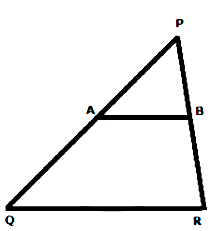
$AB \| QR$
$\frac{ AP }{ PQ }=\frac{ PB }{ PR }$
$\Rightarrow \frac{ AP }{9}=\frac{4.2}{6}$
$\Rightarrow AP =\frac{4.2 \times 9}{6}$
$\Rightarrow AP =6.3 \ cm .$ View full question & answer→Question 233 Marks
In $\triangle ABC,$ point $D$ divides $AB$ in the ratio $5:7,$ Find $: DE,$ If $BC = 4.8\ cm$
Answer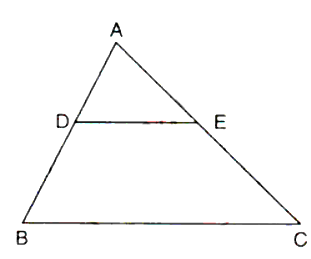
Considering $DE \| BC$
Since $DE \| BC$
$ \frac{ AD }{ AB }=\frac{ DE }{ BC }$
$\Rightarrow \frac{5}{12}=\frac{ DE }{4.8}$
$\Rightarrow DE =\frac{5 \times 4.8}{12}$
$\Rightarrow BC =2 \ cm .$ View full question & answer→Question 243 Marks
In $\triangle ABC,$ point $D$ divides $AB$ in the ratio $5:7,$ Find: $BC,$ If $DE = 2.5\ cm$
Answer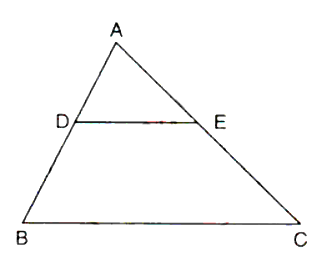
Considering $DE \| BC$
Since $DE \| BC$
$ \frac{ AD }{ AB }=\frac{ DE }{ BC }$
$\Rightarrow \frac{2}{12}=\frac{2.5}{ BC }$
$\Rightarrow BC =\frac{2.5 \times 12}{5}$
$\Rightarrow BC =6 \ cm . $ View full question & answer→Question 253 Marks
In $\triangle ABC$, point $D$ divides $AB$ in the ratio $5: 7$, Find: $\frac{ AE }{ AC }$
Answer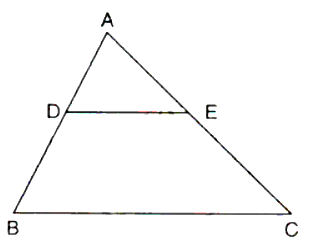
Considering $DE \| BC$
$\frac{ AD }{ DB }=\frac{5}{7} $
$\because AB = AD + DB $
$\Rightarrow AB $
$=5+7 $
$=12 $
$\therefore \frac{ AD }{ AB }=\frac{5}{12} .$ View full question & answer→Question 263 Marks
In $\triangle ABC$, point $D$ divides $AB$ in the ratio $5: 7$, Find: $\frac{ AE }{ EC }$
Answer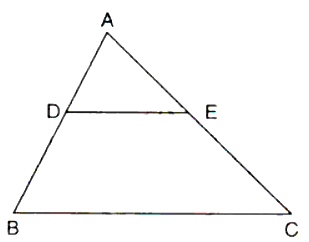
Considering $DE \| BC $
$ \frac{ AD }{ DB }=\frac{ AE }{\overline{ EC }} $
$ \Rightarrow \frac{ AE }{ EC }=\frac{ AD }{ DB } $
$ \Rightarrow \frac{ AE }{ EC }=\frac{5}{7} .$ View full question & answer→Question 273 Marks
In the given figure, $PB$ is the bisector of $ABC$ and $ABC =ACB.$ Prove that$:a. BC \times AP = PC \times AB,b. AB:AC = BP: BC$
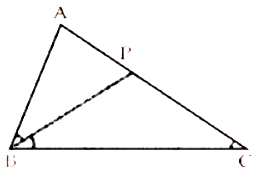
Answer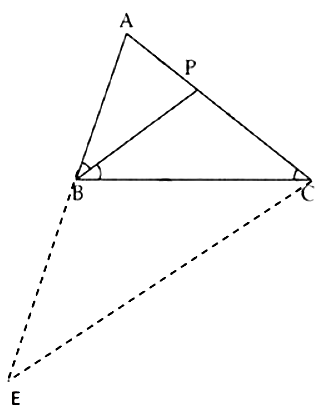
$a.$ Construction: Draw $C E \| B$ and produce $A B$ to $E$.
Proof$: BP \| EC$
$\angle PBC =\angle BCE...($Alternate angles$)$
$\angle A B P=\angle A E C...($Corresponding angles$)$
Also, $\angle ABP =\angle PBC$
$\Rightarrow \angle B C E=\angle B E C$
So, $B E=B C$
In $\triangle AEC$,
$\Rightarrow \frac{ AP }{ PC }=\frac{ AB }{ BE }$
$\Rightarrow B C \times A P=P C \times A B \text {. }$
$b.$ Note: It is not possible to prove this part due to inadequate data. View full question & answer→Question 283 Marks
In a quadrilateral $\text{PQRS},$ the diagonals $PR$ and $QS$ intersect each other at the point $T.$ If $PT:TR = QT :TS = 1:2,$ show that $\triangle PTQ - \text{DRTS}$
Answer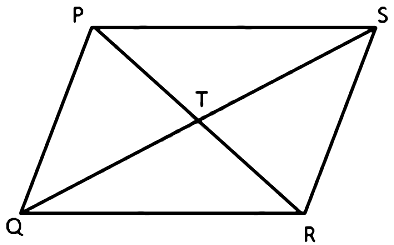
Consider $\triangle PTQ$ and $\triangle RTS$,
$\frac{ PT }{ TR }=\frac{ QT }{ TS }=\frac{1}{2} \ldots ($Given$)$
$\angle PTQ =\angle RTS \quad \ldots ($Vertically Opposite angles$) $
$\Rightarrow \triangle PTQ \sim \Delta RTS . . . (\text {SAS}$ criterion for Similarity$)$ View full question & answer→Question 293 Marks
Through the vertex $S$ of a parallelogram $\text{PQRS},$ a line is drawn to intersect the sides $Qp$ and $QR$ produced at $M$ and $N$ respectively. Prove that $\frac{ SP }{ PM }=\frac{ MQ }{ QN }=\frac{ MR }{ SR }$
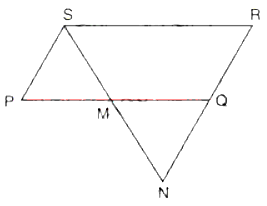
AnswerIn $\triangle PMS$ and $\triangle MQN$
$\angle PMS =\angle NMQ...($vertcally oppe angles$)$
$\angle SPM =\angle MQN...($alternate angles,since $PS \|QN)$
Therefore, $\triangle PMS \sim \triangle MQN$
$\therefore \frac{ SP }{ PM }=\frac{ MQ }{ QN }$
In $\triangle P M S$ and $\triangle M S R$
$\angle PMS =\angle MSR...($alternate angles, since $PM \| SR)$
$SM = SM$
Therefore, $\triangle PMS \sim \triangle MRS$
$\therefore \frac{ SP }{ PM }=\frac{ MR }{ SR }$
From $(i)$ and $(ii)$
$\therefore \frac{ SP }{ PM }=\frac{ MQ }{ QN }=\frac{ MR }{ SR }.$
View full question & answer→Question 303 Marks
In the figure, $D E \| A C$ and $D C \| A P$. Prove that $\frac{B E}{E C}=\frac{B C}{C P}$
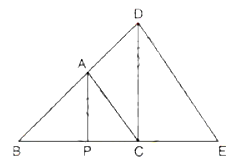
AnswerIn $\triangle A B C, D E \| A C$
$\therefore \frac{ BE }{ EC }=\frac{ BD }{ DA } \ldots .. (i)($By Basic Proportionality theorem$)$
In $\triangle A B P, C D \| A P$
$\therefore \frac{ BC }{ CP }=\frac{ BD }{ DA }$.
$(ii)($By Proportionality theorem$)$
From $(i)$ and $(ii)$
$\frac{ BE }{ EC }=\frac{ BC }{ CP }$
View full question & answer→Question 313 Marks
In the figure, $A B \| R Q$ and $B C \| S Q$. prove that $\frac{P C}{P S}=\frac{P A}{P R}$.
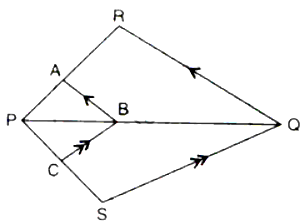
Answer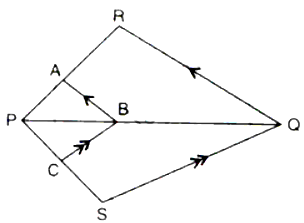
$\text { In } \triangle P Q R, A B \| R Q$
$\therefore \frac{P A}{P R} \frac{P B}{P Q} \quad \dots . . . .(i)($By Basic Proportionality theorem$) $
$\text { In } \triangle P Q S, B C \| S Q$
$\therefore \frac{P C}{P S}=\frac{P B}{P Q} \ldots . . . (ii)($By Basic Proportionality theorem$)$
From $(i)$ and $(ii)$
$\frac{P C}{P S}=\frac{P A}{P R}$ View full question & answer→Question 323 Marks
The diagonal $AC$ of a parallelogram $\text{ABCD}$ intersects $DP$ at the point $Q,$ where $P$ is any point on side $AB.$ Prove that $CQ \times PQ = QA \times QD.$
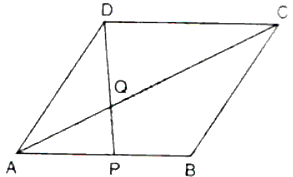
AnswerIn $\triangle PQA$ and $\triangle DQC$
$\angle PQA =\angle DQC...($vertically opposite angles$)$
$\angle A P Q=\angle Q D C... ($alternate angles since $A B \| D C )$
Therefore, $\triangle PQA \sim \triangle DQC$
$\therefore \frac{C Q}{Q D}=\frac{Q A}{P Q}$
$\Rightarrow C Q \times P Q=Q A \times Q D . $
View full question & answer→Question 333 Marks
In the figure, $\text{PQR}$ is a straight line and $PS || RT.$ If $QS = 12\ cm, QR = 15\ cm, QT = 10\ cm$ and $RT = 6\ cm,$ find $PQ$ and $PS.$
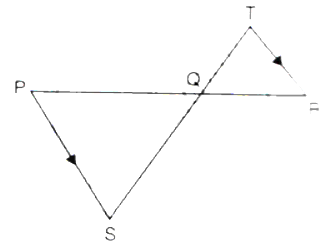
AnswerIn $\triangle P Q S$ and $\triangle Q T R$
$\angle P Q S=\angle T Q R \quad...($verticall opposite angles$)$
$\angle SPQ =\angle QRT \quad...($alternate angles$)$
Therefore, $\triangle P Q S \sim \triangle Q T R$
$ \Rightarrow \frac{ PQ }{ QS }=\frac{ QR }{ QT }$
$\Rightarrow \frac{ PQ }{12} \frac{15}{10}$
$\Rightarrow PQ =\frac{15 \times 12}{10}$
$\Rightarrow PQ =18 \ cm $
Also,
$ \Rightarrow \frac{ QS }{ PS }=\frac{ QT }{ RT }$
$\Rightarrow \frac{12}{ PS }=\frac{10}{6}$
$\Rightarrow PS =\frac{6 \times 12}{10}$
$\Rightarrow PQ =7.2 \ cm .$
View full question & answer→Question 343 Marks
$ABCD$ is a parallelogram whose sides $AB$ and $BC$ are $18\ cm$ and $12\ cm$ respectively. $G$ is a point on $AC$ such that $CG : GA = 3 : 5 BG$ is produced to meet $CD$ at $Q$ and $AD$ produced at $P.$ Prove that $\triangle CGB \sim \triangle AGP.$ Hence, fi $AP.$
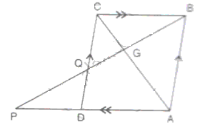
AnswerIn $\triangle C G B$ and $\triangle A G P$
$\angle C G B=\angle A G P \quad...($vertically opposite angles$)$
$\angle G A P=\angle G C B \ldots(A D|| B C, \therefore$ alternate angles$)$
Therefore, $\triangle C G B \sim \triangle A G P...(AA$ axiom$)$
$\therefore \frac{ CG }{ GA }=\frac{ BC }{ AP }$
$\Rightarrow \frac{3}{5}=\frac{12}{ AP }$
$\Rightarrow AP =\frac{5 \times 12}{3}$
$\Rightarrow AP =20 \ cm .$
View full question & answer→