Question 14 Marks
The areas of two similar triangles are $16\ cm^2$ and $9\ cm^2$ respectively. If the altitude of the smaller triangle is $1.8\ cm$, find the length of the altitude corresponding to the larger triangle.
Answer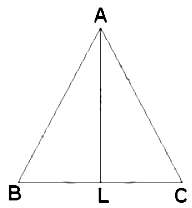
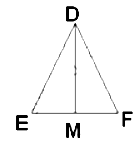
The ratio of the areas of two similar triangles is equal to the ratio of the square of the corresponding altitudes.
$ \therefore \frac{\operatorname{area}(\Delta ABC )}{\operatorname{area}(\Delta PQR )}=\frac{ AL ^2}{ DM ^2}$
$\Rightarrow \frac{16}{9}=\frac{ AL ^2}{1.8^2}$
$\Rightarrow AL ^2=\frac{16 \times 3.24}{9}$
$\Rightarrow AL ^2=5.76$
$\Rightarrow AL =2.4\ cm . $ View full question & answer→Question 24 Marks
Harmeet is $6$ feet tall and casts a shadow of $3$ feet long. What is the height of a nearby pole if it casts a shadow of $12$ feet long at the same time?
Answer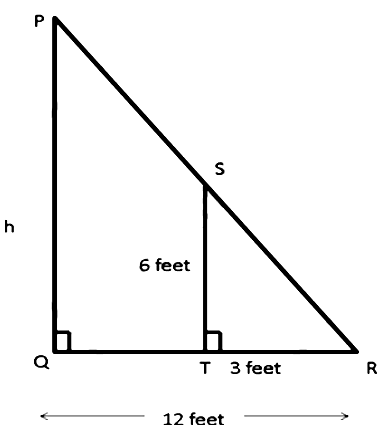
Harmeet and the pole will be perpendicular to the ground.
So, $PQ \| ST$
In $\triangle P Q R$ and $\triangle S T R$,
$\angle P Q R=\angle S T R \quad\dots...($Both are right angles$)$
$\angle PRQ =\angle SRT \quad\dots...($common angle$)$
$\triangle P Q R$ and $\triangle S T R\dots...(AA$ crriterion for similarity$)$
$\frac{ PQ }{ ST }=\frac{ QR }{ TR }$
$\Rightarrow \frac{ h }{6}=\frac{12}{3} $
$\Rightarrow h =24$ feet
Hence, the height of the pole is $24$ feet. View full question & answer→Question 34 Marks
A plot of land of area $20 \mathrm{~km}^2$ is represented on the map with a scale factor of $1:200000.$ Find: The ground area in $\mathrm{km}^2$ that is represented by $2 \mathrm{~cm}^2$ on the map.
Answer$1 \ cm$ on the map $=200,000 \ cm$ on the land $($as the scale is $1: 200000)$
$1 \ cm ^2$ on the map $=(200000)^2$ on the land
$1 \ km =100000 \ cm$
$\Rightarrow 1 \ km ^2=100000 \times 100000 \ cm ^2$
$\frac{\text { distance }(\text { map })}{\text { distance }(\text { land })}=$ Scale
$\frac{2}{\text { distance }(\text { land }) \times(100000)}=\frac{1}{(200000)^2}$
Hence $2 \ cm$ on map
$=\frac{2 \times 200000 \times 200000}{100000 \times 100000} $
$=8 \ km ^2 .$
View full question & answer→Question 44 Marks
The scale of a map is $1 : 50000.$ The area of a city is $40 sq \ km$ which is to be represented on the map. Find: The area of land represented on the map.
AnswerScale factor $=1: 50000$
area of land represented on the map:
$40 Sq\ \ km$
$=40 \times(100 \times 1000)^2[$ as $1 \ km =100000 \ cm ] $
$=40 \times 10^{10}$
$\frac{\text { Area }(\text { map })}{\text { Area }(\text { land })}=$ Scale
$\frac{\text { Area }(\text { map })}{40 \times 10^{10}}=\frac{1}{(50000)^2}$
Area(map)
$=\frac{40 \times 10^{10}}{(50000)^2}$
$=\frac{4000}{25}$
$($Area map$)=160\ cm ^2$.
View full question & answer→Question 54 Marks
On a map drawn to a scale of $1: 2,50,000,$ a triangular plot of land has the following measurements:$AB = 3\ cm, BC = 4\ cm, \angle ABC = 90^\circ.$ Calculate$:(i)$ The actual length of $AB$ in $km.(ii)$ The area of Plot in $sq. \ km.$
AnswerScale $=1: 25000$
$(i)$ Actual length of $A B$
$ =3 \times 250000 \ cm$
$=\frac{3 \times 250000}{100 \times 100} \ km$
$=7.5 \ km$
$A B=7.5 \ km . $
$(ii)$ Actual length of $BC$
$ =4 \times 250000 \ cm$
$=\frac{4 \times 250000}{100 \times 100} \ km$
$=10 \ km$
$B C=10 \ km $
Area$(\triangle ABC )=\frac{1}{2} \times AB \times BC$
Area$(\triangle ABC )=\frac{1}{2} \times 7.5 \times 10 \ km ^2$
Area$(\triangle ABC )=37.5 \ km ^2$
View full question & answer→Question 64 Marks
Find the scale factor in each of the following and state the type of size transformation:Actual area $= 64m^2$, Model area $= 100\ cm^2$
AnswerActual area $= 64\ m^2,$ Model area $= 100\ cm^2$
Actual area
$= 64 \times 10000\ cm^2$
$= 640000\ cm^2$
Scale factor
$=\sqrt{\frac{\text { Model Area }}{\text { Actual Area }}}$
$=\sqrt{\frac{100}{640000}}$
$=\sqrt{\frac{1}{6400}}$
$=\frac{\sqrt{1}}{80}$
Scale factor $= 0.0125$
Since the scale factor $< 1$ and $> 0$
$\Rightarrow$ Type of size transformation $=$ reduction.
View full question & answer→Question 74 Marks
In $\triangle ABC, AB = 8\ cm, AC = 10\ cm$ and $\angle B = 90^\circ. P$ and $Q$ are the points on the sides $AB$ and $AC$ respectively such that $PQ = 3\ cm$ and $\angle PQA = 90.$ Find: Area of quadrilateral $\text{PBCQ}:$ area of $\triangle ABC.$
Answer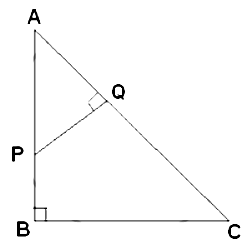
In $\triangle A Q P$ and $\triangle A B C$
$\angle A =\angle A$
$\angle PQA =\angle ABC\dots...($right angles$)$
Therefore, $\triangle A Q P \sim \triangle A B C$
Area$($trapezium $\text{EDBC})=$Area$(\triangle A B C)-$ Area $(\triangle A Q P)$
Area$($trapezium $\text{EDBC})=24-6=18 \ cm ^2$
$\frac{\text { Area(trapeziumEDBC) }}{\text { Area }(\triangle ABC )}=\frac{18}{24}$
$\Rightarrow \frac{\text { Area }(\text { trapeziumEDBC) }}{\text { Area }(\triangle ABC )}=\frac{3}{4} $
Area$($trapezium $\text{EDBC}):$ Area $(\triangle A B C)=3: 4$. View full question & answer→Question 84 Marks
In $\triangle ABC, DE$ is parallel to $BC$ and $DE = 3:8.$
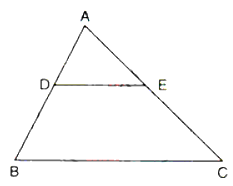
Find:$(i) AD : BD(ii) AE,$ if $AC = 16.$ Answer$(i)$ Since $DE \| BC$
$\frac{ DE }{ BC }=\frac{ AD }{ AB }$
$\Rightarrow \frac{3}{8}=\frac{ AD }{ AB }$
$\Rightarrow \frac{ AD }{ AB }=\frac{3}{8}$
Since $D B=A B-A D$
$\Rightarrow DB$
$=8-3$
$=5$
Therefore,
$A D: D B=3: 5$
$(ii) D E: B C=3: 8$
Since $D E \| B C$
$ \frac{ DE }{ BC }=\frac{ AE }{ AC }$
$\Rightarrow \frac{3}{8}=\frac{ AE }{16}$
$\Rightarrow AE =\frac{3 \times 16}{8}$
$\Rightarrow AE =6 . $
View full question & answer→Question 94 Marks
In figure, $PQ$ is parallel to $BC, AP : AB = 2 : 7.$ If $QC = 0$ and $BC = 21,$
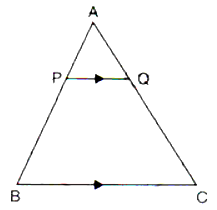
Find$(i) AQ;(ii) PQ$ Answer$(i)$ Since $PQ \| BC$
$\frac{ AP }{ PB }=\frac{ AQ }{ QC }$
$\Rightarrow \frac{ AP }{ AB - AP }=\frac{ AQ }{ QC }$
$\Rightarrow \frac{2}{5}=\frac{ AQ }{10}$
$\Rightarrow AQ =\frac{2 \times 10}{5}$
$\Rightarrow AQ =4 .$
$(ii)$ Since $P Q \| B C$
$ \frac{ AP }{ AB }=\frac{ PQ }{ BC }$
$\Rightarrow \frac{2}{7}=\frac{ PQ }{21}$
$\Rightarrow PQ =\frac{2 \times 21}{7}$
$\Rightarrow PQ =6$
View full question & answer→Question 104 Marks
In a right$-$angled $\triangle ABC, \angle B = 90^\circ , P$ and $Q$ are the points on the sides $AB$ and $AC$ such as $\text{PQBC}, AB = 8 \ cm, AQ = 6 \ cm$ and $PA:AB = 1:3.$ Find the lengths of $AC$ and $BC.$
Answer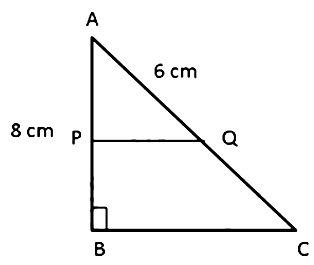
In right$-$angled $\triangle ABC$,
$ PQ \| BC$
$\Rightarrow \frac{ PA }{ AB }=\frac{ QA }{ AC }$
$\Rightarrow \frac{1}{3}=\frac{6}{ AC }$
$\Rightarrow AC =18 \ cm $
By Pythagoras Theorem,
$ BC ^2=A C^2-A B^2$
$\Rightarrow B C^2=18^2-8^2$
$\Rightarrow B C^2=324-64$
$\Rightarrow B C=16.12 \ cm . $ View full question & answer→Question 114 Marks
If $\triangle ABC, D$ and $E$ are points on $AB$ and $AC.$ Show that $DE \| BC$ for each of the following case or not:$AD = 5.7\ cm, BD = 9.5\ cm, AE = 3.3\ cm,$ and $EC = 5.5\ cm$
Answer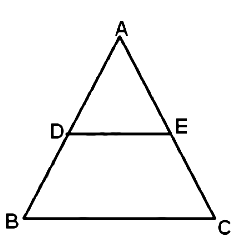
$AD =5.7 \ cm , BD =9.5 \ cm , AE =3.3 \ cm,$ and $EC =5.5 \ cm$
$\frac{ AD }{ BD }=\frac{5.7}{9.5}=0.6$
$\frac{ AE }{ EC }=\frac{3.3}{5.5}=\frac{3}{5}=0.6$
$\Rightarrow \frac{ AD }{ BD }=\frac{ AE }{ EC }$
$\therefore \triangle ADE \sim \triangle ABC$
$\Rightarrow \angle D =\angle B ; \angle E =\angle C $
But these corresponding angles
Hence, $DE \| BC.$ View full question & answer→Question 124 Marks
If $\triangle ABC, D$ and $E$ are points on $AB$ and $AC.$ Show that $DE \| BC$ for each of the following case or not:$AB = 10.8\ cm, BD = 4.5\ cm, AC = 4.8\ cm,$ and $AE = 2.8\ cm$
Answer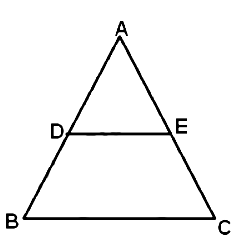
$ A B=10.8 \ cm , B D=4.5 \ cm , A C=4.8 \ cm,$ and $A E=2.8 \ cm$
$A D=A B-B D=10.8-4.5=6.3 \ cm$
$\frac{A D}{A B}=\frac{6.3}{10.8}=\frac{2}{36}=\frac{7}{12}$
$\frac{A E}{A C}=\frac{2.8}{4.8}=\frac{14}{24}=\frac{7}{12}$
$\Rightarrow \frac{A D}{A B}=\frac{A E}{A C}$
$\therefore \triangle A D E \sim \triangle A B C$
$\Rightarrow \angle D=\angle B ; \angle E=\angle C $
But these are corresponding angles
Hence, $D E \| B C$. View full question & answer→Question 134 Marks
$AM$ and $DN$ are the altitudes of two similar triangles $\text{ABC}$ and $\text{DEF}$. Prove that: $AM : DN = AB : DE.$
Answer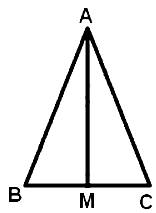
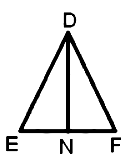
Since $\triangle ABC \sim \triangle DEF$
$\angle B=\angle E$
$\angle AMB =\angle DNE \quad\dots...($Both are right angles$)$
Therefore, $\triangle ANB \sim \triangle DNE$
$\therefore \frac{ AM }{ DN }=\frac{ AB }{ DE } $
$\Rightarrow AM : DN = AB : DE .$ View full question & answer→Question 144 Marks
In $\triangle A B C, B P$ and $C Q$ are altitudes from $B$ and $C$ on $A C$ and $A B$ respectively. $B P$ and $C Q$ intersect at $O$. Prove that$(i) PC \times OQ = QB \times OP;$(ii) $\frac{ OC ^2}{ OB ^2}=\frac{ PC \times PO }{ QB \times QO }$
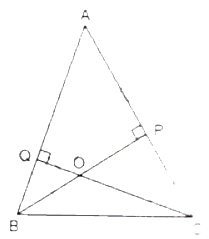
Answer$(i)$ In $\triangle OBQ$ and $\triangle OPC$
$\angle O Q B=\angle O P C=90^{\circ}\dots...(QC$ and $BP$ are altitudes$)$
$\angle QOB =\angle POC \quad\dots...($vertically opposite angles$)$
Therefore, $\triangle OBQ \sim \triangle OPC$
$\Rightarrow \frac{ PC }{ OP }=\frac{ QB }{ OQ }$
$\Rightarrow PC \times OQ = QB \times OP$
$(ii)$Since $\triangle O B Q \sim \triangle O P C$
$ \frac{ OC }{ PO } \times \frac{ OC }{ PC }=\frac{ OB }{ QB } \times \frac{ OB }{ QO }$
$\Rightarrow \frac{ OC ^2}{ PC \times PO }=\frac{ B ^2}{ QB \times Q O}$
$\Rightarrow \frac{ OC ^2}{ OB ^2}=\frac{ PC \times PQ }{ QB \times QO } .$
View full question & answer→Question 154 Marks
In $\triangle ABC, D$ and $E$ are the mid$-$point on $AB$ and $AC$ such that $DE \| BC$.If $AD : BD = 4 : 5$ and $EC = 2.5 \ cm$, find $AE.$
Answer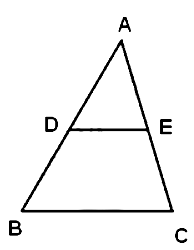
In $\triangle A D E$ and $\triangle A B C$
$\angle D=\angle B$ and $\angle C=\angle E . .(D E \| B C) $
$ \Rightarrow \triangle A D E \sim \triangle A B C $
$ \therefore \frac{A D}{D B}=\frac{A E}{E C} $
$ \Rightarrow \frac{4}{5}=\frac{A E}{2.5} $
$ \Rightarrow A E=\frac{4 \times 2.5}{5} $
$ \Rightarrow A E=2 \ cm .$ View full question & answer→Question 164 Marks
In $\triangle ABC, D$ and $E$ are the mid$-$point on $AB$ and $AC$ such that $DE \| BC.$If $AD = 4, AE = 8, DB = x - 4$ and $EC = 3x - 19$, find $x.$
Answer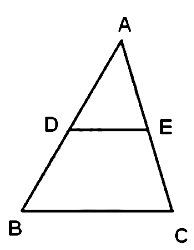
In $\triangle A D E$ and $\triangle A B C$
$\angle D=\angle B$ and $\angle C=\angle E \ldots(D E \| B C)$
$\Rightarrow \triangle A D E \sim \triangle A B C$
$\therefore \frac{A D}{D B}=\frac{A E}{E C}$
$\Rightarrow \frac{4}{x-4}=\frac{8}{3 x-19}$
$\Rightarrow 4 x(3 x-19)=8 x(x-4)$
$\Rightarrow 12 x-76=8 x-32$
$\Rightarrow 4 x=44$
$\Rightarrow x=11$ View full question & answer→Question 174 Marks
In the figure, $PR \| SQ.$ If $PR = 10\ cm, PT = 5\ cm, TQ = 6\ cm$ and $ST = 9\ cm,$ calculate $RT$ and $SQ.$
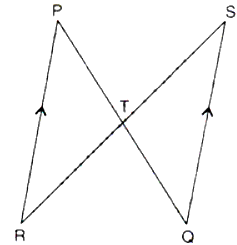
AnswerIn $\triangle P R T$ and $\triangle S Q T$
$\angle PTR =\angle STQ\dots...($veriically opposite angles$)$
$\angle R P T=\angle S Q T \quad\dots...($alternate angles $\because P R \| S Q$ )
$\therefore \triangle PRT \cong \triangle SQT$
$\Rightarrow \frac{ RT }{ PT }=\frac{ ST }{ TQ }$
$\Rightarrow \frac{ RT }{5}=\frac{9}{6}$
$\Rightarrow RT =\frac{5 \times 9}{6}$
$\Rightarrow RT =7.5 \ cm$
Also,
$\frac{ PT }{ PR }=\frac{ TQ }{ SQ }$
$\Rightarrow \frac{5}{10}=\frac{6}{ SQ }$
$\Rightarrow SQ =\frac{6 \times 10}{5}$
$\Rightarrow SQ =12 \ cm . $
View full question & answer→