Question 15 Marks
The ratio of two numbers is $\frac{2}{5}$. If $4$ is added in first and $32$ is subtracted from the second, the ratio becomes the reciprocal of the original ratio. Find the numbers.
AnswerLet the two numbers be $x$ and $y$.
According to given information, we have
$ \frac{x}{y}=\frac{2}{5}$
$\Rightarrow 5 x -2 y =0$
$\Rightarrow 5 x -2 y =0 ....(i) $
And,
$ \frac{x+4}{y-32}=\frac{5}{2}$
$\Rightarrow 2 x+8=5 y-160$
$\Rightarrow 2 x-5 y=-168 ....(ii) $
Multiplying eqn. $(i)$ by $5$ and eqn. $(ii)$ by $2 ,$ we get
$ 25 x-10 y=0 ....(iii)$
$4 x-10 y=-336 ....(iv) $
Subtracting eqn. $(iv)$ from eqn.$ (iii),$ we get
$ 21 x =336$
$\Rightarrow x =16$
$\Rightarrow 5(16)-2 y =0$
$\Rightarrow 80-2 y =0$
$\Rightarrow 2 y =80$
$\Rightarrow y =40 $
Thus, the numbers are $16$ and $40$.
View full question & answer→Question 25 Marks
If $2$ is added to the numerator and denominator it becomes $\frac{9}{10}$ and if $3$ is subtracted from the numerator and denominator it becomes $\frac{4}{5}$ Find the fraction.
AnswerLet the fraction be $\frac{x}{y}$.
According to given information, we have
$ \frac{x+2}{y+2}=\frac{9}{10} $
and
$ \frac{x-3}{y-3}=\frac{4}{5}$
$\Rightarrow 10 x+20$
$=9 y+18 $
and
$5 x -15$
$ =4 y -12 $
$ \Rightarrow 10 x-9 y=-2 .....(i) $
and
$ 5 x-4 y=3 .....(ii) $
Multiplying eqn. $(ii)$ by $2,$ we get
$ 10 x-8 y=6 .....(iii) $
Subtracting eqn. $(iii)$ from eqn.$ (i),$ we get
$-y=-8$
$\Rightarrow y=8$
$\Rightarrow 10 x=-(9)=6$
$\Rightarrow 10 x-64=6$
$\Rightarrow 10 x=70$
$\Rightarrow x=7$
$\therefore$ Required fraction $=\frac{7}{8} .$
View full question & answer→Question 35 Marks
Seven more than a $2-$digit number is equal to two less than the number obtained by reversing the digits. The sum of the digits is $5$. Find the number.
AnswerLet $x$ be the digit at ten's place and $y$ be the digit at unit's place.
Then, the number is $10x + y.$
Number obtained by reversing the digits $= 10y + x$
According to given information, we have
$(10x + y) + 7 = (10y + x) - 2$
$\Rightarrow 10x + y + 7 = 10y + x - 2$
$\Rightarrow 9x - 9y = -9$
$\Rightarrow 9(x - y) = -9$
$\Rightarrow x - y = -1 ....(i)$
Also, $x + y = 5 ....(ii)$
Adding eqns. $(i)$ and $(ii),$ we get
$2x = 4$
$\Rightarrow x = 2$
$\Rightarrow 2 + y = 5$
$\Rightarrow y = 3$
$\therefore $ Required number
$= 10x + y$
$= 10 \times 2 + 3$
$= 20 + 3$
$= 23.$
View full question & answer→Question 45 Marks
The sum of a two$-$digit number and the number obtained by reversing the digits is $110$ and the difference of two digits is $2$. Find the number.
AnswerLet $x$ be the digit at ten's place and $y$ be the digit at unit's place.
Then, the number is $10x + y.$
Number obtained by reversing the digit $= 10y + x$
According to given information, we have
$(10x + y) + (10y + x) = 110$
$\Rightarrow 11x + 11y = 110$
$\Rightarrow 11(x + y) = 9$
$\Rightarrow x + y = 10 ....(i)$
Also, $x - y = 2 ....(ii)$
Adding eqns. $(i)$ and $(ii)$, we get
$2x = 12$
$\Rightarrow x = 6$
$\Rightarrow 6 + y = 10$
$\Rightarrow y = 4$
$\therefore $ Required number
$= 10x + y$
$= 10 x 6 + 4$
$= 60 + 4 $
$= 64.$
View full question & answer→Question 55 Marks
In a two$-$digit number, the sum of the digits is 7$$. The difference of the number obtained by reversing the digits and the number itself is $9$. Find the number.
AnswerLet $x$ be the digit at ten's place and $y$ be the digit at unit's place.
Then, the number is $10x + y.$
Number obtained by reversing the digits $= 10y + x$
According to given information, we have
$x + y = 7 ....(i)$
And, $(10y + x) - (10x + y) = 9$
$\Rightarrow 10y + x - 10x - y = 9$
$\Rightarrow 9y - 9x = 9$
$\Rightarrow 9(y - x) = 9$
$\Rightarrow y - x = 1 ....(ii)$
Adding eqns. $(i)$ and $(ii),$ we get
$2y = 8$
$\Rightarrow y = 4$
$\Rightarrow x + 4 = 7$
$\Rightarrow x = 3$
$\therefore $ Required number
$= 10x + y $
$= 10 x 3 + 4$
$= 30 + 4$
$= 34.$
View full question & answer→Question 65 Marks
$A$ and $B$ can build a wall in $6 \frac{2}{3}$ days. If $A\ '$ one day work is $1 \frac{1}{4}$ of one day work of $B$, find in $4$ how many days $A$ and $B$ alone can build the wall.
AnswerLet $A$ alone will do the work in $x$ days and $B$ alone will do the same work in $y$ days.
Then $, A\ ' \ 1 $ day work $=\frac{1}{x}$ and $B\ ' \ 1$ day work $=\frac{1}{y}$
According to given information, we have
$ \frac{1}{x}+\frac{1}{y}=\frac{1}{6 \frac{2}{3}}$
$\Rightarrow \frac{1}{x}+\frac{1}{y}=\frac{3}{20} ....(i) $
And,
$ \frac{1}{x}=1 \frac{1}{4} \times \frac{1}{y}$
$\Rightarrow \frac{1}{x}-\frac{5}{4 y}=0 ...(ii) $
Subtracting eqn. $(ii)$ from eqn. $(i),$ we get
$ \frac{1}{y}+\frac{5}{4 y}=\frac{3}{20}$
$\Rightarrow \frac{9}{4 y}=\frac{3}{20}$
$\Rightarrow 4 y =\frac{9 \times 20}{3}=60$
$\Rightarrow y =15$
$\Rightarrow \frac{1}{x}-\frac{5}{4(15)}=0$
$\Rightarrow \frac{1}{x}=\frac{1}{12}$
$\Rightarrow x =12 $
Thus, $A$ alone will do the work in $12$ days and $B$ alone will do the same work in $15$ days.
View full question & answer→Question 75 Marks
Two mobiles $S_1$ and $S_2$ are sold for $Rs. 10,490$ making $4\%$ profit on $S_1$ and $6\%$ on $S_2$. If the two mobiles are sold for $Rs.10,510,$ a profit of $6\%$ is made on $S_1$ and $4\%$ on $S_2$. Find the cost price of both the mobiles.
Answer
Let the $C.P$. of $S_1$ mobile$=\text { Rs. } x$
and the $C.P$. of $S_2$ mobile$=\text { Rs. } y$
In $1^{\text {st }}$ case$:$
$\text { S.P.}$ of $S_1$ mobile
$=\text { Rs. } x +4 \%$ of $\text {Rs. } x$
$=\text { Rs. }\left(x+\frac{4}{100} x\right)$
$=\text { Rs. } \frac{104}{100} x$
$=\text { Rs. } \frac{26 x}{25}$
$\text { S.P.}$ of $S_2$ mobile
$=\text { Rs. } y \%$ of $\text {Rs. } y$
$=\text { Rs. }\left(y+\frac{6}{100} y\right)$
$=\text { Rs. } \frac{106}{100} y$
$=\text { Rs. } \frac{53 y}{50}$
$\therefore \frac{26 x}{25}+\frac{53 y}{50}=104900$
$\Rightarrow 52 x+53 y=524500 ....(i)$
In $2^{\text {nd }} \text { }$
$\text { S.P. of } S_1$ mobile
$=\text { Rs. } x+6 \%$ of $\text {Rs. } x$
$=\text { Rs. }\left(x+\frac{6}{100} x\right)$
$=\text { Rs. } \frac{106}{100} x$
$=\text { Rs. } \frac{53 x}{50}$
$\text { S.P.}$ of $S_2$ mobile
$=\text { Rs. } y+4 \%$ of $\text {Rs. y }$
$=\text { Rs. }\left(y+\frac{4}{100} y\right)$
$=\text { Rs. } \frac{104}{100} y$
$=\text { Rs. } \frac{26 y}{25}$
$\therefore \frac{53 x}{50}+\frac{26 y}{25}=10510$
$\Rightarrow 53 x+52 y=525500 ....(ii)$
Adding eqns. $(i)$ and $(ii),$ we get
$ 105 x+105 y=1050000$
$\Rightarrow x+y=10000 ....(iii) $
Subtracting eqn. $(i)$ from eqn. $(ii),$ we get
$ x-y=1000 ....(iv) $
Adding eqns. $(iii)$ and $(iv),$ we get
$ 2 x=11000$
$\Rightarrow x=5500$
$\Rightarrow 5500-y=1000$
$\Rightarrow y=4500 $
Thus, the cost price of $S_1$ mobile is $Rs. 5500$ and that of $S_2$ mobile is $Rs. 4500$ .
View full question & answer→Question 85 Marks
Salman and Kirti start at the same time from two places $28 \ km$ apart. If they walk in the same direction, Salman overtakes Kirti in $28$ hours but if they walk in the opposite directions, they meet in $4$ hours. Find their speeds $($in $km/h).$
AnswerLet the speed of Salman $= x \ km/hr$
and the speed of Kirti $= y \ km/hr$
Total distance $= 28 \ km$
When they walk in the same direction,
$28x - 28y = 28$
$\Rightarrow x - y = 1 ....(i)$
When they walk in the opposite direction,
$4x + 4y = 28$
$\Rightarrow x + y = 7 ....(ii)$
Adding eqns. $(i)$ and $(ii)$, we get
$2x = 8$
$\Rightarrow x = 4$
$\Rightarrow 4 + y = 7$
$\Rightarrow y = 3$
Thus, the speed of Salman is $4 \ km/hr$ and that of Kirti is $3 \ km/hr.$
View full question & answer→Question 95 Marks
A boat goes $18 \ km$ upstream in $3$ hours and $24 \ km$ downstream in $2$ hours. Find the speed of the boat in still water and the speed of the stream.
AnswerLet the speed of the boat in still water be $x \ km / hr$
and the speed of the stream be $y \ km / hr$.
Speed of the boat upstream $=(x-y) k m / h r$.
Speed of the boat downstream $=(x+y) \ km / hr$
Time required to go $18 \ km$ upstream $=3$ hours
$ \Rightarrow \frac{18}{x-y}=3$
$\Rightarrow \frac{6}{x-y}=1$
$\Rightarrow x-y=6 ....(i) $
Time required to go $24 \ km$ downstream $=2$ hours
$ \Rightarrow \frac{24}{x+y}=2$
$\Rightarrow \frac{12}{x+y}=1$
$\Rightarrow x+y=12 ....(ii) $
Adding eqns. $(i)$ and $(ii),$ we get
$ 2 x=18$
$\Rightarrow x=9$
$\Rightarrow 9-y=6$
$\Rightarrow y=3 $
Thus, the speed of the boat in still water is $9 \ km / hr$ and the speed of the stream is $3 \ km / hr$.
View full question & answer→Question 105 Marks
A person goes $8 \ km$ downstream in $40$ minutes and returns in $1$ hour. Determine the speed of the person in still water and the speed of the stream.
AnswerLet the speed of the person in still water be $x \ km / hr$ and the speed of the stream be $y \ km / hr$.
Speed of the person downstream $=(x+y) \ km / hr$
Speed of the person upstream $=(x-y) \ km / hr$
Time required to go $8 \ km$ downstream
$=40$ minutes
$=\frac{40}{60}$ hours
$=\frac{2}{3}$ hours
$\Rightarrow \frac{8}{x+y}=\frac{2}{3}$
$\Rightarrow \frac{4}{x+y}=\frac{1}{3}$
$\Rightarrow 12=x+y$
$\Rightarrow x+y=12 ....(i)$
Time required to go $8 \ km$ upstream $=1$ hour
$ \Rightarrow \frac{8}{x+y}=1$
$\Rightarrow 8=x-y$
$\Rightarrow x-y=8 \ldots .(ii) $
Adding eqns. $(i)$ and $(ii),$ we get
$ 2 x =20$
$\Rightarrow x =10$
$\Rightarrow 10- y =8$
$\Rightarrow y =2 $
Thus, the speed of the person in still water is $10 \ km / hr$ and the speed of the stream is $2 \ km / hr$.
View full question & answer→Question 115 Marks
The ratio of passed and failed students in an examination was $3 : 1.$ Had $30$ less appeared and $10$ less failed, the ratio of passes to failures would have been $13 : 4.$ Find the number of students who appeared for the examination.
AnswerLet the number of passed students be $x$ and the number of failed students be $y$.
According to the question,
$ \frac{x}{y}=\frac{3}{1}$
$\Rightarrow x =3 y ....(i) $
Now, if $30$ less appeared and $10$ less failed, then we have
Number of students appeared $=x+y-30$
number of failed students $=y-10$
$\therefore$ number of passed students $= x -20$
$\Rightarrow \frac{x-20}{y-10}=\frac{13}{4}$
$\Rightarrow 4 x -80=13 y -130$
$\Rightarrow 4 x-13 y=-50$
$\Rightarrow 4(3 y)-13 y=-50 ...[$From $(i)]$
$\Rightarrow 12 y-13 y=-50$
$\Rightarrow- y =-50$
$\Rightarrow y=50$
$\Rightarrow x=3 \times 50=150$
$\Rightarrow x + y$
$=150+50$
$=200$
Hence, $200$ students appeared for the examination.
View full question & answer→Question 125 Marks
Anil and Sunita have incomes in the ratio $3 : 5.$ If they spend in the ratio $1 : 3,$ each saves $T 5000.$ Find the income of each.
AnswerLet Anil's income $= Rs.x$ and Sunita's income $= Rs.y$
According to given information,
we have $\frac{x}{y}=\frac{3}{5}$
$\Rightarrow 5 x =3 y$
$\Rightarrow 5 x -3 y =0 ....(i) $
And,
$ \frac{x-5000}{y-5000}=\frac{1}{3} \ldots . [$Expense $=$ Income $-$ Saving$]$
$\Rightarrow 3 x-15000=y-5000$
$\Rightarrow 3 x-y=10000....(ii) ....[$Expense $=$ Income $-$ Saving$]$
Multiplying eqn. $(ii)$ by $3,$
we get $9 x-3 y=30000 ....(iii)$
Subtracting eqn. $(i)$ from $(iii)$,
we get $4 x=30000$
$\Rightarrow x=7500$
$\Rightarrow 5(7500)-3 y=0$
$\Rightarrow 37500-3 y=0$
$\Rightarrow 3 y=37500$
$\Rightarrow y=12500 $
Hence, Anil's income is $Rs. 7500$ and Sunita's income is $Rs. 12,500 .$
View full question & answer→Question 135 Marks
A two$-$digit number is such that the ten's digit exceeds thrice the unit's digit by $3$ and the number obtained by interchanging the digits is $2$ more than twice the sum of the digits. Find the number.
AnswerLet $x$ be the digit at ten's place and $y$ be the digit at unit's place.
Then, the number is $10x + y.$
Number obtained by reversing the digits $= 10y + x$
According to given information, we have
$x = 3y + 3 ....(i)$
And,
$10y + x = 2(x + y) + 2$
$\Rightarrow 10y + x = 2x + 2y + 2$
$\Rightarrow 8y - x = 2$
$\Rightarrow 8y - (3y + 3) = 2 ....[$From $(i)]$
$\Rightarrow 8y - 3y - 3 = 2$
$\Rightarrow 5y = 5$
$\Rightarrow y = 1$
$\Rightarrow x$
$= 3(1) + 3$
$= 3 + 3$
$= 6$
$\therefore $ Required number
$= 10x + y$
$= 10 \times 6 + 1$
$= 60 + 1$
$= 61.$
View full question & answer→Question 145 Marks
In a $\text{ABC}, \angle A = x^\circ , \angle B = (2x - 30)^\circ , \angle C = y^\circ $ and also, $\angle A + \angle B =$ one right angle. Find the angles. Also, state the type of this triangle.
AnswerIn $\triangle ABC,$
$\angle A = x^\circ , \angle B = (2x - 30)^\circ , \angle C = y^\circ $
Now, sum of the angles of a triangle is $180^\circ .$
$\Rightarrow \angle A + \angle B + \angle C = 180^\circ $
$\Rightarrow x^\circ + (2x - 30) + y = 180^\circ $
$\Rightarrow 3x^\circ + y^\circ = 210^\circ ....(i)$
Also, it is given that $\angle A + \angle B = 90^\circ $
$\Rightarrow x^\circ + (2x - 30)^\circ = 90^\circ $
$\Rightarrow 3x^\circ = 120^\circ $
$\Rightarrow x^\circ = 40^\circ = \angle A$
$\Rightarrow \angle B = 2(40^\circ ) - 30^\circ $
$= 80^\circ - 30^\circ $
$= 50^\circ $
Substituting the value of $x$ in eqn. $(i)$, we get
$\Rightarrow 3(40^\circ ) + y^\circ = 210^\circ $
$\Rightarrow 120^\circ + y^\circ = 210^\circ $
$\Rightarrow y ^\circ = 90^\circ = \angle C$
Thus, the three angles of a triangle are as follows$ :$
$\angle A = 40^\circ , \angle B = 50^\circ $ and $\angle C = 90^\circ $
It is a right$-$angled triangle right angle at $C.$
View full question & answer→Question 155 Marks
Solve the following system of linear equations graphically $:\ 4x - 5y - 20 = 0;3x + 3y - 15 = 0$.Determine the vertices of the triangle formed by the lines, represented by the above equations and the $y-$axis.
Answer$4x - 5y - 20 = 0 ...(1)$
$3x + 3y - 15 = 0 ...(2)$
$4x - 5y - 20 = 0$
$\Rightarrow 4x = 5y + 20$
Corresponding values of $x$ and $y$ can be tabulated as$ :$
| $x$ |
$0$ |
$-5$ |
$5$ |
| $y$ |
$-4$ |
$-8$ |
$0$ |
Plotting points $(0, -4), (-5, -8), (5, 0)$ and joining them, we get a line $l_1$ which is the graph of equation $(1).$
Again$, 3x + 3y - 15 = 0$
$\Rightarrow x + y - 5 = 0$
$\Rightarrow x+ y = 5$
Corresponding values of $x$ and $y$ can be tabulated as :
| $x$ |
$0$ |
$-5$ |
$5$ |
| $y$ |
$-4$ |
$-8$ |
$0$ |
Plotting points $(0, 5), (5, 0), (2, 3)$ and joining them, we get a line $l_2$ which is the graph of equation $(2).$
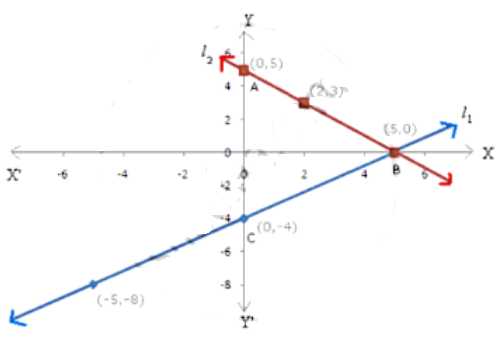
The lines $l_1$ and $l_2$ intersect at $(5, 0)$.
Thus, the solution of equations $(1)$ and $(2)$ is $x = 5$ and $y = 0.$
Now, it can be seen that $\triangle \text{ABC}$ is formed by the two lines $l_1$ and $l_2$ and the $y-$axis.
The vertices of $\triangle \text{ABC}$ is $A(0, 5), B(5, 0)$ and $C(0, -4).$ View full question & answer→Question 165 Marks
Find graphically the vertices of the triangle, whose sides are given by $3y = x + 18, x + 7y = 22$ and $y + 3x = 26.$
AnswerThe given equation are :
$3y = x + 18 ...(1)$
$x + 7y = 22 ...(2)$
$y + 3x = 26 ...(3)$
$3y = x + 18$
$\Rightarrow x = 3y - 18$
Corresponding values of $x$ and $y$ can be tabulated as $:$
| $x$ |
$0$ |
$-3$ |
$-6$ |
| $y$ |
$6$ |
$5$ |
$4$ |
Plotting points $(0, 6), (-3, 5)$ and $(-6, 4)$ joining them, we get a line $l_1$ which is the graph of equation $(1).$
Again$, x + 7y = 22$
$\Rightarrow x = 22 - 7y$
Corresponding values of $x$ and $y$ can be tabulated as :
| $x$ |
$1$ |
$8$ |
$-6$ |
| $y$ |
$3$ |
$2$ |
$4$ |
Plotting points $(1, 3), (8, 2), (-6, 4)$ and joining them, we get a line $l_2$ which is the graph of equation $(2).$
Also$, y + 3x = 26$
$\Rightarrow y = 26 - 3x$
Corresponding values of $x$ and $y$ can be tabulated as :
| $x$ |
$7$ |
$8$ |
$9$ |
| $y$ |
$5$ |
$2$ |
$-1$ |
Plotting points $(7, 5), (8, 2), (9, -1)$ and joining them, we get a line $l_3$ which is the graph of equation $(3).$
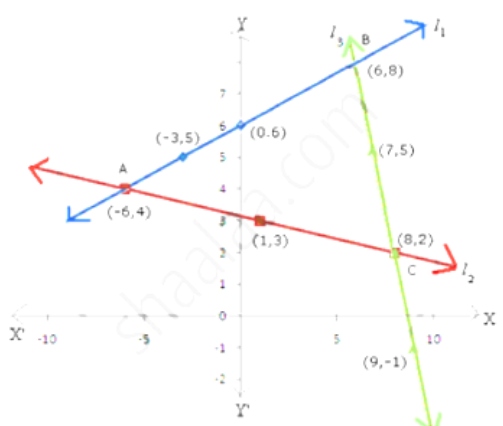
It can be seen that the lines $l_1, l_2$ and $l_3$ intersect each other to form $\triangle ABC.$
The verticles of $\triangle \text{ABC}$ are $A(-6, 4), B(6, 8)$ and $C(8, 2).$ View full question & answer→Question 175 Marks
Find graphically the vertices of the triangle, whose sides have the equations $2y - x = 8, 5y -x = 14$ and $y = 2x - 1.$
AnswerThe given equation are :
$2y - x = 8 ...(1)$
$5y - x = 14 ...(2)$
$y = 2x + 1 ...(3)$
$2y - x = 8$
$\Rightarrow x = 2y - 8$
Corresponding values of $x$ and $y$ can be tabulated as :
| $x$ |
$-4$ |
$-2$ |
$0$ |
| $y$ |
$2$ |
$3$ |
$4$ |
Plotting points $(-4, 2), (-2, 3), (0, 4)$ and joining them, we get a line $l_1$ which is the graph of equation $(1).$
Again$, 5y - x = 14$
$\Rightarrow x = 5y - 14$
Corresponding values of $x$ and $y$ can be tabulated as :
| $x$ |
$-4$ |
$-2$ |
$0$ |
| $y$ |
$2$ |
$3$ |
$4$ |
Plotting points $(-4, 2), (1, 3), (6, 4)$ and joining them, we get a line $l_2$ which is the graph of equation $(2).$
Again$, y = 2x + 1$
Corresponding values of $x$ and $y$ can be tabulated as :
| $x$ |
$0$ |
$1$ |
$2$ |
| $y$ |
$1$ |
$3$ |
$5$ |
Plotting points $(0, 1), (1, 3), (2, 5)$ and joining them, we get a line $l_3$ which is the graph of equation $(3).$
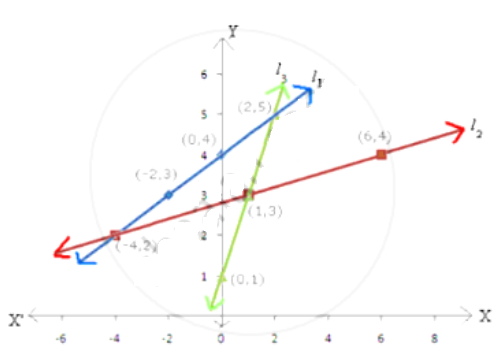
It can be seen that the lines $l_1, l_2,$ and $l_3$ intersect each other form a triangle.
The vertices of $\triangle \text{ABC}$ are $A(-4, 2), B(1, 3)$ and $C(2, 5).$ View full question & answer→Question 185 Marks
Solve the following equations graphically $:\ x+ 2y - 7 = 0;2x - y - 4 = 0$
Answer$x+ 2y - 7 = 0........(1)$
$2x - y - 4 = 0.......(2)$
$x+ 2y - 7 = 0$
$\Rightarrow x = 7 - 2y$
Corresponding values of $x$ and $y$ can be tabulated as :
| $x$ |
$7$ |
$3$ |
$1$ |
| $y$ |
$0$ |
$2$ |
$3$ |
Plotting points $(7, 0), (3, 2), (1, 3)$ and joining them, we get a line $l_1$ which is the graph of equation $(1).$
$2x - y - 4$
$\Rightarrow y = 2x - 4$
Corresponding values of $x$ and $y$ can be tabulated as $:$
| $x$ |
$0$ |
$3$ |
$2$ |
| $y$ |
$-4$ |
$2$ |
$0$ |
Plotting points $(0, -4), (3, 2), (2, 0)$ and joining them, we get a line $l_2$ which is the graph of equation $(2).$
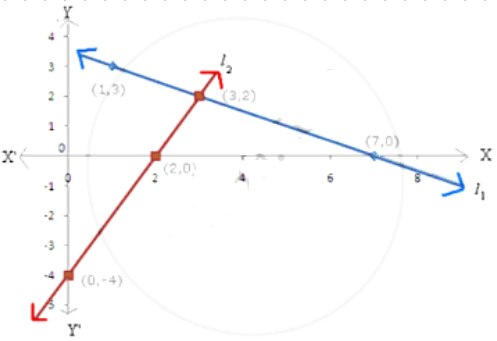
The lines $l_1$ and $l_2$ intersect at a unique point $(3, 2).$ View full question & answer→Question 195 Marks
Solve the following equations graphically $:\ 2+\frac{3 y}{x}=\frac{6}{x} , \frac{6 x}{y}-5=\frac{4}{y}$
Answer$2+\frac{3 y}{x}=\frac{6}{x}$
$\frac{6 x}{y}-5=\frac{4}{y}$
$2+\frac{3 y}{x}=\frac{6}{x}$
$ \Rightarrow 2 x+3 y=6 .....(1)$
$\frac{6 x}{y}-5=\frac{4}{y}$
$ \Rightarrow 6 x+5 y=4 ....(2)$
$2 x+3 y=6$
$\Rightarrow y=\frac{6-2 x}{3}$
Corresponding values of $x$ and $y$ can be tabulated as $:$
| $x$ |
$3$ |
$-3$ |
$0$ |
| $y$ |
$0$ |
$4$ |
$2$ |
Plotting points $(3, 0), (-3, 4), (0, 2)$ and joining them, we get a line $l_1$ which is the graph of equation $(1).$
$6x - 5y = 4$
$\Rightarrow y=\frac{6 x-4}{5}$
Corresponding values of $x$ and $y$ can be tabulated as $:$
| $x$ |
$1$ |
$2$ |
$3$ |
| $y$ |
$0.4$ |
$1.6$ |
$2.8$ |
Plotting point $(1, 0.4), (2, 1.6), (3, 2.8)$ and joining them, we get a line $l_2$ which is the graph of equation $(2).$
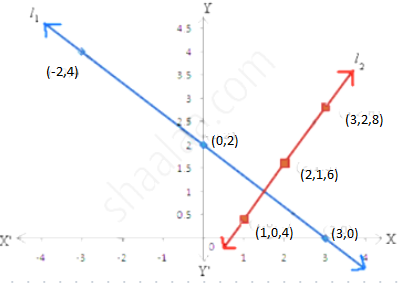
The line $l_1$ and $l_2$ intersect at a unique point $\left(\frac{3}{2}, 1\right)$. View full question & answer→Question 205 Marks
Solve the following equations graphically $:\ 2x - 6y + 10 = 0 , 3x - 9y + 25 = 0$
Answer$2 x-6 y+10=0$
$3 x-9 y+25=0$
$2 x-6 y+10=0 ....(1)$
$3 x-9 y+25=0 ....(1)$
$2 x-6 y+10=0$
$\Rightarrow x=\frac{6 y-10}{2}$
$=3 y-5$
Corresponding values of $x$ and $y$ can be tabulated as :
| $x$ |
$-5$ |
$-2$ |
$1$ |
| $y$ |
$0$ |
$1$ |
$2$ |
Plotting points $(-5, 0),(-2, 1), (1, 2)$ and joining them$,$ we get a line $l_1$ which is the graph of the equation $(1).$
Again$, 3x - 9y + 25 = 0$
$\Rightarrow x =\frac{9 y-25}{3}$
Corresponding values of $x$ and $y$ can be tabulated as :
| $x$ |
$0$ |
$\frac{-25}{3}=8.33$ |
| $y$ |
$\frac{25}{9}=2.77$ |
$ 0$ |
Plotting points $\left(0, \frac{25}{9}\right),\left(\frac{-25}{3}, 0\right)$ and joining them$,$ we get a line $I _2$ which is the graph of the equation $(2).$
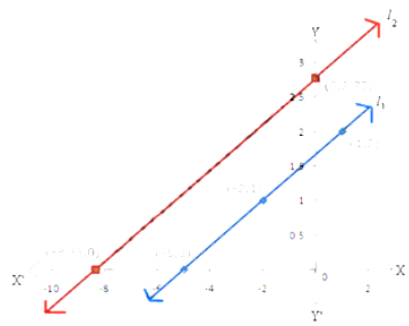
The line $l_1$ and $l_2$ do not intersect each other.
Thus$,$ the given equations do not have any solution. View full question & answer→Question 215 Marks
Solve the following equations graphically$:\ x-2 y=2 , \frac{x}{2}-y=1$
Answer$x-2 y=2$
$\frac{x}{2}-y=1$
$x-2 y=2 ....(1)$
$\frac{x}{2}-y=1 ....(2)$
$x-2 y=2$
$\Rightarrow x=2+2 y$
Corresponding values of $x$ and $y$ can be tabulated as$ :$
| $x$ |
$2$ |
$0$ |
$4$ |
| $y$ |
$0$ |
$-1$ |
$1$ |
Again $\frac{x}{2}-y=1$
$\Rightarrow y =\frac{x}{2}-1$
Corresponding values of $x$ and $y$ can be tabulated as $:$
| $x$ |
$0$ |
$2$ |
$4$ |
| $y$ |
$-1$ |
$0$ |
$1$ |
Plotting points $(0, -1), (2, 0), (4, 1)$ and joining them$,$ we get a line $l_1$ which is the graph for both the equation $(1)$ and $(2).$
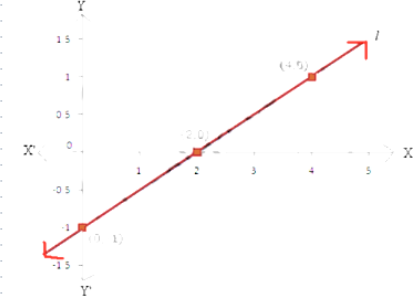
Hence$,$ the given system of equations has infinitely many solutions. View full question & answer→Question 225 Marks
Solve the following equations graphically $:\ 3y = 5 - x , 2x = y + 3$
Answer$3 y=5-x$
$2 x=y+3$
$3 y=5-x ....(1)$
$2 x=y+3 ....(2)$
$3 y=5-x$
$\Rightarrow y=\frac{5-x}{3}$
Corresponding values of $x$ and $y$ can be tabulated as $:$
| $x$ |
$2$ |
$-1$ |
$-4$ |
| $y$ |
$1$ |
$2$ |
$3$ |
Plotting points $(2, 1), (-1, 2), (-4, 3)$ and joining them$,$ we get a line $l_1$ which is the graph of equation $(1).$
Again $, 2x = y + 3$
$\Rightarrow x =\frac{y+3}{2}$
Corresponding values of $x$ and $y$ can be tabulated as $:$
| $x$ |
$2$ |
$1$ |
$3$ |
| $y$ |
$1$ |
$-1$ |
$3$ |
Plotting point $(2, 1), (-1, 1), (3, 3)$ and joining them, we get a line $l_2$ which is the graph of equation $(2).$
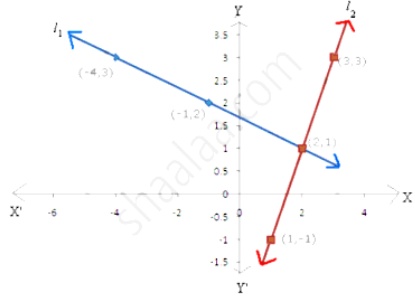
The two lines $l_1$ and $l_2$ intersect at a unique point $(2, 1).$
Thus$, x = 2$ and $y = 1$ is the unique solution of the given equations. View full question & answer→Question 235 Marks
Solve the following equations graphically$:\ x=4 , \frac{3 x}{3}-y=5$
Answer$ x =4$
$\frac{3 x}{3}-y=5$
$x =4 ....(1)$
$\frac{3 x}{3}-y=5 ....(2)$
The graph of equation $(1)$ will be the line $l_1$ which is at a distance of $4$ units from the $y-$axis.
$(4, 0)$
From $(2), x - y = 5$
Corresponding values of $x$ and $y$ can be tabulated as $:$
| $x$ |
$4$ |
$0$ |
$5$ |
| $y$ |
$-$ |
$-5$ |
$0$ |
Plotting points $(4, -1), (0, -5), (5, 0)$ and joining them, we get a line $l_2$ which is the graph of equation $(2)$.
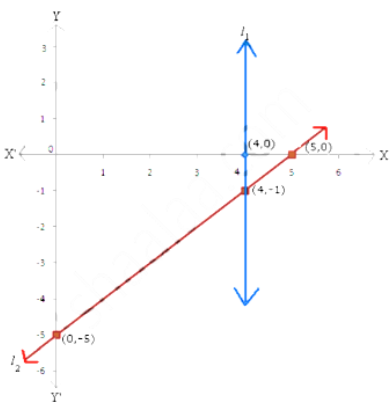
The two lines $l_1$ and $1_2$ intersect at a unique point $(4, -1)$.
Thus$, x = 4$ and $y = 1 -1$ is the unique solution of the given equations. View full question & answer→Question 245 Marks
Solve the following equations graphically $:\ x + 4y + 9 = 0 , 3y = 5x - 1$
Answer$x+4 y+9=0$
$3 y=5 x-1$
$x+4 y+9 .....(1)$
$3 y=5 x-1 .....(2)$
Now, $x+4 y=-9$
$\Rightarrow x=-9-4 y$
Corresponding values of $x$ and $y$ can be tabulated as $:$
| $x$ |
$4$ |
$-1$ |
$-5$ |
| $y$ |
$-3$ |
$-2$ |
$-1$ |
Plotting points $(4, -3), (-1, -2)$ and $(-5, -1)$ and joining them, we geta line $l_1$ which is the graph of equation $(!).$
Again$, 3y = 5 x -1$
$\Rightarrow y=\frac{5 x-1}{3}$
Corresponding values of $x$ and $y$ can be tabulated as $:$
| $x$ |
$-4$ |
$-1$ |
$5$ |
| $y$ |
$-7$ |
$-2$ |
$8$ |
Plotting points $(-4, -7), (-1, -2), (5, 8)$ and joining them we get a line $l_2$ which is the graph of equation $(2).$
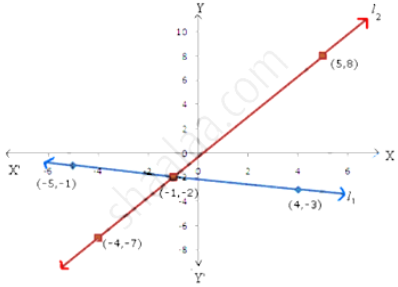
The two line $l_1$ and $l_2$ intersect at a unique point $(-1, -2)$.
Thus$, x = -1$ and $y = -2$ is the unique solution of the given equations. View full question & answer→Question 255 Marks
Solve the following equations graphically $:\ 2x - y = 9;5x + 2y = 27$
Answer$ 2 x-y=9$
$5 x+2 y=27$
$2 x-y=9 .....(1)$
$5 x+2 y=27 ....(2) $
Now$, 2 x-y=9$
$ \Rightarrow y =2 x -9 $
Corresponding values of $x$ and $y$ can be tabulated as $:$
| $x$ |
$2$ |
$3$ |
$4$ |
| $y$ |
$-5$ |
$-3$ |
$-1$ |
Plotting points $(2, -5), (3, -3), (4, -1)$ and joining them, we get a line $l,$ which is the graph pf equation $(1).$
Again$, 5x + 2y = 27$
$\Rightarrow y =\frac{27-5 x}{2}$
Corresponding values of $x$ and $y$ can be tabulated as $:$
| $x$ |
$5$ |
$4$ |
$3$ |
| $y$ |
$1$ |
$3.5$ |
$6$ |
Plotting points $(5, 1), (4, 3.5), (3, 6)$ and joining them, we get a line $l_2$ which is the graph of equation $(2).$
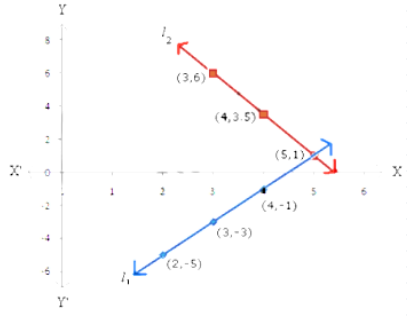
The two lines $l_1$ and $l_2$ intersect at a unique point $(5, 1).$
Thus$, x = 5$ and $y = 1$ is the unique solution of the given equations. View full question & answer→Question 265 Marks
Solve the following equations graphically $:\ 2x + 4y = 7;3x + 8y = 10$
Answer$ 2 x+4 y=7$
$3 x+8 y=10$
$2 x+4 y=7 ....(1)$
$3 x+8 y=10 ....(2) $
Now$, 2 x+4 y=7$
$ \Rightarrow 4 y=7-2 x$
$\Rightarrow y=\frac{7-2 x}{4} $
Corresponding values of $x$ and $y$ can be tabulated as $:$
| $x$ |
$2$ |
$3$ |
$4$ |
| $y$ |
$0.75$ |
$0.25$ |
$-0.25$ |
Plotting points $(2, 0.75), (3, 0.25), (3, 0.25), (4, -0.25)$ and joining them$,$ we get a line $l_1$ which is the graph of equation $(1).$
Again$, 3x + 8y = 10$
$\Rightarrow x=\frac{10-8 y}{3}$
Corresponding values of $x$ and $y$ can be tabulated as $:$
| $x$ |
$6$ |
$-2$ |
$0$ |
| $y$ |
$-1$ |
$2$ |
$1.25$ |
Plotting points $(6, 1), (2, 2), (0, 1.25)$ and joining them$,$ we get a line $l_2$ which is the graph of equation $(2).$
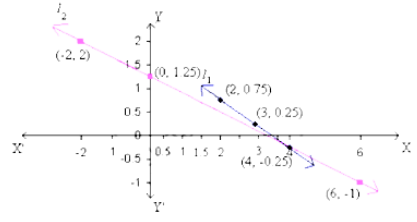
The two lines $l_1$ and $l_2$ intersect at the point $(4, -0.25),$
i.e., $\left(4,-\frac{1}{4}\right)$..
Hence $x = 4$ and $y = \frac{-1}{4}$ is the unique solution of the given equations. View full question & answer→Question 275 Marks
Solve the following equations graphically $\ :x + 3y = 8 , 3x = 2 + 2y$
Answer$ x+3 y=8$
$3 x=2+2 y$
$x+3 y=8 .....(1)$
$3 x=2+2 y .....(2) $
Now$, x+3 y=8$
$ \Rightarrow y=\frac{8-x}{3}$
Corresponding values of $x$ and $y$ can be tabulated as $:$
| $x$ |
$-1$ |
$2$ |
$5$ |
| $y$ |
$3$ |
$2$ |
$1$ |
Plotting points $(-1,3),(2,2),(5,1)$ and joiniing them$,$ we get a line I$,$ which is the graph of equation $(1).$
Again$, 3 x =2+2 y$
$\Rightarrow x =\frac{2 x+2 y}{3}$
Corresponding values of $x$ and $y$ can be tabulated as $:$
| $x$ |
$2$ |
$4$ |
$0$ |
| $y$ |
$2$ |
$5$ |
$-1$ |
Plotting points $(2, 2), (4, 5), (0, -1)$ and joining them$,$ we get a line $I_2$ which is the graph of equation $(2).$
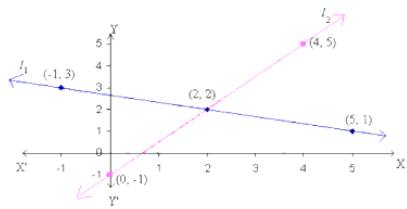
The two lines $I_2$ and $I_2$ intersect at the point $(2, 2).$
Hence$, x = 2, y = 2$ is the unique solution of the given equation. View full question & answer→Question 285 Marks
Draw the graph of the equation$:\ y = 5x - 4$, Find graphically.a. the value of $x,$ when $y = 1,b.$ the value of $y,$ when $x = -2.$
Answer$y = 5x - 4$
Corresponding values of $x$ and $y$ can be tabulated as follows :
| $X$ |
$0$ |
$2$ |
$-1$ |
| $Y$ |
$-4$ |
$6$ |
$-9$ |
Plotting the points $(0, - 4), (2, 6)$ and $(-1, -9),$
We get the following graph $:$
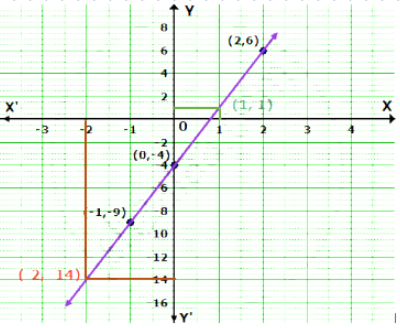
From the graph, we find that
$a.$ When $y = 1, x = 1.$
$b.$ When $x = -2, y = -14$ View full question & answer→Question 295 Marks
Draw the graph of the equation $4x - 3y + 12 = 0.$Also, find the area of the triangle formed by the line drawn and the coordinate axes.
Answer$4 x-3 y+12=0$
$\Rightarrow 4 x=3 y-12$
$\Rightarrow x=\frac{3 y-12}{4}$
Corresponding values of $x$ and $y$ can be tabulated as follows $:$
| $X$ |
$-3$ |
$-1.5$ |
$0$ |
| $Y$ |
$0$ |
$2$ |
$4$ |
Plotting the points $(-3,0),(-1.5,2)$ and $(0,4)$,
We get the following graph :
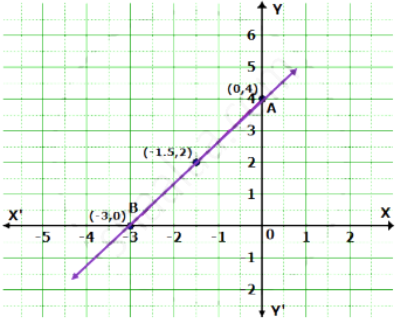
Area of $\triangle \text{OAB} =\frac{1}{2} \times \ce{OB \times OA}$
$=\frac{1}{2} \times 3 \times 4$
$=6 \text { sq.}$ units. View full question & answer→Question 305 Marks
Draw the graph for each of the following equation$:\ $ Also, find the coordinates of the points where the graph of the equation meets the coordinate axes$:\frac{3 x+14}{2}=\frac{y-10}{5}$
Answer$\frac{3 x+14}{2}=\frac{y-10}{5}$
$\Rightarrow 15 x+70=2 y-20$
$\Rightarrow 15 x-2 y=-90$
$\Rightarrow 2 y=90+15 x$
$\Rightarrow y=\frac{90+15 x}{2}$
Corresponding values of $x$ and $y$ can be tabulated as follows $:$
| $X$ |
$-5$ |
$-2$ |
$-1$ |
| $Y$ |
$7.5$ |
$30$ |
$37.5$ |
Plotting the points $(-5, 7.5), (-2, 30)$ and $(-1, 37.5),$
we get the following graph $:$
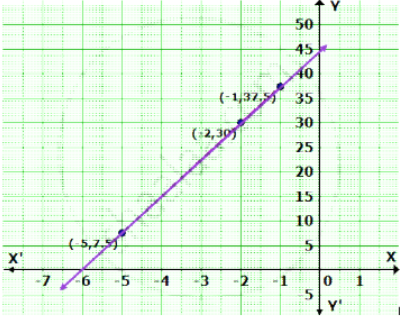
Thus, the graph of the equation meets the $X-$axis at $(-6, 0)$ and $Y-$axis at $(0, 45).$ View full question & answer→Question 315 Marks
Draw the graph for each of the following equation$:\ $ Also, find the coordinates of the points where the graph of the equation meets the coordinate axes: $\frac{1}{2} x+\frac{1}{3} y=1$
AnswerGiven, $\frac{1}{2} x+\frac{1}{3} y=1$
$\Rightarrow 3 x+2 y=6$
$\Rightarrow 2 y=6-3 x$
$\Rightarrow y=\frac{6-3 x}{2}$
Corresponding values of $x$ and $y$ can be tabulated as follows $:$
| $X$ |
$0$ |
$1$ |
$-1$ |
| $Y$ |
$3$ |
$1.5$ |
$4.5$ |
Plotting the points $(0, 3), (1, 1.5)$ and $(-1, 4.5),$
we get the following graph $:$
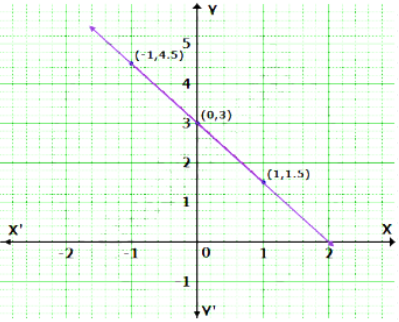
Thus, the graph of the equation meets the $X-$axis at $(2, 0)$ and $Y-$axis at $(0, 3).$ View full question & answer→Question 325 Marks
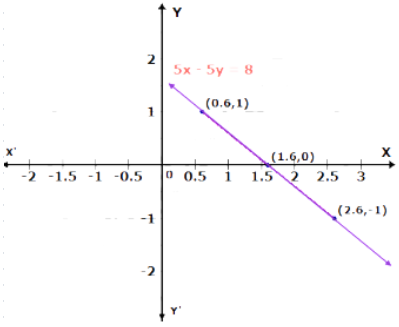
Draw the graphs of the following linear equations $: \ 5x - 5y = 8$
Answer$5 x-5 y=8$
$\Rightarrow 5 x=8-5 y$
$\Rightarrow x=\frac{8-5 y}{5}$
Corresponding values of $x$ and can be tabulated as follows $:$
| $X$ |
$1.6$ |
$0.6$ |
$2.6$ |
| $Y$ |
$0$ |
$1$ |
$1$ |
Plotting the points $(1.6, 0), (0.6, 1)$ and $(2.6, -1),$
we get the following graph $:$
View full question & answer→Question 335 Marks
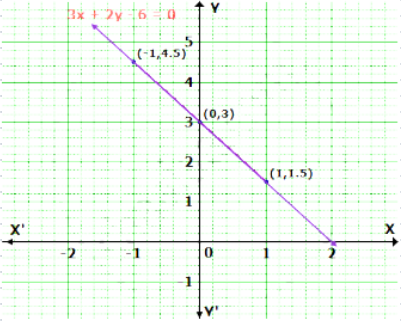
Draw the graphs of the following linear equations $: \ 3x + 2y - 6 = 0$
Answer$3 x+2 y-6=0$
$\Rightarrow 3 x+2 y=6$
$\Rightarrow 2 y=6-3 x$
$\Rightarrow y=\frac{6-3 x}{2}$
Corresponding values of $x$ and $y$ can be tabulated as follows $:$
| $X$ |
$0$ |
$1$ |
$-1$ |
| $Y$ |
$3$ |
$1.5$ |
$4.5$ |
Plotting the points $(0, 3), (1, 1.5)$ and $(-1, 4.5),$
we get the following graph $:$
View full question & answer→Question 345 Marks
Solve the following system of equations graphically$:\ 6x - 3y + 2 = 7x + 1;5x + 1 = 4x - y + 2.$Also, find the area of the triangle formed by these lines and $x-$axis in each graph.
AnswerThe given system of equations are
$6x - 3y + 2 = 7x + 1$ and $5x + 1 = 4x - y + 2$
Now$, 6x - 3y + 2$
$= 7x + 1 ....(1)$
$\Rightarrow x = 1 - 3y$
Corresponding values of $x$ and $y$ can be tabulated as $:$
| $x$ |
$1$ |
$-2$ |
$4$ |
| $y$ |
$0$ |
$1$ |
$-1$ |
Plotting points $(1, 0), (-2, 1)$ and $(4, -1)$ joining them, we get a line $l_1$ which is the graph of equation $(i).$
Again$, 5x + 1 = 4x - y + 2 ....(ii)$
$\Rightarrow x = 1 - y$
Corresponding values of $x$ and $y$ can be tabulated as $:$
| $x$ |
$-1$ |
$3$ |
$-2$ |
| $y$ |
$2$ |
$-2$ |
$3$ |
Plotting points $(-1, 2), (3, -2)$ and $(-2, 3)$ joining them, we get a line $l_2$ which is the graph of equation $(ii).$
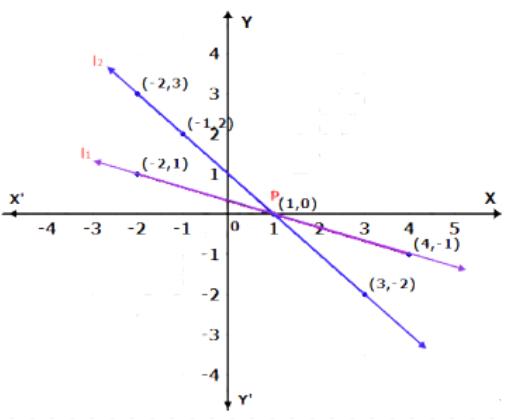
The two lines $l_1$ and $l_2$ intersect at a point $P(1, 0).$
$\therefore x = 1, y = 0$ is the solution of the given system of equations.
Since both the lines $l_1$ and $l_2$ are intersecting each other at $X-$axis, no triangle is formed by these lines with $X-$axis. View full question & answer→Question 355 Marks
Solve the following system of equations graphically$:\ 2x = 23 - 3y , 5x = 20 + 8y.$Also$,$ find the area of the triangle formed by these lines and $x-$ax is in each graph.
AnswerThe given system of equations are $2 x=23-3 y$ and $5 x$
$=20+8 y$.
Now, $2 x=23-3 y ....(i)$
$\Rightarrow x =\frac{23-3 y}{2}$
Corresponding values of $x$ and $y$ can be tabulated as follows $:$
| $x$ |
$10$ |
$7$ |
$4$ |
| $y$ |
$1$ |
$3$ |
$5$ |
Plotting points $(10, 1), (7, 3)$ and $(4, 5)$ joining them$,$ we get a line $l_1$ which is the graph of equation $(i).$
Again$, 5x = 20 + 8y ....(ii)$
$\Rightarrow x =\frac{20 x+8 y}{5}$
Corresponding values of $x$ and $y$ can be tabulated as follows $:$
| $x$ |
$4$ |
$2.4$ |
$0.8$ |
| $y$ |
$0$ |
$-1$ |
$-2$ |
Plotting points $(4, 0), (2.4, -1)$ and $(0.8, -2)$ joining them$,$ we get a line $l_2$ which is the graph of equation $(ii)$.
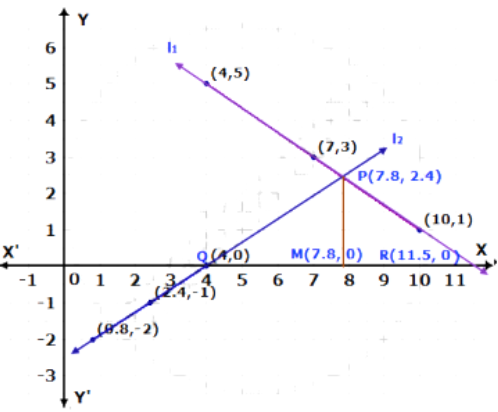
The two lines $l_1$ and $l_2$ intersect at a point $P(7.8, 2.4).$
$\therefore x = 7.8, y = 2.4$ is the solution of the given system of equations.
Draw $PM$ perpendicular from $P$ to $X-$axis.
Now$, PM = y-$coordinate of $P(7.8, 2.4)$
$\Rightarrow PM =2.4$ units
$QR =11.5-4$
$=7.5$ units
$\therefore$ Area of $\triangle PQR$
$=\frac{1}{2} \times QR \times PM$
$=\frac{1}{2} \times 7.5 \times 2.4$
$=9. sq.$ units View full question & answer→Question 365 Marks
Draw the graph of the following equations $:\ 3x + 2y + 6 = 0;3x + 8y - 12 = 0.$Also, determine the co$-$ordinates of the vertices of the triangle formed by these lines and $x-$axis.
Answer$3x + 2y + 6 = 0 ...(1)$
$3x + 8y - 12 = 0 ...(2)$
$3x + 2y = -6$
$\Rightarrow 3x = -6 - 2y$
Corresponding values of $x$ and $y$ can be tabulated as $:$
| $x$ |
$-2$ |
$0$ |
$-2.66$ |
| $y$ |
$0$ |
$-3$ |
$1$ |
Plotting points $(-2, 0), (0, 3), (-2.66, 1)$ and joining them, we get a line $l_1$ which is the graph of equation $(1).$
$3x + 8y - 12 = 0$
$\Rightarrow 3x = 12 - 8y$
Corresponding values of $x$ and $y$ can be tabulated as $:$
| $x$ |
$4$ |
$-4$ |
$0$ |
| $y$ |
$0$ |
$3$ |
$1.5$ |
Plotting points $(4, 0), (-4, 3), (0, 1.5)$ and joining them, we get a line $l_2$ which is the graph of equation $(2).$
It can be seen that the two lines $l_1$ and $l_2$ and the $x-$axis from a triangle $\text{ABC}$.
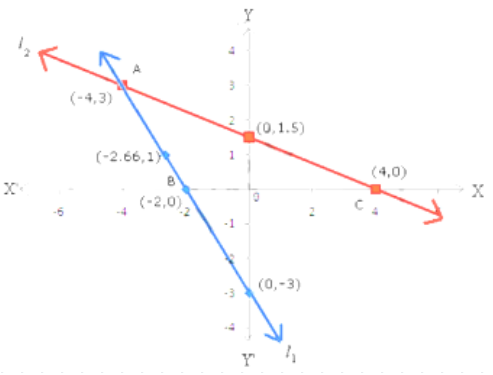
The coordinates of the vertices of $\triangle \text{ABC}$ are $A(-4, 3), B(-2, 0)$ and $C(4, 0).$ View full question & answer→Question 375 Marks
Solve the following system of equations graphically$:\ x - y + 1 = 0;4x + 3y = 24$
Answer$x-y+1=0 ....(1)$
$4 x+3 y=24 ....(1)$
$x-y+1=0$
$\Rightarrow y=x+1$
Corresponding values of $x$ and $y$ can be tabulated as $:$
| $x$ |
$0$ |
$3$ |
$-1$ |
| $y$ |
$1$ |
$4$ |
$0$ |
Plotting points $(0, 1), (1, 2), (-1, 0)$ and joining them, we get a line $l_1$ which is the graph of equation $(1).$
$4x + 3y = 24$
$\Rightarrow x =\frac{24-3 y}{4}$
Corresponding values of $x$ and $y$ can be tabulated as $:$
| $x$ |
$6$ |
$3$ |
$0$ |
| $y$ |
$0$ |
$4$ |
$8$ |
Plotting points $(6, 0), (3, 4), (0, 8)$ and joining them, we get a line $l_2$ which is the graph of equation $(2).$
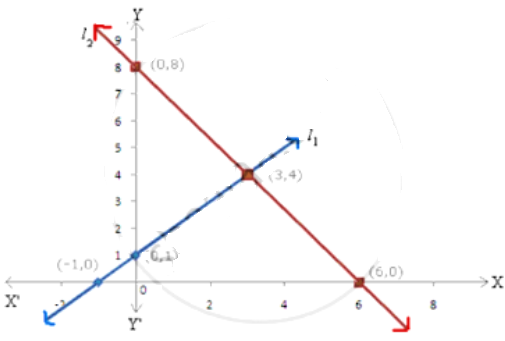
The lines $l_1$ and $l_2$ intersect at $(3, 4)$.
Thus$, x = 3$ and $y = 4$ is the unique solution of equation $(1)$ and $(2).$
Now, from the graph, it can be seen that the lines $l_1$ and $l_2$
Intersect the $x-$axis at points $(-1, 0)$ and $(6, 0)$. View full question & answer→Question 385 Marks
Can the following equations hold simultaneously?$7y - 3x = 7;5y - 11x = 87;5x + 4y = 43$.If yes, find the value of $x$ and $y.$
AnswerThe given equations are
$ 7 y-3 x=7 ....(i)$
$5 y-11 x=87 ....(ii)$
$5 x+4 y=43 ....(iii) $
Multiplying eqn. $(i)$ by $5$ and eqn. $(ii)$ by $7 ,$
we get $ 35 y-15 x=35 ....(iv)$
$35 y-77 x=609 ....(v) $
Subtracting eqn. $(iv)$ from eqn. $(v),$
we get $-62 x=574$
$\Rightarrow x=-\frac{574}{62}=-\frac{287}{31}$
$\Rightarrow 7 y-3 x\left(-\frac{287}{31}\right)=7$
$\Rightarrow 7 y+\frac{861}{31}=7$
$\Rightarrow 7 y$
$=7-\frac{861}{31}$
$=\frac{217-861}{31}$
$=-\frac{644}{31}$
$\Rightarrow y=-\frac{644}{7 \times 31}$
$=-\frac{92}{31} $
Putting $x=\frac{-287}{31}$ and $y=-(92) /(31)^{\prime}$ in $\text{L.H.S.}$ of eqn. $(iii),$
we get $\text { L.H.S. }=5 \times\left(-\frac{287}{31}\right)+4 x\left(-\frac{92}{31}\right)$
$=-\frac{1435}{31}-\frac{368}{31}$
$=-\frac{1803}{31} \neq 43$
$\Rightarrow \text { L.H.S. } \neq \text { R.H.S. } $
Hence, the given system of equations are not consistent.
View full question & answer→Question 395 Marks
$\frac{3}{x}-\frac{2}{y}=0$ and $\frac{2}{x}+\frac{5}{y}=19,$ Hence, find $a$ if $y = ax +3$
Answer$ \frac{3}{x}-\frac{2}{y}=0 ......(1)$
$\frac{2}{x}+\frac{5}{y}=19 .......(2) $
Multiplying $(1)$ by $5$ and $(2)$ by $2 ,$ we get,
$ \frac{15}{x}-\frac{10}{y}=0 .....(3)$
$\frac{4}{x}+\frac{10}{y}=38 ..... (4) $
Adding $(3)$ and $(4),$ we get,
$ \frac{19}{x}=38$
$\Rightarrow x =\frac{19}{38}$
$=\frac{1}{2} $
Now, $\frac{3}{x}=\frac{2}{y}$
$ \Rightarrow \frac{2}{y}=6$
$\Rightarrow y =\frac{2}{6}$
$=\frac{1}{3} $
Thus, the solution set is $\left(\frac{1}{2}, \frac{1}{3}\right)$.
Now, $y=a x+3$
$ \Rightarrow \frac{1}{3}$
$=\frac{1}{2} a +3$
$\Rightarrow \frac{ a }{2}$
$=\frac{1}{3}-3$
$=\frac{1-9}{3}$
$=\frac{-8}{3}$
$\Rightarrow a =\frac{-8}{3} \times 2$
$=\frac{-16}{3}$
$=-5 \frac{1}{3} . $
View full question & answer→Question 405 Marks
$4 x+\frac{6}{y}=15$ and $6 x-\frac{8}{y}=14$. Hence, find $a$ if $y= ax -2$.
Answer$ 4 x+\frac{6}{y}=15 .....(1)$
$6 x-\frac{8}{y}=14 ....(2) $
Multiplying $(1)$ by $4$ and $(2)$ by $3,$ we get,
$ 16 x+\frac{24}{y}=60 ......(3)$
$18 x-\frac{24}{y}=42 ......(4) $
Adding $(3)$ and $(4),$ we get,
$ 34 x=102$
$\Rightarrow x=\frac{102}{34}=3$
$\therefore \frac{6}{y}$
$=15-4 x$
$=15-12$
$=3$
$\Rightarrow y=\frac{6}{3}=2 $
Thus, the solution set is $(3,2)$.
Now,
$ y=a x-2$
$\Rightarrow 2=3 a-2$
$\Rightarrow 3 a-4$
$\Rightarrow a=\frac{4}{3}$
$=1 \frac{1}{3} . $
View full question & answer→Question 415 Marks
If $10y = 7x - 4$ and $12x + 18y = 1 ;$ find the value of $4x + 6y$ and $8y - x.$
Answer$10 y=7 x-4 .......(1)$
$12 x+18 y=1 ........(2) $
Multiplying $(1)$ by $9$ and $(2)$ by $5,$
we get, $63 x-90 y=36 ........(3)$
$60 x+90 y=5 ........(4)$
Adding $(3)$ and $(4),$
we get, $123 x=41$
$\Rightarrow x=\frac{41}{123}=\frac{1}{3}$
$\therefore 10 y=\frac{7}{3}-4$
$=\frac{7-12}{3}$
$=\frac{-5}{3}$
$\Rightarrow y=\frac{-5}{3} \times \frac{1}{10}$
$=\frac{-1}{6}$
$\therefore 4 x+6 y=\frac{4}{3}-1$
$=\frac{1}{3} $
$8 y-x$
$=\frac{-8}{6}-\frac{1}{3}$
$=\frac{-8-2}{6}$
$=\frac{-10}{6}$
$=\frac{-5}{3} .$
View full question & answer→Question 425 Marks
Solve the following pairs of equations$:\frac{x y}{x+y}=\frac{6}{5};\frac{x y}{y-x}=6$,Where $x+y \neq 0$ and $y-x \neq 0$
Answer$ \frac{x y}{x+y}=\frac{6}{5}$
$\Rightarrow \frac{x+y}{x y}=\frac{5}{6}$
$\Rightarrow \frac{1}{y}+\frac{1}{x}=\frac{5}{6} ....(i)$
$ \frac{x y}{y-x}=6$
$\Rightarrow \frac{y-x}{x y}=6$
$\Rightarrow \frac{1}{x}+\frac{1}{y}=\frac{1}{6} ....(ii) $
Adding eqns. $(i)$ and $(ii),$
we get $\frac{2}{x}=1$
$\Rightarrow x=2$
$\Rightarrow \frac{1}{y}+\frac{1}{2}=\frac{5}{6}$
$\Rightarrow \frac{1}{y}=\frac{5}{6}-\frac{1}{2}$
$=\frac{5-3}{6}$
$=\frac{2}{6}$
$=\frac{1}{3}$
$\Rightarrow y=3 $
Thus, the solution set is $(2,3)$.
View full question & answer→Question 435 Marks
Solve the following pairs of equations$:\frac{2}{3 x+2 y}+\frac{3}{3 x-2 y}=\frac{17}{5};\frac{5}{3 x+2 y}+\frac{1}{3 x-2 y}=2$
AnswerThe given equations are $\frac{2}{3 x+2 y}+\frac{3}{3 x-2 y}=\frac{17}{5}$ and $\frac{5}{3 x+2 y}+\frac{1}{3 x-2 y}=2$.
Let $\frac{1}{3 x+2 y}= a$ and $\frac{1}{3 x-2 y}= b$
Then, we have
$ 2 a+3 b=\frac{17}{5} ....(i) $
$5 a+b=2 ....(ii)$
Multiplying eqn. $(i)$ by $5$ and eqn. $(ii)$ by $2$ ,
we get $10 a+15 b=17 ....(iii) $
$ 10 a+2 b=4 ....(iv)$
Subtracting eqn. $(iv)$ from eqn. $(iii),$
we get $13 b =13$
$\Rightarrow b =1$
Substituting the value of $b$ in eqn. $(ii)$,
we get $5 a+1=2$
$\Rightarrow 5 a=1$
$\Rightarrow a=\frac{1}{5}$
$\Rightarrow 3 x+2 y=5$ and $3 x-2 y=1 $
Adding these two eqations,
we get $6 x =6$
$\Rightarrow x =1$
$\Rightarrow 3(1)+2 y =5$
$\Rightarrow 2 y =2$
$\Rightarrow y =1 $
Thus, the solution set is $(1,1)$.
View full question & answer→Question 445 Marks
Solve the following pairs of equations$:\frac{5}{x+y}-\frac{2}{x-y}=-1;\frac{15}{x+y}+\frac{7}{x-y}=10$
AnswerThe given equations are $\frac{5}{x+y}-\frac{2}{x-y}=-1$ and $\frac{15}{x+y}+\frac{7}{x-y}=10$.
Let $\frac{1}{x+y}= a$ and $\frac{1}{x-y}= b$
Then, we have
$ 5 a+7 b=-1 ...(i) $
$ 15 a+7 b=10 ....(ii) $
Multiplying eqn. $(i)$ by $3 ,$
we get $15 a-6 b=-3$
Subtracting eqn. $(iii)$ from eqn. $(ii),$
we get $13 b =13$
$\Rightarrow b =1 $
Substituting the value of $b$ in eqn. $(i),$
we get $5 a-2(1)=-1$
$\Rightarrow 5 a=1$
$\Rightarrow a=\frac{1}{5} $
$ \Rightarrow x + y =5$ and $x - y =1 $
Adding these two equations,
we get $2 x=6$
$\Rightarrow x=3$
$\Rightarrow 3+y=5$
$\Rightarrow y=2$
Thus, the solution set is $(3,2)$.
View full question & answer→Question 455 Marks
Solve the following pairs of equations$:\frac{6}{x+y}=\frac{7}{x-y}+3;\frac{1}{2(x+y)}=\frac{1}{3(x-y)}$,Where $x+y \neq 0$ and $x-y \neq 0$
AnswerThe given equations are $\frac{6}{x+y}=\frac{7}{x-y}+3$ and
$ \frac{1}{2(x+y)}=\frac{1}{3(x-y)} $
Let $\frac{1}{x+y}= a$ and $\frac{1}{x-y}= b$
Then, we have
$ 6 a=7 b+3$
$\Rightarrow 6 a-7 b+3 ....(i) $
And, $\frac{1}{2} a =\frac{1}{3} b$
$ \Rightarrow 3 a =2 b$
$\Rightarrow 6 a =4 b ....(ii) $
Substituting the value of $6 a$ in eqn. $(i),$ we get
$ 4 b-7 b=3$
$\Rightarrow-3 b=3$
$\Rightarrow b=-1$
$6 a=-4$
$\Rightarrow a=-\frac{2}{3} $
$\Rightarrow x + y =-\frac{3}{2}$ and $x - y =-1$
Adding both these eqns., we get
$ 2 x=-\frac{5}{2}$
$\Rightarrow x=-\frac{5}{4}$
$\Rightarrow-\frac{5}{4}-y=-1$
$\Rightarrow y=-\frac{5}{4}+1$
$=-\frac{1}{4} $
Thus, the solution set is $\left(-\frac{5}{4},-\frac{1}{4}\right)$.
View full question & answer→Question 465 Marks
Solve the following pairs of equations$:\frac{2}{x+1}-\frac{1}{y-1}=\frac{1}{2};\frac{1}{x+1}+\frac{2}{y-1}=\frac{5}{2}$
AnswerThe given equations are $\frac{2}{x+1}-\frac{1}{y-1}=\frac{1}{2}$ and $\frac{1}{x+1}+\frac{2}{y-1}=\frac{5}{2}$.
Let $\frac{1}{x+1}= a$ and $\frac{1}{y-1}= b$
Then, we have
$ 2 a-b=\frac{1}{2} ....(i)$
$a+2 b=\frac{5}{2} ....(ii)$
Multiplying eqn. $(i)$ by $2,$
we get $4 a -2 b =1 ....(iii) $
Adding eqns. $(ii)$ and $(iii),$
we get $5 a=\frac{7}{2}$
$\Rightarrow a=\frac{7}{10}$
$\Rightarrow \frac{1}{x+1}=\frac{7}{10}$
$\Rightarrow 10=7 x+7$
$\Rightarrow 7 x=3$
$\Rightarrow x=\frac{3}{7} $
Substituting the value of a in eqn. $(iii),$
we get $4 \times \frac{7}{10}-2 b=1$
$\Rightarrow \frac{14}{5}-2 b=1$
$\Rightarrow 2 b=\frac{14}{5}-1=\frac{9}{5}$
$\Rightarrow b=\frac{9}{10}$
$\Rightarrow \frac{1}{y-1}=\frac{9}{10}$
$\Rightarrow 10=9 y-9$
$\Rightarrow 9 y=19$
$\Rightarrow y=\frac{19}{9} $
Thus, the solution set is $\left(\frac{9}{10}, \frac{19}{9}\right)$.
View full question & answer→Question 475 Marks
Solve the following pairs of equations$:\ \frac{2}{x}+\frac{3}{y}=\frac{9}{x y};\frac{4}{x}+\frac{9}{y}=\frac{21}{x y}$,Where $x \neq 0, y \neq 0$
AnswerThe given equations are $\frac{2}{x}+\frac{3}{y}=\frac{9}{x y}$ and $\frac{4}{x}+\frac{9}{y}=\frac{21}{x y}$
Let $\frac{1}{x}= a$ and $\frac{1}{y}= b$
Then, we have
$ 2 a+3 b=9 a b \ldots . \text { (i) }$
$4 a+9 b=21 a b \ldots . . \text { (ii) } $
Multiplying eqn. $(i)$ by $2,$
we get $4 a+6 b=18 a b \text {....(iii) } $
Subtracting eqn. $(iii)$ from eqn. $(ii),$
we get $3 b=3 a b$
$\Rightarrow a=1$
$\Rightarrow \frac{1}{x}=1$
$\Rightarrow x=1 $
Substituting the value of a in $(i),$
we get $2(1)+3 b=9(1) b$
$\Rightarrow 2+3 b=9 b$
$\Rightarrow 6 b=2$
$\Rightarrow b=\frac{1}{3}$
$\Rightarrow \frac{1}{y}=\frac{1}{3}$
$\Rightarrow y=3 $
Thus, the solution set is $(1,3)$.
View full question & answer→Question 485 Marks
Solve the following pairs of equations$:\ y-x=0.8;\frac{13}{2(x+y)}=1$
AnswerThe given equations are
$ y-x=0.8$
$-x+y=0.8 ....(i) $
And, $\frac{13}{2(x+y)}=1$
$ \Rightarrow 13=2 x +2 y $
$ \Rightarrow 2 x+2 y=13 ....(ii) $
Multiplying eqn. $(i)$ by $2,$ we get
$ -2 x+2 y=1.6 ....(iii) $
Adding eqns. $(ii)$ and $(iii),$ we get
$ 4 y=14.6$
$\Rightarrow y=3.65 $
Substituting the value of $y$ in eqn. $(i),$ we get
$ -x+3.65=0.8$
$\Rightarrow-x=-2.85$
$\Rightarrow x=2.85 $
Thus, the solution set is $(2.85,3.65)$.
View full question & answer→Question 495 Marks
Solve the following pairs of equations$:\ \frac{3}{x}-\frac{1}{y}=-9;\frac{2}{x}+\frac{3}{y}=5$
AnswerThe given equations are $\frac{3}{x}-\frac{1}{y}=-9$ and $\frac{2}{x}+\frac{3}{y}= 5$
Let $\frac{1}{x}= a$ and $\frac{1}{y}= b$
Then, we have
$ 3 a-b=-9 ....(i)$
$2 a+3 b=5 ....(ii) $
Multiplying eqn. $(i)$ by $3 ,$
we get $9 a-3 b=-27 ....(iii) $
Adding eqns. $(ii)$ and $(iii),$
we get $11 a =-22$
$\Rightarrow a =-2$
$\Rightarrow \frac{1}{x}=-2$
$\Rightarrow x =-\frac{1}{2} $
Substituting the value of a in eqn. $(i),$
we get $3(-2)-b=-9$
$\Rightarrow-6-b=-9$
$\Rightarrow b=-6+9$
$\Rightarrow b=3$
$\Rightarrow \frac{1}{y}=3$
$\Rightarrow y=\frac{1}{3} $
Thus, the solution set is $\left(-\frac{1}{2}, \frac{1}{3}\right)$.
View full question & answer→Question 505 Marks
Solve the following pairs of equations$:\ \frac{3}{2 x}+\frac{2}{3 y}=5;\frac{5}{x}-\frac{3}{y}=1$
AnswerThe given equations are $\frac{3}{2 x}+\frac{2}{3 y}=5$ and $\frac{5}{x}-\frac{3}{y}=1$
Let $\frac{1}{x}= a$ and $\frac{1}{y}= b$
Then, we have
$ \frac{3}{2} a+\frac{2}{3} b=5$
$\Rightarrow 9 a+4 b=30 ....(i) $
And, $5 a-3 b=1 ....(ii)$
Multiplying eqn.$ (i)$ by $3$ and eqn. $(ii)$ by $4,$ we get
$ 27 a+12 b=90 ....(iii)$
$20 a-12 b=4 ....(iv) $
Adding rqns. $(iii)$ and $(iv),$ we get
$ 47 a=94$
$\Rightarrow a=2$
$\Rightarrow \frac{1}{x}=2$
$\Rightarrow x=\frac{1}{2} $
Substituting the value of a $(i),$ we get
$ 9(2)+4 b=30$
$\Rightarrow 18+4 b=30$
$\Rightarrow 4 b=12$
$\Rightarrow b=3$
$\Rightarrow \frac{1}{y}=3$
$\Rightarrow y=\frac{1}{3} $
Thus, the solution set is $\left(\frac{1}{2}, \frac{1}{3}\right)$.
View full question & answer→