Questions

[5 marks sum]

🎯

Test yourself on this topic

12 questions · timed · auto-graded

Question 15 Marks
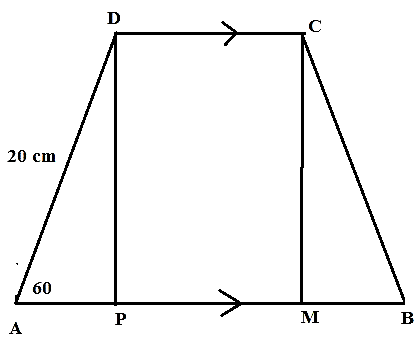
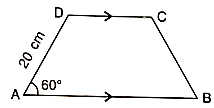
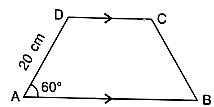
In trapezium $A B C D$, as shown, $A B \| D C, A D=D C=B C=20 \ cm$ and $A=60^{\circ}$. Find: distance between $A B$ and $D C$.
Answer
First, draw two perpendiculars to$ AB$ from point $D$ and $C$ respectively.
Since $AB \| CD$
$\therefore \text{PMCD}$ will be a rectangle.
Consider the figure,
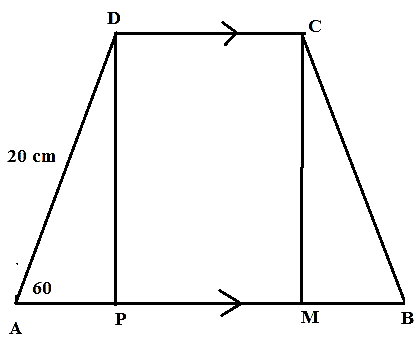
Again from the right $\triangle APD$ we have
$\sin 60^{\circ}=\frac{P D}{20}$
$\frac{\sqrt{3}}{2}=\frac{P D}{20}$
$P D=10 \sqrt{3}$
​​​​​​​Therefore the distance between $AB$ and $CD$ is $10 \sqrt{3}$.
View full question & answer
Question 25 Marks
In trapezium $\text{ABCD}$, as shown, $AB \| DC, AD = DC = BC = 20 \ cm$ and $\angle A = 60^\circ $. Find: length of $AB$
Answer
First, draw two perpendiculars to $AB$ from point $D$ and $C$ respectively.
Since $AB \| CD$
 $\therefore \text{PMCD}$ will be a rectangle.
Consider the figure,

From right triangle ADP we have
$\cos 60^{\circ}=\frac{ AP }{ AD }$
$\frac{1}{2}=\frac{ AP }{20}$
$AP = 10$
Similarly from the right $\triangle BMC$ we have $BM = 10 \ cm.$
Now from the rectangle $\text{PMCD}$ we have $CD = PM = 20 \ cm.$
Therefore,
$AB = AP + PM + MB = 10 + 20 + 10 = 40 \ cm.$
View full question & answer
Question 35 Marks
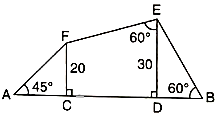
Find $AB.$
Answer
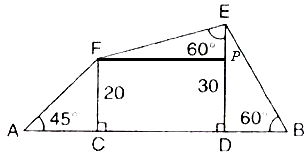
Consider the figure

From right $\triangle ACF$
$\tan 45^{\circ}=\frac{20}{ AC } $
$1=\frac{20}{ AC } $
$AC =20 \ cm$
From $\triangle DEB$
$\tan 60^{\circ}=\frac{30}{ BD }$
$\sqrt{3}=\frac{30}{ BD }$
$BD =\frac{30}{\sqrt{3}}=17.32 \ cm$
Given $FC = 20, ED = 30,$
 So $EP = 10 \ cm$
Therefore
$\tan 60^{\circ}=\frac{ FP }{ EP }$
$\sqrt{3}=\frac{ FP }{10}$
$FP =10 \sqrt{3}=17.32 \ cm $
Thus $AB = AC + CD + BD = 54.64 \ cm$
View full question & answer
Question 45 Marks
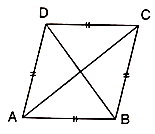
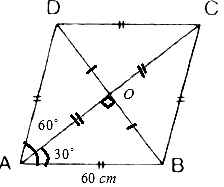
Find the lengths of diagonals $AC$ and $BD$. Given $AB = 60 \ cm$ and \angle $ BAD = 60^\circ .$
Answer
We know, diagonals of a rhombus bisect each other at right angles and also bisect the angle of the vertex. The figure is shown below:

Now
$OA = OC =\frac{1}{2} AC , OB = OD =\frac{1}{2} BD ; \angle AOB =90^{\circ}$
And $\angle OAB =\frac{60^{\circ}}{2}=30^{\circ}$
Also given $AB = 60 \ cm$
In right$ \triangle AOB$
$\sin 30^{\circ}=\frac{ OB }{ AB }$
$\frac{1}{2}=\frac{ OB }{60}$
$OB =30 \ cm $
Also
$\cos 30^\circ = \frac{ OA }{ AB }$
$\frac{\sqrt{3}}{2}=\frac{ OA }{60}$
$OA = 51.96 \ cm$
Therefore,
Length of diagonal $AC = 2 \times OA = 2 \times 51.96 = 103.92 \ cm.$
Length of diagonal $BD = 2 \times OB = 2 \times 30 = 60 \ cm.$
View full question & answer
Question 55 Marks
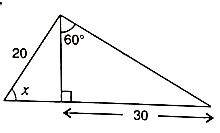
Find angle $'x\ '$ if :
Answer

The above figure we have
$\tan 60^{\circ}=\frac{30}{ AD } $
$\sqrt{3}=\frac{30}{ AD }$
$AD =\frac{30}{\sqrt{3}}$
Again
$\sin x=\frac{A D}{20}$
$AD = 20 \sin x$
Now
$20 \sin x=\frac{30}{\sqrt{3}}$
$\sin x=\frac{30}{20 \sqrt{3}}$
$\sin x=\frac{\sqrt{3}}{2}$
$\sin x = \sin 60^\circ$
$x = 60^\circ$
View full question & answer
Question 65 Marks
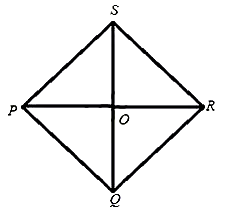
The perimeter of a rhombus is $96\ cm$ and obtuse angle of it is $120^\circ.$ Find the lengths of its diagonals.
Answer
Since in a rhombus all sides are equal.
The diagram is shown below:

Therefore $PQ = \frac{96}{4} = 24 \ cm,$ Let $\angle PQR = 120^\circ.$
We also know that in rhombus diagonals bisect each other perpendicularly and diagonals bisect the angle at vertex.
Hence $\text{PQR}$ is a right angle triangle and
$ \text{PQR} =\frac{1}{2}(\text{PQR})=60^{\circ}$
$\sin 60^{\circ}=\frac{\text { Perp. }}{\text { Hypot. }}=\frac{ PO }{ PQ }=\frac{ PO }{24}$
But
$\sin 60^{\circ}=\frac{\sqrt{3}}{2}$
$\frac{ PO }{24}=\frac{\sqrt{3}}{2}$
$P O=12 \sqrt{3}=20.784$
Therefore,
$PR =2 PO $
$=2 \times 20.784 $
$=41.568\ cm$
Also,
$\cos 60^{\circ}=\frac{\text { Base }}{\text { Hypot }}=\frac{ OQ }{24}$
But
$\cos 60^{\circ}=\frac{1}{2}$
$\frac{ OQ }{24}=\frac{1}{2}$
$O Q=12$
Therefore, $SQ = 2 \times OQ$
$= 2 \times 12$
$= 24 \ cm$
So, the length of the diagonal $PR = 41.568 \ cm$ and $SQ = 24 \ cm$.
View full question & answer
Question 75 Marks
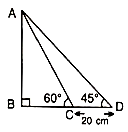
Find $AB$ and $BC$, if:
Answer
Let $BC = x m$
$BD = BC + CD = (x + 20) \ cm$
In $\triangle ABD,$
$\tan 45^\circ =\frac{A B}{B D}$
$1=\frac{ AB }{x+20}$
$x + 20 = AB \dots...(1)$
In $\triangle ABC$
$\tan 60^{\circ}=\frac{ AB }{ BC }$
$\sqrt{3}=\frac{ AB }{x}$
$x =\frac{ AB }{\sqrt{3}} \dots...(2)$
From $(1)$
$\frac{ AB }{\sqrt{3}}+20= AB$
$AB +20 \sqrt{3}=\sqrt{3} AB$
$AB (\sqrt{3}-1)=20 \sqrt{3}$
$ AB =\frac{20 \sqrt{3}}{(\sqrt{3}-1)}$
$AB =\frac{20 \sqrt{3}}{(\sqrt{3}-1)} \times \frac{(\sqrt{3}+1)}{(\sqrt{3}+1)}$
$AB =\frac{20 \sqrt{3}(\sqrt{3}+1)}{3-1}$
$AB = 47.32 \ cm$
From $(2)$
$x=\frac{A B}{\sqrt{3}}$
$x=\frac{47.32}{\sqrt{3}}$
$x = 27.32 \ cm$
$\therefore BC = x = 27.32 \ cm$
Therefore, $AB = 47.32 \ cm, BC = 27.32 \ cm.$
View full question & answer
Question 85 Marks
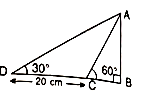
Find $AB$ and $BC$, if:
Answer
Let $BC = x m$
$BD = BC + CD = (x + 20) \ cm$
In $\triangle ABD,a$
$\tan 30^\circ = \frac{ AB }{ BD }$
$\frac{1}{\sqrt{3}}=\frac{ AB }{x+20}$
$x+20=\sqrt{3} A B \dots...(1)$
In $\triangle ABC$
$\tan 60^{\circ}=\frac{ AB }{ BC }$
$\sqrt{3}=\frac{ AB }{x}$
$x =\frac{ AB }{\sqrt{3}} \dots...(2)$
From $(1)$
$\frac{ AB }{\sqrt{3}}+20=\sqrt{3} AB$
$AB +20 \sqrt{3}=3 AB$
$2 AB =20 \sqrt{3}$
$2 AB =\frac{20 \sqrt{3}}{2}$
$AB =10 \sqrt{3}$
$AB =17.32 \ cm $
From $(2)$
$x=\frac{A B}{\sqrt{3}}$
$x=\frac{17.32}{\sqrt{3}}$
$x = 10 \ cm$
Therefore $BC = x = 10 \ cm$
Therefore, $AB = 17.32 \ cm, BC = 10 \ cm.$
View full question & answer
Question 95 Marks
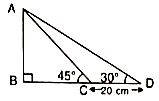
Find $AB$ and $BC$, if:
Answer
Let $BC = x m$
$BD = BC + CD = (x + 20) \ cm$
In $\triangle ABD,$
$\tan 30^{\circ}=\frac{ AB }{ BD }$
$\frac{1}{\sqrt{3}}=\frac{ AB }{x+20}$
$x+20=\sqrt{3} A B \dots...(1)$
In $\triangle ABC$
$\tan 45^{\circ}=\frac{ AB }{ BC }$
$1=\frac{ AB }{x}$
$AB = x \dots...(2)$
From $(1)$
$A B+20=\sqrt{3} A B$
$AB (\sqrt{3}-1)=20$
$ AB =\frac{20}{(\sqrt{3}-1)}$
$=\frac{20}{(\sqrt{3}-1)} \times \frac{(\sqrt{3}+1)}{(\sqrt{3}+1)}$
$=\frac{20(\sqrt{3}+1)}{3-1}$
$= 27.32\ cm$
From $(2)$
$AB = x = 27.32 \ cm$
Therefore $BC = x = AB = 27.32 \ cm$
Therefore, $AB = 27.32 \ cm, BC = 27.32 \ cm$
View full question & answer
Question 105 Marks
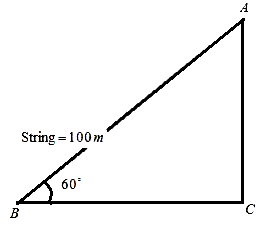
A kite is attached to a $100\ m$ long string. Find the greatest height reached by the kite when its string makes an angles of $60^\circ $ with the level ground.
Answer
Given that the kite is attached to a $100 m$ long string and it makes an angle of $60^\circ $ with the ground level which is shown in the figure below:

Suppose that the greatest height is $x m.$
From the figure
$\frac{x}{100}=\sin 60^{\circ}.\dots..\left[\because \frac{\text { Perp. }}{\text { Hypot. }}=\sin \right]$
$\frac{x}{100}=\frac{\sqrt{3}}{2}$
$x = 86.6\ m$
Therefore the greatest height reached by the kite is $86.6\ m.$
View full question & answer
Question 115 Marks
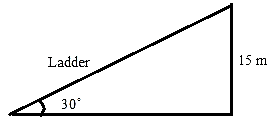
A ladder is placed against a vertical tower. If the ladder makes an angle of $30^\circ $ with the ground and reaches upto a height of $15\ m$ of the tower; find length of the ladder.
Answer
Given that the ladder makes an angle of $30^\circ $ with the ground and reaches up to a height of $15\ m$ of the tower which is shown in the figure below:

Suppose the length of the ladder is $x m$
From the figure
$\frac{15}{x}=\sin 30^{\circ} \ldots\left[\because \frac{\text { Perp. }}{\text { Hypot. }}=\sin \right]$
$\frac{15}{x}=\frac{1}{2}$
$x = 30\ m$
Therefore the length of the ladder is $30\ m.$
View full question & answer
Question 125 Marks
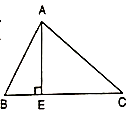
In the given figure, $\angle B = 60^\circ , AB = 16 \ cm$ and $BC = 23 \ cm,$Calculate: $(i) BE, (ii) AC$
Answer
In $\triangle ABE,$
$\sin 60^{\circ}=\frac{ AE }{ AB }$
$\Rightarrow \frac{\sqrt{3}}{2}=\frac{ AE }{16}$
$\Rightarrow AE =\frac{\sqrt{3}}{2} \times 16$
$=8 \sqrt{3} \ cm $
$(i)$ In $\triangle ABE,$
$m\angle AEB = 90^\circ$
$\therefore $By Pythagoras Theorem, we get
$BE^2 = AB^2 - AE^2$
$\Rightarrow BE^2 = (16)^2 - (8\sqrt3)^2$
$\Rightarrow BE^2 = 256 - 192$
$\Rightarrow BE^2 = 64$
$\Rightarrow BE = 8 \ cm$
$(ii) EC = BC - BE = 23 - 8 = 15$
In$ \triangle AEC,$
$m\angle AEC = 90^\circ$
$\therefore $ By Pythagoras Theorem, we get
$AC^2 = AE^2+ EC^2$
$\Rightarrow AC^2 = (8\sqrt3)^2 + (15)^2$
$\Rightarrow AC^2 = 192 + 225$
$\Rightarrow AC^2 = 417$
$\Rightarrow AC = 20. 42 \ cm$
View full question & answer
[5 marks sum] - MATHEMATICS STD 9 Questions - Vidyadip