Question 14 Marks
If $8 \tan\theta = 15$, find$(i) \sin\theta , (ii) \cot\theta , (iii) \sin^2\theta - \cot^2\theta$
Answer$8 \tan \theta=15$
$\Rightarrow \tan \theta=\frac{15}{8}=\frac{\text { Perpendicular }}{\text { Base }}$
Hypotenuse
$=\sqrt{(\text { Perpendicular })^2+(\text { Base })^2} $
$=\sqrt{15^2+8^2} $
$=\sqrt{225+64} $
$=\sqrt{289} $
$=17$
$ii) \sin \theta=\frac{\text { Perpendicular }}{\text { Hypotenuse }}=\frac{15}{17}$
$\cot \theta=\frac{1}{\tan \theta}=\frac{8}{15}$
$iii) \sin ^2 \theta-\cot ^2 \theta$
$=(\sin \theta+\cot \theta)(\sin \theta-\cot \theta) $
$=\left(\frac{15}{17}+\frac{8}{15}\right)\left(\frac{15}{17}-\frac{8}{15}\right) $
$=\left(\frac{225+136}{225}\right)\left(\frac{225-136}{225}\right) $
$=\left(\frac{361}{225}\right)\left(\frac{89}{255}\right) $
$=\frac{32129}{65025} .$
View full question & answer→Question 24 Marks
If $\sin A = 0.8,$ find the other trigonometric ratios for $A.$
Answer$\sin A =0.8=\frac{8}{10}=\frac{4}{5}=\frac{\text { Perpendicular }}{\text { Hypotenuse }} $
Base
$=\sqrt{(\text { Hypotenuse })^2-(\text { Perpendicular })^2} $
$=\sqrt{5^2-4^2} $
$=\sqrt{25-16} $
$=\sqrt{9} $
$=3 $
$\cos A =\frac{\text { Base }}{\text { Hypotenuse }}=\frac{3}{5}=0.6 $
$\tan A =\frac{\text { Perpendicular }}{\text { Base }}=\frac{4}{3}=1.33 $
$\operatorname{cosec} A =\frac{1}{\sin A }=\frac{5}{4}=1.25 $
$\sec A =\frac{1}{\cos A }=\frac{5}{3}=1.66 $
$\cot A =\frac{1}{\tan A }=\frac{3}{4}=0.75$
View full question & answer→Question 34 Marks
If $\sin A=\frac{3}{5}$, find $\cos A$ and $\tan A$.
Answer$\sin A=\frac{3}{5}=\frac{\text { Perpendicular }}{\text { Hypotenuse }} $
By Pythagoras theorem, we have
$\Rightarrow($Hypotenuse$)^2=($Perpendicular$)^2+($Base$)^2 $
$\Rightarrow($Base$) ^2=($Hypotenuse$a)^2-($Perpendicular$)^2 $
$\Rightarrow(\text { Base })=\sqrt{(\text { Hypotenuse })^2-(\text { Perpendicular })^2} $
$\Rightarrow ($Base$)$
$=\sqrt{5^2-3^2} $
$=\sqrt{25-9} $
$=\sqrt{16} $
$=4 $
$\cos A =\frac{\text { Base }}{\text { Hypotenuse }}=\frac{4}{5} $
$\tan A=\frac{\text { Perpendicular }}{\text { Base }}=\frac{3}{4} \text {. }$
View full question & answer→Question 44 Marks
In $\triangle ABC, \angle B = 90^\circ .$ If $AB = 12$ units and $BC = 5$units, find: $\cot C$
Answer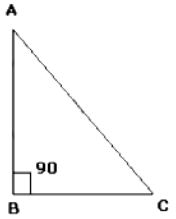
In $\triangle ABC,$
$AC^2 = AB^2 + BC^2$
$\Rightarrow AC =\sqrt{ AB ^2+ BC ^2}$
$\Rightarrow AC =\sqrt{12^2+5^2}$
$=\sqrt{144+25}$
$= 13$
$AB = 12$ units
$BC = 5$ units
$AC = 13$ units
$\cot C$
$=\frac{\text { Base }}{\text { Perpendicular }}$
$=\frac{ BC }{ AB }$
$=\frac{5}{12} .$ View full question & answer→Question 54 Marks
In $\triangle ABC, \angle B = 90^\circ .$ If $AB = 12$ units and $BC = 5$ units, find$: \cos C$
Answer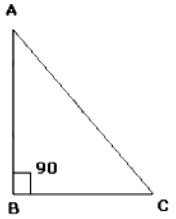
ln $\triangle A B C_1 $
$A C^2=A B^2+ BC ^2 $
$\Rightarrow A C=\sqrt{ AB ^2+ BC ^2} $
$\Rightarrow AC =\sqrt{12^2+5^2} $
$=\sqrt{144+25} $
$=13 $
$AB =12$ units
$BC =5 $ units
$AC =13$ units
$\cos C $
$=\frac{\text { Base }}{\text { Hypotenuse }} $
$=\frac{ BC }{ AC } $
$=\frac{5}{13} .$ View full question & answer→Question 64 Marks
In $\triangle ABC, \angle B = 90^\circ .$ If $AB = 12$ units and $BC = 5$ units, find: $\tan A$
Answer
ln $\triangle A B C $
$A C^2=A B^2+B^2 $
$\Rightarrow A C=\sqrt{A^2+B^2} $
$\Rightarrow A C=\sqrt{12^2+5^2} $
$=\sqrt{144+25} $
$=13 $
$A B=12$ units
$B C=5$ units
$A C=13$ units
$\tan A $
$=\frac{\text { Perpendicular }}{\text { Base }} $
$=\frac{ BC }{ AB } $
$=\frac{5}{12} .$ View full question & answer→Question 74 Marks
If $\operatorname{cosec} \theta=1 \frac{9}{20}$, show that $\frac{1-\sin \theta+\cos \theta}{1+\sin \theta+\cos \theta}=\frac{3}{7}$
Answer$\operatorname{cosec} \theta=1 \frac{9}{20}=\frac{29}{20} $
$\sin \theta=\frac{1}{\operatorname{cosec} \theta}=\frac{20}{29}$
$=\frac{\text { Perpendicular }}{\text { Hypotenuse }} $
Base
$=\sqrt{(\text { Hypotenuse })^2-(\text { Perpendicular })^2} $
$=\sqrt{(29)^2-(20)^2} $
$=\sqrt{841-400} $
$=\sqrt{441} $
$=21 $
$\cos \theta=\frac{\text { Base }}{\text { Hypotenuse }}=\frac{21}{29} $
To show:
$\frac{1-\sin \theta+\cos \theta}{1+\sin \theta+\cos \theta}=\frac{3}{7} $
$\frac{1-\sin \theta+\cos \theta}{1+\sin \theta+\cos \theta} $
$=\frac{1-\frac{20}{29}+\frac{21}{29}}{1+\frac{20}{29}+\frac{21}{29}} $
$=\frac{29-20+21}{29+20+21} $
$=\frac{30}{70} $
$=\frac{3}{7} .$
View full question & answer→Question 84 Marks
In $\triangle A B C, \angle B=90^{\circ}$. If $A B=12$ units and $B C=5$ units, find: $\sin A$
Answer
In $\triangle ABC,$
$AC^2 = AB^2 + BC^2$
$\Rightarrow AC =\sqrt{ AB ^2+ BC ^2} $
$\Rightarrow AC =\sqrt{12^2+5^2}$
$=\sqrt{144+25}$
$= 13$
$AB = 12$ units
$BC = 5$ units
$AC = 13$ units
$\sin A$
$=\frac{\text { Perpendicular }}{\text { Hypotenuse }} $
$ =\frac{ BC }{ AC }$
$=\frac{5}{13} .$ View full question & answer→Question 94 Marks
In $\triangle ABC, \angle A = 90^\circ $. If $AB = 5$ units and $AC = 12$ units, find: $\tan B.$
Answer
In $\triangle ABC,$
$BC^2 = AB^2 + AC^2$
$\Rightarrow BC =\sqrt{A B ^2+A C^2}$
$\Rightarrow BC =\sqrt{5^2+12^2}$
$=\sqrt{169}$
$= 13$
$AC = 12$ units
$BC = 13$ units
$AB = 5$ units
$\tan B$
$=\frac{\text { Perpendcular }}{\text { Base }}$
$=\frac{ AC }{ AB }$
$=\frac{12}{5} .$ View full question & answer→Question 104 Marks
In $\triangle A B C, \angle A=90^{\circ}$. If $A B=5$ units and $A C=12$ units, find: $\cos C$
Answer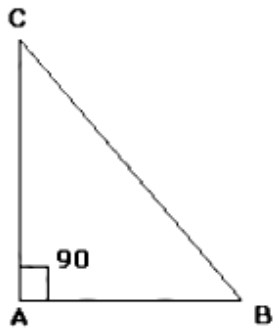
In $\triangle ABC,$
$BC^2 = AB^2 + AC^2$
$\Rightarrow BC =\sqrt{ AB ^2+ AC ^2}$
$\Rightarrow BC =\sqrt{5^2+12^2}$
$=\sqrt{169}$
$=13$
$AC =12$ units
$BC =1$3 units
$AB =5$ units
$\cos C$
$=\frac{\text { Base }}{ Hypotenuse }$
$=\frac{ AC }{ BC }$
$=\frac{12}{13}$. View full question & answer→Question 114 Marks
In the given figure, $\angle Q=90^{\circ}, P S$ is a median om $Q R$ from $P$, and $R T$ divides $P Q$ in the ratio $1: 2$. Find: $\frac{\tan \angle TSQ }{\tan \angle PRQ }$
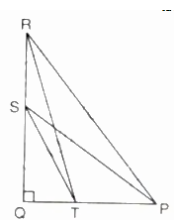
AnswerAs $PS$ is the median on $QR$ from $P$.
$ \therefore Q S=S R$
$\Rightarrow Q R=2 Q S$
and $R T$ divides $P Q$ in the ratio $1: 2$
$ \therefore QT = x$ and $PT =2 x$
$\Rightarrow PQ =3 x$
$\frac{\tan \angle TSQ }{\tan \angle PRQ }$
$=\frac{\frac{ QT }{ QS }}{\frac{ PQ }{ QR }}$
$=\frac{ QT }{ QS } \times \frac{ QR }{ PQ }$
$=\frac{x}{ QS } \times \frac{2 QS }{3 x}$
$=\frac{2}{3} . $
View full question & answer→Question 124 Marks
In $\tan \theta = 1$, find the value of $5\cot^2\theta + \sin^2\theta - 1$.
Answer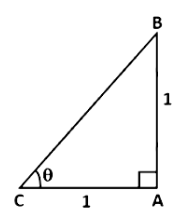
Consider $\triangle A B C$, where $\angle A=90^{\circ}$
$\tan \theta=\frac{\text { Perpendicular }}{\text { Basse }}=\frac{ AB }{ AC }=1=\frac{1}{1}$
By Pythagoras theorem,
$B C^2$
$=A B^2+A C^2$
$=1^2+1^2$
$=2$
$\Rightarrow B C=\sqrt{2} $
Now,
$ \cot \theta=\frac{1}{\tan \theta}=1$
$\sin \theta=\frac{ AB }{ BC }=\frac{1}{\sqrt{2}}$
$\therefore 5 \cot ^2 \theta+\sin ^2 \theta-1$
$=5 \times(1)^2+\left(\frac{1}{\sqrt{2}}\right)^2-1$
$=5+\frac{1}{2}-1$
$=4+\frac{1}{2}$
$=\frac{9}{2} . $ View full question & answer→Question 134 Marks
In the given figure, $\triangle A B C$ is right angled at $B . A D$ divides $B C$ in the ratio $1: 2$. Find$\text { (i) } \frac{\tan \angle BAC }{\tan \angle BAD } \text { (ii) } \frac{\cot \angle BAC }{\cot \angle BAD }$
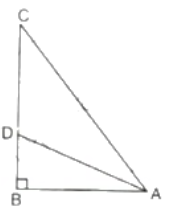
Answerwe are given that $BD : DC = 1 : 2$ as $AD$ divides $BC$ in the ratio $1 : 2$.
i.e $BD = x,DC = 2x $
$\Rightarrow BC = 3x$
$(i)\frac{\tan \angle BAC }{\tan \angle BAD }$
$=\frac{\frac{B C}{A B}}{\frac{B D}{A B}}$
$=\frac{B C}{B D}$
$=\frac{3 x}{x}$
$=3$
$(ii)\frac{\cot \angle BAC }{\cot \angle BAD }$
$=\frac{\frac{A B}{B C}}{\frac{A B}{B D}}$
$=\frac{B D}{B C}$
$=\frac{x}{3 x}$
$=\frac{1}{3} .$
View full question & answer→Question 144 Marks
In an isosceles $\triangle A B C, A B=B C=6 \mathrm{\sim cm}$ and $\angle B=90^{\circ}$. Find the values of $\cos ^2 C+\operatorname{cosec}^2 C$
Answer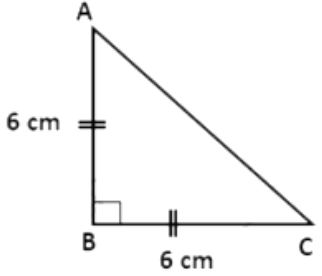
$\triangle A B C$ is an isosceles right$-$angled triangle.
$ \therefore A C^2$
$=A B^2+B C^2$
$=6^2+6^2$
$=36+36$
$=72$
$\Rightarrow A C=6 \sqrt{2} \ cm$
$\cos ^2 C+\operatorname{cosec}^2 C$
$=\left(\frac{1}{\sqrt{2}}\right)^2+(\sqrt{2})^2$
$=\frac{1}{2}+2$
$=\frac{5}{2} .$ View full question & answer→Question 154 Marks
In an isosceles $\triangle ABC, AB = BC = 6\ cm$ and $\angle B = 90^\circ.$ Find the values of $\operatorname{cosec C}$
Answer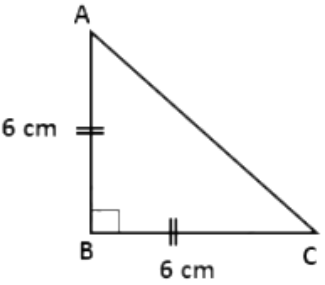
$\triangle A B C$ is an isosceles right$-$angled triangle.
$ \therefore A C^2$
$=A B^2+B C^2$
$=6^2+6^2$
$=36+36$
$=72$
$\Rightarrow A C=6 \sqrt{2} \ cm$
$\operatorname{cosec} C$
$=\frac{A C}{A B}$
$=\frac{6 \sqrt{2}}{6}$
$=\sqrt{2} . $ View full question & answer→Question 164 Marks
In an isosceles $ \triangle ABC, AB = BC = 6 \ cm$ and $\angle B = 90^\circ $. Find the values of $\cos C$
Answer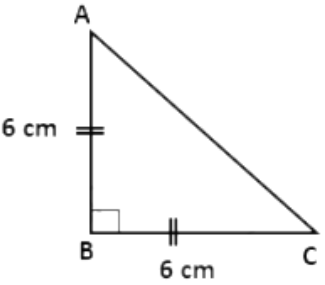
$\triangle A B C$ is an isosceles right$-$angled triangle.
$\therefore A C^2$
$=A B^2+B C^2$
$=6^2+6^2$
$=36+36$
$=72$
$\Rightarrow A C=6 \sqrt{2} \ cm$
$\cos C$
$=\frac{B C}{A C}$
$=\frac{6}{6 \sqrt{2}}$
$=\frac{1}{\sqrt{2}} .$ View full question & answer→Question 174 Marks
In each of the following, one trigonometric ratio is given. Find the values of the other trigonometric. $\operatorname{cosec} C=\sqrt{10}$
Answer$\operatorname{cosec} C =\sqrt{10} $
$\operatorname{cosec} C =\frac{1}{\sin C }$
$=\frac{\text { Hypotenuse }}{\text { Perpendicular }}=\frac{\sqrt{10}}{1} $
By Pythagoras theorem, we have
$($Hypotenuse$)^2=($Perpendicular$)^2+($Base$)^2 $
$\Rightarrow \text { Base }=\sqrt{(\text { Hypotenuse })^2-(\text { Perpendicular })^2} $
$\Rightarrow$ Base
$=\sqrt{(\sqrt{10})^2-(1)^2} $
$=\sqrt{10-1} $
$=\sqrt{9} $
$=3 $
$\sin C=\frac{\text { Perpendicular }}{\text { Hypotenuse }}=\frac{1}{\sqrt{10}} $
$\cos C=\frac{\text { Base }}{\text { Hypotenuse }}=\frac{3}{\sqrt{10}} $
$\tan C=\frac{\text { Perpendicular }}{\text { Base }}=\frac{1}{3} $
$\sec C =\frac{1}{\cos C }=\frac{\sqrt{10}}{3} $
$\cot C=\frac{1}{\tan A}=3 $
View full question & answer→Question 184 Marks
In each of the following, one trigonometric ratio is given. Find the values of the other trigonometric. $\tan B=\frac{8}{15}$
Answer$\tan B =\frac{8}{15} $
$\tan B =\frac{\text { Perpendicular }}{\text { Base }}=\frac{8}{15}$
By Pythagoras theorem, we have
$($Hypotenuse$)^2=($Perpendicular$)^2+($Base$)^2$
$(\text { Hypotenuse })=\sqrt{(\text { Perpendicular })^2+(\text { Base })^2}$
$=\sqrt{(8)^2+(15)^2}$
$=\sqrt{64+225}$
$=\sqrt{289}$
$=17$
$\cot B =\frac{1}{\tan B }=\frac{15}{8}$
$\sin B=\frac{\text { Perpendicular }}{\text { Hypotenuse }}=\frac{8}{17}$
$\cos B =\frac{\text { Base }}{\text { Hypotenuse }}=\frac{15}{17}$
$\sec B =\frac{1}{\cos B }=\frac{17}{15}$
$\operatorname{cosec} B=\frac{1}{\sin B}=\frac{17}{8}$.
View full question & answer→Question 194 Marks
In each of the following, one trigonometric ratio is given. Find the values of the other trigonometric. $\cos A =\frac{7}{25}$
Answer$\cos A=\frac{7}{25}$
$\cos A=\frac{\text { Base }}{\text { Hypotenuse }}=\frac{7}{25}$
By Pythagoras theorem, we have
$($Hypotenuse$)^2=($Perpendicular$)^2+($Base$)^2$
$\Rightarrow \text { Perpendicular }=\sqrt{(\text { Hypotenuse })^2-(\text { Base })^2}$
$\Rightarrow$ Perpendicular
$=\sqrt{(25)^2-(7)^2}$
$=\sqrt{625-49}$
$=\sqrt{576}$
$=24$
$\sin A =\frac{\text { Perpendicular }}{\text { Hypotenuse }}=\frac{24}{25}$
$\tan A =\frac{\text { Perpendicular }}{\text { Base }}=\frac{24}{7}$
$\sec A =\frac{1}{\cos A }=\frac{25}{7}$
$\cot A =\frac{1}{\tan A }=\frac{7}{24}$
$\operatorname{cosec} A =\frac{1}{\sin A }=\frac{25}{24} .$
View full question & answer→Question 204 Marks
In each of the following, one trigonometric ratio is given. Find the values of the other trigonometric. $\sin B=\frac{\sqrt{3}}{2}$
Answer$ \sin B=\frac{\sqrt{3}}{2}$
$\sin B=\frac{\text { Perpendicular }}{\text { Hypotenuse }}=\frac{\sqrt{3}}{2}$
By Pythagoras theorem, we have
$($Hypotenuse$)^2=($Perpendicular$)^2+($Base$)^2$
$\Rightarrow \text { Base }=\sqrt{(\text { Hypotenuse })^2-(\text { Perpendicular })^2}$
$\Rightarrow$ Base
$\sqrt{(2)^2-(\sqrt{3})^2}$
$=\sqrt{4-3}$
$=\sqrt{1}$
$=1$
$\cos B=\frac{\text { Base }}{\text { Hypotenuse }}=\frac{1}{2}$
$\tan B=\frac{\text { Perpendicular }}{\text { Base }}=\sqrt{3}$
$\sec B=\frac{1}{\cos B}=2$
$\cot B=\frac{1}{\tan B}=\frac{1}{\sqrt{3}}$
$\operatorname{cosec} B=\frac{1}{\sin A}=\frac{2}{\sqrt{3}} .$
View full question & answer→Question 214 Marks
In each of the following, one trigonometric ratio is given. Find the values of the other trigonometric. $\tan C=\frac{5}{12}$
Answer$ \tan C=\frac{5}{12}$
$\tan C=\frac{\text { Perpendicular }}{\text { Base }}=\frac{5}{12} $
By Pythagoras theprem, we have
$($Hypotenuse$)^2=($Perpendicular$)^2+($Base$)^2$
$($ Hypotenuse $)=\sqrt{(\text { Perpendicular })^2+(\text { Base })^2}$
$=\sqrt{(5)^2+(12)^2}$
$=\sqrt{25+144}$
$=\sqrt{169}$
$=13$
$\cot C =\frac{1}{\tan C }=\frac{12}{5}$
$\sin C=\frac{\text { Perpendicular }}{\text { Hypotenuse }}=\frac{5}{13}$
$\cos C=\frac{\text { Base }}{\text { Hypotenuse }}=\frac{12}{13}$
$\sec C =\frac{1}{\cos C }=\frac{13}{12}$
$\operatorname{cosec} C=\frac{1}{\sin C}=\frac{13}{5}$.
View full question & answer→Question 224 Marks
In each of the following, one trigonometric ratio is given. Find the values of the other trigonometric. $\cot A =\frac{1}{11}$
Answer$ \cot A =\frac{1}{11}$
$\cot A =\frac{1}{\tan A }=\frac{\text { Base }}{\text { Perpendicular }}$
By Pythagoras theorem, we have
$($Hypotenuse$)^2=($Perpendicular$)^2+($Base$)^2$
$(\text { Hypotenuse })=\sqrt{(\text { Perpendicular })^2+(\text { Base })^2}$
$=\sqrt{(11)^2+(1)^2}$
$=\sqrt{121+1}$
$=\sqrt{122}$
$\cos A =\frac{\text { Base }}{\text { Hypotenuse }}=\frac{1}{\sqrt{122}}$
$\tan A =\frac{\text { Perpendicular }}{\text { Base }}=11$
$\sec A =\frac{1}{\cos A }=\sqrt{122}$
$\sin A =\frac{\text { Perpendicular }}{\text { Hypotenuse }}=\frac{11}{\sqrt{122}}$
$\operatorname{cosec} A =\frac{1}{\sin A }=\frac{\sqrt{122}}{11} . $
View full question & answer→Question 234 Marks
In each of the following, one trigonometric ratio is given. Find the values of the other trigonometric.$\sin A =\frac{12}{13}$
Answer$ \sin A=\frac{12}{13}$
$\sin A=\frac{\text { Perpendicular }}{\text { Hypotenuse }}=\frac{12}{13} $
By Pythagoras theorem, we have
$ ($Hypotenuse$)^2=($Perpendicular$)^2+($Base$)^2$
$\Rightarrow \text { Base }=\sqrt{(\text { Hypotenuse })^2-(\text { Perpendicular })^2}$
$\Rightarrow$ Base
$=\sqrt{(13)^2-(12)^2}$
$=\sqrt{169-144}$
$=\sqrt{25}$
$=5$
$\cos A =\frac{\text { Base }}{\text { Hypotenuse }}=\frac{5}{13}$
$\sec A =\frac{1}{\cos A }=\frac{13}{5}$
$\cot A =\frac{1}{\tan A }=\frac{5}{12}$
$\operatorname{cosec} A =\frac{1}{\sin A }=\frac{13}{12} . $
View full question & answer→