Question 15 Marks
If $\tan \theta=\frac{m}{n}$, show that $\frac{m \sin \theta-n \cos \theta}{m \sin \theta+n \cos \theta}=\frac{m^2-n^2}{m^2+n^2}$
Answer$\tan \theta=\frac{ m }{ n }=\frac{\text { Perpendicular }}{\text { Base }}$
Hypotenuse
$=\sqrt{(\text { Perpendicular })^2+{\text { (Base })^2}^2}$
$=\sqrt{ m ^2+ n ^2}$
$\sin \theta=\left(\frac{ m }{\sqrt{ m ^2+ n ^2}}\right)$
$\cos \theta=\left(\frac{ n }{\sqrt{ m ^2+ n ^2}}\right) $
To show: $\frac{m \sin \theta-n \cos \theta}{m \sin \theta+n \cos \theta}=\frac{m^2-n^2}{m^2+n^2}$.
$m \sin \theta- n \cos \theta$
$\overline{ m \sin \theta+ n \cos \theta}$
$=\frac{\left(\frac{m}{\sqrt{m^2+n^2}}\right)-n\left(\frac{n}{\sqrt{m^2+n^2}}\right)}{\left(\frac{m}{\sqrt{m^2+n^2}}\right)+n\left(\frac{n}{\sqrt{m^2+n^2}}\right)}$
$=\frac{\frac{m^2-n^2}{\sqrt{m^2+n^2}}}{\frac{m^2+n^2}{\sqrt{m^2+n^2}}}$
$=\frac{m^2-n^2}{\sqrt{m^2+n^2}} \times \frac{\sqrt{m^2+n^2}}{m^2+n^2}$
$=\frac{m^2-n^2}{m^2+n^2}$.
View full question & answer→Question 25 Marks
If $3 \tan \theta=4$, prove that $\frac{\sqrt{\sec \theta-\operatorname{cosec} \theta}}{\sqrt{\sec \theta-\operatorname{cosec} \theta}}=\frac{1}{\sqrt{7}}$.
Answer$ 3 \tan \theta=4$
$\Rightarrow \tan \theta=\frac{4}{3}=\frac{\text { Perpendicular }}{\text { Base }} $
Hypotenuse
$=\sqrt{(\text { Perpendicular })^2+(\text { Base })^2}$
$=\sqrt{(4)^2+(3)^2}$
$=\sqrt{16+9}$
$=\sqrt{25}$
$=5 $
$\sec \theta=\frac{\text { Hypotenuse }}{\text { Base }}=\frac{5}{3}$
$\operatorname{cosec} \theta=\frac{\text { Hypotenuse }}{\text { Perpendicular }}=\frac{5}{4}$
To prove: $\frac{\sqrt{\sec \theta-\operatorname{cosec} \theta}}{\sqrt{\sec \theta-\operatorname{cosec} \theta}}=\frac{1}{\sqrt{7}}$.
$\frac{\sqrt{\sec \theta-\operatorname{cosec} \theta}}{\sqrt{\sec \theta-\operatorname{cosec} \theta}}$
$=\frac{\sqrt{\frac{5}{3}-\frac{5}{4}}}{\sqrt{\frac{5}{3}+\frac{5}{4}}}$
$=\frac{\frac{\sqrt{20-15}}{12}}{\frac{\sqrt{20+15}}{12}}$
$=\frac{\sqrt{\frac{5}{12}}}{\sqrt{\frac{35}{12}}}$
$=\frac{\sqrt{5}}{\sqrt{12}} \times \frac{\sqrt{12}}{\sqrt{35}}$
$=\frac{\sqrt{5}}{\sqrt{12}} \times \frac{\sqrt{12}}{\sqrt{5} \times \sqrt{7}}$
$=\frac{1}{\sqrt{7}} .$
View full question & answer→Question 35 Marks
If $\sec A =\frac{17}{8}$, verify that $\frac{3-4 \sin ^2 A }{4 \cos ^2 A -3}=\frac{3-\tan ^2 A }{1-3 \tan ^2 A }$
Answer$ \sec A=\frac{17}{8}$
$\Rightarrow \cos A=\frac{8}{17}=\frac{\text { Base }}{\text { Hypotenuse }}$
Perpendicular
$=\sqrt{(\text { Hypotenuse })^2-(\text { Base })^2}$
$=\sqrt{(17)^2-(8)^2}$
$=\sqrt{289-64}$
$=\sqrt{225}$
$=5$
$\sin A=\frac{\text { Perpendicular }}{\text { Hypotenuse }}=\frac{15}{17}$
$\tan A =\frac{\text { Perpendicular }}{\text { Base }}=\frac{15}{8}$
To prove: $\frac{3-4 \sin ^2 A }{4 \cos ^2 A -3}=\frac{3-\tan ^2 A }{1-3 \tan ^2 A }$
$ \text { L.H.S. }=\frac{3-4 \sin ^2 A }{4 \cos ^2 A -3}$
$=\frac{3-4\left(\frac{15}{17}\right)^2}{4\left(\frac{8}{17}\right)^2-3}$
$=\frac{3-\frac{900}{289}}{\frac{256}{289}-3}$
$=\frac{\frac{867-900}{289}}{\frac{256-867}{289}}$
$=\frac{-33}{\frac{611}{33}}$
$=\frac{611}{63} $
$\text{R.H.S. }=\frac{3-\tan ^2 A }{1-3 \tan ^2 A }$
$=\frac{3-\left(\frac{15}{8}\right)^2}{1-3\left(\frac{15}{8}\right)^2}$
$=\frac{3-\frac{225}{64}}{1-\frac{675}{64}}$
$=\frac{\frac{192-225}{64}}{\frac{64-675}{64}}$
$=\frac{-33}{-611}$
$=\frac{33}{611}$.
View full question & answer→Question 45 Marks
If $\sin \theta=\frac{3}{4}$, prove that $\sqrt{\frac{\operatorname{cosec}^2 \theta-\cot ^2 \theta}{\sec ^2 \theta-1}}=\frac{\sqrt{7}}{3}$.
Answer$\sin \theta=\frac{3}{4} $
$\frac{\text { Perpendicular }}{\text { Hypotenuse }}=\frac{3}{4} $
Base
$=\sqrt{(\text { Hypotenuse })^2-(\text { Perpendicuar })^2} $
$=\sqrt{16-9} $
$=\sqrt{7} $
$\operatorname{cosec} \theta=\frac{4}{3} $
$\cot \theta=\frac{\text { Base }}{\text { Perpendicular }}=\frac{\sqrt{7}}{3} $
$\sec \theta=\frac{\text { Hypotenuse }}{\text { Base }}=\frac{4}{\sqrt{7}} $
To prove $\sqrt{\frac{\operatorname{cosec}^2 \theta-\cot ^2 \theta}{\sec ^2 \theta-1}}=\frac{\sqrt{7}}{3} $
$\sqrt{\frac{\operatorname{cosec}^2 \theta-\cot ^2 \theta}{\sec ^2 \theta-1}} $
$=\sqrt{\frac{\left(\frac{4}{3}\right)^2-\left(\frac{\sqrt{7}}{3}\right)^2}{\left(\frac{4}{\sqrt{7}}\right)^2-1}} $
$=\sqrt{\frac{\frac{16}{9}-\frac{7}{9}}{\frac{16}{7}-1}} $
$=\sqrt{\frac{\frac{16-7}{9}}{\frac{16-7}{7}}} $
$=\sqrt{\frac{\frac{9}{9}}{\frac{9}{7}}} $
$=\sqrt{\frac{1}{\frac{9}{7}}} $
$=\sqrt{\frac{7}{9}} $
$=\frac{\sqrt{7}}{3} \text {. } $
View full question & answer→Question 55 Marks
If $\sec A =\frac{5}{4}$, cerify that $\frac{3 \sin A-4 \sin ^3 A }{4 \cos ^3 A -3 \cos A }=\frac{3 \tan A -\tan ^3 A }{1-3 \tan ^2 A }$.
Answer$\sec A=\frac{5}{4}$
$\Rightarrow \cos A=\frac{4}{5}=\frac{\text { Base }}{\text { Hypotenuse }}$
Perpendicular
$=\sqrt{(\text { Hypotenuse })^2-(\text { Base })^2}$
$=\sqrt{25-16}$
$=\sqrt{9}$
$=3$
$\sin A =\frac{\text { Perpendicular }}{\text { Hypotenuse }}=\frac{3}{5}$
$\tan A =\frac{\text { Perpendicular }}{\text { Base }}=\frac{3}{4}$
To show:$ \frac{3 \sin A-4 \sin ^3 A}{4 \cos ^3 A-3 \cos A}=\frac{3 \tan A-\tan ^3 A}{1-3 \tan ^2 A} \text {. }$
$\text { L.H.S. }=\frac{3 \sin A-4 \sin ^3 A}{4 \cos ^3 A-3 \cos A}$
$=\frac{3\left(\frac{3}{5}\right)-4\left(\frac{3}{5}\right)^3}{4\left(\frac{4}{5}\right)^3-3\left(\frac{4}{5}\right)}$
$=\frac{\frac{9}{5}-\frac{108}{125}}{\frac{256}{125}-\frac{12}{5}}$
$=\frac{\frac{\overline{125}-\frac{2}{5}}{125}}{\frac{256-300}{125}}$
$=\frac{117}{-44}$
$\text { R.H.S. }=\frac{3 \tan A -\tan ^3 A }{1-3 \tan ^2 A }$
$=\frac{3\left(\frac{3}{4}\right)-\left(\frac{3}{4}\right)^3}{1-3\left(\frac{3}{4}\right)^2}$
$=\frac{\frac{9}{4}-\frac{27}{64}}{1-\frac{27}{16}}$
$=\frac{\frac{144-27}{64}}{\frac{16-27}{16}}$
$=\frac{117}{64} \times \frac{16}{-11}$
$=\frac{117}{4} \times \frac{1}{-11}$
$=\frac{-117}{44}$
$\Rightarrow \text { L.H.S. = R.H.S. } $
View full question & answer→Question 65 Marks
If $12 \cot \theta=13$, find the value of $\frac{2 \sin \theta \cos \theta}{\cos ^2 \theta-\sin ^2 \theta}$.
Answer$\cot \theta=\frac{13}{12}$
$\Rightarrow \frac{\cos \theta}{\sin \theta}=\frac{13}{12}$
$\Rightarrow \frac{\text { Base }}{\text { Hypotenuse }} \times \frac{\text { Hypotenuse }}{\text { Perpendicular }}=\frac{13}{12}$
$\Rightarrow \frac{\text { Base }}{\text { Perpendicular }}=\frac{13}{12}$
Hypotenuse
$=\sqrt{(\text { Perpendicular })^2+(\text { Base })^2}$
$=\sqrt{(12)^2+(13)^2}$
$=\sqrt{144+169}$
$=\sqrt{313}$
$\frac{2 \sin \theta \cos \theta}{\cos ^2 \theta-\sin ^2 \theta}$
$=\frac{2 \times \frac{12}{\sqrt{313}} \times \frac{13}{\sqrt{313}}}{\left(\frac{13}{\sqrt{313}}\right)^2-\left(\frac{12}{\sqrt{313}}\right)^2}$
$=\frac{\frac{312}{313}}{\frac{169}{313}-\frac{144}{313}}$
$=\frac{\frac{312}{313}}{\frac{25}{313}}$
$=\frac{312}{25} .$
View full question & answer→Question 75 Marks
If $12 \operatorname{cosec} \theta=13$, find the value of $\frac{\sin ^2 \theta-\cos ^2 \theta}{2 \sin \theta \cos \theta} \times \frac{1}{\tan ^2 \theta}$.
Answer$12 \operatorname{cosec} \theta=13$
$\Rightarrow \operatorname{cosec} \theta=\frac{13}{12}$
$\Rightarrow \sin \theta=\frac{12}{13}=\frac{\text { Perpendicular }}{\text { Hypotenuse }}$
$\Rightarrow$ Base
$=\sqrt{(\text { Hypotenuse })^2-(\text { Perpendicular })^2}$
$=\sqrt{(13)^2-(12)^2}$
$=\sqrt{169-144}$
$=\sqrt{25}$
$=5$
$\cos \theta=\frac{\text { Base }}{\text { Hypotenuse }}=\frac{5}{13}$
$\tan \theta=\frac{\text { Perpendicular }}{\text { Base }}=\frac{12}{5}$
Now $\frac{\sin ^2 \theta-\cos ^2 \theta}{2 \sin ^2 \cos \theta} \times \frac{1}{\tan ^2 \theta}$
$=\frac{\left(\frac{12}{13}\right)^2-\left(\frac{5}{13}\right)^2}{2\left(\frac{12}{13}\right)\left(\frac{5}{13}\right)} \times \frac{1}{\left(\frac{12}{5}\right)^2}$
$=\frac{\frac{144}{169}-\frac{25}{169}}{\frac{120}{169}} \times \frac{25}{144}$
$=\frac{119}{120} \times \frac{25}{144}$
$=\frac{595}{3456} .$
View full question & answer→Question 85 Marks
If $\cot \theta=\sqrt{7}$, show that $\frac{\operatorname{cosec}^2 \theta-\sec ^2 \theta}{\operatorname{cosec}^2 \theta+\sec ^2 \theta}=\frac{3}{4}$
Answer$\cot \theta=\sqrt{7}$
$\Rightarrow \frac{\cos \theta}{\sin \theta}=\sqrt{7}$
$\Rightarrow \frac{\text { Base }}{\text { Hypotenuse }} \times \frac{\text { Hypotenuse }}{\text { Perpendicular }}=\frac{\sqrt{7}}{1}$
$\Rightarrow \frac{\text { Base }}{\text { Perpendicular }}=\frac{\sqrt{7}}{1}$
Hypotenuse
$=\sqrt{(\text { Perpendicular })^2+(\text { Base })^2}$
$=\sqrt{1+7}$
$=2 \sqrt{2}$
To show:$\frac{\operatorname{cosec}^2 \theta-\sec ^2 \theta}{\operatorname{cosec}^2 \theta+\sec ^2 \theta}=\frac{3}{4}$
$\operatorname{cosec}^2 \theta-\sec ^2 \theta$
$\operatorname{cosec}^2 \theta+\sec ^2 \theta$
$=\frac{\left(\frac{\text { Hypotenuse }}{\text { Perpendicular }}\right)^2-\left(\frac{\text { Hypotenuse }}{\text { Base }}\right)^2}{\left(\frac{\text { Hypotenuse }}{\text { Perpendicular }}\right)^2+\left(\frac{\text { Hypotenuse }}{\text { Base }}\right)^2}$
$=\frac{\left(2 \frac{\sqrt{2}}{1}\right)^2-\left(2 \frac{\sqrt{2}}{\sqrt{7}}\right)^2}{\left(\frac{2 \sqrt{2}}{1}\right)^2+\left(2 \frac{\sqrt{2}}{\sqrt{7}}\right)^2}$
$=\frac{\frac{8}{1}-\frac{8}{7}}{\frac{8}{1}+\frac{8}{7}}$
$=\frac{\frac{56-8}{7}}{\frac{56+8}{7}}$
$=\frac{48^7}{64}$
$=\frac{3}{4} . $
View full question & answer→Question 95 Marks
If $a \cot \theta=b$, prove that $\frac{a \sin \theta-b \cos \theta}{a \sin \theta+b \cos \theta}=\frac{a^2-b^2}{a^2+b^2}$
Answer$ a \cot \theta= b$
$\Rightarrow \cot \theta=\frac{ b }{ a }$
$\Rightarrow \tan \theta=\frac{1}{\cot \theta}=\frac{ a }{ b }$
To prove: $\frac{ a \sin \theta- b \cos \theta}{ a \sin \theta+ b \cos \theta}=\frac{ a ^2- b ^2}{ a ^2+ b ^2}$
Consider: $\frac{ a \sin \theta- b \cos \theta}{ a \sin \theta+ b \cos \theta}$
To prove: $\frac{a \sin \theta-b \cos \theta}{a \sin \theta+b \cos \theta}=\frac{a^2-b^2}{a^2+b^2}$
Consider $\frac{a \sin \theta-b \cos \theta}{a \sin \theta+b \cos \theta}$
Dividing the numerator and denominator by $\cos \theta$, we get
$ \frac{a \sin \theta-b \cos \theta}{a \sin \theta+b \cos \theta}$
$=\frac{a \frac{\sin \theta}{\cos \theta}-b}{a \frac{\sin \theta}{\cos \theta}+b}$
$=\frac{a \tan \theta-b}{a \tan \theta+b}$
$=\frac{a \times \frac{a}{b}-b}{a \times \frac{a}{b}+b}$
$=\frac{\frac{a^2-b^2}{b^2}}{\frac{a^2+b^2}{b^2}}$
$=\frac{a^2-b^2}{a^2-b^2} . $
View full question & answer→Question 105 Marks
If $b \tan \theta=a$, find the values of $\frac{\cos \theta+\sin \theta}{\cos \theta-\sin \theta}$.
Answer$b \tan \theta= a $
$\Rightarrow \tan \theta=\frac{ a }{ b } $
Consider $\frac{\cos \theta+\sin \theta}{\cos \theta-\sin \theta}$
Dividing the numerator and demoninator by $\cos \theta$, we get
$\frac{\cos \theta+\sin \theta}{\cos \theta-\sin \theta} $
$=\frac{1+\frac{\sin \theta}{\cos \theta}}{1-\frac{\sin \theta}{\cos \theta}} $
$=\frac{1+\tan \theta}{1-\tan \theta} $
$=\frac{1+\frac{a}{b}}{1-\frac{a}{b}} $
$=\frac{\frac{b+a}{b}}{\frac{b-a}{b}} $
$=\frac{(b+a)}{(b-a)} .$
View full question & answer→Question 115 Marks
If $\cot \theta=\frac{1}{\sqrt{3}}$, show that $\frac{1-\cos ^2 \theta}{2-\sin ^2 \theta}=\frac{3}{5}$
Answer$ \cot \theta=\frac{1}{\sqrt{3}}$
$\Rightarrow \cot \theta=\frac{1}{\tan \theta}=\frac{1}{\sqrt{3}}=\frac{\text { Base }}{\text { Perpendicular }} $
Hypotenuse
$ =\sqrt{(\text { Perpendicular })^2+{\text { (Base })^2}^2}$
$=\sqrt{(\sqrt{3})^2+1}$
$=\sqrt{3+1}$
$=2$
$\cos \theta=\frac{\text { Base }}{\text { Hypotenuse }}=\frac{1}{2}$
$\sin \theta=\frac{\text { Perpendicular }}{\text { Hypotenuse }}=\frac{\sqrt{3}}{2} $
To show: $\frac{1-\cos ^2 \theta}{2-\sin ^2 \theta}=\frac{3}{5}$
$ \frac{1-\cos ^2 \theta}{2-\sin ^2 \theta}$
$=\frac{1-(\cos \theta)^2}{2-(\sin \theta)^2}$
$=\frac{1-\frac{1}{4}}{2-\frac{3}{4}}$
$=\frac{\frac{3}{4}}{\frac{5}{4}}$
$=\frac{3}{5} . $
View full question & answer→Question 125 Marks
If $35 \sec \theta = 37$, find the value of $\sin \theta - \sin \theta \tan \theta .$
Answer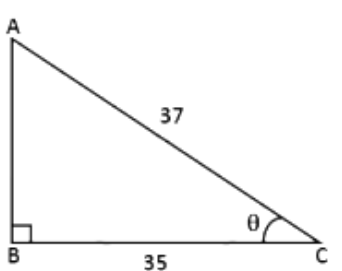
Consider $\triangle ABC$, where $\angle B = 90^\circ$
$\Rightarrow 35 \sec\theta = 37$
$\Rightarrow \sec \theta=\frac{37}{35}$
$\Rightarrow \sec \theta=\frac{\text { Hypotenuse }}{\text { Base }}=\frac{ AC }{ BC }=\frac{37}{35}$
By Pythagoras theorem,
$AB^2$
$= AC^2 - BC^2$
$= 37^2- 35^2$
$= (37 + 35)(37 - 35)$
$= 72 x 2$
$= 144$
$\Rightarrow AB = 12$
Now,
$\sin \theta=\frac{\text { Perpendicular }}{\text { Hypotenuse }}=\frac{A B}{A C}=\frac{12}{37}$
$\tan \theta=\frac{\text { Perpendicular }}{\text { Hypotenuse }}=\frac{A B}{B C}=\frac{12}{35}$
$\therefore \sin \theta-\sin \theta \tan \theta$
$=\frac{12}{37}-\frac{12}{37} \times \frac{12}{35}$
$=\frac{12}{37}\left(1-\frac{12}{35}\right)$
$=\frac{12}{37}\left(\frac{35-12}{35}\right)$
$=\frac{12}{37} \times \frac{23}{35}$
$=\frac{276}{1295} .$ View full question & answer→Question 135 Marks
If $4 \sin \theta=\sqrt{13}$ find the value of $4 \sin ^3 \theta-3 \sin \theta$
Answer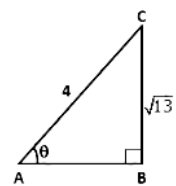
Consider $\triangle A B C$, where $\angle B=90^{\circ}$
$ \Rightarrow 4 \sin \theta=\sqrt{13}$
$\Rightarrow 4 \sin \theta=\frac{\sqrt{13}}{4}$
$\Rightarrow \sin \theta=\frac{\text { Perpendicular }}{\text { Hypotenuse }}=\frac{ BC }{ AC }=\frac{\sqrt{13}}{4} $
By Pythagoras theorem,
$ A C^2=A B^2+B C^2$
$\Rightarrow A B^2$
$=A C^2-B C^2$
$=4^2-(\sqrt{13})^2$
$=16-13$
$=3$
$\Rightarrow A B=\sqrt{3} $
Now,
$ \cos \theta=\frac{\text { Base }}{\text { Hypotenuse }}=\frac{ AB }{ AC }=\frac{\sqrt{3}}{4}$
$4 \sin ^3 \theta-3 \sin \theta$
$=4\left(\frac{\sqrt{13}}{4}\right)^3-3 \times \frac{\sqrt{13}}{4}$
$=\frac{13 \sqrt{13}}{16}-\frac{3 \sqrt{13}}{4}$
$=\frac{13 \sqrt{13}-12 \sqrt{13}}{16}$
$=\frac{\sqrt{13}}{16} . $ View full question & answer→Question 145 Marks
If $4 \sin \theta=\sqrt{13}$, find the value of $\frac{4 \sin \theta-3 \cos \theta}{2 \sin \theta+6 \cos \theta}$
Answer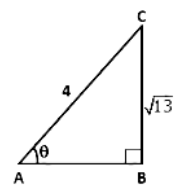
Consider $\triangle A B C$, where $\angle B=90^{\circ}$
$ \Rightarrow 4 \sin \theta=\sqrt{13}$
$\Rightarrow 4 \sin \theta=\frac{\sqrt{13}}{4}$
$\Rightarrow \sin \theta=\frac{\text { Perpendicular }}{\text { Hypotenuse }}=\frac{ BC }{ AC }=\frac{\sqrt{13}}{4}$
By Pythagoras theorem,
$ A C^2=A B^2+B C^2$
$\Rightarrow A B^2$
$=A C^2-B C^2$
$=4^2-(\sqrt{13})^2$
$=16-13$
$=3$
$\Rightarrow A B=\sqrt{3} $
Now,
$ \cos \theta=\frac{\text { Base }}{\text { Hypotenuse }}=\frac{ AB }{ AC }=\frac{\sqrt{3}}{4}$
$\frac{4 \sin \theta-3 \cos \theta}{2 \sin \theta+6 \cos \theta}$
$=\frac{4 \times \frac{\sqrt{3}}{4}-3 \times \frac{\sqrt{3}}{4}}{2 \times \frac{\sqrt{13}}{4}+6 \frac{\sqrt{3}}{4}}$
$=\frac{\frac{4 \sqrt{13}-3 \sqrt{13}}{4}}{\frac{2 \sqrt{13}+6 \sqrt{13}}{4}}$
$=\frac{4 \sqrt{13}-3 \sqrt{13}}{2 \sqrt{13}+6 \sqrt{13}}$
$=\frac{\sqrt{13}}{8 \sqrt{13}}$
$=\frac{1}{8} . $ View full question & answer→Question 155 Marks
In a right$-$angled $\triangle ABC, \angle B = 90^\circ , BD = 3, DC = 4$, and $AC = 13$. A point $D$ is inside the triangle such as $\angle BDC = 90^\circ .$
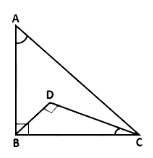
Find the values of $3 - 2 \cos \angle BAC + 3 \cot \angle BCD$ Answer$\triangle B D C$ is a right$-$angled triangle.
$ \therefore B C^2$
$=B D^2+D C^2$
$=3^2+4^2$
$=9+16$
$=25$
$\Rightarrow B C=5 \ cm $
$\triangle A B C$ is a right$-$angled triangle.
$ \therefore A B^2$
$=A C^2-B C^2$
$=13^2-5^2$
$=169-25$
$=144$
$\Rightarrow A B=12 \ cm$
$3-2 \cos \angle B A C+3 \cot \angle B C D$
$=3-2 \times \frac{A B}{A C}+3 \times \frac{D C}{B D}$
$=3-2 \times \frac{4}{13}+3 \times \frac{4}{3}$
$=3-\frac{24}{13}+4$
$=7-\frac{24}{13}$
$=\frac{91-24}{13}$
$=\frac{67}{13} . $
View full question & answer→Question 165 Marks
In a right$-$angled $\triangle ABC, \angle B = 90^\circ , BD = 3, DC = 4$, and $AC = 13$. A point $D$ is inside the triangle such as $\angle BDC = 90^\circ .$
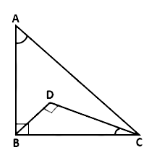
Find the values of $2 \tan \angle BAC - \sin \angle A$ Answer$\triangle B D C$ is a right$-$angled triangle.
$ \therefore B C^2$
$=B D^2+D C^2$
$=3^2+4^2$
$=9+16$
$=25$
$\Rightarrow B C=5 \ cm $
$\triangle A B C$ is a right$-$angled triangle.
$ \therefore A B^2$
$=A C^2-B C^2$
$=13^2-5^2$
$=169-25$
$=144$
$\Rightarrow A B=12 \ cm $
$2 \tan \angle B A C-\sin \angle B C D$
$=2 \times \frac{ BC }{ AB }-\frac{ BD }{ BC }$
$ =2 \times \frac{5}{12}-\frac{3}{5}$
$=\frac{5}{6}-\frac{3}{5}$
$=\frac{25-18}{30}$
$=\frac{7}{30} . $
View full question & answer→Question 175 Marks
In $\triangle ABC, \angle A = 90^\circ.$ If $AB = 5$ units and $AC = 12$ units, find$: \sin B$
Answer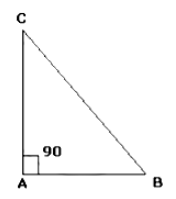
In $\triangle ABC$
$BC ^2= AB ^2+ AC ^2$
$\Rightarrow BC =\sqrt{ AB ^2+ AC ^2}$
$\Rightarrow BC =\sqrt{5^2+12^2}$
$=\sqrt{169}$
$=13$
$AC =12$ units
$BC =13$ units
$AB =5$ units
$\sin B$
$ =\frac{\text { Perpndicular }}{\text { Hypoenuse }}$
$=\frac{ AC }{ BC }$
$=\frac{12}{13}$
and
$\cos B$
$=\frac{\text { Base }}{\text { Hypotenuse }}$
$=\frac{ AB }{ BC }$
$=\frac{5}{13} . $ View full question & answer→Question 185 Marks
In the given figure, $A D$ is perpendicular to $B C$. Find$:\frac{3}{\sin x}+\frac{4}{\cos y}-4 \tan y$
Answer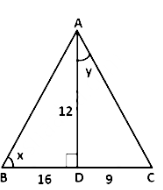
$\triangle A D B$ is a right$-$angled triangle.
$ \therefore A B^2$
$=A B^2+B D^2$
$=12^2+16^2$
$=144+256$
$=400$
$\Rightarrow A B=20\ cm$
$\triangle A D C$ is a right$-$angled triangle.
$\therefore A C^2$
$=A D^2+D C^2$
$=12^2+9^2$
$=144+81$
$=225$
$\Rightarrow AC =15 \ cm$
$\frac{3}{\sin x}+\frac{4}{\cos y}-4 \tan y$
$=\frac{3}{\frac{ AD }{ AB }}+\frac{4}{\frac{ AD }{ AC }}-4 \times \frac{ CD }{ AD }$
$=\frac{\frac{3}{12}}{\frac{ AB }{20}}+\frac{4}{\frac{12}{15}}-4 \times \frac{9}{12}$
$=\frac{60}{12}+\frac{60}{12}-3$
$=5+5-3$
$=7 \text {. }$ View full question & answer→Question 195 Marks
In the given figure, $AD$ is perpendicular to $BC.$ Find $: 5\cos x - 12\sin y +\tan x$
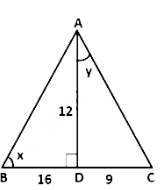
Answer
$\triangle A D B$ is a right$-$angled triangle.
$\therefore A B^2$
$=A B^2+B D^2$
$=12^2+16^2$
$=144+256$
$=400$
$\Rightarrow A B=20 \ cm $
$\triangle A D C$ is a right$-$angled triangle.
$\therefore AC ^2$
$=A D^2+D C^2$
$=12^2+9^2$
$=144+81$
$=225$
$\Rightarrow AC =15 \ cm$
$5 \cos x -12 \sin y +\tan x$
$=4-12 \times \frac{ CD }{ AC }+\frac{ AD }{ BD }$
$=4-12 \times \frac{9}{15}+\frac{12}{16}$
$=4-\frac{36}{5}+\frac{3}{4}$
$=\frac{80-144+15}{20}$
$=\frac{-49}{20}$. View full question & answer→Question 205 Marks
In the given figure, $AD$ is perpendicular to $BC.$ Find $:\ 15 \tan y$
Answer
$\triangle A D B$ is a right$-$angled triangle.
$ \therefore A B^2$
$=A B^2+B D^2$
$=12^2+16^2$
$=144+256$
$=400$
$\Rightarrow A B=20 \ cm$
$\triangle A D C$ is a right$-$angled triangle.
$ \therefore A C^2$
$=A D^2+D C^2$
$=12^2+9^2$
$=144+81$
$=225$
$\Rightarrow A C=15 \ cm $
$ 15 \tan y$
$=15 \times \frac{ CD }{ AD }$
$=15 \times \frac{9}{12}$
$=\frac{45}{4} . $ View full question & answer→Question 215 Marks
In the given figure $,AD$ is perpendicular to $BC.$ Find $: 5 \cos x$
Answer
$\triangle A D B$ is a right$-$angled triangle.
$ \therefore A B^2$
$=A B^2+B D^2$
$=12^2+16^2$
$=144+256$
$=400$
$\Rightarrow A B=20\ cm$
$\triangle A D C$ is a right$-$angled triangle.
$\therefore A C^2$
$=A D^2+D C^2$
$=12^2+9^2$
$=144+81$
$=225$
$\Rightarrow A C=15 \ cm$
$5 \cos x$
$=5 \times \frac{B D}{A B}$
$=5 \times \frac{16}{20}$
$=4 . $ View full question & answer→Question 225 Marks
In the given figure, $A C=13 \ cm , B C=12 \ cm$ and $\angle B=90^{\circ}$. Without using tables, find the values of: $\frac{\cos A-\sin A}{\cos A+\sin A}$
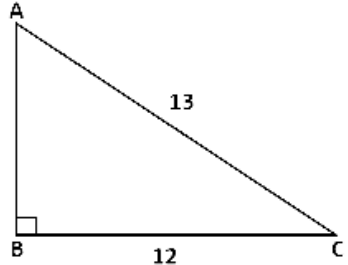
Answer$\triangle A B C$ is a right$-$angled triangle.
$ \therefore A C^2=A B^2+B C^2$
$\Rightarrow A B^2$
$=A C^2-B C^2$
$=13^2-12^2$
$=169-144$
$=25$
$\Rightarrow A B=5 \ cm$
$\sin A=\frac{B C}{A C}=\frac{12}{13}$
$\cos A=\frac{A B}{A C}=\frac{5}{13}$
$\frac{\cos A-\sin A}{\cos A+\sin A}$
$=\frac{\frac{5}{13}-\frac{12}{13}}{\frac{5}{13}+\frac{12}{13}}$
$=\frac{-\frac{7}{13}}{\frac{17}{13}}$
$=-\frac{7}{13} \times \frac{13}{17}$
$=-\frac{7}{17} .$
View full question & answer→Question 235 Marks
If $\operatorname{cosec} \theta=\frac{29}{20}$, find the value of$: \frac{\sec \theta}{\tan \theta-\operatorname{cosec} \theta}$
Answer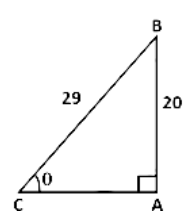
Consider $\triangle A B C$, where $\angle A=90^{\circ}$
$\Rightarrow \operatorname{cosec} \theta=\frac{\text { Hypotenuse }}{\text { Perpendicular }}=\frac{ BC }{ AB }=\frac{29}{20}$
By Pythagoras theorem,
$ B C^2=A B^2+A C^2$
$\Rightarrow A C^2=B C^2-A B^2$
$=29^2-20^2$
$=841-400$
$=441$
$\Rightarrow A C=21 $
Now,
$ \sec \theta=\frac{\text { Hypotenuse }}{\text { Base }}=\frac{ BC }{ AC }=\frac{29}{21}$
$\tan \theta=\frac{\text { Perpendicular }}{\text { Base }}=\frac{ AB }{ AC }=\frac{20}{21}$
$\Rightarrow \cot \theta=\frac{1}{\tan \theta}=\frac{21}{20}$
$\frac{\sec \theta}{\tan \theta-\operatorname{cosec} \theta}$
$=\frac{\frac{29}{21}}{\frac{20}{21}-\frac{29}{20}}$
$=\frac{\frac{29}{21}}{-\frac{209}{420}}$
$=\frac{29}{21} \times \frac{-420}{209}$
$=\frac{-580}{209} . $ View full question & answer→Question 245 Marks
If $\operatorname{cosec} \theta=\frac{29}{20}$, find the value of$: \operatorname{cosec} \theta-\frac{1}{\cot \theta}$
Answer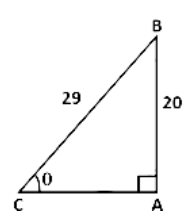
Consider $\triangle A B C$, where $\angle A=90^{\circ}$
$\Rightarrow \operatorname{cosec} \theta=\frac{\text { Hypotenuse }}{\text { Perpendicular }}=\frac{ BC }{ AB }=\frac{29}{20}$
By Pythagoras theorem,
$B C^2=A B^2+A C^2$
$\Rightarrow A C^2=B C^2-A B^2$
$=29^2-20^2$
$=841-400$
$=441$
$\Rightarrow A C=21 $
Now,
$ \sec \theta=\frac{\text { Hypotenuse }}{\text { Base }}=\frac{ BC }{ AC }=\frac{29}{21}$
$\tan \theta=\frac{\text { Perpendicular }}{\text { Base }}=\frac{ AB }{ AC }=\frac{20}{21}$
$\Rightarrow \cot \theta=\frac{1}{\tan \theta}=\frac{21}{20}$
$\operatorname{cosec} \theta-\frac{1}{\cot \theta}$
$=\frac{29}{20}-\frac{1}{\frac{21}{20}}$
$=\frac{29}{20}-\frac{20}{21}$
$=\frac{609-400}{420}$
$=\frac{209}{420} . $ View full question & answer→Question 255 Marks
If $\sin A=\frac{7}{25}$, find the value of $: \cot ^2 A-\operatorname{cosec}^2 A$
Answer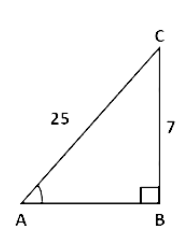
Consider $\triangle A B C$, where $\angle B=90^{\circ}$
$\Rightarrow \sin A =\frac{\text { Perpendicular }}{\text { Hypotenuse }}=\frac{ BC }{ AC }=\frac{7}{25}$
$\Rightarrow \operatorname{cosec} A =\frac{1}{\sin A }=\frac{25}{7} $
By Pythagoras theorem,
$ A C^2=A B^2+B C^2$
$\Rightarrow A B^2$
$=A C^2-B C^2$
$=25^2-7^2$
$=625-49$
$=576$
$\Rightarrow A B-24 $
Now,
$\cos A =\frac{\text { Base }}{\text { Hypotenuse }}=\frac{ AB }{ AC }=\frac{24}{25}$
$\tan A =\frac{\text { Perpendicular }}{\text { Base }}=\frac{ BC }{ AB }=\frac{7}{24}$
$\Rightarrow \cot A =\frac{1}{\tan A }=\frac{24}{7}$
$\cot ^2 A -\operatorname{cosec}^2 A$
$=\left(\frac{24}{7}\right)^2-\left(\frac{25}{7}\right)^2$
$=\frac{576}{49}-\frac{625}{49}$
$=\frac{-49}{49}$
$=-1 . $ View full question & answer→Question 265 Marks
If $\sin A=\frac{7}{25}$, find the value of $: \cos A+\frac{1}{\cot A}$
Answer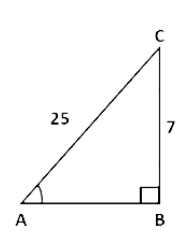
Consider $\triangle A B C$, where $\angle B=90^{\circ}$
$ \Rightarrow \sin A =\frac{\text { Perpendicular }}{\text { Hypotenuse }}=\frac{ BC }{ AC }=\frac{7}{25}$
$\Rightarrow \operatorname{cosec} A =\frac{1}{\sin A }=\frac{25}{7} $
By Pythagoras theorem,
$ A C^2=A B^2+B C^2$
$\Rightarrow A B^2$
$=A C^2-B C^2$
$=25^2-7^2$
$=625-49$
$=576$
$\Rightarrow A B-24 $
Now,
$ \cos A =\frac{\text { Base }}{\text { Hypotenuse }}=\frac{ AB }{ AC }=\frac{24}{25}$
$\tan A =\frac{\text { Perpendicular }}{\text { Base }}=\frac{ BC }{ AB }=\frac{7}{24}$
$\Rightarrow \cot A =\frac{1}{\tan A }=\frac{24}{7}$
$\cos A +\frac{1}{\cot A }=\cos A +\tan A$
$=\frac{24}{25}+\frac{7}{24}$
$=\frac{576+175}{600}$
$=\frac{751}{600} .$ View full question & answer→Question 275 Marks
If $\sin A=\frac{7}{25}$, find the value of $: \frac{2 \tan A}{\cot A-\sin A}$
Answer
Consider $\triangle A B C$, where $\angle B=90^{\circ}$
$\Rightarrow \sin A =\frac{\text { Perpendicular }}{\text { Hypotenuse }}=\frac{ BC }{ AC }=\frac{7}{25}$
$\Rightarrow \operatorname{cosec} A =\frac{1}{\sin A }=\frac{25}{7} $
By Pythagoras theorem,
$A C^2=A B^2+B C^2$
$\Rightarrow A B^2$
$=A C^2-B C^2$
$=25^2-7^2$
$=625-49$
$=576$
$\Rightarrow A B-24 $
Now,
$\cos A =\frac{\text { Base }}{\text { Hypotenuse }}=\frac{ AB }{ AC }=\frac{24}{25}$
$\tan A =\frac{\text { Perpendicular }}{\text { Base }}=\frac{ BC }{ AB }=\frac{7}{24}$
$\Rightarrow \cot A =\frac{1}{\tan A }=\frac{24}{7}$
$\frac{2 \tan A }{\cot A -\sin A }$
$=\frac{2 \times \frac{7}{24}}{\frac{24}{7}-\frac{7}{25}}$
$=\frac{\frac{7}{12}}{\frac{551}{175}}$
$=\frac{7}{12} \times \frac{175}{551}$
$=\frac{1225}{6612} . $ View full question & answer→Question 285 Marks
In a right$-$angled triangle $P Q R, \angle P Q R=90^{\circ}, Q S \perp P R$ and $\tan R=\frac{5}{12}$, find the value of $\tan \angle S Q R$
Answer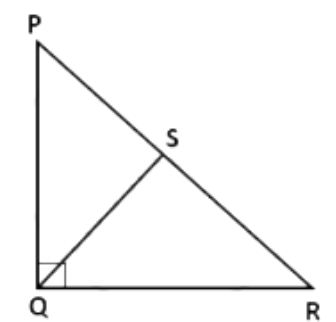
$ \tan R=\frac{5}{12}$
$\Rightarrow \frac{P Q}{Q R}=\frac{5}{12}$
$\Rightarrow P Q=5$ and $Q R=12 $
In right$-$angled $\triangle P Q R$,
$PR$
$=P^2+Q^2$
$=5^2+12^2$
$=25+144$
$=169$
$\Rightarrow P R=13$
$\angle S Q R+\angle R=90^{\circ}$ and $\angle R+\angle P=90^{\circ}$
$\Rightarrow \angle S Q R+\angle R=\angle R+\angle P$
$\Rightarrow \angle S Q R=\angle P$
$\therefore \tan \angle S Q R$
$=\tan P$
$=\frac{Q R}{P Q}$
$=\frac{12}{5} . $ View full question & answer→Question 295 Marks
In a right$-$angled triangle $P Q R, \angle P Q R=90^{\circ}, Q S \perp P R$ and $\tan R=\frac{5}{12}$, find the value of $\sin \angle P Q S$
Answer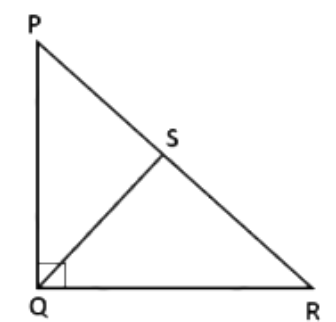
$\tan R=\frac{5}{12}$
$\Rightarrow \frac{P Q}{Q R}=\frac{5}{12}$
$\Rightarrow P Q=5$ and $Q R=12$
In right$-$angled $\triangle P Q R,$
$P R$
$=P Q^2+Q^2$
$=5^2+12^2$
$=25+144$
$=169$
$\Rightarrow P R=13$
$\angle P Q S+\angle P=90^{\circ}$ and $\angle P+\angle R=90^{\circ}$
$\Rightarrow \angle P Q S+\angle P=\angle P+\angle R$
$\Rightarrow \angle P Q S=\angle R$
$\therefore \sin \angle P Q S$
$=\frac{\sin R}{P Q}$
$=\frac{P}{P R}$
$=\frac{5}{13} .$ View full question & answer→Question 305 Marks
In the given figure, $A D$ is the median on $B C$ from $A$. If $A D=8 \ cm$ and $B C=12 \ cm$, find the value of $\frac{1}{\sin ^2 x}-\frac{1}{\tan ^2 x}$
Answer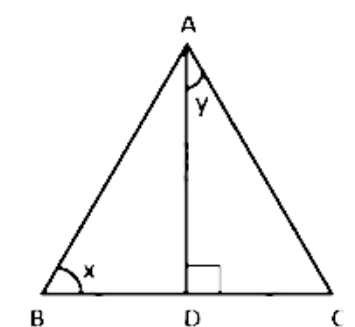
Since $AD$ is median on $BC$, we have
$B D=D C=\frac{1}{2} \times B C=\frac{1}{2} \times 12=6 \ cm$
$\triangle A D B$ is a right$-$angled triangle.
$ \therefore A B^2$
$=A D^2+B D^2$
$=8^2+6^2$
$=64+36$
$=100$
$\Rightarrow A B=10 \ cm $
$\triangle A D C$ is a right$-$angled triangle.
$ \therefore A C^2$
$=A D^2+D C^2$
$=8^2+6^2$
$=64+36$
$=100$
$\Rightarrow A C=10 \ cm$
$\frac{1}{\sin ^2 x}-\frac{1}{\tan ^2 x}$
$=\frac{1}{\left(\frac{4}{5}\right)^2}-\frac{1}{\left(\frac{4}{3}\right)^2}$
$=\frac{25}{16}-\frac{9}{16}$
$=\frac{16}{16}$
$=1 . $ View full question & answer→Question 315 Marks
In the given figure, $AD$ is the median on $BC$ from $A.$ If $AD = 8\ cm$ and $BC = 12\ cm,$ find the value of $\tan x. \cot y$
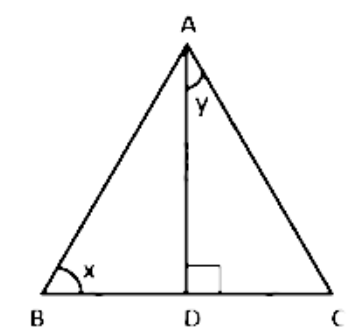
Answer
Since $A D$ is median on $B C$, we have
$B D=D C=\frac{1}{2} \times B C=\frac{1}{2} \times 12=6 \ cm$
$\triangle A D B$ is a right$-$angled triangle.
$ \therefore A B^2$
$=A D^2+B D^2$
$=8^2+6^2$
$=64+36$
$=100$
$\Rightarrow A B=10 \ cm$
$\triangle A D C$ is a right$-$angled triangle.
$ \therefore A C^2$
$= A D^2+D C^2$
$= 8^2+6^2$
$= 64+36$
$= 100$
$\Rightarrow A C=10 \ cm$
$B D $
$\cos x=\frac{ BD }{ AB }=\frac{6}{10}=\frac{3}{5}$ and $\sin y=\frac{ DC }{ AC }=\frac{6}{10}=\frac{3}{5}$
$\therefore \tan x=\frac{\sin x}{\cos x}=\frac{\frac{4}{5}}{\frac{3}{5}}=\frac{4}{3}$ and $\cot y=\frac{\cos y}{\sin y}=\frac{\frac{4}{5}}{\frac{3}{5}}=\frac{4}{3}$
$\therefore \tan x \cdot \cot y=\frac{4}{3} \times \frac{4}{3}=\frac{16}{9}$. View full question & answer→Question 325 Marks
In the given figure, $AD$ is the median on $BC$ from $A.$ If $AD = 8\ cm$ and $BC = 12\ cm,$ find the value of $\cos y$
Answer
Since $A D$ is median on $B C_r$ we have
$B D=D C=\frac{1}{2} \times B C=\frac{1}{2} \times 12=6 \ cm$
$\triangle A D B$ is a right$-$angled triangle.
$ \therefore A B^2$
$=A D^2+B D^2$
$=8^2+6^2$
$=64+36$
$=100$
$\Rightarrow A B=10 \ cm $
$\triangle A D C$ is a right$-$angled triangle.
$ \therefore A C^2$
$=A D^2+D C^2$
$=8^2+6^2$
$=64+36$
$=100$
$\Rightarrow A C=10 \ cm$
$\cos y$
$=\frac{A D}{A C}$
$=\frac{8}{10}$
$=\frac{4}{5} . $ View full question & answer→Question 335 Marks
In the given figure, $AD$ is the median on $BC$ from $A.$ If $AD = 8\ cm$ and $BC = 12\ cm,$ find the value of $\sin x$
Answer
Since $A D$ is median on $B C$, we have
$BD = DC =\frac{1}{2} \times BC =\frac{1}{2} \times 12=6 \ cm$
$\triangle A D B$ is a right$-$angled triangle.
$ \therefore A B^2$
$=A D^2+B D^2$
$=8^2+6^2$
$=64+36$
$=100$
$\Rightarrow A B=10 \ cm $
$\triangle A D C$ is a right$-$angled triangle.
$ \therefore A C^2$
$=A D^2+D C^2$
$=8^2+6^2$
$=64+36$
$=100$
$\Rightarrow A C=10 \ cm$
$\sin x$
$=\frac{A D}{A B}$
$=\frac{8}{10}$
$=\frac{4}{5} . $ View full question & answer→Question 345 Marks
In each of the following, one trigonometric ratio is given. Find the values of the other trigonometric. $\sec B=\frac{15}{12}$
Answer$\sec B=\frac{15}{12}$
$\sec B=\frac{1}{\cos B}=\frac{\text { Hypotenuse }}{\text { Base }}=\frac{15}{12}$
By Pythagoras theorem, we have
$($Hypotenuse$)^2=($Perpendicular$)^2+($Base$)^2$
$\Rightarrow$ Perpendicular$=\sqrt{(\text { Hypotenuse })^2-(\text { Base })^2}$
$\Rightarrow$ Perpendicular
$=\sqrt{(15)^2-(12)^2}$
$=\sqrt{225-144}$
$=\sqrt{81}$
$=9$
$\sin B=\frac{\text { Perpendicular }}{\text { Hypotenuse }}=\frac{9}{15}$
$\tan B=\frac{\text { Perpendicular }}{\text { Base }}=\frac{9}{12}$
$\cot B=\frac{1}{\tan B}=\frac{12}{9}$
$\operatorname{cosec} B=\frac{1}{\sin B}=\frac{15}{9}$
$\cos B=\frac{\text { Base }}{\text { Hypotenuse }}=\frac{12}{15} . $
View full question & answer→Question 355 Marks
In each of the following, one trigonometric ratio is given. Find the values of the other trigonometric.$\operatorname{cosec}=\frac{15}{11}$
Answer$\operatorname{cosec}=\frac{15}{11}$
$\operatorname{cosec}=\frac{1}{\sin C}=\frac{\text { Hypotenuse }}{\text { Perpendicular }}=\frac{15}{11}$
By Pythagoras theorem, we have
$($Hypotenuse$)^2=($Perpendicular$)^2+($Base$)^2$
$\Rightarrow$ Base$=\sqrt{(\text { Hypotenuse })^2-(\text { Perpendicular })^2}$
$\Rightarrow$ Base
$=\sqrt{(15)^2+(11)^2}$
$=\sqrt{225-121}$
$=\sqrt{104}$
$\sin C=\frac{\text { Perpendicular }}{\text { Hypotenuse }}=\frac{11}{15}$
$\cos C=\frac{\text { Base }}{\text { Hypotenuse }}=\frac{\sqrt{104}}{11}$
$\tan C=\frac{\text { Perpendicular }}{\text { Base }}=\frac{11}{\sqrt{104}}$
$\sec C =\frac{1}{\cos C }=\frac{15}{\sqrt{104}}$
$\cot C=\frac{1}{\tan A }=\frac{\sqrt{104}}{11} .$
View full question & answer→Question 365 Marks
In each of the following, one trigonometric ratio is given. Find the values of the other trigonometric.$\cos B=\frac{4}{5}$
Answer$\cos B =\frac{4}{5}$
$\cos B =\frac{\text { Base }}{\text { Hypotenuse }}=\frac{4}{5} $
By Pythagoras theorem, we have
$($Hypotenuse$)^2=($Perpendicular$)^2+($Base$)^2$
$\Rightarrow$ Perpendicular$=\sqrt{(\text { Hypotenuse })^2-(\text { Base })^2}$
$\Rightarrow$ Perpendicular
$=\sqrt{(5)^2-(4)^2}$
$=\sqrt{25-16}$
$=\sqrt{9}$
$=3$
$\sin B =\frac{\text { Perpendicular }}{\text { Hypotenuse }}=\frac{3}{4}$
$\tan B =\frac{\text { Perpendicular }}{\text { Base }}=\frac{3}{4}$
$\sec B =\frac{1}{\cos B }=\frac{5}{4}$
$\cot B =\frac{1}{\tan B }=\frac{1}{3}$
$\operatorname{cosec} B =\frac{1}{\sin B }=\frac{5}{3} . $
View full question & answer→