Questions

[3 Mark Question Answer]

🎯

Test yourself on this topic

10 questions · timed · auto-graded

Question 13 Marks
(a) What do you understand by the term electric resistance?
(b) Why does the filament of an electric bulb in an electric circuit get white hot, but not the connecting wires?
Answer
(a) Electric resistance: The obstruction offered to the passage of electric current by a material is called resistance of the material.
(b) Filament of an electric bulb is made up of tungsten having high resistance. Due to its high resistance, on passing electric current through it, a electrical energy changes into heat energy. So much heat is produced that filament of bulb becomes white hot and gives light.
Resistance of connecting wires is very low and hence the connecting wires do not get heated.
View full question & answer
Question 23 Marks
What do you understand by the following terms?
1. electric circuit
2. closed electric circuit
3. open electric circuit.
Answer
1. Electric circuit : The path along which electric current flows is known as electric circuit.
2. Closed electric circuit : When the path of an electric circuit starting from one terminal of the cell, ends at the other terminal of cell, without any break, then such a circuit is called closed circuit.
3. Open electric circuit: When the path of an electric circuit, starting from one terminal of the cell, is broken at some point, then such a circuit is called open electric circuit.
View full question & answer
Question 33 Marks
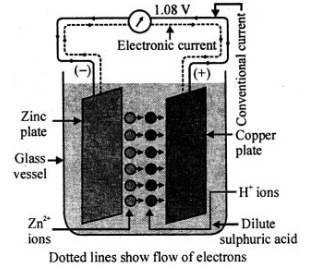
Draw a neat and labelled diagram of simple voltaic cell showing clearly the direction of flow ofconventional current and direction of flow of electrons.
Answer
Simple voltaic cell was invented by Alessandro Volta in year 1800 . It was the first device which could creat a constant potential difference between two plates with the help of chemical energy.
Image
View full question & answer
Question 43 Marks
A charge of 25 C is moved from infinity to points A and B in an electric field when the work done to do so is 10 J and 10.5 J respectively. Calculate the potential difference between the points A and B .
Answer
$
W_{A}=10 J
$
Charge $Q =25 C$
Potential at point $A = V _1=\frac{ W _{ A }}{ Q }$
$
V_1=\frac{10}{25}=0.4 V
$
$
\text { Also, } W_{B}=10.5 J
$
Potential at point $B=V_2=\frac{W_B}{Q}$
$
V_2=\frac{10.5}{25}=0.42 volt
$
Potential difference between A and $B = V$
$
\begin{array}{l}
V=V_2-V_1 \\
V=0.42-0.40 \\
V=0.02 \text { volt }
\end{array}
$
View full question & answer
Question 53 Marks
Answer
$\begin{array}{l}\text { Number of electrons }=n=4 \times 10^{20} \\ \text { Time }=t=10 \text { hours } \\ t=10 \times 60 \times 60 s \\ t=36000 s \\ \text { Charge on one electron }=e=1.6 \times 10^{-19} C \\ \text { Electric current }= I =? \\ \text { Charge }= Q = ne \\ \begin{array}{l} Q =4 \times 10^{20} \times 1.6 \times 10^{-19} \\ Q =6.4 \times 10^1 \\ Q =64 C \end{array} \\ \text { Electric current }= I =\frac{ Q }{t} \\ I =\frac{64}{36000}=\frac{64}{36} \times 10^{-3} A \\ =\frac{16}{9} \times 10^{-3} \\ I =1.77 \times 10^{-3} A \\ I =1.77 mA\end{array}$
View full question & answer
Question 63 Marks
(a) Define the term potential difference.
(b) How is potential difference related to work done and quantity of charge?
Answer
(a) Potential difference : The amount of work done in moving a unit positive charge from one point to another point in an electric field is called potential difference.
(b) If $Q =$ Charge moving from one point to another in an electric field.
$W =$ Work done to move the charge Q from one point to another.
$V =$ Potential difference between two points.
Then work done in moving Q units of charge $= W$
Work done in moving one unit of charge = W/Q
But work done in moving one unit of charge $=$ Potential difference $= V$
$
\Rightarrow V=W / Q
$
View full question & answer
Question 73 Marks
(a) What do you understand by the term electric current?
(b) State and define the SI unit of electric current.
(c) State the relation between electric current; number of electrons moving in a circuit and time in seconds.
Answer
(a) Electric current: The rate of flow of electric charge in an electric circuit is called electric current.
(b) Ampere (A) is the SI unit of electric current.
One ampere: When one coulomb charge flows through an electric circuit in one second, then the electric current flowing the circuit is said to be ampere.
(c) If Q is the charge (in coulombs) flowing through conductor in time $t$ (in seconds)
such that current I flows through the conductor then
Rate of flow of charge $=Q / t$
We know rate of flow of charge $=1=$ Electric current.
$
\Rightarrow I=Q / t
$
View full question & answer
Question 83 Marks
(a) What do you understand by the term quantity of electric charge?
(b) State SI unit of electric charge and define it.
(c) How many electrons constitute one unit electric charge in SI system?
Answer
(a) Quantity of electric charge : The number of charge (electrons) which drift from lower to higher potential is called quantity of charge.
(b) SI unit of electric charge is coulomb (C).
One coulomb : The quantity of electric charge which will deposit 0.00118 g of silver on the cathode, when passed through silver nitrate is called one coulomb.
(c) $6.25 \times 10^{18}$ electrons constitute one unit (IC) electric charge in SI system.
View full question & answer
Question 93 Marks
(a) What do you understand by the term electric potential?
(b) Define electric potential in terms of energy spent.
(c) State the unit of electric potential and define it.
Answer
(a) Electric potential : The amount of work done in moving a unit positive charge from infinity to a given point in an electric field is called electric potential.
(b) Electric potential : The amount of energy spent in moving a unit positive charge
from infinity to a given point in an electric field is called electric potential.
(c) Volt is the SI unit of electric potential.
One volt: When one coulomb of charge is brought from infinity to a given point in an electric field, such that work done is one joule, then electric potential is said to be one volt.
OR
Electric potential is said to be one volt if one Joule of work is done in moving one coulomb of charge from infinity to a given point in an electric field.
View full question & answer
Question 103 Marks
There is a positively charged sphere A and negatively charged sphere B, such that they are brought in electrical contact by a copper wire. Answer the following questions :
(a) Which sphere is at higher potential before electrical contact on the basis of convention?
(b) Which sphere is at lower potential before electrical contact on the basis of convention?
(c) In which direction conventional current flows?
(d) In which direction electronic current flows?
(e) What is potential of the spheres after electrical contact?
Answer
Sphere $A$ is positively charged and sphere $B$ is negatively charged.
Both the sphere A and B are brought in electrical contact by a copper wire.
(a) On the basis of convention, positively charged sphere A is at higher potential before electrical contact.
(b) On the basis of convention, negatively charged sphere B is lower potential before electrical contact.
(c) Conventional current flows from sphere A to sphere B i. e. from a body at higher potential to the body at lower potential.
(d) Electronic current flower from sphere B to sphere A i.e. from a body at lower potential to the body at higher potential.
(e) After electrical contact, both the spheres will be at same potential.
View full question & answer
[3 Mark Question Answer] - PHYSICS STD 9 Questions - Vidyadip