Questions

[5 Mark Question Answer]

🎯

Test yourself on this topic

6 questions · timed · auto-graded

Question 14 Marks
(a) What do you understand by the term parallel circuit?
(b) State two characteristics of resistance in the parallel circuit.
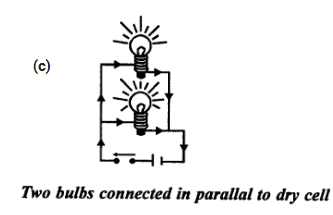
(c) Draw a diagram showing two bulbs connected in parallel to a dry cell.
Answer
(a) Parallel circuit : When a number of resistances (bulbs) are connected in an electrical circuit in such a way that all of them are connected to common positive and common negative terminal of a cell, then the resistance (bulbs) are said to be connected in parallel.
OR
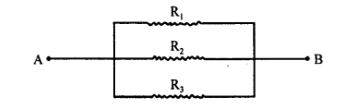
A number of resistors are said to be connected in parallel if one end of each resistor is connected to one point and other end of each resistor is connected to another point so that the potential difference across each resistor is same.
Image
Here the three resistors $R _1, R _2$ and $R _3$ are in parallel.
(b) Characteristics of resistances in Parallel:
1. The sum total of resistances in parallel decreases with the increase in number of resistors.
2. The current flowing in any resistor in parallel will be inversely proportional to resistance i.e., more the resistance, less the current.
3. Each resistor in parallel functions independently with respect to the other resistors in parallel.
Image
View full question & answer
Question 24 Marks
(a) What do you understand by the term series circuit?
(b) State two characteristics of resistances in the series circuit.
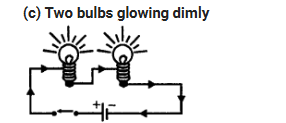
(c) Draw a diagram showing two bulbs connected in series to a dry cell.
Answer
(a) Series circuit : When a number of resistances are connected in an electrical circuit in such a way that positive of one resistance acts as the negative of the other resistance, then resistances are said to be in series.
OR
A number of resistors are said to be in series if these are joined end to end and same current flows through each one of them when a potential difference is applied across the combination.
Image
(b) Characteristics of resistances in series:
1. The sum total of resistances in series increases with increase in number of resistors.
2. The potential difference remaining constant, the current in series circuit decreases with the increase in number of resistors in series.
3. All the elements in series circuit work simultaneously. If the circuit is broken anywhere between the elements, none of the elements work.
Image
View full question & answer
Question 34 Marks
Briefly describe the theory of simple voltaic cell.
Answer
Theory of simple voltaic cell: Amongst the zinc and copper plates, zinc is more electropositive (ionisation potential -0.76 V ) as compared to copper (ionisation potential +0.34 V ) in electrochemical series. The dilute sulphuric acid is used as an electrolyte in the ionised state.
$
H_2 SO_4 \rightleftarrows 2 H^{+}+SO_4^{2-}
$
When zinc plate comes in contact with $\left( H ^{+}\right)$hydrogen ions, it being more electropositive, ionises to form zinc ions and free electrons.
$
Zn \longrightarrow Zn^{2+}+2 e^{-}
$
The free electrons so formed, take the passage of least resistance, and hence, move out in the external circuit through the copper wires. The zinc ions, however, enter in the dilute sulphuric acid. Since $Zn _{2+}$ ions are positively charged, they repel $H +$ ions in the acid solution, with the result that $H ^{+}$ions start crowding at the copper plate.
The copper plate in turn loses its free electrons to $H +$ ions, which. form nascent hydrogen.
$
2 H^{+}+2 e^{-} \longrightarrow 2 H
$
The nascent hydrogen atoms so formed unite to form molecular hydrogen.
$
2 H \longrightarrow H_2
$
From the above explanation, it is clear that free electrons actually drift from zinc to copper in external circuit, and hence, current should flow from zinc to copper.
However, we still continue saying the electric charge flows from copper to zinc and this current is called conventional current, whereas the actual flow of electrons is from zinc to copper which constitutes electronic current.
The emf between the zinc copper plate in the external circuit is $0.34 V-(-0.75 V)=1.10$ V.
View full question & answer
Question 44 Marks
A work of 25 J and 30 J is done when 5 C charge is moved first to point A and then to point B from infinity. Calculate the potential difference between points A and B .
Answer
$
W_{A}=25 J ; W_{B}=30 J
$
Work done to move the 5 C charge from A to $B = W _{ B }- W _{ A }$
$
W=30-25=5 J
$
Charge $Q =5 C$
Potential difference between A and B
$
\begin{array}{l}
V=\frac{W}{Q}=\frac{5}{5}=1 V \\
V=1 \text { volt }
\end{array}
$
OR
$
\begin{array}{l}
W_{A}=25 J \\
W_{B}=30 J, \text { charge }=Q=5 C
\end{array}
$
Potential at point $A=V_1=\frac{W_A}{Q}$
$
V_1=\frac{25}{5}=5 volt
$
Potential at piont $B = V _2=\frac{ W _{ B }}{ Q }$
$
V_2=\frac{30}{5}=6 volt
$
Potential difference $A$ and $B=V=V_2-V_1$
$
V=6-5=1 volt
$
View full question & answer
Question 54 Marks
Calculate the total number of electrons flowing through a circuit in 20 mins and 40 S , if a current of $40 \mu A$ flows through the circuit.
$[1 e-=1.6 \times 10^{-19} C]$
Answer
$
\begin{array}{l}
\text { Number of electrons }=n=? \\
\text { Time }=t=20 min 40 s \\
t=(20 \times 60+40) s \\
t=1240 s \\
\text { Electric current }=I=40 \mu A \\
I=40 \times 10^{-6} A \\
\text { Change on one electron }=1 e=1.6 \times 10^{-19} C \\
\text { Charge }=Q=? \\
I=\frac{Q}{t} \\
Q=I t \\
Q=40 \times 10^{-6} \times 1240 \\
Q=49600 \times 10^{-6} C \\
Q=4.96 \times 10^{-2} C \\
\text { Now } Q=n(charge \text { on } 1 \text { electron })=n e \\
4.96 \times 10^{-2}=n \times 1.6 \times 10^{-19} \\
n=\frac{4.96 \times 10^{-2}}{1.6 \times 10^{-19}} \\
n=3.1 \times 10^{17} \text { electrons }
\end{array}
$
View full question & answer
Question 64 Marks
How electric current flows in (i) solids, (ii) liquids?
Answer
(i) Flow of electric current in solids : In solids, the positive charges are associated with atomic nuclei. As the nuclei are firmly packed and closely held by inter-atomic forces, therefore, positive charges cannot drift.
On the other hand, negative charges (electrons) are not held firmly. Thus, when a potential difference, however small, is applied they start drifting from lower to higher potential.
The continuous drift of electrons, through the body of a solid conductor constitutes the current.
(ii) Flow of electric current in liquids: Within a liquid no electrons move. However, when a negatively charged and a positively charged electrodes are placed in a liquid, it sets up an electric field.
Under the influence of the electric field, the positively charged ions migrate towards the negatively charged electrode and vice versa.
At the cathode the positively charged ions gain electrons. At the anode the negatively charged ions lose same number of electrons.
Thus, in a way number of electrons given by the cathode is equal to the number of electrons accepted by the anode. The sum up, we can say that simultaneous movement and discharge of positive and negative ions in the opposite directions constitutes the current in the liquids.
View full question & answer
[5 Mark Question Answer] - PHYSICS STD 9 Questions - Vidyadip