Questions · Page 1 of 3

[1 Mark Question Answer]

🎯

Test yourself on this topic

50 questions · timed · auto-graded

Question 11 Mark
What type of charge is produced on an ebonite rod when it is rubbed with a cat's fur?
Answer
When the ebonite rod is rubbed with the cat's fur, the ebonite rod acquires the negative charge.
View full question & answer
Question 21 Mark
What will happen when a glass rod is rubbed with some silk cloth?
Answer
When a glass rod is rubbed with silk, the glass rod acquires a positive charge.
View full question & answer
Question 31 Mark
Name the scientist who first assigned algebraic signs to charges.
Answer
Benjamin Franklin was the scientist who first assigned the algebraic signs to charges.
View full question & answer
Question 41 Mark
What does a negatively charged body signify?
Answer
A negatively charged body signifies that it contains a number of electrons more than the number of protons.
View full question & answer
Question 51 Mark
What does a positively charged body signify?
Answer
A positively charged body signifies that its nucleus contains more protons than electrons.
View full question & answer
Question 61 Mark
How many kinds of charges have you come across?
Answer
There are two kinds of charges - positive and negative charges.
View full question & answer
Question 71 Mark
What is meant by the earthing of an electroscope?
Answer
Earthing of an electroscope is meant to take the thick copper strip inside the earth so that charges induced from thunderstorms on the metal spikes can move to earth to safeguard buildings from thunderstorms.
View full question & answer
Question 81 Mark
Name the scientist who first observed the electrical properties of amber.
Answer
Thales of Miletus was the scientist who observed the electric properties of amber.
View full question & answer
Question 91 Mark
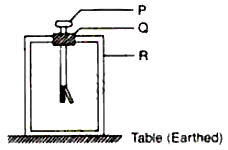
The following Figure represents a negatively charged gold Ieaf electroscope. Label the parts, P, Q, and R and the estate whether each is an insulator or a conductor. Also, indicate the distribution of charges on the system in the diagram.
Answer
P is a Cap, Q is plug and R is the bottle in the negatively charged gold leaf electroscope. P is a conductor and Q, R is an insulator.
View full question & answer
Question 101 Mark
What is the purpose of an electroscope?
Answer
The purpose of an electroscope is to detect the presence of charge on the body and nature of the charge (whether its positively charged or negatively charged) on the body.
View full question & answer
Question 111 Mark
The charge on a body is -1.8e. Is this statement true?
Answer
The charge is quantized and Q = ne where n should be the only integer. Since Q = -1.8 e where n is not an integer. So, this charge is not possible.
View full question & answer
Question 121 Mark
Sometimes when you take off your nylon clothes, your hair stands on their end. Explain the observation.
Answer
When the nylon cloth gets rubbed with hairs then it acquires the negative charge because few free electrons get transferred from hairs to nylon and they get attracted towards nylon cloth so the hair stands on their end.
View full question & answer
Question 151 Mark
What are free electrons?
Answer
The electrons of the outermost orbit of an atom are the free electrons and they easily leave their respective atoms and become free to move inside the solid.
View full question & answer
Question 161 Mark
What is the other name of frictional electricity?
Answer
Frictional electricity is also known as static electricity.
View full question & answer
Question 181 Mark
What is the value of charge on an electron? Is a charge less than the value possible?
Answer
The value of charge on an electron = $-1.6 x 10^{-19}C$. No, the charge less than the charge of an electron is not possible.
View full question & answer
Question 201 Mark
A glass rod rubbed with silk cloth acquires a charge of $+1.6 X 10^{-12}C.$ What is the charge on the silk cloth?
Answer
The silk cloth will acquire the charge opposite to the charge of the glass rod. So the charge acquired by silk cloth will be $= -1.6 x 10 ^{-19}C.$
View full question & answer
Question 211 Mark
Can ever photons have a charge? If not, why?
Answer
Photons can never have a charge because charges never exist without rest mass.
View full question & answer
Question 221 Mark
Does the motion of a body affect its charge?
Answer
No, the motion of the object does not affect the charge on the body.
View full question & answer
Question 231 Mark
How do the charges interact?
Answer
Unlike charges attract each other and like charges repel each other.
View full question & answer
Question 241 Mark
Consider three charged bodies A, B, and C. If A and B repel each other and A attracts C, what is the nature of force between B and C?
Answer
There will be an attractive force between the B and C because both carry opposite charges.
View full question & answer
Question 251 Mark
Is the mass of the body affected by charging?
Answer
Yes, the mass of the body gets affected by charging.
View full question & answer
Question 271 Mark
Who first showed two kinds of charges and who gave them algebraic signs?
Answer
Sir Williams Gilbert was the scientist who showed two charges and Benjamin Franklin was the scientist who gave name to charges.
View full question & answer
Question 281 Mark
What is the cause of charging?
Answer
The cause of charging is the frictional forces between the two bodies when they are rubbed against each other.
View full question & answer
Question 291 Mark
What is the origin of frictional forces?
Answer
The origin of frictional forces is electrical in nature.
View full question & answer
Question 301 Mark
What is the value of charge on a body which carries 100 excess electrons?
Answer
$Q = n e$
The charge on an electron $= -1.6 x 10^{-19}$
$= 100 x 1.6 x 10^{-19} = 1.6 x 10^{-17}$​​​​​​​
View full question & answer
Question 311 Mark
Which is bigger: 1 C or magnitude of the charge on an electron?
Answer
1 C is bigger than the charge on an electron.
View full question & answer
Question 321 Mark
How many electrons are present in one coulomb?
Answer
$Q = ne$
$N = Q/e = 1C / 1.6 x 10^{-19} = 6.25 x 10^{18}$
View full question & answer
Question 331 Mark
Name a physical quantity, other than an electric charge, which is quantized.
Answer
Energy other than electric charge is quantized.
View full question & answer
Question 341 Mark
What is the quantization of charge?
Answer
The quantization of charge is the property by virtue of which every charge exists only in discrete lumps or packets of some minimum charge.
View full question & answer
Question 351 Mark
What do you mean by induced magnetism?
Answer
The magnetism acquired by the magnetic material when it is kept near the magnet is called induced magnetism.
View full question & answer
Question 371 Mark
Define the term Effective length of a magnet
Answer
Effective Length of the magnet: The distance between the poles of the magnet is the effective length of a magnet.
View full question & answer
Question 381 Mark
Define the term Poles of a magnet
Answer
Poles of the Magnet: The points of the magnet where the attraction appears to be maximum are called poles of the magnet.
View full question & answer
Question 391 Mark
Define the term Magnetic axis
Answer
Magnetic axis: The imaginary line joining the poles of the magnet is called the magnetic axis.
View full question & answer
Question 401 Mark
How will you test whether a given rod is made of iron or copper?
Answer
Bring the rod near the magnet, iron rod will get attracted towards the magnet while copper will not.
View full question & answer
Question 411 Mark
What do you understand by poles of a magnet?
Answer
The magnetic forces appear to be concentrated at the near ends of the magnet. These points are called the magnetic poles.
View full question & answer
Question 421 Mark
What is the resultant magnetic field at a neutral point?
Answer
The resultant magnetic field at a neutral point is zero.
View full question & answer
Question 431 Mark
What is the significance of a neutral point?
Answer
Neutral points help in finding the magnitude and direction of the earth's magnetic field at that particular point.
View full question & answer
Question 441 Mark
What do you mean by the term neutral point?
Answer
Neutral points are the points where the magnetic field of magnet has the magnitude equal to the magnitude of the earth's magnetic field but in the opposite direction.
View full question & answer
Question 451 Mark
How will you plot the magnetic field lines by using a small compass needle?
Answer
The directions indicated by the needle of the compass will help to draw the magnetic lines of force.
View full question & answer
Question 461 Mark
Magnetic field lines intersect each other, if yes, why?
Answer
No, the Magnetic field of lines cannot intersect each other.
View full question & answer
Question 471 Mark
What is the use of a magnetic compass?
Answer
The magnetic compass is used to draw the magnetic field of lines around the magnet.
View full question & answer
Question 481 Mark
What is a lodestone?
Answer
The natural magnet which was used for the navigation by the mariners is called a lodestone.
View full question & answer
Question 491 Mark
What do you mean by the term lines of the magnetic field?
Answer
The lines of the magnetic field are the continuous curve such that the tangent drawn at any point gives the direction of the magnetic field at that point.
View full question & answer
Question 501 Mark
What is the purpose of an electroscope?
Answer
An electroscope is used to determine the nature of the charge and to detect the presence of charge on the body.
View full question & answer
[1 Mark Question Answer] - PHYSICS STD 9 Questions - Vidyadip