Questions

[3 Mark Question Answer]

🎯

Test yourself on this topic

21 questions · timed · auto-graded

Question 13 Marks
What is solar energy? How is the solar energy used to generate electricity in a solar power Plant?
Answer
The energy obtained from Sun is called solar energy.
A solar power plant is a device in which heat energy of sun is used to generate electricity. It consists of a large number of concave reflectors, at the focus of which there are black painted water pipes. The reflectors concentrate the heat energy of the sun rays on the pipes due to which water inside the pipes starts boiling and produces steam. The steam thus produced is used to rotate a steam turbine which drives a generator producing electricity.
View full question & answer
Question 33 Marks
What is geothermal energy? Explain in brief.
Answer
Geothermal energy: The heat energy possessed by the rocks inside the Earth is called geothermal energy. The hot rocks present at the hot spots deep inside the Earth, heat the underground water and turn it into steam. This steam is compressed at high pressure between the rocks. Holes are drilled deep into the Earth up to the hot spots to extract the steam through pipes, which is utilized to rotate the turbines connected to the armature of an electric generator to produce electricity.
View full question & answer
Question 43 Marks
What is ocean energy? Explain in brief.
Answer
Ocean energy: Water in the oceans possesses energy in two forms:
  1. Ocean thermal energy- The energy available due to the difference in temperature of water at the surface and at deeper levels of the ocean is called the ocean thermal energy. This energy is harnessed for producing electricity by a device called ocean thermal energy conversion power plant (OCTEC power plant).
  2. Oceanic waves energy- The kinetic energy possessed by fast-moving oceanic (or sea) waves is called oceanic waves energy. Though models have been made to generate electricity from oceanic waves, but so far it has not been put to practical use.
View full question & answer
Question 53 Marks
Name five renewable and three non-renewable sources of energy.
Answer
Renewable:
  1. Sun
  2. Wind
  3. Flowing water
  4. Tides
  5. Nuclear fuel

Non-renewable:

  1. Coal
  2. Petroleum
  3. Natural gas
View full question & answer
Question 63 Marks
What is meant by the renewable and non-­renewable sources of energy? State two differences between them, giving two examples of each
Answer
Renewable: The natural sources providing us energy continuously are called renewable sources of energy.
Non-renewable: The sources of energy that have accumulated in nature over a very long period of time and cannot be quickly replaced when exhausted are called non-renewable sources of energy.

Difference:
Renewable sources Non-renewable sources
They can be utilised continuously.They cannot be utilised once exhausted.
Examples: Sun, WindExample: Coal, Petroleum
View full question & answer
Question 73 Marks
State two advantages and two disadvantages of using nuclear energy for producing electricity.
Answer
Advantages of using nuclear energy:
  1. A very small amount of nuclear fuel can produce a tremendous amount of energy.
  2. Once the nuclear fuel is loaded into nuclear power plant, it continues to release energy for several years.

Disadvantages of using nuclear energy:

  1. It is not a clean source of energy because very harmful nuclear radiations are produced in the process.
  2. The waste causes environmental pollution.
View full question & answer
Question 83 Marks
State two advantages and two disadvantages of producing hydro electricity.
Answer
Advantages of producing the hydro electricity:
  1. It does not produce any environmental pollution.
  2. It is a renewable source of energy.

Disadvantages of producing hydroelectricity:

  1. Due to the construction of dams over the rivers, plants and animals of that place get destroyed or killed.
  2. The ecological balance in the downstream areas of rivers gets disturbed.
View full question & answer
Question 93 Marks
What is hydro energy? Explain the principle of generating electricity from hydro energy. How much hydro electric power is generated in India?
Answer
The kinetic energy possessed by flowing water is called the water or hydro energy.
Principle of a hydroelectric power plant is that the water flowing in high altitude rivers is collected in a high dam (or reservoir). The water from the dam is then allowed to fall on a water turbine which is located near the bottom of the dam. The shaft of the turbine is connected to the armature of an electric generator or dynamo.
At present only 23% of the total electricity is generated by the hydro energy.
View full question & answer
Question 103 Marks
State the law which governs the energy flow in an ecosystem.
Answer
The laws of thermodynamics govern the energy flow in the ecosystem.
According to the first law of thermodynamic, the energy can be transformed from one form to the other form, but it can neither be created nor destroyed.
According to the second law of thermodynamics, when energy is put to work, a part of it is always converted in un-useful form such as heat mainly due to friction and radiation.
View full question & answer
Question 123 Marks
What is a food chain?
Answer
A food chain shows the feeding relationship between different living things in a particular environment or habitat. Often, a plant will begin a food chain because it can make its own food using energy from the Sun. In addition, a food chain represents a series of events in which food and energy are transferred from one organism in an ecosystem to another. Food chains show how energy is passed from the sun to producers, from producers to consumers, and from consumers to decomposers.
View full question & answer
Question 133 Marks
State the functions of decomposers in an ecosystem.
Answer
The role of a decomposer is to break down dead organisms and then feed on them. The nutrients created by the dead organisms are returned to the soil to be later used by the producers. Once these deceased organisms are returned to the soil, they are used as food by bacteria and fungi by transforming the complex organic materials into simpler nutrients. The simpler products can then be used by producers to restart the cycle. These decomposers play an important role in every ecosystem.
View full question & answer
Question 143 Marks
What is an ecosystem ? Name its two components .
Answer
An ecosystem is defined as a self contained unit of living things and non living things. An ecosystem required Sunlight to maintain its working. The two main components of an ecosystem are following :
1. Abiotic component: It includes all the non-living components such as soll, water, air temperature, rocks, etc.

2. Biotic component: It includes all living components. All flora and fauna comes under biotic components.
View full question & answer
Question 153 Marks
Draw a diagram to show that the energy flow in an ecosystem is governed by the law of conservation of energy.
View full question & answer
Question 173 Marks
Show that the energy flow in an ecosystem is linear.
Answer
The energy flow in ecosystem is linear i.e., it moves in a fixed direction. The solar energy is absorbed by plants and a part of it is converted into food. These plants (or primary producers) are then eaten by the primary consumers, which are consumed by secondary consumers and the secondary by tertiary consumers. This cycle is unidirectional. The dead and decomposed are fed by decomposers, which return the nutrients to the soil. At the end, the energy reaches the degraded state. It does not return to the sun to make the process cyclic, thus energy flow is linear.
View full question & answer
Question 193 Marks
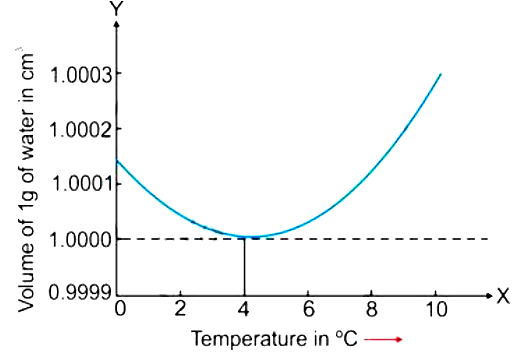
A given mass of water is cooled from 10°C to 0°C. State the volume changes you will observe. Represent these changes on a temperature-volume graph.
View full question & answer
Question 203 Marks
Draw a graph to show the variation in density of water with temperature in the range from 0°Cto 10°C.
View full question & answer
Question 213 Marks
State the volume changes that you will observe when a given mass of water is heated from 0°Cto 10°C. Sketch a temperature-volume graph to show the behaviour.
Answer
When a given mass of water is heated from 0°C to 4°C, it contracts, i.e. its volume decreases.
On heating from 4°C to 10°C, it expands, i.e. its volume increases.
View full question & answer