Questions

[5 Mark Question Answer]

🎯

Test yourself on this topic

9 questions · timed · auto-graded

Question 14 Marks
Describe, briefly how can you calculate the value of ' $g$ ' with a simple pendulum.
Answer
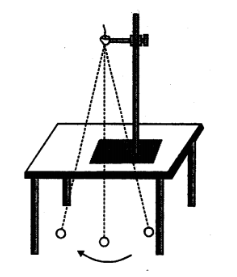
Simple pendulum : A simple pendulum consists of a small heavy mass in the form a bob suspended by a light inelastic string.
The pendulum is suspended from a suitable support (the thread may be held firmly between two halves of a cork held by a clamp and stand). The pendulum is allowed to oscillate and its time period for one oscillation is noted with the help of a stopwatch by observing a large number of oscillations. The length of the pendulum is changed several times and the time period is determined in each case. A graph is plotted between I, the length of the pendulum, and $T _2$, the square of time period.
Image
We know, time period of a simple pendulum $= T =2 \pi \sqrt{\frac{l}{g}}$
where $l=$ length of the pendulum and $g=$ acceleration due to gravity.
$
T=2 \pi \sqrt{\frac{l}{g}}
$
Squaring both sides,
$
T^2=4 \pi^2\left(\frac{l}{g}\right) \Rightarrow g=4 \pi^2\left(\frac{l}{T^2}\right)
$
By substituting the value of $\frac{l}{T^2}$ in this equation, we can calculate the value of acceleration due to gravity.
View full question & answer
Question 24 Marks
How is acceleration due to gravity related to
(1) mass of a planet
(2) distance of body from the center of earth?
Answer
Acceleration due to gravity: The acceleration of a freely falling body, under the action of gravity of earth, is called acceleration due to gravity.
Consider a body of mass 'm' on the surface of earth such that it falls towards it with an acceleration ' $g$ '.
Let, $M =$ mass of the earth
$d =$ distance between center of earth and center of the body
$F=$ Force acting on the body
$
\begin{array}{l}
F=mg\quad \quad \ldots \ldots(i) \\
F=G \frac{M m}{d^2}\quad \quad \ldots \ldots(ii)
\end{array}
$
Comparing (i) and (ii)
$
m g=G \frac{M m}{d^2}
$
$
g=\frac{G m}{d^2}
$
From this equation, it is clear that
(1) $g \propto M$ Acceleration due to gravity on the earth is directly proportional to the mass of that earth.
(2)
$
g \propto \frac{1}{d^2}
$
Acceleration due to gravity is inversely proportional to square of the distance of the body from centre of the earth.
View full question & answer
Question 34 Marks
Explain the following:
1. Why do we jerk wet clothes before spreading them on a line?
2. Why does dust fly off, when carpet is hit with a stick?
3. Why do fruits fall off the branches in the strong wind?
4. Why does a pillion rider fall forward, when the driver of a two-wheeler suddenly applies the brakes?
5. Why does a boatman push the bank backward with a long bamboo pole, on launching his boat in water?
6. Why is it difficult to walk on marshy ground?
7. Why is it dangerous to jump out of a moving vehicle? How can the danger be minimised?
8. Why does a boat-man push water backward with the oars, while rowing a boat?
Answer
1. When clothes are suddenly jerked, the dust flies off.
2. Because on the sudden movement, the clothes moves, but dust on account of the inertia of rest, is left behind.
3. When carpet is beaten with a stick, then carpet comes in motion but dust particles present on them try to remain at rest because of inertia of rest and hence the dust fly off. (hi) Strong winds slake the branches of a tree, laden with fruits, vigorously. As a result, branches come in motion but fruits try to remaining at rest due to inertia of rest and hence get detached from the tree and fall off.
4. When the driver of a two wheeler suddenly applies the brakes, then lower part of pillion rider comes to rest but his upper part remain in motion due to inertia of motion. As a result, pillion rider falls forward.
5. On launching his boat in water, a boatman push the bank backward with a long bamboo pole. As a result bank offers equal and opposite reaction and hence the boat move.
6. It becomes difficult to walk on marshy ground because when we push the marshy ground with our feet, the ground yields. So it does not react back with same force.
7. It is dangerous to jump out of a moving vehicle. Because when we jump out of a moving vehicles, then our feet will suddenly come to rest, while the rest of the body will be in the state of motion and hence, one can fall down and get seriously injured. We can minimise this danger by running along with the moving bus and in the same direction in which the bus is moving.
8. A boatman push water backwards with the oars. As a reaction, water pushes the boat in forward direction with the same force.
View full question & answer
Question 44 Marks
State Newton's third law of motion and give two examples reaction are equal and opposite.
Answer
Newton's third law of motion states "to every action there is an equal and opposite reaction." It is useful for rocket propulsion.
Examples:
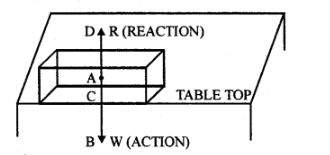
(1) Consider a book lying on the table. Its weight (w) acts vertically downward (Action on the table) and book does not fall. That means table is exerting equal force on the book, but in opposite direction [normal reaction R] called reaction. Thus, action and reaction are equal and opposite.
Image
Action and reaction on a book lying on a table
(2) When we swim in water, we push the water backward [Action] and water in turn exerts equal force on us but in opposite direction (Reaction) i.e. there are two different objects man and water and two forces equal in magnitude and opposite in direction.
View full question & answer
Question 54 Marks
Prove mathematically F = ma
Answer
Derivation of F = ma from Newton's Second Law of Motion:
Newton introduced the concept of momentum and say "The momentum of a moving body is defined as the product of its mass and velocity."
Thus, $p=m v$, where $p=$ momentum of body
$m =$ mass of body
$v=$ velocity of body
Suppose the velocity of body of mass $m$ changes from $u$ to $v$ in time $t$.
Initial momentum, $p _1= mu$
and final momentum, $p _2= mv$
the change in momentum, $\left(p_2-p_1\right)$ takes place in time $t$. Then according to Newton's second law of motion, the magnitude of force $F$ is:
$\frac{p_2-p_1}{t} \propto F, \text { or } F=\frac{km(v-u)}{t}$
 where $k=$ constant of proportionality
Now, $a \frac{(v-u)}{t}$, where $a=$ acceleration of body
$\begin{array}{l}
\therefore F=k m a \\
\Rightarrow F=m a
\end{array}
$
$
(\because k=1, \text { constant })
$
This relation holds good when mass of the body remains constant.
View full question & answer
Question 64 Marks
(a) What do you understand by the term inertia?
(b) What are its kinds?
(c) Give two examples of each kind, stated in
Answer
(a) Inertia. "Is the property of a body due to which it cannot change its state (rest or of uniform motion) itself." Untill some external force is applied on it.
(b) The three kinds of inertia are:
1. Inertia of rest,
2. Inertia of motion,
3. Inertia of direction.
(1) Inertia of rest: The tendency of a body to continue in its state of rest, even when some external unbalanced force is applied on it, is called inertia of rest.
(2) Inertia of motion: The tendency of a body to continue in its state of motion, in a straight line, even when some external unbalanced force acts on it, is called inertia of motion.
(3) Inertia of direction: The tendency of a body by which it is unable to change its direction of motion, even when some external unbalanced force acts on it, is called inertia of direction.
(c) Examples of inertia of rest:
1. Imagine a pile of books placed on a sheet of paper. If the paper is suddenly pulled with a jerk, the books are left behind, because of the inertia of rest.
2. When a carpet is suddenly jerked, the dust flies off. Because on the sudden movement, the carpet moves, but dust on account of the inertia of rest, is left behind.
Examples of inertia of motion:
1. A man standing in a moving bus falls forward as soon as tiie bus stops, due to the inertia of motion of upper part of his body.
2. Before taking a long jump, a boy runs a certain distance, because in doing so he picks up the inertia of motion, which helps him in taking a longer leap.
Examples of inertia of direction:
1. It is a common experience that passengers tend to fall sideways, when a speeding bus takes a sharp turn. It is because, when the bus is moving along straight line in a particular direction suddenly takes a sharp turn, the passengers on account of inertia of direction continue along their direction and hence fall sideways.
2. The sparks produced during sharpening of a knife against a grinding wheel leave the rim of the wheel tangentially because of inertia of direction.
View full question & answer
Question 74 Marks
(a) Define force.
(b) State four effects which a force can bring about. Give two examples in each case.
Answer
(a) Force: It is defined as an external cause which changes or tends to change the state of rest or uniform motion of a body in a straight line.
(b) Effects of force: A force can bring about the following effects.
1. Force can set a stationary body into motion.
For example:
1. A player can set a ball (at rest) in motion by hitting it with suitable material like hockey.
2. A magnet can move an iron nail.
2. Force can stop the moving bodies.
For example:
1. A speeding car is stopped by the force of friction of brakes.
2. A rolling football stops because of the force of friction from the ground.
3. Force can change the speed or direction of a moving body.
For example:

1. A stone projected vertically upwards changes its speed and direction of motion because of the force of gravity.
2. A moving bicycle starts running faster, when more force is applied on its peddles.
4. Force can change the dimensions of a body.
For example:

1. Lenght of a rubber band increases, when stretching force is applied on it.
2. We clay can be moulded in any shape by applying a force with hands.
View full question & answer
Question 84 Marks
A car of mass 1000 kg develops a force of 500 N over a distance of 49 m . If initially the car is at rest find (1) Final velocity (2) time for which it accelerates.
Answer
Mass of car $= m =1000 kg$
$
\text { Force }=F=500 N
$
Acceleration of car $=a=\frac{ F }{m}=\frac{500}{1000}=0.5 ms^{-2}$
Initially velocity $=u=0$
Distance covered $= S =49 m$
Final velocity $= v =$ ?
Time $= t =$ ?
(1)
$
\begin{array}{l}
v^2-m^2=2 a S \\
v^2-(0)^2=2(0.5)(49) \\
v^2=49 \\
v=7 ms^{-1}
\end{array}
$
(2)
$
v=u+at
$
$
\begin{array}{l}
7=0+0.5 t \\
0.5 t=7 \\
\qquad t=\frac{7}{0.5}=14 s
\end{array}
$
View full question & answer
Question 94 Marks
A bullet of mass 30 g , and moving with a velocity x hits a wooden target with a force of 187.5 N . If the bullet penetrates 80 cm , find the value of $x$
Answer
Mass of bullet $= m =30 g=\frac{30}{1000} kg=0.03 kg$
Force $= F =187.5 N$
Acceleration $=a-$ ?
$
\begin{array}{l}
\text { Acceleration }=a=-\frac{F}{m} \quad \text { [because of retardation] } \\
\begin{aligned}
a & =-\frac{187.5}{0.03} \\
& =-\frac{18750}{3}=-6250 ms^{-2}
\end{aligned}
\end{array}
$
Initial velocity $= u = x$
Final velocity $=v=$ ?
Distance covered by bullet $= S =80 cm=\frac{80}{100} m$
$
\begin{array}{l}
S=0.8 m \\
V^2-U^2 =2as
\end{array}
$
$
\begin{array}{l}
(0)^2-(x)^2=2 \times(-6250) \times 0.8 \\
-x^2=-10000 \\
x^2=10000 \\
x=\sqrt{10000}=100 ms^{-1}
\end{array}$
View full question & answer
[5 Mark Question Answer] - PHYSICS STD 9 Questions - Vidyadip