Questions

[3 Mark Question Answer]

🎯

Test yourself on this topic

27 questions · timed · auto-graded

Question 13 Marks
A ball is released from a height and it reaches the ground in $3$ s. If $g= 9.8 m s^{-2}$ Find :
the velocity with which the ball will strike the ground .
Answer
Let ' $S$ ' be the height.
Time taken, $t =3 s ; g =9.8 m / s ^2$
Initial velocity, $u =0$ (because the body starts from rest)
Let ' $v$ ' be the velocity with which the ball strikes the ground.
Using the third equation of motion,
$v^2-u^2=2 g s$
or, $v^2-0^2=2(9.8)(44.1)$
or, $v^2=864.36$
or, $v=29.4 m / s$
View full question & answer
Question 23 Marks
A ball is released from a height and it reaches the ground in 3 s . If $g =9.8 m s ^{-2}$ Find: the height from which the ball was released
Answer
Let 'S' be the height.
Time taken, $t =3 s ; g =9.8 m / s ^2$
Initial velocity, $u =0$ (because the body starts from rest)
Using the second equation of motion,
$
S = ut +(1 / 2) gt ^2
$
We get,
$
\begin{aligned}
& S =0+(1 / 2)(9.8)(3)(3) \\
& S =44.1 m
\end{aligned}
$
View full question & answer
Question 33 Marks
The force of attraction between two bodies at certain separation is 10 N. What will be the force of attraction between them if the separation is reduced to half?
Answer
Given the force of attraction between two bodies $=10 N$
Now, $F = G \frac{ Mm }{ R ^2}$.
If the new distance $R^{\prime}=R / 2$, then let $F^{\prime}$ be the force acting between the bodies. Then:
$
F^{\prime}= G \frac{ Mm }{(R / 2)^2}=4 G \frac{M m}{R^2}
$
or, $F ^{\prime}=4 F$
or, $F ^{\prime}=4 \times 10=40 N$
View full question & answer
Question 43 Marks
 A pebble is dropped freely in a well from its top. It takes 20 s for the pebble to reach the water surface in the well. Taking g $=10 m s ^{-2}$ and speed of sound $=330 m s ^{-1}$. Find: The time when echo is heard after the pebble is dropped.
Answer
Speed of sound $=330 m / s$ Depth of well $=2000 m$
Time is taken to hear the echo after the pebble reaches the water surface $=\frac{\text { Depth }}{\text { speed }}$
$ =\left(\frac{2000}{330}\right) s$
$=6.06 \approx 6.1 s $
Time is taken for pebble to reach the water surface $=20 s$. Therefore, the total time taken to hear the echo after the pebble is dropped $=20+6.1=26.1 s$.
View full question & answer
Question 53 Marks
A stone is dropped freely from the top of a tower and it reaches the ground in $4$ s. Taking $g = 10m s^{-2},$ calculate the height of the tower.
Answer
Initial velocity $u =0$
Time $t =4 s$
$g =10 m / s ^2$
Let ' $H$ ' be the height of the tower.
Using the second equation of motion,
$H=u t+(1 / 2) g t^2$
Or, $H =0+(1 / 2)(10)(4)^2$
Or, $H =80 m$
View full question & answer
Question 63 Marks
A ball is thrown vertically upwards with an initial velocity of $49 m s ^{-1}$. calculate : the maximum height attained.
Answer
Initial velocity, u $=49 m / s$
$
g =9.8 m / s ^2
$
Let $H$ be the maximum height attained.
At the highest point, velocity $=0$.
Using the third equation of motion,
$
v^2-u^2=2 g H
$
or, $0-49^2=2(-9.8)( H )$
or, $H=\left(49^2\right) / 19.6$
or, $H =122.5 m$
View full question & answer
Question 73 Marks
A ball is thrown vertically upwards. It returns 6 s later. Calculate : the initial velocity of the ball (Take $g=10 m s ^{-2}$ )
Answer
Total time of journey $=6 s$
$
g =10 m / s ^2
$
Let $u ^{\prime}$ be the initial velocity.
Final velocity, $v=0$
Using the third equation of motion,
$v^2-u^2=2 g H$
or, $v^2-0=2(10)(45)$
or, $v^2=900$
or, $v=30 m / s$
View full question & answer
Question 83 Marks
A ball is thrown vertically upwards. It returns 6 s later. Calculate : The greatest height reached by the ball . (Take $g =10 m s ^{-2}$ )
Answer
Total time of journey $=6 s$
$
g =10 m / s ^2
$
Let ' $H$ ' be the greatest height.
Time of ascent, $t=6 / 2=3 s$,
For ascent, initial velocity, $u =0$
Using the second equation of motion,
$
\begin{aligned}
& H=u t+(1 / 2) g t^2 \\
& H=0+(1 / 2)(10)(3)^2 \\
& H=45 m
\end{aligned}
$
View full question & answer
Question 93 Marks
A ball is thrown vertically upwards. It goes to a height 20 m and then returns to the ground. Taking acceleration due to gravity g to be $10 ms^{-2}$, find: the total time of journey of the ball .|
Answer
Given, maximum height reached, $s=20 m$
Acceleration due to gravity, $g=10 m / s ^2$
Now total time for which the ball remains in air, $t=2 u / g$.
Or, $t =2(20) /(10)$.
Or, $t=4 s$.
View full question & answer
Question 103 Marks
A ball is thrown vertically upwards. It goes to a height 20 m and then returns to the ground. Taking acceleration due to gravity g to be $10 ms^{-2}$​​​​​​​ , find :
the final velocity of the ball on reaching the ground .
Answer
Given, maximum height reached, $s=20 m$
Acceleration due to gravity, $g =10 m / s ^2$
Let $v^{\prime}$ be the final velocity of the ball on reaching the ground.
Considering the motion from the highest point to ground,
Velocity at highest point $=0=$ Initial velocity for downward journey of the ball.
Distance travelled, $s =20 m$
Using the third equation of motion,
$v^2-u^2=2 g s$
or, $v^2-0=2(10)(20) m / s$
or, $v^2=400 m / s$
or, $v=20 m / s$
View full question & answer
Question 113 Marks

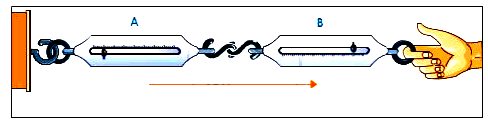
When two spring balances joined at their free ends are pulled apart, both show the same reading. Explain.

Answer
Couple two spring balances A and B as shown in the figure. When we pull the balance B, both the balances show the same reading indicating that both the action and reaction forces are equal and opposite. In this case, the pull of either of the two spring balances can be regarded as action and that of the other balance as the reaction.
View full question & answer
Question 123 Marks

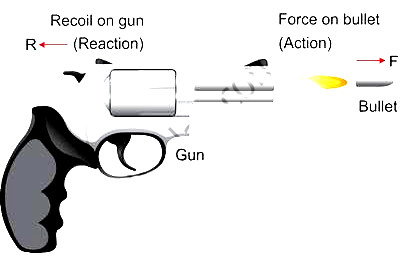
When a shot is fired from a gun, the gun is recoiled. Explain.

Answer
When a man fires a bullet from a gun, a force F is exerted on the bullet (action), and the gun experiences an equal and opposite recoil (reaction) and hence gets recoiled.
View full question & answer
Question 133 Marks

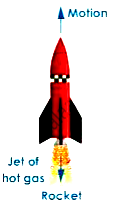
Explain the motion of a rocket with the help of Newton's third law.

Answer
When a rocket moves in space, it pushes gases outside, i.e. the rocket applies force on the gases in the backward direction. As a reaction, the gases put equal amount of force on the rocket in the opposite direction and the rocket moves in the forward direction.
View full question & answer
Question 143 Marks
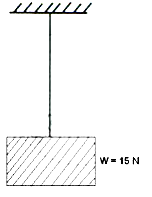
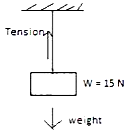
In the Figure a block of weight 15 N is hanging from a rigid support by a string. What force is exerted by (a) a block on the string and (b) a string on the block? Name and show them in the diagram.
Answer
(a) A block exerts 15 N force (weight) on the string downwards. (b) The string exerts an equal force of 15 N on the block in the opposite direction, i.e. upward direction (tension).
View full question & answer
Question 153 Marks
Two balls A and B of masses m and 2 m are in motion with velocities 2v and v, respectively. Compare: (i) Their inertia. (ii) Their momentum. (iii) The force needed to stop them in the same time.
Answer
(i) Inertia of body A:Inertia of body B :: m:2mOr, Inertia of body A:Inertia of body B :: 1:2.
(ii) Momentum of body $A = m (2 v )=2 mv$Momentum of body $B=(2 m) v=2 m v$
Momentum of body A:Momentum of body B :: $2 mv : 2 mv$
Or, Momentum of body A:Momentum of body B :: 1:1.
(iii) According to Newton's $2^{\text {nd }}$ law of motion, rate of change of momentum is directly proportional to the force applied on it. Therefore,Force needed to stop A:Force needed to stop $B:: 1: 1$.
View full question & answer
Question 163 Marks
A force of 10 N acts on a body of mass 2 kg for 3 s, initially at rest. Calculate : Change in momentum of the body.
Answer
Force, $F=10 N$
Mass, $m=2 kg$
Time, $t =3 s$
Initial velocity, $u=0 m / s$.
Change in momentum $=$ Final momentum - initial momentum
$
\Delta p = mv - mu \text {. }
$
Or, $\Delta p=m(v-u)$.
Or, $\Delta p=2(15-0)=30 kg m / s ^{-1}$
View full question & answer
Question 173 Marks
A force of 10 N acts on a body of mass 2 kg for 3 s, initially at rest. Calculate : The velocity acquired by the body
Answer
Force, $F=10 N$
Mass, $m =2 kg$
Time, $t =3 s$
Initial velocity, $u =0 m / s$.
Let $v$ be the final velocity acquired.
From Newton's second law,
$
F = ma \text {. }
$
Or, $a=F / m=10 / 2=5 ms ^{-2}$.
From the $1^{\text {st }}$ equation of motion,
$
a =( vu ) / t
$
Or, $v=a t+u$.
Or, $v=(5)(3)+0=15 m / s ^{-1}$
View full question & answer
Question 183 Marks
Two bodies A and B of same mass are moving with velocities v and 2v, respectively. Compare their (i) inertia and (ii) momentum.
Answer
(i) Mass is the measure of inertia. Let 'm' be the mass of the two bodies. Inertia of body A:Inertia of body B :: m:m Or, Inertia of body A:Inertia of body B :: 1:1 (ii) Momentum of body A = m (v) Momentum of body B = m (2v) = 2mv Momentum of body A:Momentum of body B :: mv:2mv Or, Momentum of body A:Momentum of body B :: 1:2.
View full question & answer
Question 193 Marks
Show that the rate of change of momentum = mass × acceleration. Under what condition does this relation hold?
Answer
Let a force 'F' be applied on a body of mass m for a time 't' due to which its velocity changes from u to v. Then,
Initial momentum of body = mu
Final momentum of body = mv
Change in momentum of the body in 't' seconds = mv -­­ mu = m (v - u)
Rate of change of momentum = Change in momentum/time
= [m (v - u)]/t
However, acceleration a = Change in velocity/time = (v - u)/t
Therefore, rate of change of momentum = ma = mass × acceleration
This relation holds true when the mass of the body remains constant.
View full question & answer
Question 203 Marks
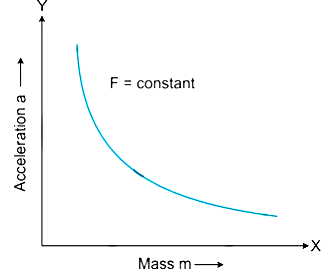
How does the acceleration produced by a given force depend on the mass of the body? Draw a graph to show it.
Answer
If a given force is applied on bodies of different masses , then the acceleration produced in them is inversely proportional to their masses .
A graph plotted for acceleration (a) against mass (m) is a hyperbola .
View full question & answer
Question 213 Marks
A car is moving with a uniform velocity $30 ms^{-1}$. It is stopped in $2$ s by applying a force of $1500$ N through its brakes. Calculate the following values: The mass of car.
Answer
Initial velocity, $u=30 m / s$
Final velocity, $v=0$
Time, $t =2 s$
Force, $F =1500 N$
Here, $a =( v - u ) / t =(0-30) / 2=-15 ms ^{-2}$.
Here, negative sign indicates retardation.
Now, $F = ma$.
Or, $m=F / a=(1500 / 15)=100 kg$.
From Newton's second law of motion,
$
F = ma
$
Or, $m=F / a=(1500 / 15)=100 kg$.
View full question & answer
Question 223 Marks
A car is moving with a uniform velocity $30 ms^{-1}$. It is stopped in 2 s by applying a force of 1500 N through its brakes. Calculate the following values: The retardation produced in car.
Answer
Initial velocity, $u =30 m / s$ Final velocity, $v =0$ Time, $t =2 s$ Force, $F =1500 N$
Here, $a=(v-u) / t=(0-30) / 2=-15 ms^{-2}$.
Here, negative sign indicates retardation. Now, $F= ma$. Or, $m=F / a=(1500 / 15)=100 kg$.
Acceleration, $a=(v-u) / t$. Or, $a=(0-30) / 2=-15 ms^{-2}$
Here, negative sign indicates retardation. Thus, retardation $= 15 ms^{-2}.$
View full question & answer
Question 233 Marks
A car is moving with a uniform velocity $30 ms^{-1}$​​​​​​​. It is stopped in 2 s by applying a force of 1500 N through its brakes. Calculate the following values : The change in momentum of car.
Answer
Initial velocity, u $=30 m / s$
Final velocity, $v=0$
Time, $t =2 s$
Force, $F =1500 N$
Here, $a =( v - u ) / t =(0-30) / 2=-15 ms ^{-2}$.
Here, negative sign indicates retardation.
Now, $F = ma$.
Or, $m=F / a=(1500 / 15)=100 kg$.
Change in momentum $=$ Final momentum - Initial momentum
Or, $\Delta p = m ( v - u )$
Or, $\Delta p=100(0-30)$
Or, $\Delta p=3000 kg m / s ^{-1}$
View full question & answer
Question 243 Marks
A car of mass 480 kg moving at a speed of $54 km h ^{-1}$ is stopped by applying brakes in 10 s . Calculate the force applied by the brakes.
Answer
Mass, $m =480 kg$.
Initial velocity, $u =54 km / hr =15 m / s$.
Final velocity, $v=0$.
Time, $t =10 s$.
Acceleration $=$ Change in velocity/time.
Or, $a =( v - u ) / t$.
Or, $a=(0-15) / 10=-1.5 ms ^{-2}$.
Here, negative sign indicates retardation.
Now, Force $=$ Mass $\times$ Acceleration
Or, $F=(480)(1.5)=720 N$.
View full question & answer
Question 253 Marks
A body of mass 500 g, initially at rest, is acted upon by a force which causes it to move a distance of 4 m in 2 s, Calculate the force applied.
Answer
Mass of an object $=500 g =0.5 kg$
The second equation of motion is
$
s = ut +\frac{1}{2} a t ^2
$
As the body is at rest $u=0$,
$
t =2 s
$
Displacement of an object $=4 m$
$
\begin{aligned}
& 4=(0) \times(2)+\frac{1}{2} a(2)^2 \\
& a=2 m / s ^2 \\
& F = m \times a =0.5 \times 2=1 \text { Newton }
\end{aligned}
$
Thus, the force applied to move the body is 1 Newton.
View full question & answer
Question 263 Marks
A force acts for $0.1$ s on a body of mass $2.0 kg$ initially at rest. The force is then withdrawn and the body moves with a velocity of $2 m s^{-1}$. Find the magnitude of the force.
Answer
Mass, $m=2.0 kg$ i.e. $2 kg$
Initial velocity, $u =0$
Final velocity, $v=2 m / s$

Time, $t=0.1 s$
Acceleration $=\frac{\text { Change in velocity }}{\text { time }}$
$\therefore a =\frac{ v - u }{ t }$
$\therefore a=\frac{2-0}{0.1}$
$\therefore a=20 ms ^{-2}$.

Force $=$ Mass $\times$ Acceleration
$\Rightarrow F =2 \times 20$
$\therefore F =40 N$.
View full question & answer
Question 273 Marks

Give two examples to show that greater the mass, greater is the inertia of the body.

Answer
Examples to show that greater the mass, greater is the inertia of the body are as shown below: (i) If you want to start a car by pushing it, you find that it takes a very large force to overcome its inertia. On the other hand, only a small force is needed to start a child's express wagon. The difference between the car and express wagon is the difference in mass. The car has a large mass, whereas the wagon has a small one. (ii) A cricket ball is more massive than a tennis ball. The cricket ball acquires a much smaller velocity than a tennis ball when the two balls are pushed with equal force for the same time.
View full question & answer
[3 Mark Question Answer] - PHYSICS STD 9 Questions - Vidyadip