Questions

[5 Mark Question Answer]

🎯

Test yourself on this topic

5 questions · timed · auto-graded

Question 15 Marks
A ball is thrown vertically upwards from the top of a tower with an initial velocity of $19.6 m s ^{-1}$. The ball reaches the ground after 5 s . Calculate:
(i) The height of the tower, (ii) The velocity of the ball on reaching the ground. Take $g =9.8 ms^{-2}$.
Answer
Let x be the height of the tower.
Let h be the distance from the top of the tower to the highest point
nitial velocity $u = 19.6 m/s$
$g = 9.8 m/s^2$
At the highest point, velocity = 0
Using the third equation of motion,
$v^2 - u^2 = 2gh$
$Or, - (19.6)^2 = 2 (-9.8) h$
$Or, h = 19.6 m$
If the ball takes time $t_1$ to go to the highest point from the top of building, then for the upward journey from the relation, v = u gt,
$0 = 19.6 - (9.8) (t_1)$
$Or, t_1 = 2s$
(ii) Let us consider the motion for the part $(x+h)$
Time taken to travel from highest point to the ground $= (5 2) = 3s$
Using the equation $s = ut + (1/2) gt^2​​​​​​​$​​​​​​​
We get,
$(x + h) = 0 + (1/2) (9.8) (3)^2$
$Or, (x + 19.6) = 44.1 m$
$Or, x = 44.1 19.6 = 24.5 m$
Thus, height of the tower = 24.5 m
(iii) Let v be the velocity of the ball on reaching the ground.
Using the relation, $v = u + gt$
We get:
$v = 0 + (9.8) (3)$
Or,$ v = 29.4 m/s$
View full question & answer
Question 25 Marks

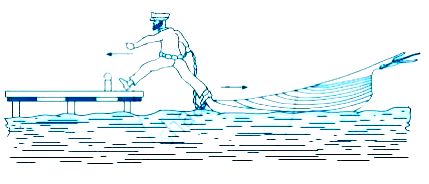
When you step ashore from a stationary boat, it tends to leave the shore. Explain.

Answer
When you step ashore from a stationary boat, it tends to leave the shore this is because of newton's third law of motion which states that, 'Every action has an equal and opposite reaction'. In order to get out of the boat we exert a force (action) on the board of the boat. This creates a force (reaction) which enables us to step out of the boat.
At the same instant, the boat tends to leave the shore due to the force exerted by us (i.e., action).
For the safety of the passengers the boatman ties the boat to the pole on the shore so that it does not move away.
View full question & answer
Question 35 Marks
State and explain the law of action and reaction. by giving two examples.
Answer
Law of action and reaction: In an interaction of two bodies $A$ and $B$, the magnitude of action, i.e. the force $F_{A B}$ applied by the body B on the body A , is equal in magnitude to the reaction, i.e., the force $F _{ BA }$ applied by the body A on the body B , but they are in directions opposite to each other. Examples: (i) When a book is placed on a table, it does not move downwards. It implies that the resultant force on the book is zero, which is possible only if the table exerts an upward force of reaction on the book, equal to the weight of the book. (ii) While molving on the ground, we exert a force by our feet to push the ground backwards; the ground exerts a force of the same magnitude on our feet forward, which makes it easier for us to move. Explanation: In the above stated example, there are two objects and two forces. In the first example, the weight of the book acts downwards (action) and the force of the table acts upwards (reaction). In the second example, our feet exerts a force on the ground (action) and the ground exerts an equal and opposite force (reaction) on our feet.
View full question & answer
Question 45 Marks
 A bullet of mass $50$ g moving with an initial velocity $100 m s ^{-1}$ strikes a wooden block and comes to rest after penetrating a distance $2$ cm in it. Calculate: (i) Initial momentum of the bullet, (ii) Final momentum of the bullet, (iii) Retardation caused by the wooden block and (iv) Resistive force exerted by the wooden block.
Answer
Mass, $m =50 gm =0.05 kg$.
Initial velocity, $u =100 m / s$.
Final velocity, $v=0$.
Distance, $s =2 cm=0.02 m$.
(i) Initial momentum $= mu =(0.05)(100)=5 kg m / s ^{-1}$
(ii) Final momentum $=m v=(0.05)(0)=0 kg m / s$.
(iii) Acceleration, $a=\left(v^2-u^2\right) / 2 s$.
Or, $a =\left(0^2-100^2\right) / 2(0.02)$.
Or, $a=-2.5 \quad 10^5 ms^{-2}$.
Therefore, retardation is $2.5 \times 10^5 ms^{-2}$.
(iv) Force, $F = ma$
Or, $F=(0.05 kg)\left(2.5 \times 10^5 ms^{-2}\right)$
Or, F $=12500 N$
View full question & answer
Question 55 Marks
State and explain the law of inertia (or Newton's first law of motion).
Answer
Statement of Newton's first law: If a body is in a state of rest, it will remain in the state of rest, and if the body is in the state of motion, it will remain moving in the same direction with the same speed unless an external force is applied on it. Explanation:
Newton's first law can be explained in the following two parts: (i) Definition of inertia: The $1^{\text {st }}$ part of Newton's first law of motion gives the definition of inertia, according to which an object cannot change its state by itself. Example: A book lying on a table will remain in its position unless it is displaced. (ii) Definition of force: The $2^{\text {nd }}$ part of Newton's first law defines force, according to which force is that external cause which can move a stationary object or which can stop a moving object. Example: A book lying on a table is displaced from its place when it is pushed.
View full question & answer
[5 Mark Question Answer] - PHYSICS STD 9 Questions - Vidyadip