Question 11 MarkCan every force produced motion in every type of body?AnswerNo, every force does not produce motion in every type of body.View full question & answer→
Question 21 MarkUse Newton's second law to explain the following:While catching a fast moving ball, we always pull our hands backwards.AnswerWhile catching a fast moving ball, we always pull our hands backwards to increase reaction time so force experienced would decrease.View full question & answer→
Question 31 MarkWhat does a force do in the following case?You catch a kicked ball.AnswerForce decreases the momentum of ball and finally stops the ball.View full question & answer→
Question 41 MarkWhat does a force do in the following case?You apply brakes to a running car.AnswerForce provides retardation to the car and finally stops the car.View full question & answer→
Question 51 MarkWhat does a force do in the following case?You twist a piece of rubber.AnswerForce produces stretching in the rubber.View full question & answer→
Question 61 MarkWhat does a force do in the following case?You pull the skin of your armAnswerForce changes the shape of skin.View full question & answer→
Question 71 MarkWhat is the relationship between force and acceleration?AnswerForce applied is equal to the product of mass and acceleration produced in the body. F = mass X acceleration.View full question & answer→
Question 81 MarkWrite the SI unit of retardation.AnswerSI unit of retardation is $ms^{-2}.$View full question & answer→
Question 91 MarkWhat do you mean by an impulsive force?AnswerThe force that acts on a body for a very short time but produces a large change in its momentum, is known as impulsive force.View full question & answer→
Question 101 MarkIs force a scalar quantity?AnswerNo, force is a vector quantity.View full question & answer→
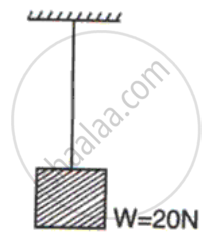
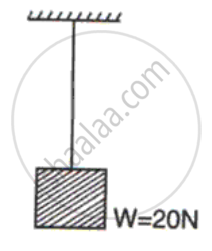
Question 111 MarkIn the below figure, a block of weight 20 N is hanging from a rigid support by a string. Find:The force exerted by string on the block.AnswerThe force exerted by string on the block is equal to the tension in the string and this is also equal to the 20N.View full question & answer→
Question 121 MarkIn the below figure, a block of weight 20 N is hanging from a rigid support by a string. Find:The force exerted by block on the string.AnswerThe force exerted by the block on is the weight of box and that is equal to 20N.View full question & answer→
Question 131 MarkWhat is the relation between Newton and dyne?AnswerNewton is the SI unit of force whereas dyne is the CGS unit of force. $1 N = 10^5$ dyne.View full question & answer→
Question 141 MarkWhat do you understand by the free fall?AnswerFree fall means motion of a body under the gravity of earth only.View full question & answer→
Question 151 MarkExplain the difference between g and G.Answerg' is acceleration due to earth's gravity and 'G' is universal gravitational constant.View full question & answer→
Question 161 MarkExplain why:A moon rocket needs to reach a certain velocity.AnswerA moon rocket needs to reach a certain velocity because during its motion earth attracts the rocket towards it by its gravitational force.View full question & answer→
Question 171 MarkExplain why:The atmosphere does not escape.AnswerAtmosphere does not escape because molecules of atmosphere are attracted by earth due to the gravitational force of the earth.View full question & answer→
Question 181 MarkExplain why:Objects fall to the earth.AnswerObjects fall on the earth due to gravitational force between the earth and object.View full question & answer→
Question 191 MarkName the instrument used to measure the weight of a body.AnswerSpring scale is used to measure the weight of a body.View full question & answer→
Question 201 MarkName the scientist who first stated the law of inertia.AnswerNewton stated the law of inertia.View full question & answer→
Question 211 MarkDefine one Newton.Answer1 Newton is the force which when applied to a body of unit mass produces a unit acceleration in it. > > View full question & answer→
Question 221 MarkA boy pushes a wall with a force of 30 N towards east. What force is exerted by the wall on the boy?AnswerAccording to Newton's third law, every action has equal and opposite reaction so force exerted by the wall on the boy is 30 N.View full question & answer→
Question 231 MarkTwo equal and opposite forces act on a moving body. How is its motion affected?AnswerAs these forces are balanced so they will not affect the motion and motion of the body will remain unaffected.View full question & answer→
Question 241 MarkTwo equal and opposite forces acting at the same point on a stationary body. Will the body move? Give reason to explain your answer.AnswerNo, the body will not move as the two forces are equal and opposite and they constitute balanced forces.View full question & answer→
Question 251 MarkName the physical quantity which equals the rate of change of linear momentum.AnswerForce is equal to the rate of change of linear momentum.View full question & answer→
Question 261 MarkWhy does a ball moving on a table top eventually stops?AnswerBall moving on a table top stops eventually due to force of friction between the ball surface and table surface.View full question & answer→
Question 271 MarkWhat is a force?AnswerForce is that external agency which tends to change the state of rest or the state of motion of a body.View full question & answer→
Question 281 MarkGive qualitative definition of force on the basic of Newton's first law of motion.AnswerForce is that external cause which can move a stationary object or which can stop a moving object.View full question & answer→
Question 291 MarkWrite the SI unit of momentum.AnswerSI unit of momentum is $kgms^{-1}.$View full question & answer→
Question 301 MarkWhat causes motion in a body?AnswerUnbalance external force causes motion in the body.View full question & answer→
Question 311 MarkName and state the action and reaction in the following case:Pushing a wall.AnswerForce applied by us on wall is action and opposite force applied by wall on us or we can say that resistance of wall to our force is reaction.View full question & answer→
Question 321 MarkName and state the action and reaction in the following case: Firing a bullet from a gun.AnswerFiring of bullet is the action and recoiling of gun is the reaction.View full question & answer→
Question 331 MarkName and state the action and reaction in the following case:Hammering a nail.AnswerForce applied by hammer on nail is action and normal force applied by nail on hammer is reaction to this force.View full question & answer→
Question 341 MarkName and state the action and reaction in the following case:A person walking on the ground.AnswerForce applied by man on ground is action and force of friction is the reactionView full question & answer→
Question 351 MarkName and state the action and reaction in the following case:A book lying on a table.AnswerWeight of the book is action and normal force applied by table on book is reaction.View full question & answer→
Question 361 MarkWhat are the SI units of constant of gravitation?AnswerSI unit of constant of gravitation is $Nm^2kg^{-2}.$View full question & answer→
Question 381 MarkDefine acceleration due to gravity.AnswerAcceleration due to gravity is the acceleration experienced by a body during free fall.View full question & answer→
Question 391 MarkState whether the below statement is True or False.Neglecting air resistance, a body falling freely near the earth's surface has a constant acceleration.AnswerYes a body falling freely near the earth surface has a constant acceleration.View full question & answer→
Question 401 MarkIn vacuum, all freely falling objects have the same force. Is it true?AnswerYes, in absence of gravity all freely falling body have same force acting on them.View full question & answer→
Question 411 MarkDoes the force of gravitation between two objects depend on the medium between them?AnswerNo, the force of gravitation between two objects does not depend on the medium between them.View full question & answer→
Question 421 MarkWhere will you weigh more: at the moon's surface or at the earth's surface?AnswerWe will weigh more on earth surface as value of g is greater on earth surface.View full question & answer→
Question 431 MarkHow are kgwt and N related to each other?AnswerNewton 1N = 9.8 kgwt.View full question & answer→
Question 441 MarkWhere do you weigh more: at the poles or at equator?AnswerThe weight is greater at the poles than the equator.View full question & answer→
Question 451 MarkName the instrument by which the weight of a body can be measured.AnswerSpring scale is used to measure the weight of a body.View full question & answer→
Question 461 MarkName an instrument used to measure the mass of a body.AnswerBeam balance is used to measure the mass of a body.View full question & answer→
Question 471 MarkWhere will you weigh more: at the centre of the earth or at the surface of the earth?AnswerWe will weigh more on the surface of the earth.View full question & answer→
Question 481 MarkWhat is the value of g at the surface of the earth?AnswerValue of the g at the surface of the earth is $9.8ms^{-2}.$View full question & answer→
Question 491 MarkWho stated the law of gravitation?AnswerSir Isaac Newton stated the law of gravitation.View full question & answer→
Question 501 MarkWhat is the relation between $'g'$ and $'G'?$Answer$g = GM/R^2.$View full question & answer→