Questions

[3 Mark Question Answer]

🎯

Test yourself on this topic

30 questions · timed · auto-graded

Question 13 Marks
A ball is thrown upward and reaches a maximum height of $19.6 \ m$. Find its initial speed?
Answer
Maximum Height attained by ball $= 19.6 m$
Let initial speed of ball $= u ms^{-1}.$
Acceleration applied on ball due to gravity$ = -9.8 ms^{-2}.$
Final speed of ball at maximum height $= 0 ms^{-1}.$
We know that from second equation of motion
$V^2 - u^2 = 2as$
$0 -u^2 = 2 X(-9.8)X19.6$
$u^2 = 19.6 X 19.6$
$u= 19.6 ms^{-1}$
So initial speed of ball to attain maximum height of 19.6 m should be $19.6ms^{-1}.$
View full question & answer
Question 23 Marks
A ball is thrown vertically downward with an initial velocity of $10 \ m/s$. What is its speed $1 \ s$ later and $2 \ s$ later?
Answer
Initial speed of ball $=10 ms^{-1}$.
Acceleration due to gravity on ball $=-9.8 ms^{-2}$
We know that from first equation of motion
$v=u+gt .$
After 1 sec
$v=10-9.8 \times 1$
$v=0.2 ms^{-1}$
so velocity after 1 sec would be $0.2 ms^{-1}$.
Velocity after 2 seconds
$v=10-9.8 \times 2=10-19.6=-9.6 ms^{-1} .$
Here negative sign shows that velocity is in downward direction and magnitude is $9.6 ms^{-1}$.
View full question & answer
Question 33 Marks
A stone is dropped from a cliff $98 \ m$ high.
What will be its speed when it strikes the ground?
Answer
Height of cliff = 98 m.
Initial velocity of stone $= 0 ms^{-1}.$
Acceleration due to gravity $= 9.8 ms^{-2}.$
Final velocity when it strikes the ground
$V^2 - u^2 = 2 g H$
$V^2 = 2X9.8X98$
$V^2= 1920$
$V= 44.6 ms^{-1}.$
View full question & answer
Question 43 Marks
A stone is dropped from a cliff $98 \ m$ high.
How long will it take to fall to the foot of the cliff?
Answer
Height of cliff $= 98 m.$
Initial velocity of stone $= 0 ms^{-1}.$
Acceleration due to gravity $= 9.8 ms^{-2}.$
We know $H = ut + 1/2 gt^2.$
$98 = 1/2 X 9.8X t_2.$
$t^2 = 98X2/9.8 = 20$
$t= 4.47 sec.$
View full question & answer
Question 53 Marks
A force of $10 \ N$ acts on a body of mass $2 \ kg$ for $3 \ s$, initially at rest. Calculate:
Change in momentum of the body.
Answer
Time for which force is applied $=3 s.$
Mass of the body $= 2 kg.$
Initial speed of body $= 0 ms^{-1}$​​​​​​​
Force applied $= 10 N.$
As $m(v - u)$ is change in momentum and this is equal to the F $X$ t so change in momentum is equal to the $30 kgms^{-1}.$
View full question & answer
Question 63 Marks
A force acts for $0.1 \ s$ on a body of mass $3.2 \ kg$ initially at rest. The force then ceases to act and the body moves through $3 \ m$ in the next one second. Calculate the magnitude of force.
Answer
Time for which force is applied $=0.1 s.$
Mass of the body $= 3.2 kg.$
Initial speed of body $= 0 ms^{-1}$​​​​​​​
After removal of forces body covers a distance of 3m in 1 second so final speed of body $= 3/1 = 3ms^{-1}.$
We know $FX t = m (v - u)$
$F X 0.1 = 3.2 (3 -0)$
$F = 9.6/0.1 = 96 N.$
So applied force is $96 N.$
View full question & answer
Question 73 Marks
A cricket ball of mass $500 \ g$ moving at a speed of $30$ ms $1$ is brought to rest by a player in $0.03 \ s$. Find the average force applied by the player.
Answer
Mass of ball $=500 g=0.5 kg$.
Initial speed of the ball $=30 ms^{-1}$
Final speed of ball $=0 ms^{-1}$
Time taken by player to stop the ball $=0.03 s$.
We know FX $t = m (v - u)$
$F X 0.03 = 0.5 (0 - 30)$
$F = - 1.5 / 0.03 = - 500 N$
$(- )$ sign shows that player has to apply force in opposite direction of the motion of the ball.
View full question & answer
Question 83 Marks
State Newton's third law of motion. Give an experimental demonstration of Newton's third law.
Answer
According to newton's third law, for every action, there is always an equal and opposite reaction.
To demonstrate newton's third law blow a balloon and hold its neck tightly facing downwards. When we release the balloon, the balloon will move up instead of falling to the ground. As air is releasing from bottom of the balloon and this air apply equal and opposite force to the balloon and this force helps the balloon to move upwards
View full question & answer
Question 93 Marks
What do you mean by linear momentum of a body? A force causes an acceleration of $10 ms^{-2}$ in a body of mass $1 kg$ . What acceleration will be caused by the same force in a body of mass $4 kg $?
Answer
Linear Momentum is defined as the physical quantity which is associated with bodies in linear motion. It is given by the product of the mass of the body and its velocity.
Mass of body $=1 kg$
Acceleration produced $=10 ms^{-2}$.
Force applied would be $=1 \times 10 N=10 N$.
Mass of second body $=4 kg$.
As same force has to be applied on second body so force $=10 N$.Acceleration produced is $= F/M =10/4 = 2.5 ms^{-2}.$
View full question & answer
Question 103 Marks
State Newton's second law of motion.
A body of mass $400 g$ is resting on a frictionless table. Find the acceleration of the body when acted upon by a force of $0.02 N.$
Answer
According to Newton's second law of motion, when a force acts on a body, the rate of change in momentum of a body equals the product of the mass of the body and acceleration produced in it due to that force, provided the mass remains constant.
Mass of body $= 400 g = 0.4kg$
Force applied on body $= 0.02 N$
Acceleration = force/mass $= 0.02/0.4 = 0.05 ms^{-2}.$
View full question & answer
Question 113 Marks
A force of 0.9 N acting on a body increases its velocity from $5 ms^{-1}$ to $8 ms^{-1}$ in 2 s . Calculate the mass of the body.
Answer
Initial speed of body $=5 ms^{-1}$
Final speed of body $=8 ms^{-1}$
Time taken to acquire this speed $=2 s$.
Acceleration of body $=( v - u ) / t$ $a=(8-5) / 2=1.5 ms^{-2}$.
Force applied on body $=0.9 N$.
we know $F = m X$ a.
$m=f / a=0.9 / 1.5=0.6 kg$
mass of the body is 600 gm .
View full question & answer
Question 123 Marks
A force of $4 \ N$ gives a mass $m_1$ an acceleration of $8 ms^{-2} $and a mass $m_2$ an acceleration of $20 ms^{-2}​​​​​​​$. What would be the acceleration if the same force acts on both the masses tied together?
Answer
We know $F = m X a$
$m= F/a$
so we can calculate mass of each body
Mass of body $1 m_1 = 4/8 = 0.5 kg.$
Mass of body $2 m_2 = 4/20 = 0.2 kg.$
Total mass when two masses are tied together $M = 0.5 + 0.2 = 0.7 kg.$
Now as force is acting on total mass so acceleration produced is
$a= 4/0.7 = 5.71 ms^{-2}.$
View full question & answer
Question 133 Marks
State Newton's law of gravitation. What is the difference between:
g and G?
Answer
Newton law of gravitation is that every object in the universe attracts every other object with a force directly proportional to the product of their masses and inversely proportional to the square of the distance between them.

'g' is the acceleration due to earth's gravity and 'G' is universal gravitational constant.

View full question & answer
Question 143 Marks
State Newton's law of gravitation. What is the difference between:
Gravity and gravitation
Answer
Newton law of gravitation is that every object in the universe attracts every other object with a force directly proportional to the product of their masses and inversely proportional to the square of the distance between them.

Gravity is the force of attraction between the object and the earth whereas gravitation refers to the force of attraction that exists between any two bodies that possess mass.

View full question & answer
Question 153 Marks
Differentiate between gravitational mass and inertial mass.
Answer
Inertial mass is a measure of inertia of the object. According to the second law of motion $F = m \times a$
m= F/a and this mass is called inertial mass.
Newton law of gravitation gives another definition of mass.
$F = (G m_1m_2)/R^2$​​​​​​​
Thus $m_2$ is the mass of the body by which another body of mass $m_1$ attracts it towards it by the law of gravitation.
This mass is called gravitational mass.
View full question & answer
Question 163 Marks
State Newton's third law of motion. Explain, the motion of a rocket with the help of Newton's third law of motion.
Answer
According to Newton's third law, for every action, there is always an equal and opposite reaction. Rocket works on the same principle. The exhaust gases produced as the result of the combustion of the fuel are forced out at one end of the rocket. As a reaction, the main rocket moves in the opposite direction.
View full question & answer
Question 173 Marks
State Newton's second law of motion. Is Newton's first law of motion contained in Newton's second law of motion?
Answer
According to newton's second law of motion, when a force acts on a body, the rate of change in momentum of a body is equal to the product of the mass of the body and acceleration produced in it.
Yes, Newton's first law is contained in the second law as if force is zero then the acceleration would be zero which means the body would remain in its state of rest or in state of constant motion.
View full question & answer
Question 183 Marks
Define the constant of gravitation.
Answer
We know that law of gravitation.
$F = G ( m_1Xm_2)/R^2.$
Here G is universal constant and is called constant of gravitation. It doesnot depend upon on the value of $m_1,m_2$​​​​​​​ or R.
Its value is same between any two objects in the universe.
View full question & answer
Question 193 Marks
What will happen to the gravitational force of attraction between two objects if the mass of each is doubled and the distance between them is also doubled?
Answer
We know that law of gravitation.
$F = G ( m_1Xm_2)/R^2.$
Now $m_1 = 2 m_1$
$m_2 = 2 m_2$
$R = 2 R$
$F_1 = G ( 2m_1 X2 m_2)/4R^2.$
$F_1 = F$
So force between them remains same.
View full question & answer
Question 203 Marks
When some rock is brought to the earth from the surface of the moon, Will its mass and weight change?
Answer
Mass of the body is constant at all positions so mass will not change. But weight will change as gravity on the surface of earth is almost 6 times than on the surface of the moon, so its weight will increase almost 6 times on the surface of earth.
View full question & answer
Question 213 Marks
A ball is thrown up with a speed of $4.9 ms^{-1}.$
Prove that the time of ascent is equal to the time of descent.
Answer
For highest point initial velocity is zero
Acceleration due to gravity is $= 9.8 ms^{-2}.$
Final velocity at ground is v
$V_2 - 0 = 2 \times 9.8 \times 1.125$
$V = 4.9 ms^{-1}.$
Time taken to reach ground from highest point
$V = u + at$
$4.9 = 0 + 9.8 t$
$T = 4.9/9.8 = 0.5 sec.$
So time of ascent is equal to time descent.
View full question & answer
Question 223 Marks
Given:
Mass of the earth $= 6X10^{24}kg.$
Radius of the earth $= 6.4 X 10^6 m$
$G = 6.7 x 10^{11}Nm^2kg^{-2}$​​​​​​​
Using this data, calculate the force of gravity due to the earth acting on a $100 \ kg$ person stannding on the ground.
Answer
We know that law of gravitation.
$F = G ( m_1Xm_2)/R^2.$
Mass of earth $= 6X10^{24}kg.$
Mass of the person $= 100 kg.$
$G = 6.7 X10^{-11} Nm^2kg^{-2}.$
Radius of earth $= 6.4 X 10^{14}.$
$F = (6.7 X10^{-11}X 100 X 6 X10^{14} )/ (6.4 X6.4 X10^{12}) = 981.4N$
Force of gravity due to earth acting on a $100 kg$ person is $981.4 N.$
View full question & answer
Question 233 Marks
Name the different kinds of inertia an object can possess. Give an example of each.
Answer
An object possesses two kinds of inertia, the inertia of rest and inertia of motion. A book lying on a table will remain placed at the table unless it is displaced by some external force. This is an example of inertia of rest.
A ball rolling on the ground will continue to roll unless the external force, the force of friction between the ball and the ground stops it.
View full question & answer
Question 243 Marks
How does a person move forward during swimming?
Answer
A person applies force on the water in backward direction and water according to the third law of motion water apply an equal and opposite force in the forward direction which helps a person to swim.
View full question & answer
Question 253 Marks
Why do you feel a backward jerk on your shoulder when you fire a gun?
Answer
When we fire a gun, a force is exerted in the forward in the forward direction as the bullets comes out; in reaction to which an equal and opposite force is act in the backward direction and hence, we feel a backward jerk on the shoulder.
View full question & answer
Question 263 Marks
A truck rolls down a hill with constant acceleration after starting from rest. It travels a distance of $100 m$ in $10 s$. find its acceleration. Find the force acting on it, if its mass is $5$ metric tons. (tonne)
Answer
Initial velocity of the truck $=0 ms^{-1}$
Distance covered by truck $=100 m$
Time taken to cover this distance $=10 s$.
We know Distance covered would be $S=u t+1 / 2$ at $^2$.
$100=1 / 2$ Xa X100
$a=2 ms^{-2}$
Mass of truck $=5$ metric tons $=5000 kg$.
Force acted on truck = mass X acceleration
Force $=5000 \times 2=10000 N$.
View full question & answer
Question 273 Marks
An object undergoes an acceleration of $8$ ms-2 starting from rest. Find the distance travelled in $5$ seconds.
Answer
Initial velocity of the object $=0 ms^{-1}$
Acceleration of the object $=8 ms^{-2}$.
Time $=5 s$.
Distance covered would be $S=u t+1 / 2 at ^2$.
$S=1 / 2 \times 8 \times 5 \times 5=100 m .$
View full question & answer
Question 283 Marks
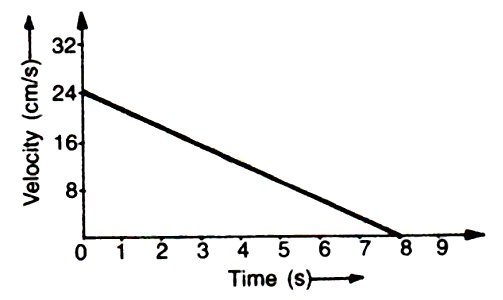
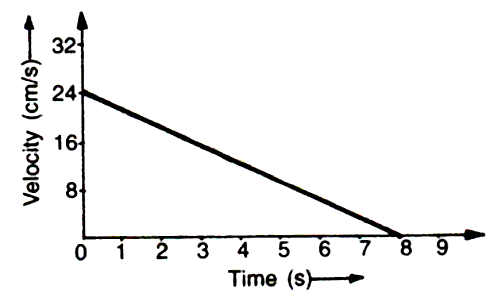
The velocity-time graph of a coin moving on a table is shown in the below figure. If the mass of the coin is $20 g$, then how much force does the table exert on the coin to bring it to rest?
Answer

As we know that slope of velocity time graph gives acceleration so acceleration of the coin is $= (v-u)/t= (0-24)/8= -3ms^{-2}$​​​​​​​

And force= mass x accelaration

Forece= $20/1000 x -3/100 N$

Forece$= -6X10^4 N$
View full question & answer
Question 293 Marks
Why do the dust particles come out of a hanging carpet when it is beaten with a stick?
Answer
When a hanging carpet is beaten using a stick, the dust particles will start coming out of the carpet because the part of the carpet where the stick strikes, immediately come in motion while the dust particle sticking to the carpet remains at rest. Hence a part of the carpet moves ahead along with the stick, and the dust particles fall down due to the earth's pull.
View full question & answer
Question 303 Marks
Give one example each of inertia of rest and inertia of motion.
Answer
A book lying on a table will remain placed at the table unless it is displaced by some external force. This is an example of inertia of rest.
A ball rolling on the ground will continue to roll unless the external force, the force of friction between the ball and the ground stops it.
View full question & answer
[3 Mark Question Answer] - PHYSICS STD 9 Questions - Vidyadip