Question 11 Mark
Mention one main application of convex mirrors.
AnswerView full question & answer→
Convex mirrors are used as a rearview mirror in automobiles as it provides a wider view of the following traffic.
Question 21 Mark
Give three applications of concave mirrors.
AnswerView full question & answer→
Concave mirrors are used in reflecting microscope, in shaving and makeup glasses, and an ophthalmoscope.
Question 31 Mark
Which mirror has a wider field of view?
AnswerView full question & answer→
A convex mirror has a wider field of view.
Question 41 Mark
Define the term Principal axis.
Answer
View full question & answer→The principal axis is the straight line passing through the pole and the centre of curvature.
Question 51 Mark
Define the term Aperture.
Answer
View full question & answer→Aperture is the distance between the extreme points on the periphery of the mirror.
Question 61 Mark
Define the term Centre of curvature.
Answer
View full question & answer→Centre of curvature is the centre of the imaginary sphere to which the mirror belongs.
Question 71 Mark
Define the term Pole.
Answer
View full question & answer→Pole is the centre of the reflecting surface, in this case, a spherical mirror.
Question 81 Mark
What do you mean by a focal point?
AnswerView full question & answer→
A focal point is a principal focus of the mirror where a parallel beam of light meets(or appears to meet) after reflection from the mirror.
Question 91 Mark
If the radius of curvature of a concave mirror is 30 cm, what is its focal length?
Answer
View full question & answer→Focal length = 1/2 of radius of curvature
= 1/2 X 30 = 15cm.
= 1/2 X 30 = 15cm.
Question 101 Mark
When we look into a plane mirror, is the image of our face real or virtual?
AnswerView full question & answer→
When we look into a plane mirror, the image of our face is virtual because the image cannot be obtained on a screen.
Question 111 Mark
What is the nature of the mirror having a focal length of -20 cm?
AnswerView full question & answer→
The mirror having -20 cm as its focal length is a concave mirror because the focal length is taken negatively only in case of a concave mirror.
Question 121 Mark
What is the nature of a mirror having a focal length of +15 cm?
AnswerView full question & answer→
What is the nature of a mirror having a focal length of +15 cm?
Question 131 Mark
A person in front of a spherical mirror finds his image having a very small head, a fat body and legs of normal size. What are the shapes of three parts of the mirror?
AnswerView full question & answer→
The top mirror is a convex mirror, the middle mirror is a concave mirror and the bottom mirror is a plane mirror.
Question 141 Mark
What do you mean by a spherical mirror?
AnswerView full question & answer→
A spherical mirror is a part of a hollow glass sphere silvered on one side.
Question 151 Mark
Write down the SI unit of focal length.
AnswerView full question & answer→[1 Mark Question Answer] - PHYSICS STD 9 Questions - Vidyadip
SI unit of the focal length is meter.
Question 161 Mark
Where should an object be placed in front of a concave mirror so as obtain its magnified erect image?
AnswerView full question & answer→
The object should be placed between F and P to obtain its magnified and erect image.
Question 171 Mark
What is the focal length of a plane mirror?
AnswerView full question & answer→
The focal length of the plane mirror is infinity.
Question 181 Mark
Name the spherical mirror which can produce a real and diminished image of the object.
Answer
View full question & answer→A concave mirror can produce a real and diminished image of the object.
Question 191 Mark
What is the relationship between the focal length and radius of curvature?
Answer
View full question & answer→The relationship between the focal length, f, and radius of curvature, r is
f = 1/2 x r.
f = 1/2 x r.
Question 201 Mark
What kind of mirror is used in vehicles to see the traffic following it?
Answer
View full question & answer→A convex mirror is used in vehicles to see the traffic following it.
Question 211 Mark
Name two non-luminous bodies.
Answer
View full question & answer→Two non -luminous bodies are the moon, chair.
Question 221 Mark
Name two luminous bodies.
Answer
View full question & answer→The Sun and the stars are the two luminous bodies.
Question 231 Mark
What is the velocity of light in a vacuum?
Answer
View full question & answer→The velocity of light in a vacuum is $3 x 10^8 m/s.$
Question 241 Mark
What is meant by a plane mirror?
Answer
View full question & answer→A smooth, highly polished plane surface is called a plane mirror.
Question 251 Mark
Is light a form of energy?
Answer
View full question & answer→Yes, light is a form of energy that produces the sensation of vision in our eyes.
Question 261 Mark
What do you mean by a mirror?
Answer
View full question & answer→Any smooth, highly polished reflecting surface is called a mirror.
Question 271 Mark
What do you mean by the point of incidence?
Answer
View full question & answer→The point at which the light is incident on the reflecting surface is called the point of incidence.
Question 281 Mark
Name the principle employed in a periscope.
Answer
View full question & answer→The principle employed in a periscope is successive reflections from two plane mirrors.
Question 291 Mark
Name one phenomenon which is based on the laws of reflection.
Answer
View full question & answer→The formation of the image is the phenomenon based on laws of reflection.
Question 301 Mark
What is meant by lateral inversion?
Answer
View full question & answer→Lateral inversion is the reversal of the image experienced in a plane mirror. The image is of the same size and equidistant from the object but the left and right sides are transposed.
Question 311 Mark
What is meant by rectilinear propagation of light?
Answer
View full question & answer→Rectilinear propagation of light is that the light travels along a straight line.
Question 321 Mark
What is the cause of regular reflection?
Answer
View full question & answer→A smooth and polished flat surface is the cause of the regular surface.
Question 331 Mark
What do you mean by reflection?
Answer
View full question & answer→When rays of light fall on a surface, they are turned back into the same medium in accordance with some definite laws. This process is known as reflection.
Question 341 Mark
What do you mean by light?
Answer
View full question & answer→Light may be defined as the radiant energy which produces in us the sensation of sight. Light itself is invisible but makes other objects visible.
Question 351 Mark
Out of the following, choose the substance which is translucent medium:
Wood
water
waxed paper
stone
black paper
Answer
View full question & answer→Waxed paper is the translucent medium among the given substances.
Question 361 Mark
Are metals transparent by nature?
Answer
View full question & answer→No, no metal is transparent by nature.
Question 371 Mark
Is glass an opaque medium?
Answer
View full question & answer→No, glass is a transparent medium.
Question 381 Mark
What is meant by rectilinear propagation of light?
Answer
View full question & answer→Rectilinear propagation of light is that the light travels along a straight line.
Question 391 Mark
Name the substance through which light is made to pass.
Answer
View full question & answer→The substance through which light is made to pass is called medium.
Question 401 Mark
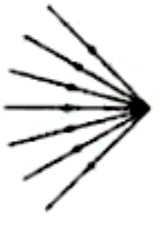
Identify the following kind of beam of light.
Answer
View full question & answer→A parallel beam of light
Question 411 Mark
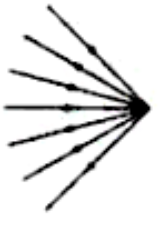
Identify the following kind of beam of light.
Answer
View full question & answer→Divergent beam of light
Question 421 Mark
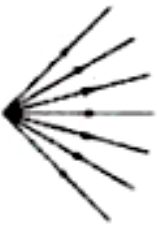
Identify the following kind of beam of light.
Answer
View full question & answer→Divergent beam of light
Question 431 Mark
Identify the following kind of beam of light.

Answer
View full question & answer→A ray of light
Question 441 Mark
Give three distinctions between sound and light waves.
Answer
View full question & answer→Three distinctions between light and sound waves are
(a). Light waves can travel through a vacuum while sound waves cannot.
(b). Light waves are transverse waves while sound waves are longitudinal waves.
(c). The velocity of light in air is $3 \times 10^8 $m/s while the speed of light in air is just about $330 m/s.$
(a). Light waves can travel through a vacuum while sound waves cannot.
(b). Light waves are transverse waves while sound waves are longitudinal waves.
(c). The velocity of light in air is $3 \times 10^8 $m/s while the speed of light in air is just about $330 m/s.$
Question 451 Mark
What is the focal length of a plane mirror?
Answer
View full question & answer→The focal length of the plane mirror is infinity.
Question 461 Mark
Name the type of mirror having a focal length of +20 cm.
Answer
View full question & answer→The mirror having +20 cm as its focal length is a convex mirror because the focal length is taken positive only in case of a convex mirror.
Question 471 Mark
What do you mean by the focal length of a mirror?
Answer
View full question & answer→The distance of the principal focus from the pole of the mirror is called the focal length of the mirror.
Question 481 Mark
Name the spherical mirror which can produce a real and diminished image of an object.
Answer
View full question & answer→Only a concave mirror can produce a real and diminished image of an object.
Question 491 Mark
If you want to see an enlarged image of your face, state whether you will use a convex mirror or a concave mirror?
Answer
View full question & answer→We will use a convex mirror to see an enlarged image of our face.
Question 501 Mark
A concave mirror can be used to produce a parallel beam of light. Draw a ray to illustrate this.
Answer
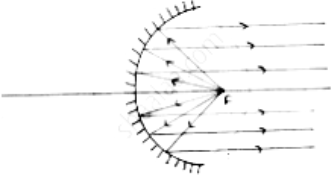
View full question & answer→In the case of a concave mirror if the object is placed at a Focal point then ray emerging from it after reflecting from the mirror would be parallel to the principal axis.