Questions

[5 Mark Question Answer]

🎯

Test yourself on this topic

17 questions · timed · auto-graded

Question 15 Marks
Distinguish between real and virtual images.
Answer
difference between real and virtual images.
Real images Virtual images
it can be obtained on a screen It can't be obtained on a screen
it is inverted (upside down with respect to the object) It is erect with respect to the object
It is formed when two or more reflected rays intersect each other at a point in front of the mirror It is formed when two or more reflected rays appear to intersect at a point behind the mirror
View full question & answer
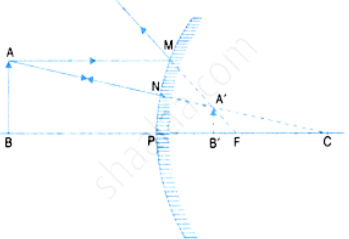
Question 25 Marks
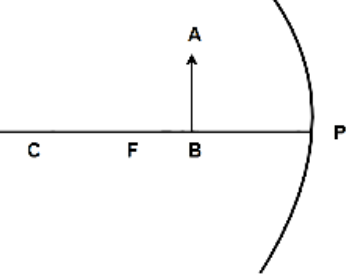
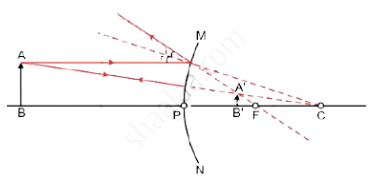
In the following figure shows a concave mirror with its pole (P), focus (F) and centre of curvature (C). Draw a ray diagram to show the formation of the image of an object AB by the concave mirror.
Image
Answer
Image
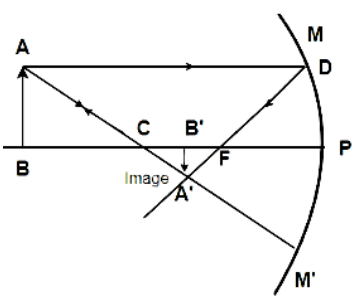
A light ray, parallel to the principal axis, coming from a point on object AB is reflected from the surface of the mirror, it passes through the principal focus and the other ray striking normally to the mirror reflects back and passes through the center of curvature. These two reflected rays, when produced backward, coincide at a point where the image is formed. The image, A'B' is virtual, erect, and magnified in size.
View full question & answer
Question 35 Marks
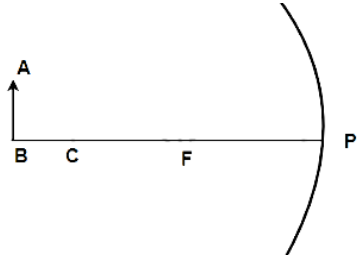
The following figure shows a concave mirror with its pole (P), focus (F), and center of curvature (C). Draw a ray diagram to show the formation of the image of an object AB by the concave mirror.
Image
Answer
Image
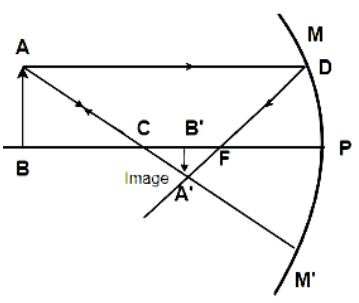
A light ray, parallel to the principal axis, coming from a point on object AB is reflected from the surface of the mirror, it passes through the principal focus and the other ray striking normally to the mirror reflects back and passes through the center of curvature. These two reflected rays, when produced backward, coincide at a point where the image is formed. The image, A'B' is virtual, erect, and magnified in size.
View full question & answer
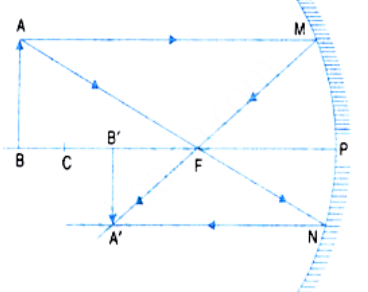
Question 45 Marks
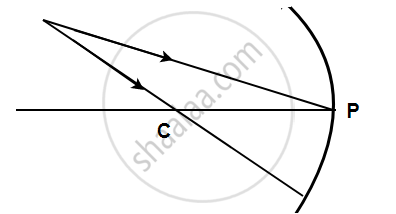
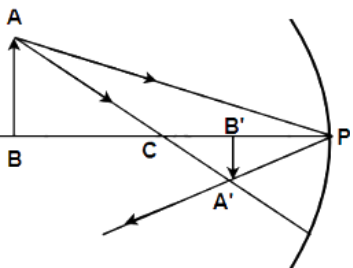
Complete the following diagrams shown in the below figure by drawing the reflected ray for each incident ray.
Image
Answer
Image
A light ray coming from a point on object AB passes through the principal focus and after reflection, it becomes parallel to the principal axis in accordance with laws of reflection and the other ray passing through the centre of curvature strikes the mirror normally i.e. 90 degrees. Hence it will reflect back. These two reflected rays coincide at a point where the image is formed. The image, A'B' is real, inverted, and diminished in size.
View full question & answer
Question 55 Marks
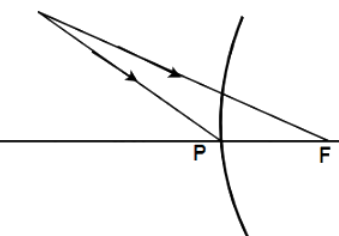
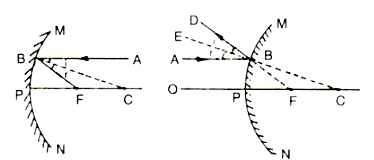
Complete the following diagrams shown in the below figure by drawing the reflected ray for each incident ray.
Image
Answer
Image
A light ray when produced backwards passes through principal focus as shown in the problem figure. We draw the normal through the centre of curvature at the point of incidence and draw the reflected ray at an angle equal to the angle of incidence thus following the laws of reflection. The reflected ray is parallel to the principal axis. The other ray is passing through the centre of curvature as shown in the problem figure. This ray retraces its incident path because it strikes the mirror normally i.e. 90 degrees. These two reflected rays when produced backwards coincide at a point where the image is formed. The image, A'B' is virtual, erect, and diminished in size.
View full question & answer
Question 65 Marks
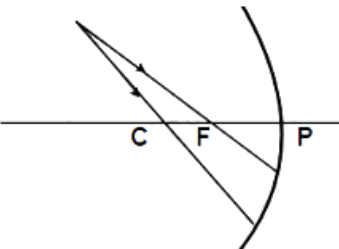
Complete the following diagrams shown in the following figures by drawing the reflected rays.
Answer
Image
A light ray coming from a point on object AB is reflected from the surface of the mirror, it passes through the principal focus and the other ray passing through the center of curvature strikes the mirror normally i.e. 90 degrees. Hence it will reflect back. These two reflected rays coincide at a point where the image is formed. The image, A'B' is real, inverted, and diminished in size.
View full question & answer
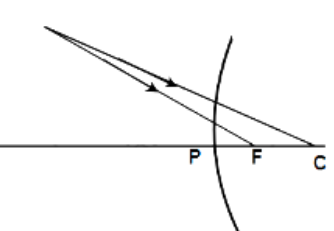
Question 75 Marks
Complete the following diagrams shown in the following figures by drawing the reflected rays.
Image
Answer
Image
A light ray when produced backwards passes through principal focus as shown in the problem figure. We draw the normal through the centre of curvature at the point of incidence and draw the reflected ray at an angle equal to the angle of incidence thus following the laws of reflection. The reflected ray is parallel to the principal axis. The other ray is reflected at the pole by an angle in accordance with the laws of reflection. These two reflected rays when produced backwards coincide at a point where the image is formed. The image, A'B' is virtual, erect, and diminished in size
View full question & answer
Question 85 Marks
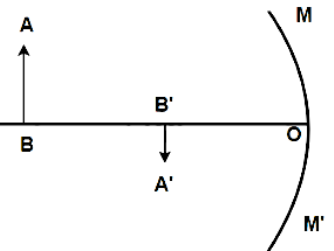
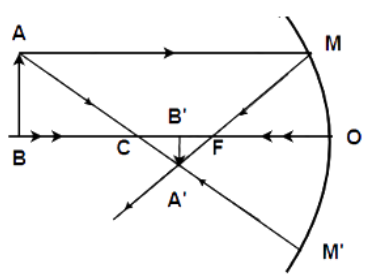
AB is the object, A'B' is the image, and MM' is the position of the mirror. Complete the ray diagram showing the formation of the image and find the focal length of the mirror.
Image
Answer
A light ray coming from a point on object $AB$ is reflected from the surface of the mirror, it passes through the principal focus and the other ray passing through the center of curvature strikes the mirror normally i.e. $90$ degrees. Hence it will reflect back. These two reflected rays coincide at a point where the image is formed. The image, $A'B$' is real, inverted, and diminished in size. The focal length was found to be 16 mm.
Image
View full question & answer
Question 95 Marks
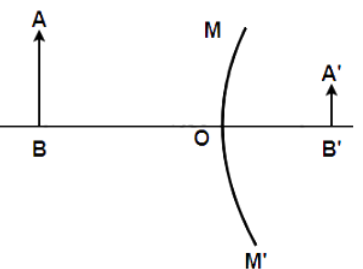
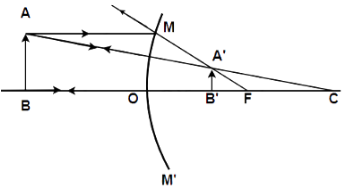
AB is the object, $A_1B_1$ is its image. MM' is the position of the mirror. Complete the ray diagram and find the position of the center of curvature and focus of the mirror. Also, measure the focal length.
Image
Answer
Image
A light ray coming from a point on object AB is reflected from the surface of the mirror. When this ray is produced backwards, it passes through the principal focus and the ray which traces its incident path after reflection, when produced backwards, passes through the centre of curvature. These two reflected rays coincide at a point where the image is formed. The image, A'B' is virtual, erect, and diminished in size The focal length was found to be 24 mm.
View full question & answer
Question 105 Marks
How will you determine the focal length of a concave mirror?
Answer
Image
i = < r In accordance with the laws of reflection. As the incident ray AB is parallel to the principal axis PC, so the reflected ray Bf passes through the principal focus, F. in figure (i) < ABC = < CBF
But < ABC = alternate< BCF
Therefore< CBF = < BCF
And the ΔFBC is isosceles
BF = FC ... (i) Since the aperture is assumed to be very small, so the point of incidence B is close to P And BF = PF (approx.) ... (ii ) From (i) and (ii )
PF = FC Adding PF to both sides
PF + PF= PF + FC 2PF = PC
Now since PF = f, the focal length of the mirror
And PC = R, the radius of curvature of the mirror Therefore 2f = R
From here we can determine the focal length of the concave mirror i.e. half of radius of curvature  
View full question & answer
Question 115 Marks
Distinguish between convergent and divergent beams of light.
Answer
Difference between convergent and a divergent beam of light.
Convergent beam Divergent beam
1. Rays of light converge to a point as the beam progresses Rays of light diverge from each other as the beam progresses
2. The rays concentrate at a point The rays emerging from a point source
3. A parallel beam of light converges on passing through a convex lens A parallel beam of light diverges on passing through a concave lens
View full question & answer
Question 125 Marks
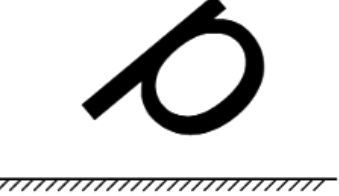
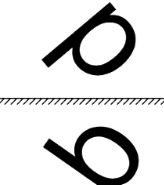
Draw two sets of rays of light to show the formation of an image of the letter as shown in figure p.
Image
Answer
Image
The reflection takes place at the surface of the plane mirror in accordance with the laws of reflection in which the angle of incidence is equal to the angle of reflection.
The light coming from the letter p is reflected from the surface of the plane mirror. When these reflected rays are produced backward, they form an inverted virtual image of letter p which is the same in size of letter p.
View full question & answer
Question 135 Marks
The angle between an incident ray and the mirror is $35^0.$
(i) What is the angle of incidence?
(ii) What is the angle of reflection?
(iii) What is the total angle turned by the ray of light?
(iv) What is the angle between the incident and the reflected rays?
Answer
Given, angle between incident ray and mirror $=35^{\circ}$
(a). Angle of incidence = angle of mirror to the normal - angle between incident ray and mirror $=90-35=55^{\circ}$
(b). Angle of reflection $=$ angle of incidence $=55^{\circ}$
(c). Total angle turned $=$ angle of incidence + angle of reflection $=55+55=110^{\circ}$
(d). The angle between incident ray and reflected ray = Angle of incidence + Angle of reflection $=55+55=110^{\circ}$
View full question & answer
Question 145 Marks
What is the difference between a ray of light and a beam of light?
Answer
Difference between a ray of light and a beam of light.
Rav of light Beam of light
1. Ray of light is the path along which the light travels Many rays of light form a beam of light
2. A ray of light can be emitted from any source in any direction A beam of light can be emitted from a Laser source
3. A ray of light contains only one photon A beam of light contains multiple photons
View full question & answer
Question 155 Marks
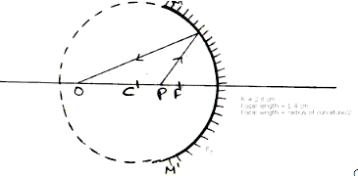
The following Figure shows a concave mirror MM' on which a ray of light incident from a point P gets reflected to meet the principle axis at O.
(a) Find, by construction, the position of the centre of curvature of the concave mirror.
(b) Write down the value for the radius of curvature of the mirror.
(c) Calculate the focal length of the mirror.
(d ) Which relation is used in deducing the focal length from the radius of curvature?
Answer
(i) Centre of curvature can be determined by constructing the imaginary sphere to which lens belongs.
(ii) Value of radius of curvature can be found by measuring the radius of this imaginary sphere geometrically.
(iii) The focal length is the midpoint of the pole and centre of curvature.
(iv) focal length of mirror = centre of curvature/2.
Image
Centre of curvature = 2 .8 cm.
Focal length of mirror = 1.4 cm.
Focal length = radius of curvature/2.
View full question & answer
Question 165 Marks
Distinguish between real and virtual images.
Answer
difference between real and virtual images.
Real images Virtual images
it can be obtained on a screen It can't be obtained on a screen
it is inverted (upside down with respect to the object) It is erect with respect to the object
It is formed when two or more reflected rays intersect each other at a point in front of the mirror It is formed when two or more reflected rays appear to intersect at a point behind the mirror
View full question & answer
Question 175 Marks
Find the height of the image of a body of height 1.5m in a mirror with a magnification of 1.5.
Answer
Mirror formula is the relation between the focal length f of the mirror, the distance u of the object from the pole of the mirror, and the distance v of the image from the pole.
Mirror formula is
1/v +1/u = 1/f.
Size of body = 1.5 m.
Magnification of body = 1.5.
Magnification = height of image / height of object.
Height of image = magnification x height of object.
Height of image = 1.5 x 1.5= 2.25 m.
View full question & answer
[5 Mark Question Answer] - PHYSICS STD 9 Questions - Vidyadip