Questions

[2 Mark Question Answer]

🎯

Test yourself on this topic

29 questions · timed · auto-graded

Question 12 Marks
State three uses of graph.
Answer
Uses of a graph:
(a) One can determine constant of proportionality by calculating slope of graph.
(b) It can be used to calculate mean average value of large number of observations.
(c) It can be used for verifying already known physical laws.
(d) It can also show the weakness of the experimenter at some particular instant during the course of experiment.
View full question & answer
Question 22 Marks
(a) What is a best fit line for a graph?
(b) What does best fit line show regarding the variables plotted and the work of experimenter?
Answer
(a) A best bit line for a graph means a line which either passes through maximum number of points or passes closest to the maximum number of points, which appear on either side of the line.
(b) A best fit line shows that two variable quantities are directly proportional to each other. With its help, experimenter can easily understand nature of proportional relations between two variable quantities.
View full question & answer
Question 32 Marks
State two important precautions for drawing a graph line.
Answer
Precautions for drawing a graph line:
1. The graph line should be thin, single straight line and sharp.
2. It is not necessary that graph line should pass through all the points. A best fit graph line should be drawn.
View full question & answer
Question 42 Marks
State three important precautions which must be followed while plotting points on a graph.
Answer
Precautions for plotting points on a graph:
1. The points marked on graph paper should be sharp, but not thick.
2. Ordinates of points should be written close to the plotted point.
3. It is not necessary that graph line should pass through all points. A best fit line should be drawn.
View full question & answer
Question 52 Marks
What do you understand by (a) amplitude and (b) frequency of oscillations of simple pendulum?
Answer
(a) Amplitude : The maximum displacement of bob from mean position on either side is called amplitude.
Amplitude $=A B$ or $A C$. It is denoted by ' $a$ '.
(b) Frequency: "It is the number of vibrations or oscillations made in one second."It is denoted by f or n and its unit is Hertz $( Hz )$ or per second ( $s -1)$.
View full question & answer
Question 62 Marks
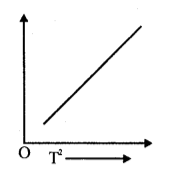
Draw a graph of I , the length of simple pendulum against $T_2$, the square of its time period.
Answer
Nature: The graph of length (l) of simple pendulum against square of its time period ( $T ^2$ ) is a straight line inclined to time axis.
Image
View full question & answer
Question 72 Marks
State the numerical value of the frequency of oscillation of a second's pendulum. Does it depend on the amplitude of oscillation?
Answer
$
\text { Frequency }=\frac{1}{T}
$
and T for seconds' pendulum is 2 seconds
$
\therefore \text { Frequency }=\frac{1}{2}=0.5 s^{-1}
$
Oscillation of pendulum does not depend on amplitude.
View full question & answer
Question 82 Marks
Two simple pendulums, $A$ and $B$ have equal lengths but their bobs weigh 50 gf and 100 gf respectively. What would be the ratio of their time periods? What is the reason for your answer?
Answer
We know that time period of simple pendulum at a place is given by
$
T=2 \pi \sqrt{\frac{l}{g}}\quad \quad \ldots \ldots(1)
$
and this expression does not contain weight of bob i.e. is independent of the weight of bob.
$\therefore$ Time period of both pendulums will be same.
$\therefore$ Ratio of their time periods $=1: 1$
View full question & answer
Question 92 Marks
The time period of two pendulums are 2 s and 3 s respectively. Find the ratio of their lengths.
Answer
$
T_1=2 s ; T_2=3 s
$
Let $l_1$ and $l_2$ be the length of the two pendulums.
$
\begin{array}{l}
\frac{T_1}{T_2}=\sqrt{\frac{l_1}{l_2}} \\
\sqrt{\frac{l_1}{l_2}}=\frac{2}{3}
\end{array}
$
Squaring both sides,
$
\begin{array}{l}
\left(\sqrt{\frac{l_1}{l_2}}\right)^2=\left(\frac{2}{3}\right)^2=\frac{4}{9} \\
\sqrt{\frac{l_1}{l_2}}=\frac{4}{9}=4: 9
\end{array}
$
View full question & answer
Question 102 Marks
The time periods of two pendulums are 1.44 s and 0.36 s respectively. Calculate the ratio of their lengths.
Answer
$
\begin{array}{l}
T_1=1.44 s ; \\
T_2=0.36 s
\end{array}
$
Let $l_1$ and $l_2$ be the lengths of the two pendulums.
$
\begin{array}{l}
\frac{T_1}{T_2}=\sqrt{\frac{l_1}{l_2}} \\
\sqrt{\frac{l_1}{l_2}}=\frac{1.44}{0.36}=\frac{144}{36}=\frac{4}{1}
\end{array}
$
Squaring both sides,
$
\left(\sqrt{\frac{l_1}{l_2}}\right)^2=\left(\frac{4}{1}\right)^2 \Rightarrow \frac{l_1}{l_2}=\frac{16}{1}
$
View full question & answer
Question 112 Marks
A pendulum 100 cm and another pendulum 4 cm long are oscillating at the same time. Calculate the ratio of their time periods.
Answer
$
\begin{array}{l}
l_1=100 cm ; \\
l_2=4 cm
\end{array}
$
Let $T_1$ and $T_2$ be the time period of two pendulums.
$
\begin{array}{l}
\frac{T_1}{T_2}=\sqrt{\frac{l_1}{l_2}} \\
\frac{T_1}{T_2}=\sqrt{\frac{100}{4}}=\sqrt{\frac{25}{1}} \\
\frac{T_1}{T_2}=\frac{5}{1}
\end{array}
$
View full question & answer
Question 122 Marks
The length of two pendulum are 110 cm and 27.5 cm . Calculate the ratio of their time periods.
Answer
$
l_1=110 cm ; l_2=27.5 cm
$
Let $T_1$ and $T_2$ be the time period of two pendulums.
$
\begin{array}{l}
\frac{T_1}{T_2}=\sqrt{\frac{l_1}{l_2}} \\
\frac{T_1}{T_2}=\sqrt{\frac{110}{27.5}}=\sqrt{\frac{4}{1}} \\
\frac{T_1}{T_2}=\frac{2}{1}
\end{array}
$
View full question & answer
Question 142 Marks
Calculate the time period of simple pendulum of length 0.84 m when $g =9.8 ms^{-2}$.
Answer
Length of the pendulum $=l=0.84 m$
$
\begin{array}{l}
g=9.8 ms^{-2} \\
\text { Time period }(T)=2 \pi \sqrt{\frac{l}{g}}=2 \times \frac{22}{7} \times \sqrt{\frac{0.84}{9.8}} \\
\quad=\frac{44}{7} \times 0.2928=1.84 s
\end{array}
$
View full question & answer
Question 152 Marks
The level of water in a measuring cylinder is 12.5 ml . When a stone is lowered in it, the volume is 21.0 ml . Find the volume of the stone.
Answer
Level of water in measuring cylinder $= V _1=12.5 ml$
When stone is lowered, then level of water in measuring cylinder
$
=V_2=21.0 ml
$
Volume of stone $=V_2-V_1$
$
\begin{array}{l}
V=21.0-12.5 \\
V=8.5 ml
\end{array}
$
View full question & answer
Question 162 Marks
Find the volume of a book of length 25 cm , breadth 18 cm and height 2 cm in $m ^3$.
Answer
Length of book $=l=25 cm$
Breadth of book $=b=18 cm$
Height of book $=h=2 cm$
Volume of biook $=l \times b \times h$
$
\begin{array}{l}
V=25 \times 18 \times 2 \\
V=900 cm^3 \\
V=\frac{900}{10^6} m^3 ; V=\frac{9}{10000} m^3 \\
V=0.0009 m^3
\end{array}
$
View full question & answer
Question 172 Marks
In which unit, volume of liquid is measured? How is this unit is related to S.I. unit of volume?
Answer
The volume of liquid is measured in litre of its sub-multiple millilitre ( mL ).
$
\begin{array}{c}
1 m^3=1000 \text { litre } \\
\text { and } 1 \text { litre }=1000 mL \\
\Rightarrow \quad 1 m^3=1000 \text { litre }=1000 \times 1000 mL=10^6 mL
\end{array}
$
View full question & answer
Question 182 Marks
(a) What do you understand by the term volume of substance?
(b) State the unit of volume in SI system.
Answer
(a) Volume : The space occupied a substance (solid, liquid or gas) is called volume.
(b) SI unit of volume is Cubic metre ( $m ^3$ ).
One cubic metre: Is the volume occupied by a cube whose each side is equal to 1 m .
View full question & answer
Question 192 Marks
What do you understand by the terms
(a) pitch of screw
(b) least count of screw?
Answer
(a) Pitch of screw: The pitch of screw is defined as the distance between two consecutive threads he screw, measured along the axis of the screw.
(b) Least count of the screw : Least distance of the screw is defined as the smallest distance moved by its tip when the screw turn through one division marked on it.
View full question & answer
Question 202 Marks
Which part of vernier callipers is used to measure
(a)external diameter of a cylinder
(b)internal diameter of a hollow cylinder
(c)internal length of a hollow cylinder?
Answer
(a) External Jaws of a vernier callipers are used to measure the external diameter of cylinder.
(b) Internal Jaws are used to measure internal diameter of a hollow cylinder.
(c) Tail of vernier callipers is used to measure the internal length of a hollow cylinder.
View full question & answer
Question 212 Marks
State the formula for calculating length if :
1. Number of vernier scale division coinciding with main scale and number of division of main scale on left hand side of zero of vernier scale are known.
2. The reading of main scale is known and the number of vernier scale divisions coinciding with main scale are known.
Answer
1. If we know the number of vernier scale divisions (V.S.D.) coinciding with main scale and number of main scale divisions (M.S.D.) on left hand side of zero of vernier scale then Length recorded $=$ Main scale reading + L.C. $\times$ V.S.D.
2. Same as in part (i).
View full question & answer
Question 222 Marks
The final result of calculations in an experiment is 125,347,200. Express the number in terms of significant places when
1. accuracy is between 1 and 10
2. accuracy is between 1 and 100
3. accuracy is between 1 and 1000
Answer
Final result of calculations in an experiment $=125,347,200$
1. When accuracy lies between 1 and 10 , then final result may be written as $1.2 \times 10^8$.
2. When accuracy lies between 1 and 100 , then final result may be written as $1.25 \times 10^8$.
3. When accuracy lies between 1 and 1000 than final result may be written as $1.253 \times 10^8$.
View full question & answer
Question 232 Marks
(a) What do you understand by the term degree of accuracy?
(b) Amongst the various physical measurements recorded in an experiment, which physical measurement determines the degree of accuracy?
Answer
(a) Degree of accuracy: It means that we can measure a quantity, without any error of estimation.In any experiment, all observations should be taken with same degree of accuracy.
(b) Amongst the various physical measurements recorded in an experiment, least accurate observation determines the degree of accuracy.
View full question & answer
Question 242 Marks
Express the order of magnitude of the following quantities:
1. 12578935 m
2. 222444888 kg
3. $0.000,000,127 s$
4. $0.000,000,000,00027 m$
Answer
(i) $12578935 m=1.2578935 \times 10^7 m$
So order of magnitude $=10^7 m$
(ii) $222444888 kg=2.22444888 \times 10^8 kg$
Order of magnitude $=10^8 kg$
(iii) $0.000,000,127 s=1.27 \times 10^{-7} s$
Order of magnitude $=10^{-7} s$
(iv) $0.000,000,000,00027 m=2.7 \times 10^{-13} m$
Order of magnitude $=10^{-13}$
View full question & answer
Question 252 Marks
Name the convenient unit you will use to measure :
(a) length of a hall
(b) width of a book
(c) diameter of hair
(d) distance between two cities.
Answer
(a) Foot (Ft)
(b) Centimetre (cm)
(c) Micrometre (µm)
(d) Kilometre (km)
View full question & answer
Question 262 Marks
State four characteristics of a standard unit.
Answer
Characteristics of standard unit:
1. It should be of convenient size.
2. It should not change with respect to place and time.
3. It should be well defined.
4. It should be easily reproduced.
View full question & answer
Question 272 Marks
A body measures 25 m . State the unit and the magnitude of unit in the statement.
Answer
Here S.I. unit of length i.e. metre $( m )$ has been used. Magnitude of the given quantity $=25$ Metre: It is defined as $1,650,763,73$ times the wavelength of specified orange red spectral line a emission spectrum of Krypton-86 or 1,553,164.1 times the wavelength of the red line in emission spectrum of cadmium.
or one metre is defined as the distance travelled by the light in $1 / 299,792,458$ of a second in air/vacuum.
View full question & answer
Question 282 Marks
What do you understand by the terms
1. unit
2. magnitude, as applied to a physical quantity?
Answer
(i) Unit : Unit "is a standard quantity of the same kind with which a physical quantity is compared for measuring it. " In order to measure a physical quantity, a standard is needed (which is acceptable internationally). The standard should be some convenient, definite and easily reproducible quantity of the same kind in terms of which the physical quantity as a whole is expressed. This standard is called a unit
(ii) Magnitude of a physical quantity : The number of times a standard quantity is present in a given physical quantity is called magnitude of physical quantity.
Physical quantity $=$ Magnitude $\times$ Unit
View full question & answer
Question 292 Marks
What do you understand by the term measurement?
Answer
"Measurement implies comparison of a physical quantity with a standard unit to find out how many times the given standard is contained in the physical quantity."
Physics, like other branches of science requires experimental study which involves measurement.
View full question & answer
[2 Mark Question Answer] - PHYSICS STD 9 Questions - Vidyadip